SIPLACE Vision Customer_en.pdf - 第112页
Component Shapes New SIPLACE Vision Functions for 605 and 701 Station SW SIPLACE Vision Flux Inspection – only in 605 SW S tudent Guide SIPLACE V ision (Customer) Component Shapes Edition 12/2008 EN 11 2 Brightness Evalu…
Component Shapes
SIPLACE Vision Flux Inspection – only in 605 SW New SIPLACE Vision Functions for 605 and 701 Station SW
Student Guide SIPLACE Vision (Customer)
Edition 12/2008 EN Component Shapes
111
BGA not completely dipped into the flux
Component poorly positioned on the nozzle
Component and dipping unit not aligned in parallel.
Dipping time too short
Optical Appearance
Blue pigmented fluxes and gray solder pastes have a similar optical appearance.
If BGA contacts are dipped with the layer thicknesses being too thin they look almost like undipped
BGAs.
Aged components with oxidized contacts also influence the optical appearance. These contacts are
coated worse with flux or solder paste so that the optical appearance is similar to an un-dipped
component in the camera image.
Of course these contacts are also extremely difficult to solder, but soldering is not the aim of this
inspection step!
Component Shape - Test Procedure
3 operating modes have been created in order to prepare components completely for the test:
No dipping of the component and no flux inspection
No dipping of the component but carrying out a flux inspection
Dipping the component and carrying out a flux inspection
Thus, it is possible to test the component completely in both states in the optical centering. That means,
that complete position measurement and BGA contact inspection is also possible.
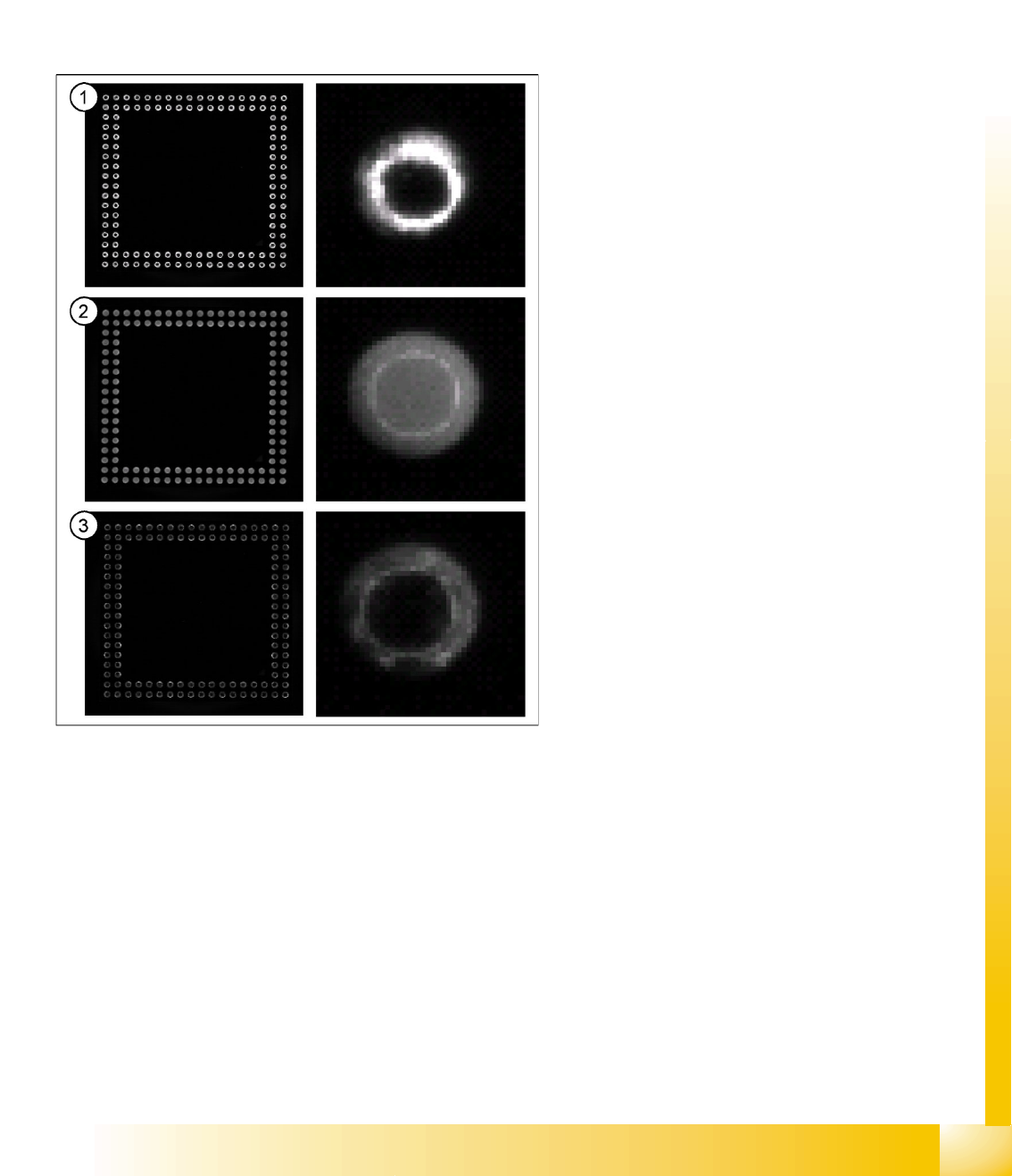
Legend
1. Component undipped:
BGA and ball without flux
A ball can be seen as a bright ring. This ring is
very bright and the center is very dark; the
image is very rich in contrast.
2. Component dipped; flux with white pigments
BGA and ball with white flux
A ball can be seen as a bright ring with an even
brightness to a large extent. The center is
similarly bright as the outer area and the
contrasts are low.
3. Component dipped; flux with dark (blue)
pigments
BGA and ball with dark (blue pigmented) flux.
A ball can still be seen as ring, but
considerably darker as for the undipped ball.
Because of the diversity of fluxes it is necessary to
have the optical appearances of dipped and
undipped checked by Siemens (at least by means
of the SIPLACE Vision log files).
Component Shapes
New SIPLACE Vision Functions for 605 and 701 Station SW SIPLACE Vision Flux Inspection – only in 605 SW
Student Guide SIPLACE Vision (Customer)
Component Shapes Edition 12/2008 EN
112
Brightness Evaluation
Brightness evaluation as the first measurement method is a simple procedure for determining the
medium brightness per ball in the evaluation area as a characteristic. This brightness is compared to an
adjustable threshold.
If the brightness value exceeds the threshold the corresponding ball will be evaluated as insufficiently
coated.
The positions of the balls are derived from the inspection step previously carried out.
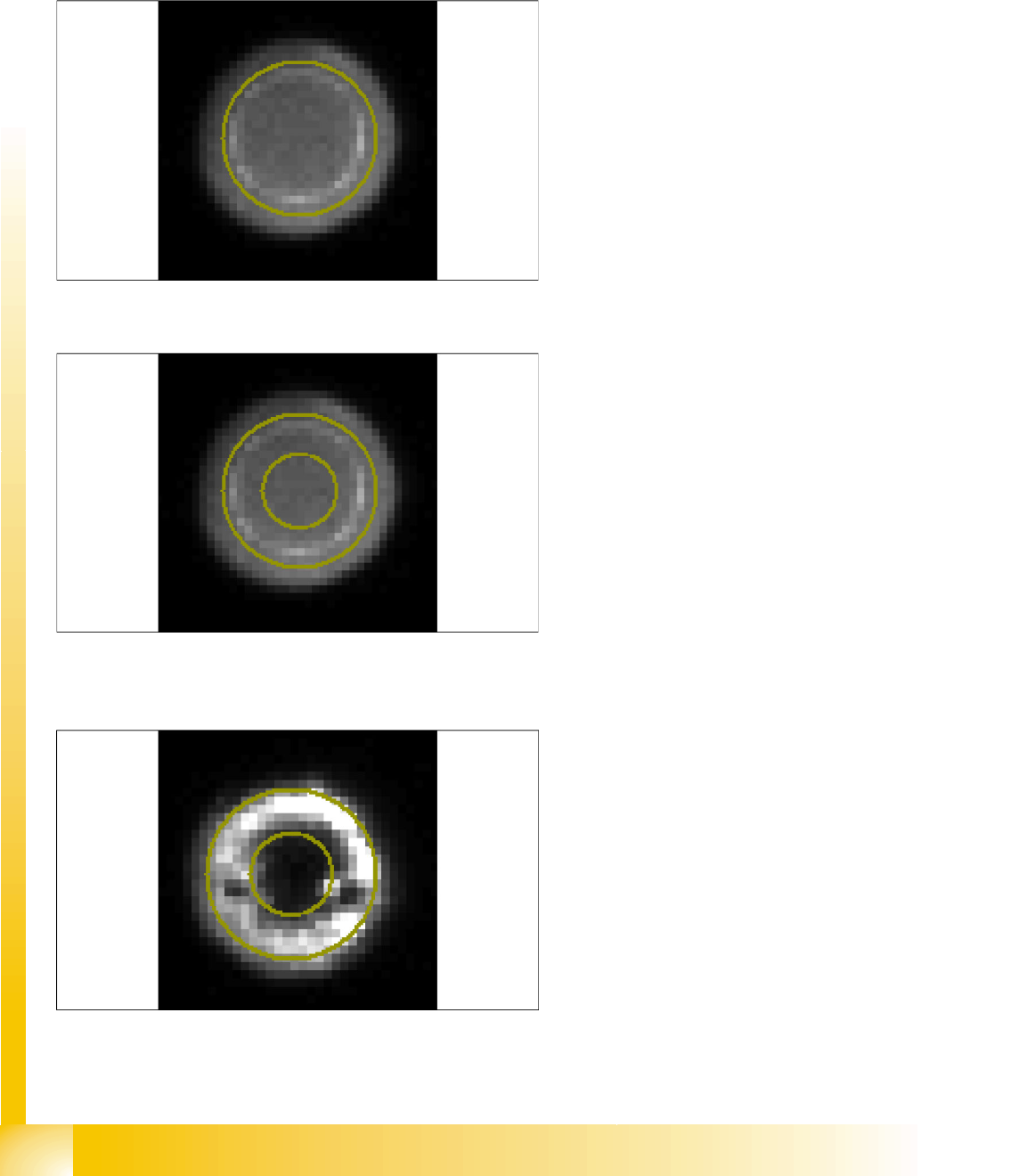
5-15: Cirlce (DonutOuter)
The whole circular area whose diameter is
determined by the ball diameter in combination
with the DonutOuter parameter can be selected as
the evaluation area.
5-16: Circular ring (DonutOuter; DonutInner)
Another evaluation area consists of the area
created by a circular ring as a result of the ball
diameter in combination with the DonutOut
parameter for the outer diameter and DonutInner
for the inner diameter.
5-17: Selection of DonutOuter and DonutInner
DonutOuter and DonutInner parameters should
not be selected using an un-dipped component.
Usually it is advisable to choose DonutOut in such
a way that the brightness transition is located just
outside the circular ring given by DonutOuter.
DonutInner should only encompass the dark
center.
Component Shapes
SIPLACE Vision Flux Inspection – only in 605 SW New SIPLACE Vision Functions for 605 and 701 Station SW
Student Guide SIPLACE Vision (Customer)
Edition 12/2008 EN Component Shapes
113
Evaluation of Homogeneity
The evaluation of homogeneity and brightness are
based on the same principle to a large extent. The
difference is, that only the amplitudes of the
gradients in the evaluation area are calculated in
advance. The mean value of the gradient on the
circular area or on the ring is the characteristic for
each ball which is compared to the threshold (40 in
this example).
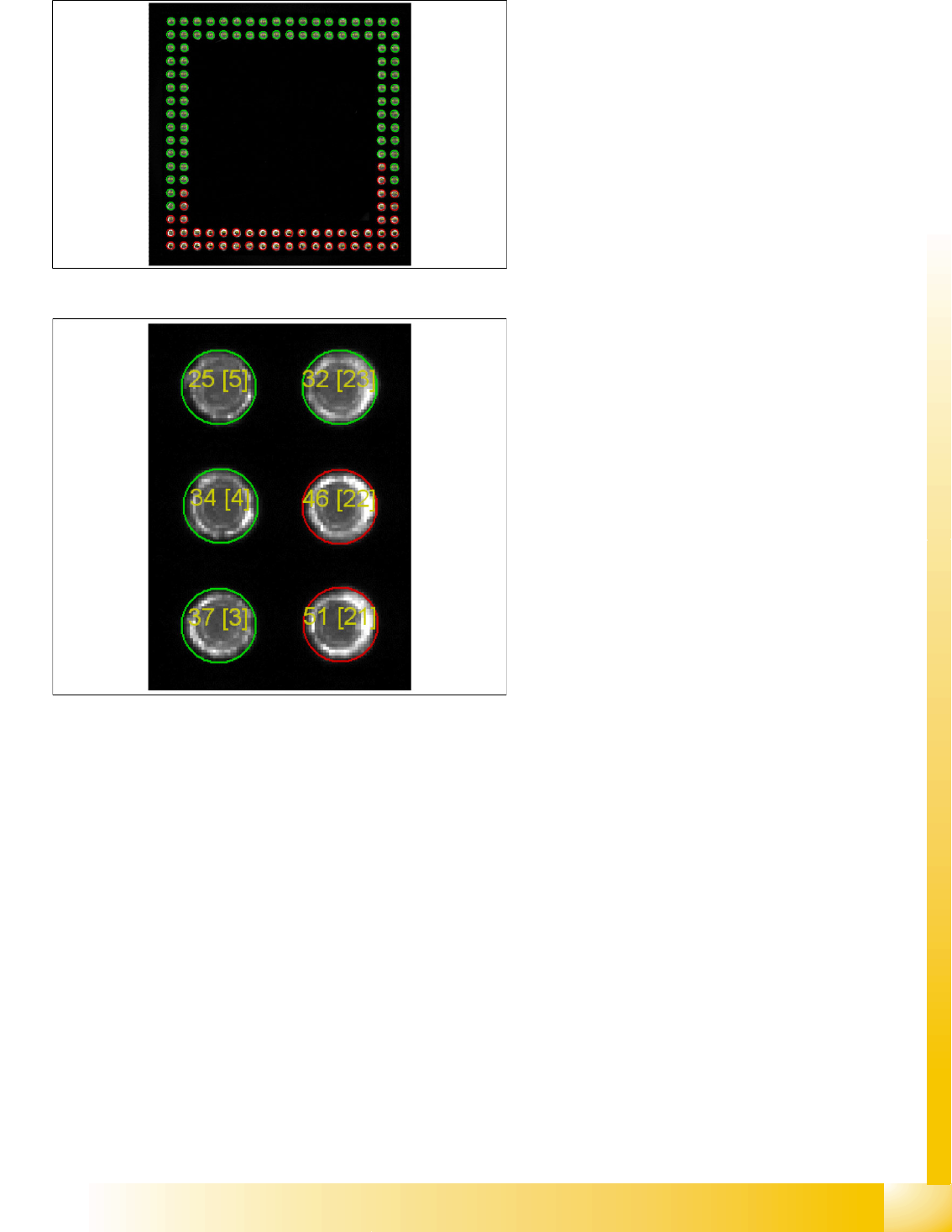
5-18: The result image shows the evaluation of the coating for each ball.
Balls that are sufficiently coated are marked in
green.
Balls that are insufficiently coated are marked in
red.
The inserted numbers represent the calculated
characteristic (left) and the ball number (in
squared brackets [ ]).