SIPLACE Vision Customer_en.pdf - 第133页
SIPLACE Vision - T eaching Fiducials Synthetic Fiducials for Position Rec ognition Applications Fiducial shapes S tudent Guide SIPLACE Vision (Customer) Edition 12/2008 EN SIPLACE Vision - T eaching Fiducials 133 6.2.1.1…

SIPLACE Vision - Teaching Fiducials
Fiducial shapes Synthetic Fiducials for Position Recognition Applications
Student Guide SIPLACE Vision (Customer)
SIPLACE Vision - Teaching Fiducials Edition 12/2008 EN
132
6.2 Fiducial shapes
One fiducial shape can be used for all the applications described above. However, since one application
uses position measuring algorithms and the other application (inkspot) does not, this shape will need to
be trained twice.
This means:
A fiducial shape is trained for the fiducial library in SIPLACE Pro and can then be called up for PCB
programming and supplemented with coordinates and the respective position measurement
application.
A fiducial shape is trained for the fiducial library in SIPLACE Pro and can then be assigned
coordinates, so that the gantry can position the camera for good/bad recognition.
See also the programming guides in SIPLACE Pro x.x
6.2.1 Synthetic Fiducials for Position Recognition Applications
Fiducials which have shapes which are symmetrically arranged around a center point can be easily
described and recognized.
Synthetic fiducials are more exact than sample fiducials, as the inaccuracies of the so-called "gold
sample", to be learnt, do not apply.
The following parameters are sufficient for the description of these fiducials:
The shape (cross, circle, ring, rectangle (special shape: square), rectangular ring, 45° square
(diamond), doublecross)
The size or other dimensions such as bar width
The contrast to the background (fiducial bright or dark)
Using these specifications, the outer edges can be determined and taken for rough (coarse) and fine
structure recognition.
Since SR/MC 603.xx, synthetic fiducials can also be trained with a fiducial wizard.
SIPLACE Vision - Teaching Fiducials
Synthetic Fiducials for Position Recognition Applications Fiducial shapes
Student Guide SIPLACE Vision (Customer)
Edition 12/2008 EN SIPLACE Vision - Teaching Fiducials
133
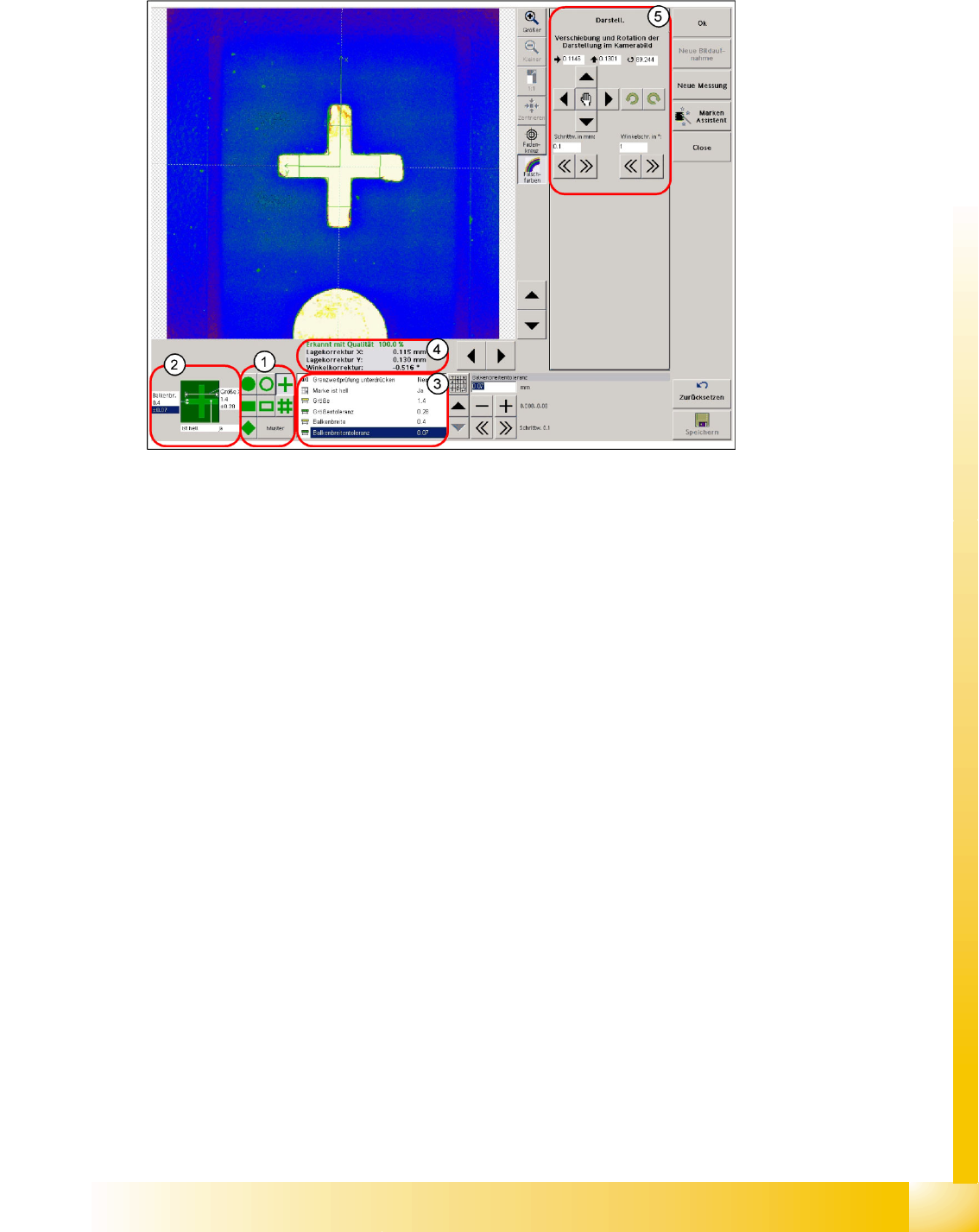
6.2.1.1 Programming the Fiducial
Fiducial recognition is based on a correct description of the geometry, which is why the geometry
programming window is described here.
6-4: Programming geometry – teaching
Legend
1. Selection of geometry for synthetic fiducials or pattern programming
2. Quick access to the dimension parameters of the fiducial geometry and to the contrast to the PCB
background
3. Table of fiducial dimension parameters
4. Result of fiducial recognition
The X/Y deviation to the camera center point is given for the correctly recognized fiducial
During teaching/testing, a fiducial angle (exception: circular fiducials 0.0°) to the camera coordinates
is specified. However, this is not processed further by the MC during placement measurement.
5. Programming drawing displacement or centering step selection area
The fiducial is saved once the notifications window displayed when you exit the teaching menu has
been acknowledged.
A smaller size can be programmed for structures such as the cross-shaped fiducial, since the fiducial
shape remains the same and leads to the same fiducial center if parts of the cross bars are cut off. The
image pairs, 16 per cross bar, are set closer together in smaller cross-shaped fiducial sizes to ensure
that the edges are recognized reliably.
In fiducials taking up more space, such as circles, the fiducial background of the entire shape must be
recognizable. If this is not the case, it will not be possible to recognize the fiducial shape and the fiducial
center. This means that the evaluation area needs to be larger than the fiducial area.

SIPLACE Vision - Teaching Fiducials
Fiducial shapes Synthetic Fiducials for Position Recognition Applications
Student Guide SIPLACE Vision (Customer)
SIPLACE Vision - Teaching Fiducials Edition 12/2008 EN
134
6.2.1.2 Shapes and Sizes of Synthetic Fiducials
The cross is the most suitable fiducial shape, as the ends of the cross bars can be cut off and the
fiducial reference point still remains in the center of the cross. This shape does not require much
space on the PCB layout.
SIPLACE Vision detects the doublecross as a geometric shape by searching for all outer and inner
edges. There is therefore only one fiducial reference point, in the center of the fiducial. (In ICOS
brightness evaluations, doublecrosses with unfavorably long outer arms could cause the
coincidental and faulty detection of 4 "auxiliary positions" as the correct fiducial center.)
Squares, as a special type of rectangle with even sides, are not listed as a separate programming
item. A rectangular, square ring is a fiducial shape which hardly ever appears on a standard PCB
layout.
A square rotated by 45° is known as a diamond and is classified as a filled synthetic fiducial.
The circle and the circular ring are frequently used fiducial options. When selecting the circular ring,
which uses the "vias" of multiple PCBs, make sure you pay attention to the quality of the outer line
of the metallic ring. If this outer line is not totally circular for all PCBs, we advise using dark circles
on a bright background, unless other suitable fiducials are available in the PCB layout.
All other shapes can be trained as samples (explanations in following text).
Geometric
fiducial shape
Min. structure size Max. structure size Min. tolerance Max. tolerance
Circle Diameter: 250 µm Diameter: 3 mm 2% of nominal
dimensions
20% of nominal
dimensions
Cross Size: 300 µm
Bar width: 100 µm
Size: 3 mm
Bar width: 1.5 mm
2% of nominal
dimensions
20 % of nominal bar
width, from SC/MC
702 30%
Doublecross Size: 500 µm
Bar width: 100 µm
Extension:100 μm
Size: 3 mm
Bar width: 1.2 mm
2% of nominal
dimensions
20 % of nominal bar
width, from SC/MC
702 30%
Rectangle/
square
Length: 250 µm
Width: 250 µm
Length: 3 mm
Width: 3 mm
2% of nominal
dimensions
20% of nominal
dimensions
Rectangle/
square frame
Length: 300 µm
Width: 300 µm
Frame thickness: 100 µm
Length: 3 mm
Width: 3 mm
2% of nominal
dimensions
20% of nominal
dimensions
Circular ring Diameter: 300 µm
Ring thickness:100 µm
Diameter: 3 mm 2% of nominal
dimensions
20% of nominal
dimensions
Diamond Length/width: 350 µm Length/width: 3 mm 2% of nominal
dimensions
20% of nominal
dimensions
Pattern Length/width: 500 µm Length/width: 3 mm 2% of nominal
dimensions
20% of nominal
dimensions