SIPLACE Vision Customer_en.pdf - 第166页
SIPLACE Pro 3.0 Programming Interface for Componen t Shapes Programming the Component Shapes in SIPLACE Vision Applic ation Example for 'Requires Separate Group Description' S tudent Guide SIPLACE V ision (Cust…
SIPLACE Pro 3.0 Programming Interface for Component Shapes
Programming Interface for SIPLACE Vision Parameterization Programming the Component Shapes in SIPLACE Vision
Student Guide SIPLACE Vision (Customer)
Edition 12/2008 EN SIPLACE Pro 3.0 Programming Interface for Component Shapes
165
7.3.3 Programming Interface for SIPLACE Vision Parameterization
Select Requires separate group description to copy the programmed parameters from ICOS to SIPLACE
Vision.
7.3.4 Application Example for 'Requires Separate Group Description'
This example uses the programming of a Shield to show the different programming procedures for the
two Vision systems.
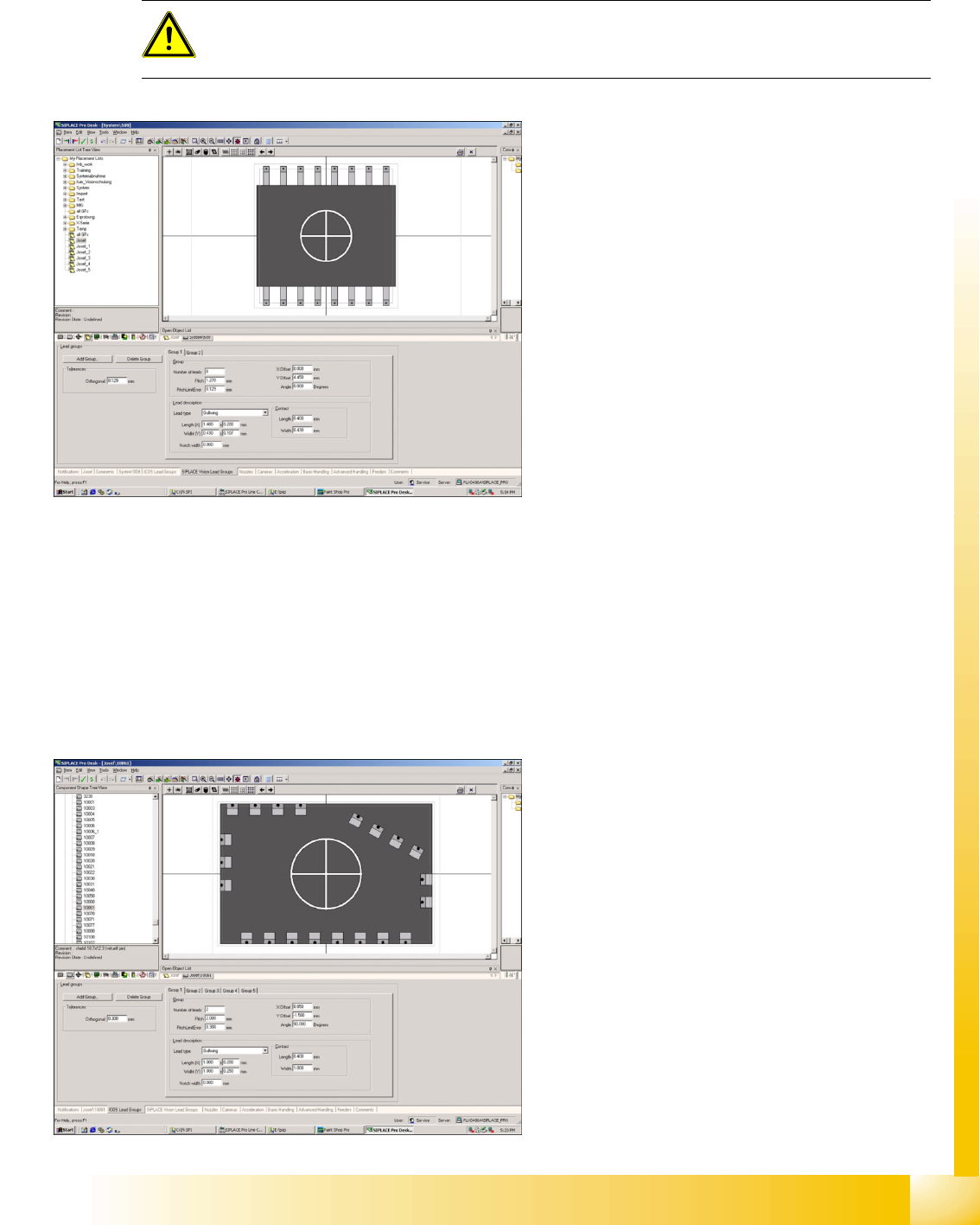
ICOS uses a programming trick to make sure that the outer edge of the Shield is recognized: virtual leads
are defined along the outer edge, which the ICOS Vision system searches for with ROW (CORNER and
LEAD disabled) mode only. The lead ends and the position information for each shield side are
recognized during component centering.
ATTENTION:
Disable Requires separate group description to delete the SIPLACE Vision parameter set
WITHOUT BACKUP!!!
After enabling Requires separate group
description, you will be given the opportunity to
program different lead group descriptions for
SIPLACE Vision. A copy of the ICOS parameters
(see above) forms the basis for programming in
SIPLACE Vision.
Shield programming in ICOS.
SIPLACE Pro 3.0 Programming Interface for Component Shapes
Programming the Component Shapes in SIPLACE Vision Application Example for 'Requires Separate Group Description'
Student Guide SIPLACE Vision (Customer)
SIPLACE Pro 3.0 Programming Interface for Component Shapes Edition 12/2008 EN
166
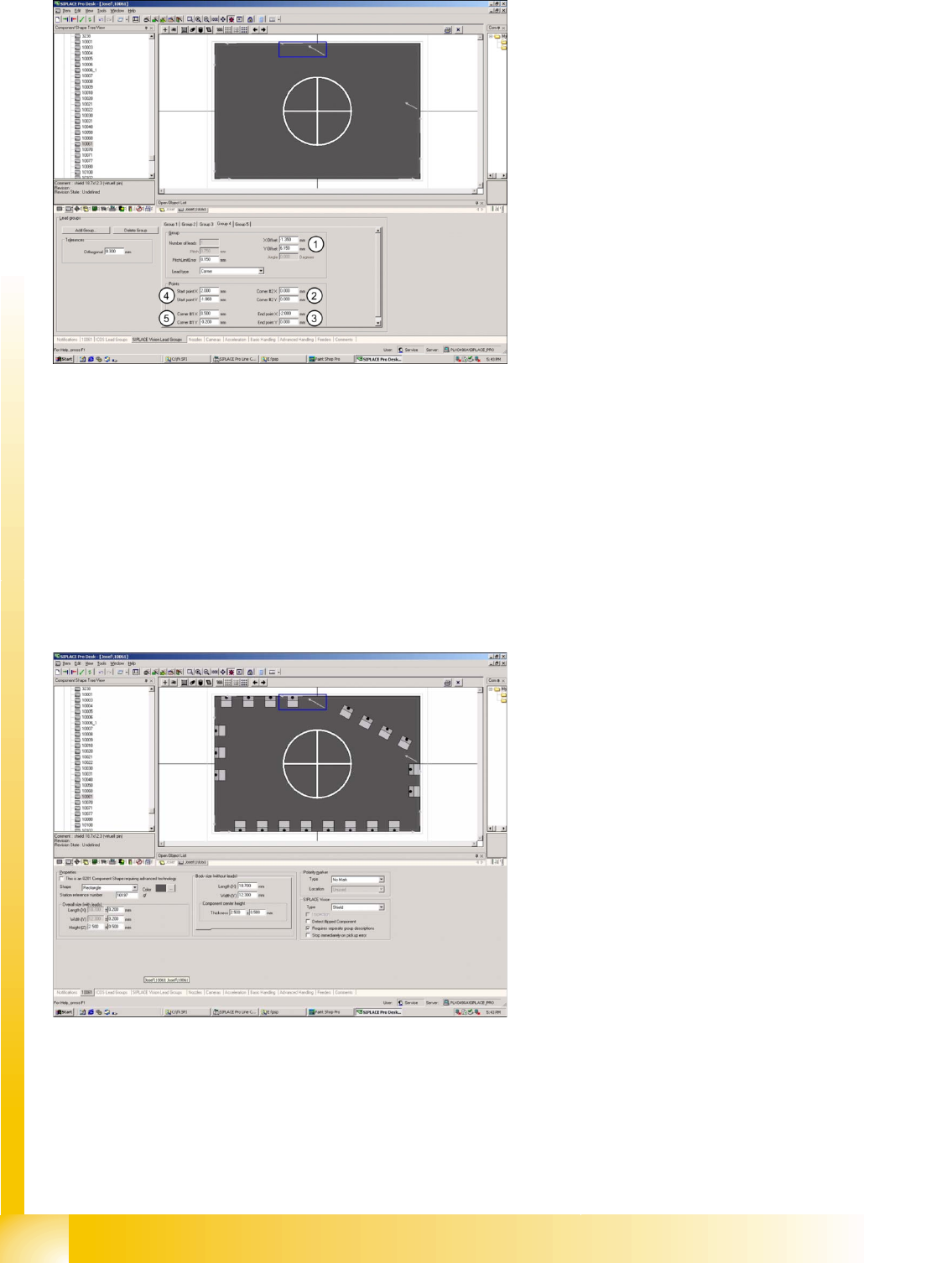
For SIPLACE Vision, CORNER recognition is programmed on the outer edge of the Shield.
For SIPLACE Pro, there are two programming options:
Programming the corner positions as the basis for definition of the coordinates for the lead start and
end recognition vectors.
Programming the component center as the basis for the definition of the lead start and end
recognition vectors.
A further alternative is to directly correct/program the X/Y offset values of a recognition position in
SIPLACE Vision. We particularly recommend this option for corners which can not be programmed with
an opening angle of 90°.
Legend
1. Corner offset from the component center.
2. Start point for the horizontal recognition
vector.
3. End point for the horizontal recognition vector.
4. Start point for 30° corner recognition vector.
5. End point for 30° corner recognition vector.
This programming window for body dimensions
shows ICOS lead group programming, with 21
leads in five groups.
The arrows in the Shield corners show the
programming of SIPLACE Vision recognition
vectors; the blue window marks one of five
programmed corners.
At the end of component shape programming, the
integrity check (see above) can be used to check
the dataset for completeness and correctness
(new in SIPLACE Pro 3.0).
SIPLACE Pro 3.0 Programming Interface for Component Shapes
Vision Data Manager Handling Component Programming
Student Guide SIPLACE Vision (Customer)
Edition 12/2008 EN SIPLACE Pro 3.0 Programming Interface for Component Shapes
167
7.3.5 Vision Data Manager
7.4 Handling Component Programming
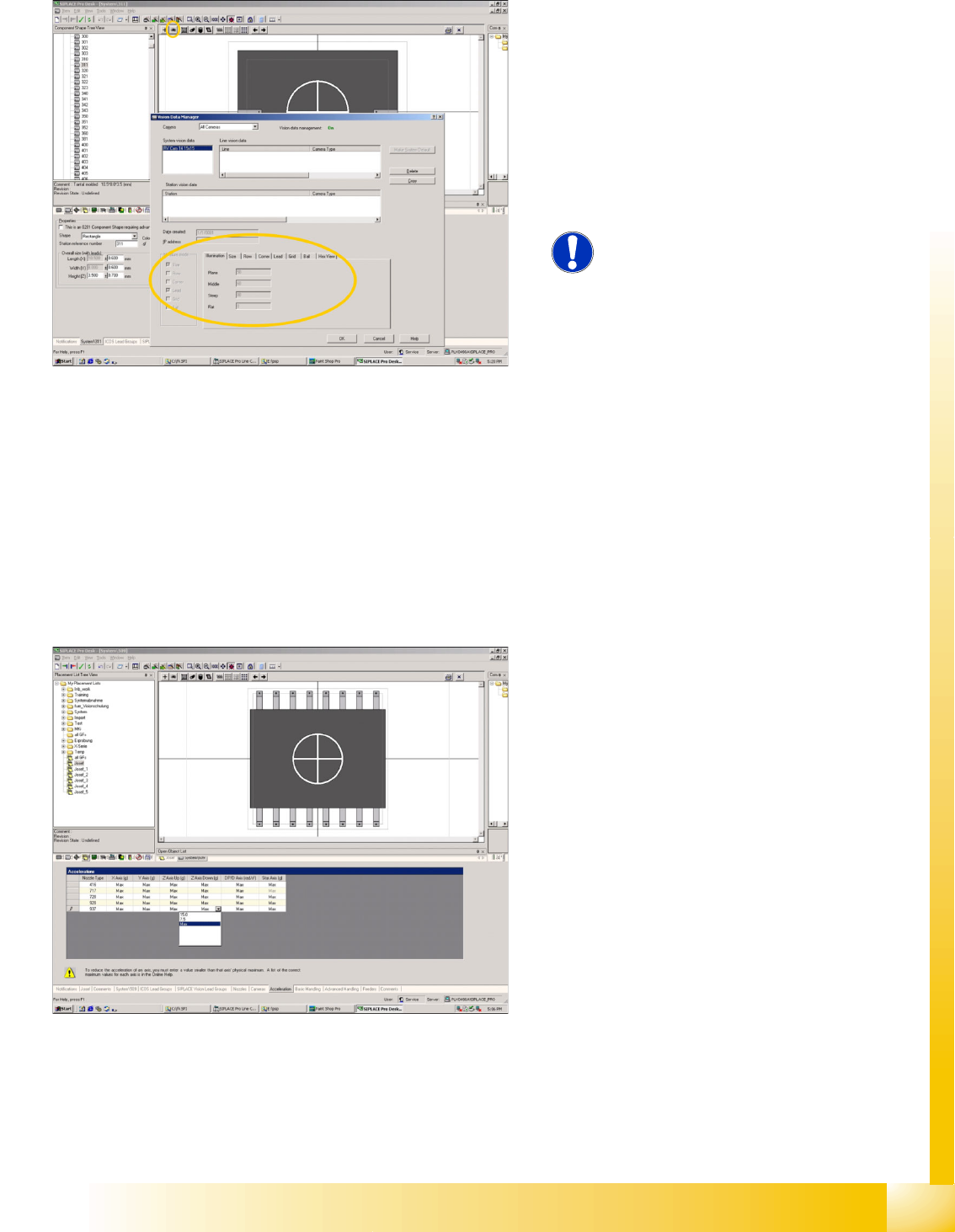
The Vision Data Manager (VDM) enables you to
check the component shape teaching data. This
can also be performed when the Vision Manager
(full) function is disabled (Vision Management is
switched to ON in screen dump).
Click on the eye symbol to view the teaching data
for a particular camera type. Select the required
Camera to view the insensitive data for the ICOS
measurement methods and camera illumination.
NOTE: When importing the CS data,
always import the SST files!
Experience shows that this is often
forgotten, although this is very
important.
If leads have been programmed for this
component shape, although the lead
measurement mode is disabled in the SST file, it
can be assumed that a programming trick was
used in ICOS. Nonstandard programming
methods such as these might well have a negative
affect on the SIPLACE Vision centering
procedure.
The acceleration of the selected axis refers to the
fastest machine type. Maximum therefore means
that the fastest axis speed for that machine type is
permitted.
If the acceleration is reduced, this will ONLY
reduce the acceleration value and will not initiate a
special processing mode*.
* In the SR/MC 4XX.xx Sw, reduced acceleration
programs slower initial Z-axis upwards travel.