SIPLACE Vision Customer_en.pdf - 第115页
Component Shapes SIPLACE Vision Flux Inspection – on ly in 605 SW New SIPLACE Vision Functions for 605 and 701 Station SW S tudent Guide SIPLACE Vision (Customer) Edition 12/2008 EN Component Shapes 11 5 These ar e numbe…
Component Shapes
New SIPLACE Vision Functions for 605 and 701 Station SW SIPLACE Vision Flux Inspection – only in 605 SW
Student Guide SIPLACE Vision (Customer)
Component Shapes Edition 12/2008 EN
114
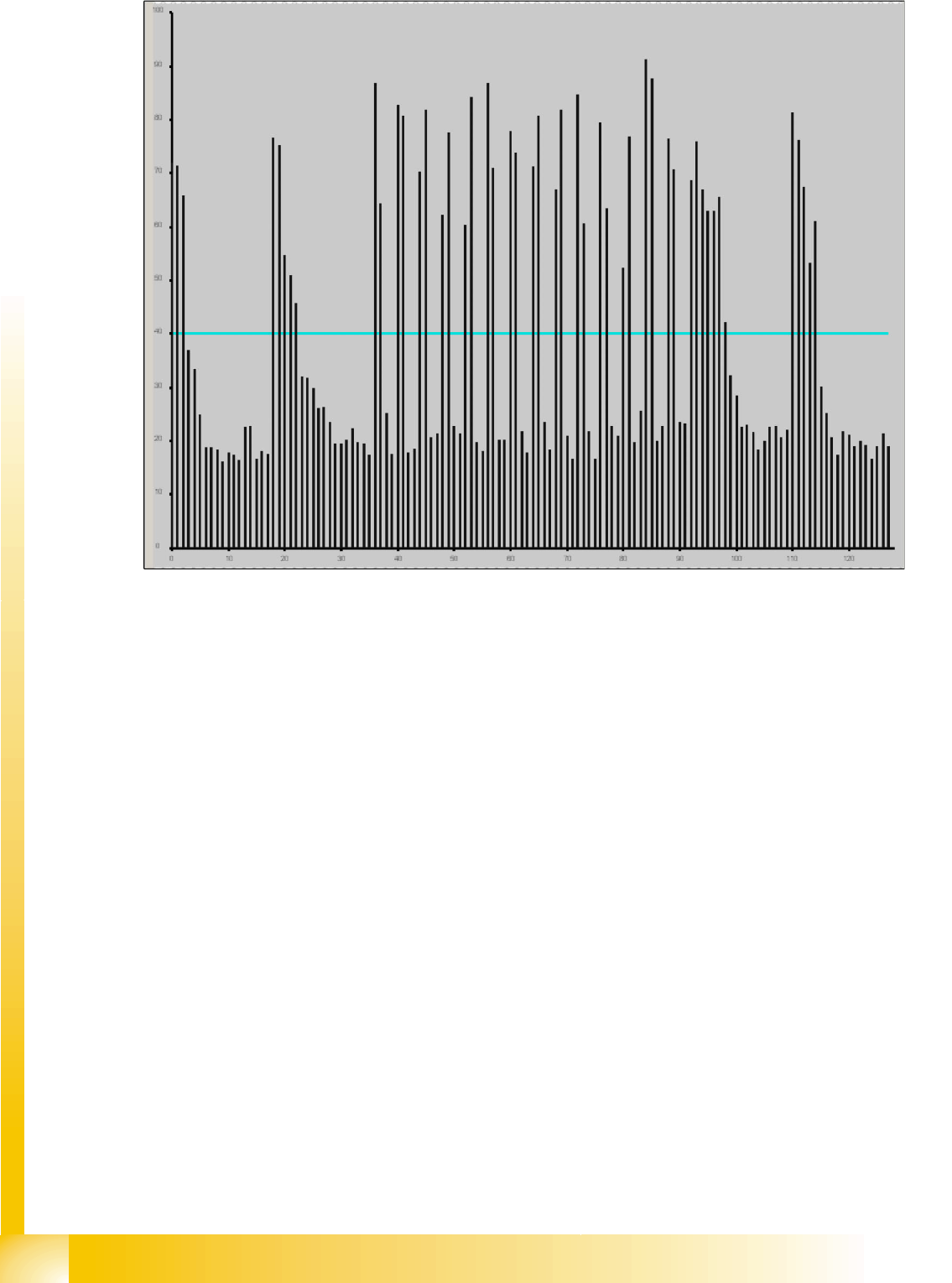
5-19: The result diagram shows the calculated characterisitcs per ball.
The ball numbers are given along the X axis (128 in this example). The calculated characteristic per
ball is given along the Y axis.
The horizontal line in turquoise represents the threshold being set.
All balls whose characteristics are below the threshold are shown in green in the result image (see
above).
All balls whose characteristics are above the threshold are shown in red in the result image (see
above).
Parameterization
The parameterization is carried out on the station during shape component teaching using the algorithm
parameters in the programming area labeled
Flux inspection
.
Selection of the Analyzing Procedure
Initially, 2 procedures (brightness and homogeneity analysis) are provided as described.
Both procedures return a characteristic value per ball that is compared to a threshold. If the characteristic
exceeds the threshold, that is to be set here, the ball is characterized as insufficiently coated.
The procedures differ in the anlysis area.
Analysis is either carried out on the entire circular area, defined by means of DonutOuter (see 0 setting
of the evaluation area), or on the area of the circular ring (Donut), defined by means of DonutOuter and
DonutInner. Thus 4 different analysis variants are offered in total.

Component Shapes
SIPLACE Vision Flux Inspection – only in 605 SW New SIPLACE Vision Functions for 605 and 701 Station SW
Student Guide SIPLACE Vision (Customer)
Edition 12/2008 EN Component Shapes
115
These are numbered from 1 to 4 as follows
Analysis of homogeneity on the circular area
Analysis of homogeneity on the circular ring
Analysis of brightness on the circular area
Analysis of brightness on the circular ring
Choose the procedure, whose ball characteristics comply with the following requirements:
The characteristics for dipped and un-dipped balls differ to a great extent.
The characteristics for dipped and un-dipped balls differ to a small extent.
Setting of the Evaluation Area
2 parameters, refering to the ball diameter, are available for setting the evaluation area.
DonutOuter defines the diameter of the circular area if the entire area is to be analyzed, or the outer
diameter of the circular ring is determined if only the ring is to be analyzed.
DonutInner defines the inner diameter of the circular ring if this ring is to be analyzed. Otherwise it
has no meaning.
Both parameters are entered as the factor for the ball diameter.
Range of values:
DonutInner: 0.1 to 1.0
DonutOuter: 0.4 to 1.3 and > DonutInner + 0.1
Default Settings of the Parameters
Parameterization procedure
Parameterization is carried out during component shape teaching:
X Preparation in SIPLACE Pro:
Activate dipping for the component and flux inspection for the component shape. (Flux inspection
can also be activated in the component shape editor of the station. Dipping, however, can only be
activated in SIPLACE Pro.)
X Select the recipe.
X Switch to the station and launch
Teach Component Shapes.
Analysis procedure = 3 Analysis of homogeneity on the circular ring
Threshold = 35
DonutOuter = 0.8 0.8 * ball diameter
DonutInner = 0.4 0.4 * ball diameter
Component Shapes
New SIPLACE Vision Functions for 605 and 701 Station SW SIPLACE Vision Flux Inspection – only in 605 SW
Student Guide SIPLACE Vision (Customer)
Component Shapes Edition 12/2008 EN
116
X In a next step check the parameter settings for an undipped component. Switch back to the form
editor and re-activate dipping.
X Get the component and switch to the
Monitoring
Vision view.
If the position of the component cannot be detected because the component is too dark, the
illumination must be brightened up until the position can be reliably determined. Please brighten up
only to such an extent, that is absolutely necessary to detect the component.
X Select the
Flux diagram
view (see above).
In this view you have to check if the selected areas really show the greatest modifications through
dipping. Again, the differences between the characteristics should be as small as possible. The
threshold should be above all characteristics now (if they were set as described).
If this is not the case, either the parameterization has to be checked or it has to be checked if the flux
or solder paste is suitable.
If the threshold is comfortably above the characteristics it can be reduced to a value that enables
insufficiently coated balls to be detected earlier. The selected threshold depends on the conditions
and the process requirements at the customer's site.
X If the correct parameterization has been found, save it.
X Based on the existing patterns the distance of the characteristics between dipped and un-dipped
component should be at least 20 pixel for the contrast procedure and at least 40 for the brightness
procedure.
X The values for the characteristics and their differences between dipped and un-dipped depend on:
the properties of the flux, the surface properties of the balls, the height of the flux or solder paste in
the dipping unit, the dipping time, the selected analysis areas (via DonutInner and DonutOuter) and
the selected illumination.
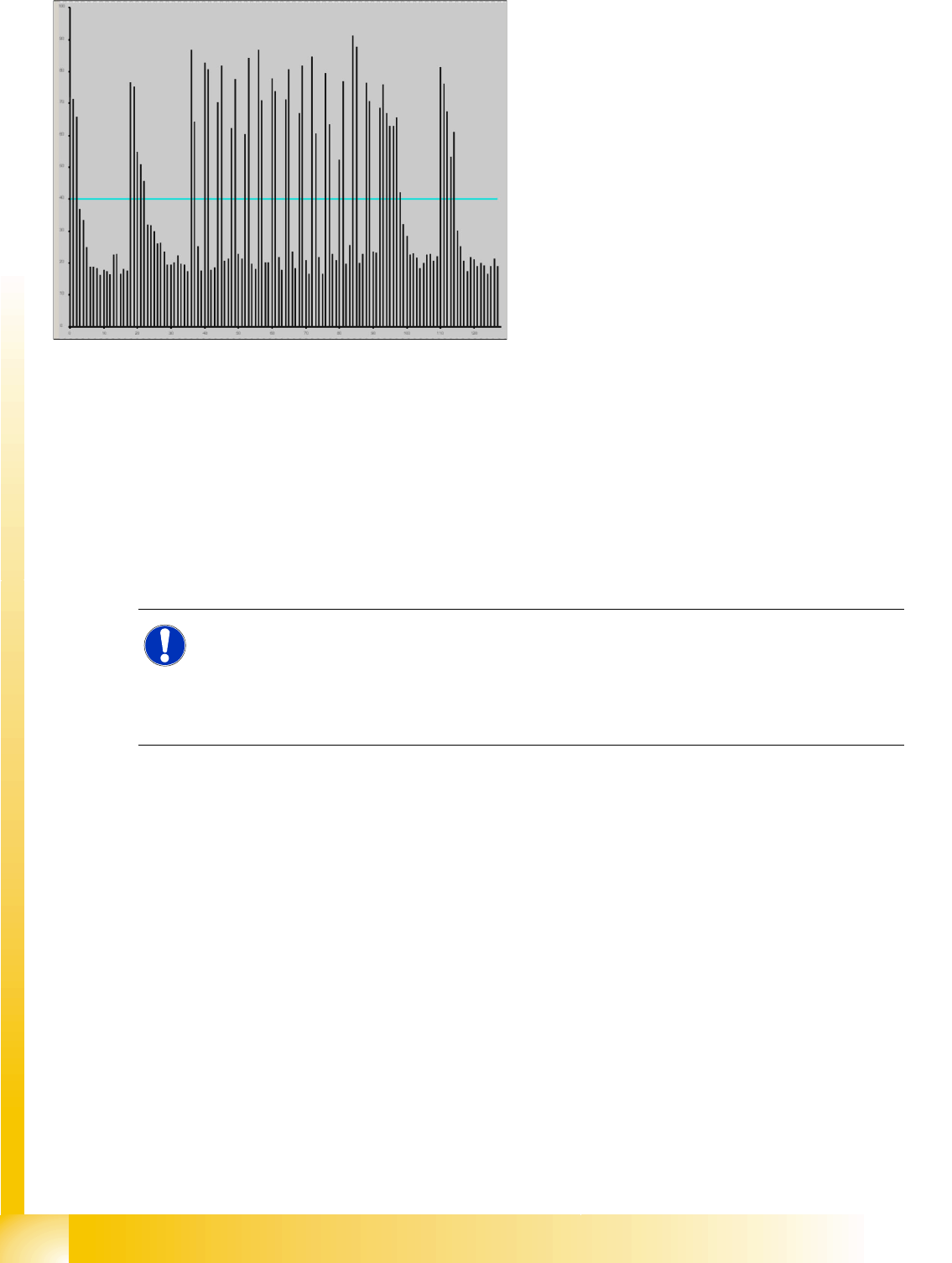
5-20: Flux diagram
X Deactivate dipping in order to calculate the
characteristics for un-dipped balls.
Get the component and switch to the
Monitoring
Vision view. Select the
Flux
diagram
view (see the figure).
X This diagram shows the characteristics of all
balls and the differentiation threshold.
The selected detection procedure and the
parameterization of the evaluation areas
(DonutOuter and DonutInner) have an effect
on the characteristics.
It is the aim to find a setting that includes the
areas with the greatest modifications as a
result of the dipping. At the same time the
differences between the characteristics should
be as small as possible.
X Set the threshold to a value that is a bit lower
than all characteristics of the balls. Thus all
balls will be characterized as insufficiently
coated.
NOTE:
If the illumination is too bright the differentiation becomes worse because pixel on un-coated
balls may be overexposed. Overexposed pixel always have a gray value of 255 independent of
the extent of the overexposure. If the previously dark pixel also become very bright after
brightening the illumination, e. g. if a gray value of 40 augments to 200, the differentiation gets
correspondingly worse.