MAN00000772_SI-G200BB_SVCPDFA.pdf - 第624页
4. Basic Operations of the Multifunctional Mounter TFGB-10101-0 1 SI-G200 (B Head) Overview SHEET 9/20 4-4-2 Global Recognition Up to eight parts display ed in a pictu re taken by t he Large view of the fixed cam era are…
4. Basic Operations of the Multifunctional Mounter
TFGB-10101-01
SI-G200 (B Head) Overview
SHEET
8/20
4-4 Recognition
There are three parts recognition methods: individual recognition, global recognition, and split recognition.
Which method can be used is determined according to part types based on shapes.
Recognition Methods Used According to Part Types Based on Shapes
Recognition Methods
Part Type Based on Shapes
Individual
Recognition
Global Recognition Split Recognition
Chip part O O ×
Lead part O O (partly*) O
BGA part O × O
Odd-shaped part (with leads) O × O
Odd-shaped part (without leads) O × O
Odd-shaped part (with balls) O × ×
- Global recognition can be set only for parts in Category A.
- When parts in the normal mode and ones in the high-Accuracy mode coexist in one path, the order in
which parts are picked up changes from the mount information setting. Parts with the same Accuracy
level as that of the first parts to be picked up are picked up and mounted first, and the remaining parts are
passed on to a recovery path.
- When globally recognized parts and individually recognized parts coexist in one path, either of global
recognition and individual recognition is conducted first. Which recognition is conducted first is
determined according to how the first parts to be mounted in the target path are recognized.
When the first parts to be mounted are individually recognized, individual recognition is conducted
first.
When the first parts to be mounted are globally recognized, global recognition is conducted first.
4-4-1 Individual Recognition
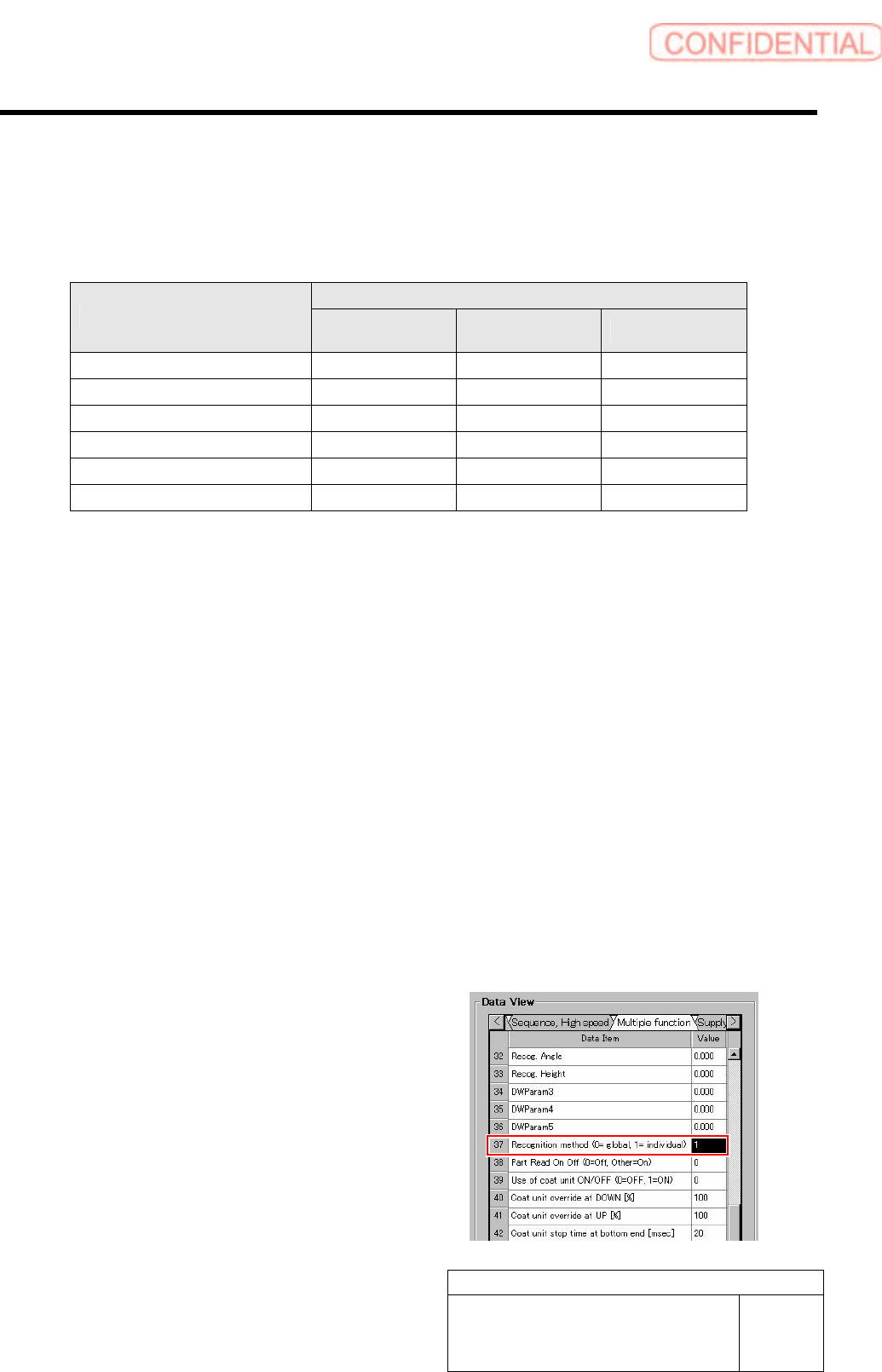
Picked up parts are recognized individually one by one. According to part sizes, you can select the wide or
Small view of the fixed camera. The H axis descends to the recognition height.
[Setting Method]
The setting for whether individual recognition
is conducted is configured for part data.
When you set “1” for “Recognition Method”
in “Sequence (Multifunction)” displayed after
selecting “Data Editing” and “Part
Management” in this order, individual
recognition is conducted.
4. Basic Operations of the Multifunctional Mounter
TFGB-10101-01
SI-G200 (B Head) Overview
SHEET
9/20
4-4-2 Global Recognition
Up to eight parts displayed in a picture taken by the Large view of the fixed camera are recognized. With
global recognition selected, the number of rotating operations of the turret and that of pictures taken are
decreased, thereby improving production takt time.
Global recognition is conducted with the center of the turret placed in the center position of the Large view
of the fixed camera.
The RT axis conducts global recognition with Index1 being below the H axis. At this time, recognition is
conducted with the H axis not descending.
[Scope of Application]
Global recognition can be conducted only for parts that meet the conditions for both part sizes and part
types based on shapes.
Global recognition can be conducted only for parts in Category A (□10 mm, part thickness: 6.5 mm or
less).
For the types (shapes) of parts for which global recognition can be conducted, see the table below.
Parts for Which Global Recognition Can Be Conducted and Other Conditions
Part Types Based on Shapes
Whether Recognition
Can Be Conducted
Other Conditions
Chip part O -
Lead part O (partly)
The number of lead sets is less than three, the number of leads
per set is less than five, and the width of a lead is 0.3 mm or
more at the same time.
BGA part × -
Odd-shaped part (with leads) × -
Odd-shaped part (without leads) × -
Odd-shaped part (with balls) × -
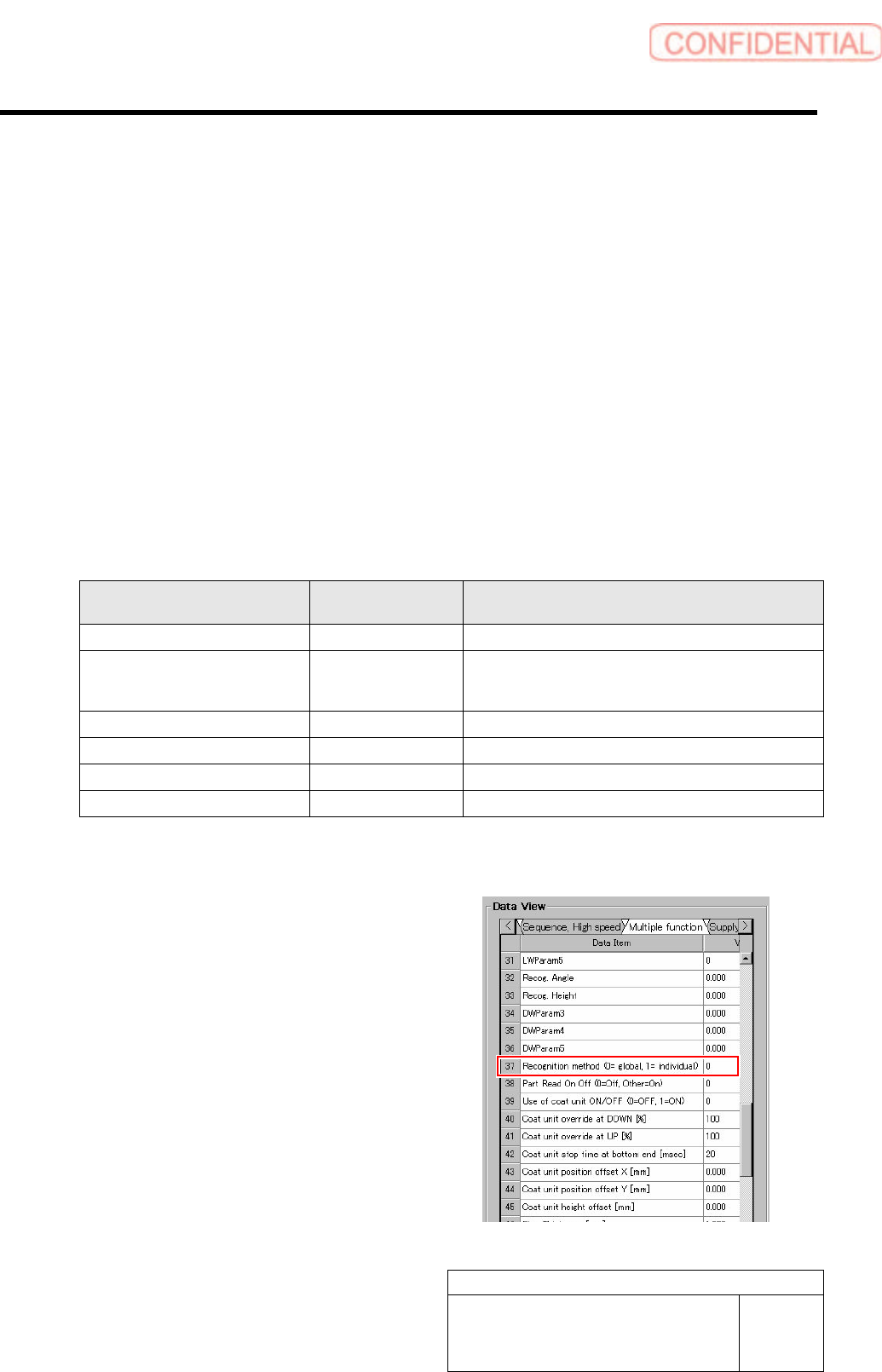
[Setting Method]
The setting for whether global recognition is
conducted is configured for part data.
When you set “0” for “Recognition Method” in
“Sequence (Multifunction)” displayed after
selecting “Data Editing” and “Part Management”
in this order, global recognition is conducted.
4. Basic Operations of the Multifunctional Mounter
TFGB-10101-01
SI-G200 (B Head) Overview
SHEET
10/20
When global recognition is conducted, part data is also shared by individual recognition. However, the set
values in the table below are automatically applied to the items to be set below, regardless of the already
set values.
Set Values Applied Automatically When Global Recognition Is Conducted
Items to Be Set Location Set Values to Be Applied
Field of view of the fixed camera Sequence (multifunction) Fixed camera (Large view)
Accuracy level Sequence (multifunction) 0 (normal)
Recognition angle specification Sequence (multifunction) OFF
Lighting pattern Sequence (multifunction) Defined in machine data
- When global recognition is conducted, the Large view of the fixed camera is used. (The camera defined
in part data is for individual recognition.)
- For the lighting pattern used for global recognition, values defined in “Vision Parameter” displayed after
“Machine Setup” has been selected are used. (The lighting pattern defined in part data is for individual
recognition.)
- Retrial of recognition of parts for global recognition is conducted as global recognition.
[Restrictions on Global Recognition Operations]
Even parts for which global recognition has been set may not be recognized globally, depending on
operating conditions. (They may be handled forcibly as parts for individual recognition.) Cases where
global recognition is not conducted are shown below.
- When multiple part types based on shapes for which global recognition has been set exist in one path
Among the part types in part data, only three types can be recognized globally.
Part Types Recognized Globally and Internal Recognition Method
Types Part Types Based on Shapes Lead Shapes Priority Order
1 Chip part - 1
2 Lead part Gull-wing 2
3 Lead part J-Lead 3
In one global recognition operation (in one path), only one part type can be recognized globally.
Therefore, when multiple part types exist in one path, global recognition is conducted only for one part
type to which most of the existing parts belong. Parts that do not belong to the part type are individually
recognized forcibly.
When the same number of parts belong to each of the part types in one path, global recognition is
conducted according to the priority order.
- Parts whose recognition method and Accuracy level have been set as global recognition and high
Accuracy, respectively, are globally recognized preferentially and then mounted. However, they are
mounted in an antibacklash operation.