4OM-1345-009_w.pdf - 第220页
5-3 AKHEMT -ID 0605-001 2. T roubleshooting on Pickup Errors 2.1 Cause and Remedy of Pickup Errors (1) Component-Based Factors When the cause of a failure lies in speci fi c components or lots, the components must be exam…
5-2
AKHEMT-ID
0605-001
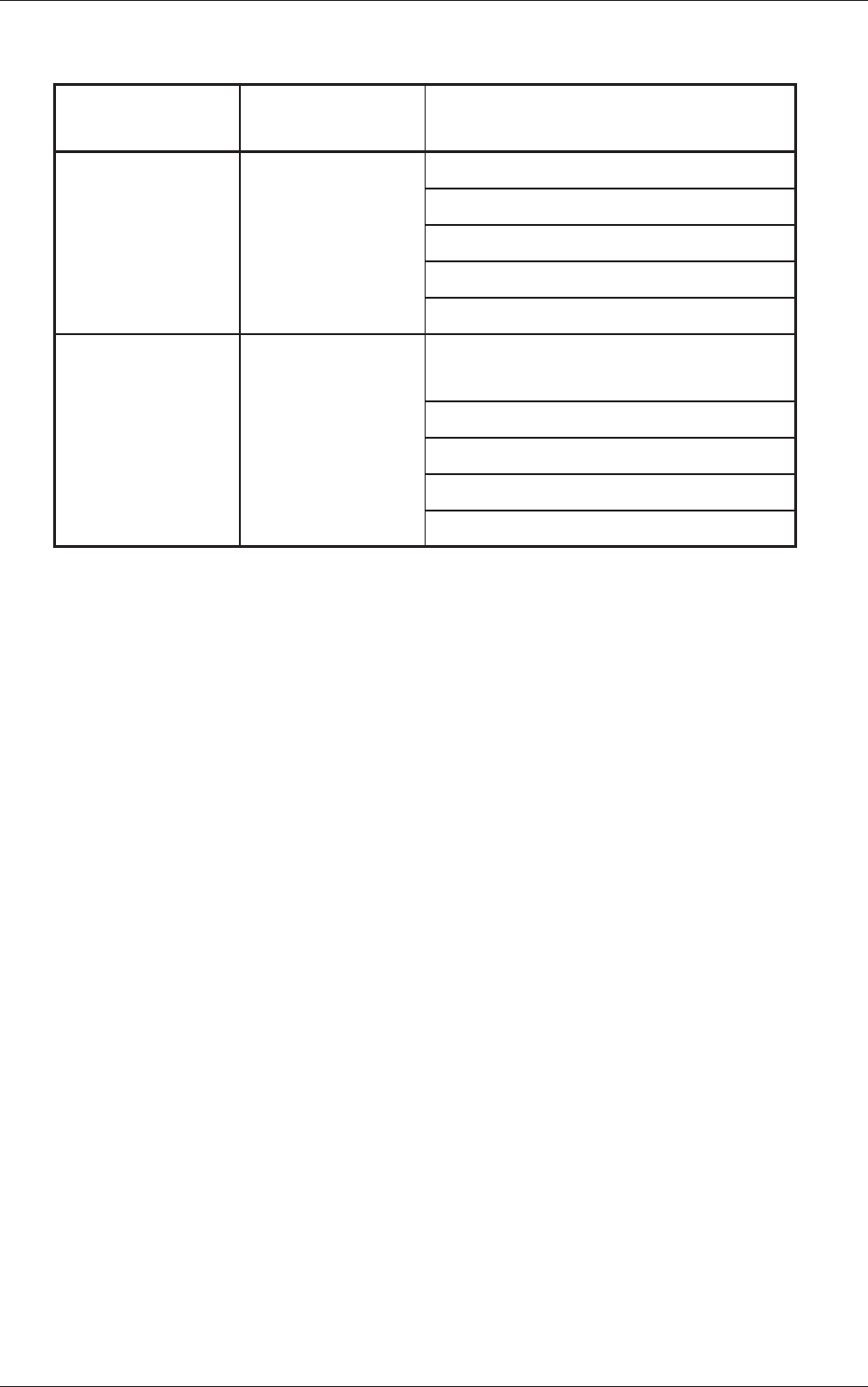
Failures can further be classifi ed as shown in the table below
.
Table 4E1
Classifi cation of
Failures
Contents of
Failures
Symptom of Failures
Failure before
Component
Placement
Component Pickup
Error
Components cannot be picked up.
Components are turned vertically.
A recognition error occurs.
Components fall down.
Others
Failure after
Component
Placement
Component
Placement Error
The positional and angular deviation of
component occurs.
Components are turned over and placed.
Some components are missing.
Some components are cracked or nicked.
Others
1.2 Helpful Hints on Countermeasures against Failure
•
The fi rst helpful hint on countermeasures against failure is to catch
precisely what kind of symptom is produced and how frequently the
symptom appears.
•
The second helpful hint is to grasp the tendency (environment and
condition) of a failure.
Shown below are the concrete items to be checked.
(1) Check if the failure occurs on specifi c components.
(2) Check if the failure occurs on a specifi c production lot.
(3) Check if the failure occurs on a specifi c machine.
(4) Check if the failure occurs at a limited stage.
•
The third helpful hint is to fi nd in which process the failure occurs.
In normal cases, a failure after component placement is found in the fi nal
inspection process. In such a case, it is required to track the failure by
checking all processes and specify the process in which the failure has
occurred.
It is very important to grasp a failure symptom precisely on these helpful
hints. Precise capture of a failure symptom makes it possible to track the
factor and make a plan to take countermeasures against the failure.
When this phenomenon grasp is negligently done, it takes time to defective
measures by executing ineffectual measures.
Especially, as for less failures (low generation rate), it is necessary to take
data accurately, examine the factors as a result, and execute measures
against such failures.
1.1 Classifi cation of Failure Symptoms
5-3
AKHEMT-ID
0605-001
2. Troubleshooting on Pickup Errors
2.1 Cause and Remedy of Pickup Errors
(1) Component-Based Factors
When the cause of a failure lies in specifi c components or lots, the
components must be examined fi rst of all.
Shown below are the cases of failures whose factors lie in components.
[Factors of Pickup Errors on Component Side]
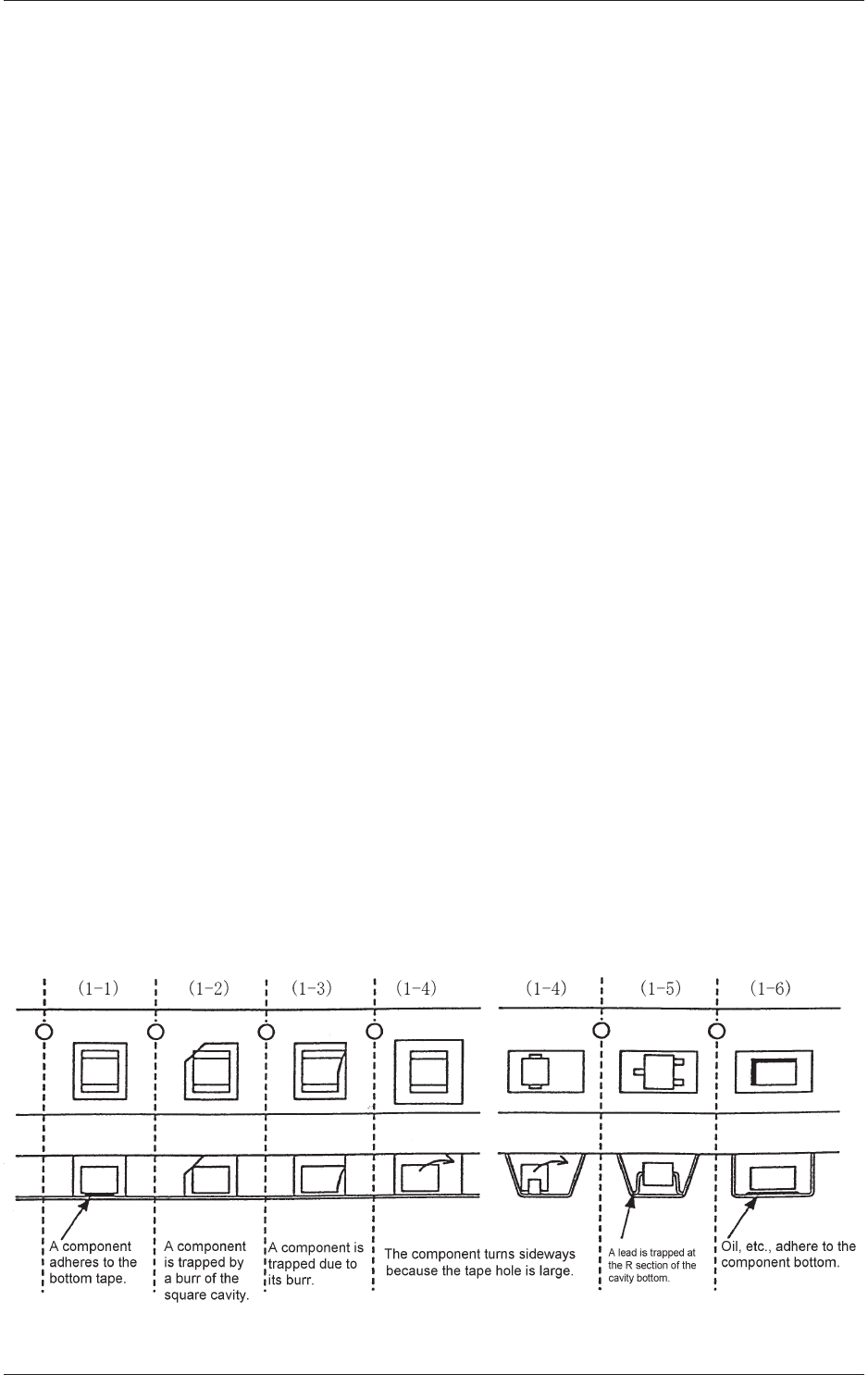
(1-1) A component adheres to the bottom tape.
(1-2) The shape of a cavity is defective.
(1-3) The shape of a component is defective.
(1-4) A component turns sideways because the tape cavity is too large.
(1-5) The fl atness of the cavity bottom is defective.
(1-6) Oil or mold lubricant adheres to the bottom of a component.
The failures described in (1-1) through (1-4) have a tendency to occur
easily due to the components packaged in a paper tape and the failures
described in (1-4) through (1-6) due to the components packaged in an
embossed tape.
Special caution should be paid to minute components such as 0603 and
1005 types because such components are directly affected by how they
are packaged in the tape.
To determine whether or not the taped components are packaged in
good condition, turn the tape upside down and check to see how the
components fall down from the cavities. If the components fall down
freely, it means that they were packaged in good condition.
The specifi cations of taping are specifi ed in "JIS-C0806". However, as
the detailed regulations are not provided as for the failures described in
(1-1) through (1-6), it is required to ask the component maker about the
details when the components are purchased.
Fig. 4E2 Exemplifi cation of Troubled Taped Components
2. Troubleshooting on Pickup Errors

5-4
AKHEMT-ID
0605-001
(2) Machine-Based Factors
When a component has no problem, check the main body of the
machine.
A
failure can be tracked by checking if it occurs on a specifi c vacuum
nozzle or feeder slot No. (lane).
(2-1) When a failure occurs on a specifi c vacuum nozzle, check
the following items concerning the pertinent vacuum
nozzle.
•
Check if the vacuum nozzle is abnormal.
•
Check if the vacuum line is abnormal.
•
Check if the vacuum ON/OFF valve is abnormal.
•
Check if the linear measure sensor is abnormal.
When a factory is dusty or a lot of components packaged in paper
tapes are used, the vacuum nozzles and their fi lters get dirty easily.
Therefore, it becomes important to clean the vacuum nozzles and fi lters
periodically.
Reference
Refer to "2.2 (1) Frequent Pickup Errors on Specifi c Vacuum Nozzle" for the
troubleshooting.
(2-2) When a failure occurs on a specifi c feeder slot No. (tape
feeder), check the following items concerning the pertinent
feeder slot No. (tape feeder).
(1) Check if the tape feeder is loaded correctly with components.
(2) Check if the top cover tape is peeled off normally.
(3) Check if the data related to the component picks is normal.
Reference
Refer to "2.2 (2) Frequent Pickup Errors on Specifi c Feeder Slot No." for the
troubleshooting.
2.1 Cause and Remedy of Pickup Errors