1.011.1_VPC使用手册.pdf - 第120页
119/144 • Always overwrite files (last inspection is maintained). • Never overwrite files (first inspection is maintained). 8.5.6 Step 6: Starting the import Clicking the button "Start" starts the data import, …

118/144
8.5 File Import
8.5.1 Step 1: Input directory
Here, the directories containing the SPC/SPM and/or the INDEX files are
defined. For pre-settings, the software uses the value of the environment
variables SPC_DATA_DIR or SPC_INDEX_DIR or - if these are not defined -
the directories “C:\VISCOM\PROJECT\VISSPC\DATA\WORK“ and
“C:\VISCOM\PROJECT\VISSPC\DATA\INDEX“.
Any directory can be selected under the "Browse..." button.
8.5.2 Step 2: Release directory
Here, the directory in which the generated VPC or VPM files are to be stored is
chosen.
Any directory can be selected under the "Browse..." button.
8.5.3 Step 3: Handling imported data
If desired, successful SPC or SPM files can be removed to another directory
after a successful import.
8.5.4 Step 4: File format for release
Here it can be chosen if a single VPC file for each inspection or a VPM file per
day and machine should be generated.
Basically, the VPM format is faster during evaluation and saves hard disc
space, and so is preferred to the VPC format.
8.5.5 Step 5: Multiple inspected barcodes
If "VPC" is chosen as release format, its actions when multiple barcodes in a
day are inspected by an inspection system can be defined.
• Add a counter, to get a clear, definite barcode.

119/144
• Always overwrite files (last inspection is maintained).
• Never overwrite files (first inspection is maintained).
8.5.6 Step 6: Starting the import
Clicking the button "Start" starts the data import, which can be broken off with
the button "Cancel" if necessary.
8.5.7 Step 7: Progress of the file import
Here is where the actual status of the data import is read out. This includes:
• the current processed input/output file,
• the number of the completely read or written bytes,
• the ratio and finally,
• the number of processed and aborted files.
120/144
8.6 VPCSetup
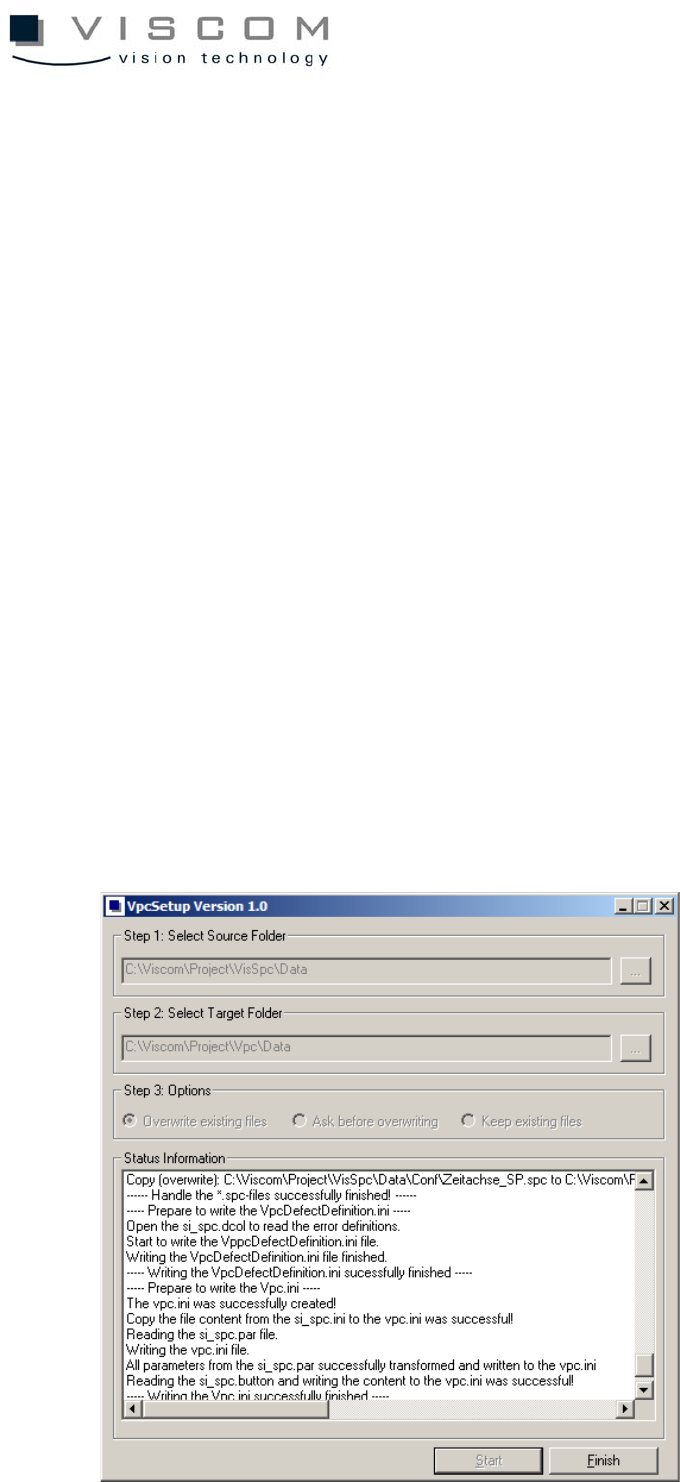
VpcSetup makes it possible to automatically transfer SPC configurations to
VPC configurations, so the operator no longer has to carry out manual
modifications. The following example illustrates the VpcSetup program after a
successful configuration transfer.
VpcSetup transfers the configuration files (with the file ending "spc") and the
configuration set files (with the data ending "sps") for the new software VPC. In
the process, the files from the "Conf" directory of the SPC software are copied
to the "Conf" directory of the VPC software, and named according to the
following convention:
• configuration set: old file ending: “sps“; new file ending “vps“
• configuration set: old file ending: “sps“; new file ending “vps“
At the end, a Vpc.ini file and a VpcDefectDefinition.ini file (see "Error definition
setup") are generated, in which all the settings for the VPC software are saved.