CYCLONE-User-Manual.pdf - 第123页
User Manual For Cyclone LC Programmers 123 Figure 12-1: Serialize Main Screen 12.2.1 Startup And File Options On startup, the Serialize program will automatically open the last file saved. If no file has been saved, it w…

User Manual For Cyclone LC Programmers 122
12 AUTOMATIC SERIAL NUMBER MECHANISM
When producing a microcontroller- or microprocessor-based product, it is often useful to program
a unique serial number into the permanent memory (FLASH) of the product.
PEmicro offers a serial number mechanism to automate this process. Each time you issue a
serialization command in the programming software, the current serial number is programmed at a
specified address. In addition, the serial number is incremented to the next available serial number
and saved for future serialized programming operations.
The Cyclone adopts this automatic serial number mechanism for its stand-alone operations. The
user can create a Serial File using PEmicro’s Serialize Utility and then include commands in the
programming sequence of the programming image to implement that Serial File. If needed,
adjustments can later be made to the serial number of a programming image.by using the Cyclone
menu screen (see Section 5.2.2.3 - Serial Numbers).
12.1 Understanding Serialization
The automatic serial number mechanism supports serial numbers from 1 to 16 bytes in length.
Each byte of a serial number ranges between a lower and an upper bound. This approach allows
the individual bytes of the serial number to have distinct properties. Some of the forms these
properties can take are:
Type Lower Bound (hex) Upper Bound (hex)
Constant Constant Constant
Binary 00 FF
ASCII Printable 20 7E
ASCII Numeric 30 39
ASCII Upper Case Letter 41 5A
ASCII Lower Case Letter 61 7A
Other XX YY
Each serial number and its properties are stored in a separate file. Any file name can be used for
the serial number file, however the extension .ser is normally appended because it makes it
simpler to locate the file.
A utility called SERIALIZE has been developed to make it easy to create, visualize, edit, and
maintain these serial number files.
12.2 Serialize Utility
The serialize utility allows the user to create a serial number file with a serial number that is
anywhere from 1 to 16 bytes long. Each byte may be bounded as a full binary or as a Number,
Constant, Alpha Uppercase, Alpha Lowercase, or ASCII printable character. The serial number file
also has a field for a starting hex address that may range from 00000000 to FFFFFFFF. Serial
numbers can be programmed in order or in reverse order.
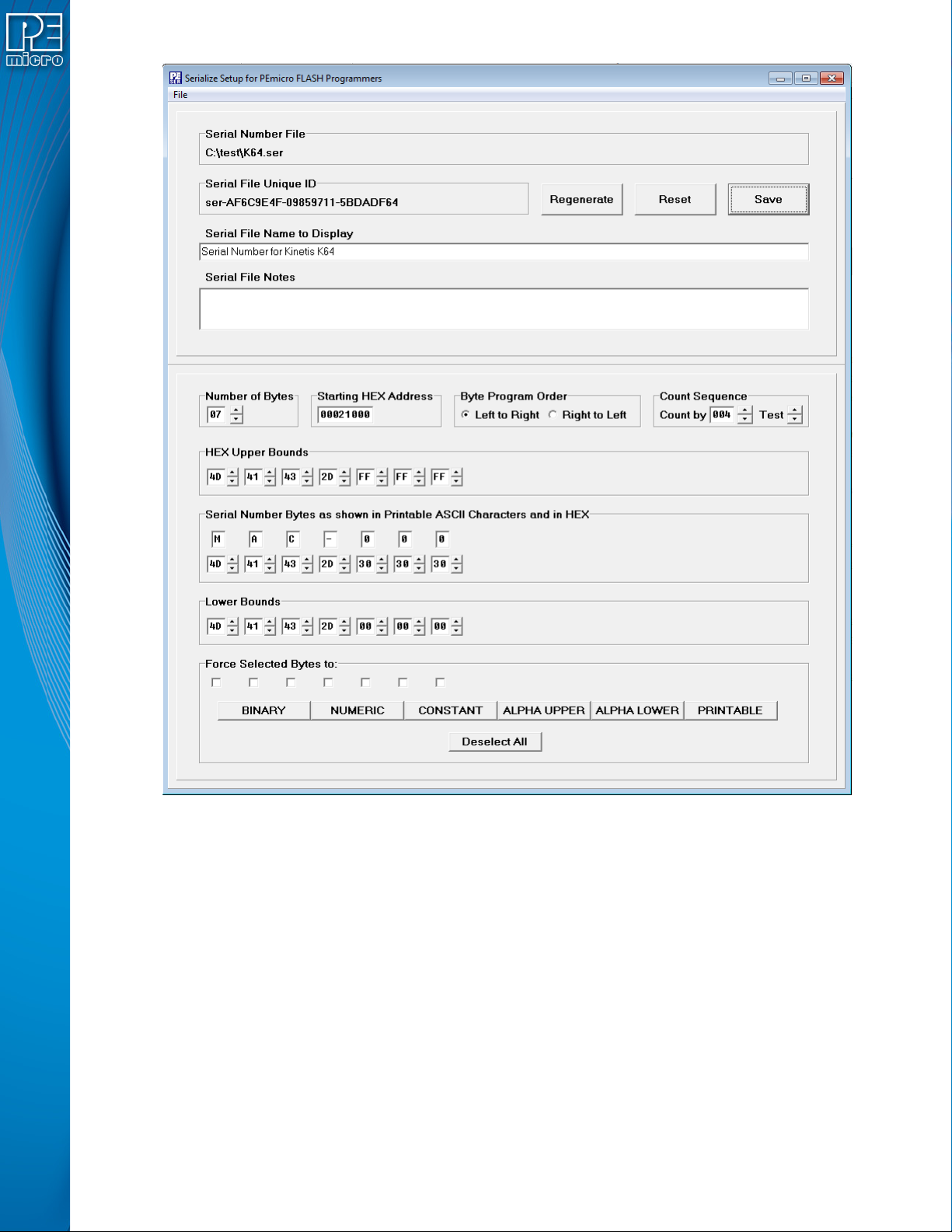
User Manual For Cyclone LC Programmers 123
Figure 12-1: Serialize Main Screen
12.2.1 Startup And File Options
On startup, the Serialize program will automatically open the last file saved. If no file has been
saved, it will default to blank.
• Reset Button - Lets you reset to a screen with only a single serial number byte defaulted to
binary (00), Hex Address 00000000.
• Regenerate Button - Preserves serial number bytes and bounds but assigns a new Serial
Number Unique ID
• Save Button, File→Save - Brings up a dialog to which is set to save to the current serial
file configuration.
• File→Save As - Brings up a dialog to select any file
• File→Load - Brings up a dialog to select a previously saved file

User Manual For Cyclone LC Programmers 124
12.2.1.1 Reset
Instructs the program to start editing a NEW (as yet un-named) serial number file. It will throw
away the information for any serial number currently being edited unless that information has been
saved (Save Button). The new serial number is initialized with one (1) byte of binary.
12.2.1.2 Save
Pops up a Save dialog with the current serial number being edited into the file name and path as
shown in the Serial Number File window. If a file name has not been provided, a dialog will pop up
to allow the user select a file name. Save will save any setup information in the file Serialize.ini.
This file will initialize the setup information the next time the program is started.
12.2.2 Serial Number File
Displays the path and filename of the open Serial File, if saved.
12.2.3 Serial File Unique ID
Displays the unique ID associated with the Serial File. A unique ID is generated anytime a Serial
File is created or modified. Multiple programming images are able to share the same serial
numbers by referencing the same ID number (see Section 13.6 - Shared Serial Numbers). The
user can click the “Regenerate” button to assign a new unique ID to the current Serial File.
12.2.4 Serial File Name To Display
The name that will appear in the JSON viewer, Cyclone menu, and in the Name field of the
Cyclone Control GUI. A descriptive name can help to easily differentiate Serial Files.
12.2.5 Serial File Notes
Allows the user to save notes regarding the Serial File. These will appear in the JSON viewer
when viewing the properties of the Serial File, see Section 13.3 - Serial File Properties.
12.2.6 Number of Bytes in Serial Number
The up and down arrows allow the user to add or delete bytes for the serial number, the maximum
in hexadecimal = 0x10 (16 base ten), the minimum = 1.
• Up Arrow Click - Adds new bytes to the Serial Number. Each byte added appears as a
new column in the serial number representation. Added bytes are input as Binary Bytes,
i.e. the upper bound is FF and the lower bound is 00.
• Down Arrow Click - Deletes bytes from the right end of the Serial Number. Any previously
entered byte properties are lost.
12.2.7 Starting HEX Address
Assigns the starting address (in hexadecimal) of the device memory where the serial number will
be programmed.
12.2.8 Count Sequence
This window lets you test the serial number by counting up or down through the sequencing of the
serial number. The serial number will roll over the upper bounds of the highest serial number back
to the lower bounds of the serial number, and vice versa.
• Up Arrow Click - Counts the serial number up.
• Down Arrow Click - Counts the serial number down.
12.2.9 Serial Number Bytes as Hex
There is one display column for each byte in the serial number shown as printable ASCII
characters. Non-printable ASCII characters are indicated by a blank gray box.
• Up Arrow Click - Counts the serial number up.