CYCLONE-User-Manual.pdf - 第97页
User Manual For Cyclone LC Programmers 97 8.4.3 The Status and Error Window: Figure 8-13: Status & Error Window This section of the Cyclone Control GUI displays the status of the utility as well as any errors during …
User Manual For Cyclone LC Programmers 96
can be used to make changes to the serialization of these images.
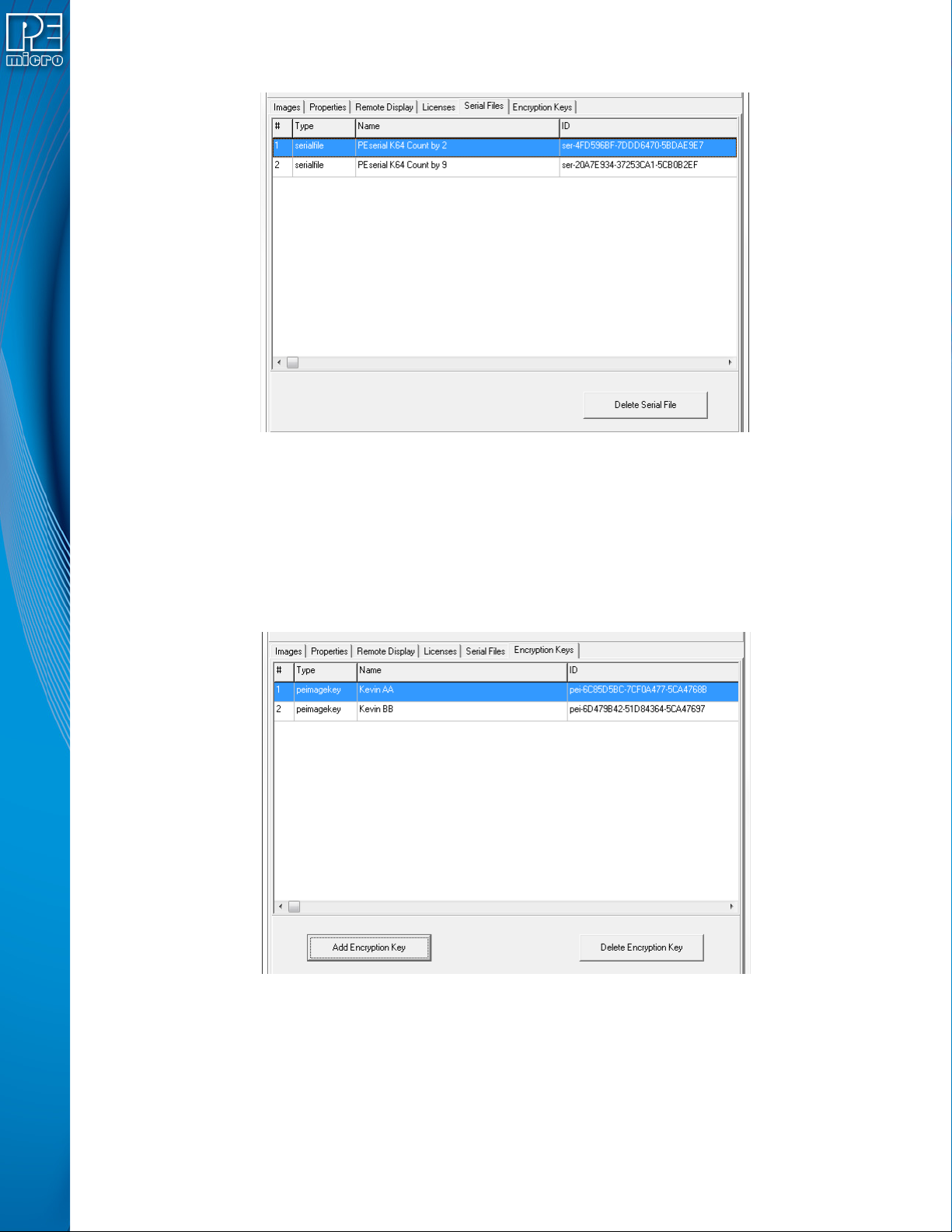
Figure 8-11: Serial Files Tab
8.4.2.6 Encryption Keys Tab
CYCLONE FX programmers and CYCLONE programmers with the ProCryption Security
Activation License are able to encrypt programming images with a user-generated ImageKey. In
order to load an encrypted image onto a Cyclone, or to program with an encrypted image once it is
on the Cyclone, the ImageKey used to encrypt that image must be present on the Cyclone.
The Encryption Keys tab displays any ImageKeys that reside on the Cyclone. The Name and
unique ID number for each ImageKey is shown.
Figure 8-12: Encryption Keys Tab
The Add Encryption Key button allows the user to browse to an ImageKey that they wish to add to
the Cyclone. Encrypted (eSAP) programming images cannot be loaded onto the Cyclone unless
the ImageKey that was used to encrypt them is present on the Cyclone.
The Delete Encryption Key button will delete the selected ImageKey from the Cyclone. The user
should bear in mind that if the ImageKey is missing for an eSAP image, that image will be locked
and cannot be programmed.

User Manual For Cyclone LC Programmers 97
8.4.3 The Status and Error Window:
Figure 8-13: Status & Error Window
This section of the Cyclone Control GUI displays the status of the utility as well as any errors
during the connection or any of the actions performed by the utility. It’ll show detailed errors on
images that failed to be properly added or actions that require additional licensing.
This new status and error window increases the visibility of the user into the tasks the utility is
performing as well as the issues that may arise.
8.5 License
The Cyclone Control Suite software does not need a license to operate when using the standard
features with any touchscreen Cyclone or when using advanced features with a Cyclone FX.
When using the advanced automation features of the SDK or Console with non-FX cyclones, a
“Cyclone Control Advanced Automation License” needs to be present in the Cyclone. This
advanced license is available for purchase for the Cyclone LC programmers.
Information on how to install the license for your Cyclone LC programmer is available in
CHAPTER 8 - CYCLONE PROGRAMMER AUTOMATED CONTROL (CYCLONE CONTROL
SUITE).
Advanced automation features in the Cyclone Control Suite are not available for older, non-
touchscreen Cyclone models (Cyclone MAX, Cyclone PRO, Cyclone for STMicro, and Cyclone
Renesas). Please use the Classic Cyclone Automated Control Package when using advanced
features with these Cyclones
8.5.1 Hardware Licensing
PEmicro’s Cyclone licensing is hardware-based to provide the user with added flexibility. For
example, a customer in Germany can configure a Cyclone for a contract manufacturer in China,
without requiring the contract manufacturer to re-license PEmicro's software. The manufacturer
can simply download any PEmicro software, and as long as a licensed PEmicro hardware is
available on site, they can simply use the product.
Additionally, a hardware license does not require a networked or USB connection to a host PC,
thereby making possible stand-alone operations that may require other licensing (such as the use
of an SDHC card). Hardware licensing also simplifies the management of personal computers by
IT departments. PCs can be replaced, upgraded, or re-formatted, without any impact to the
functionality and /licensing in place on PEmicro's hardware.
One last beneficial feature of the hardware licensing mechanism is the fact that it requires no
change to how licenses are obtained from PEmicro. It preserves backwards compatibility, and it
maintains the same traditional licensing workflow that was previously used to license PEmicro
software.

User Manual For Cyclone LC Programmers 98
9 SAP IMAGE COMPILER (SCRIPTED PROGRAMMING & IMAGE
CREATION)
PEmicro’s Cyclone SAP Image Compiler, or CSAP, is an essential component in the Stand-Alone
Programming (SAP) image creation process. It is designed to work in tandem with the Cyclone
Image Creation Utility, by running in the background, but it can also be called directly by the user.
The CSAP image compiler typically takes the .CFG file that was generated by the Image Creation
Utility and uses it to locate and combine all of the components that will be included in the specific
SAP image that is being created. However the user can also use a command line to submit a CFG
file and various Command-Line Parameters directly to the image compiler. This allows users to
write scripts that can automate the image creation/re-creation process.
In order for the user to do this, they will need to know what Command-Line Parameters are
available and how they are used, and what items can/must be included in a CFG file, including
Programming Commands and Configuration Commands. There is also a specific Command-Line
Parameter that allows the user to easily substitute values inside a specific CFG file. This can
enable a single CFG file to be used to create different SAP images.
9.1 Launching From the Command Line
The image compiler can be launched from the command line to create a SAP image. Below is an
example of a command-line that the user might put together, along with descriptions of its various
components.
9.1.1 Command-Line Example
Below is an example of using the command line to launch CSAP for ARM Cortex devices. The
command line specifies where to locate the .CFG file and other necessary information.
>csapacmpz.exe "C:\MyWorkspace\MyProject\KL25Z128_script.cfg" /image-
file "C:\MyWorkspace\MyProject\KL25Z128_image.sap"
Most command-line parameters can be used with any device, but some are specific to certain
architectures or device types.
9.1.1.1 CSAP Executable
The user must first specify the particular CSAP executable that is compatible with their device. See
the area of the example in green, which is specifically for ARM devices:
>csapacmpz.exe "C:\MyWorkspace\MyProject\KL25Z128_script.cfg"
/imagefile "C:\MyWorkspace\MyProject\KL25Z128_image.sap"
Below is a list of which executable corresponds to which architecture/device type.
Target Architecture / Executable Name
ARM-based devices (all manufacturers) : CSAPACMPZ.exe
MAC71XX, MAC72XX: CSAPARMZ.exe
HC(S)12(X): CSAPBDM12Z.exe
ColdFire V1: CSAPBDMCFV1Z.exe
ColdFire V2, V3, V4: CSAPBDMCFZ.exe
MPC5xx/8xx: CSAPBDMPPCZ.exe
DSC: CSAPDSCZ.exe
HCS08: CSAPHCS08Z.exe