CYCLONE-User-Manual.pdf - 第43页
User Manual For Cyclone LC Programmers 43 5.2.2.1.6 Launch Image Programming Launches the selected programming image. Replaces the hardware Start Button. 5.2.2.2 Set Image V alidation Allows the user to choose between tw…
User Manual For Cyclone LC Programmers 42
5.2.1 Select Programming Image
Displays a list of the available programming images so that the user may select one for
programming. Images in the Cyclone’s internal memory are preceded by the designation “IN” and
numbered sequentially, i.e., IN1: first image name, IN2: second image name. If the SDHC port of
the Cyclone is activated and contains a memory card (and the SDHC License Activation is
installed), any programming images that reside on the SD card will be preceded by the designation
“EX” in similar fashion.
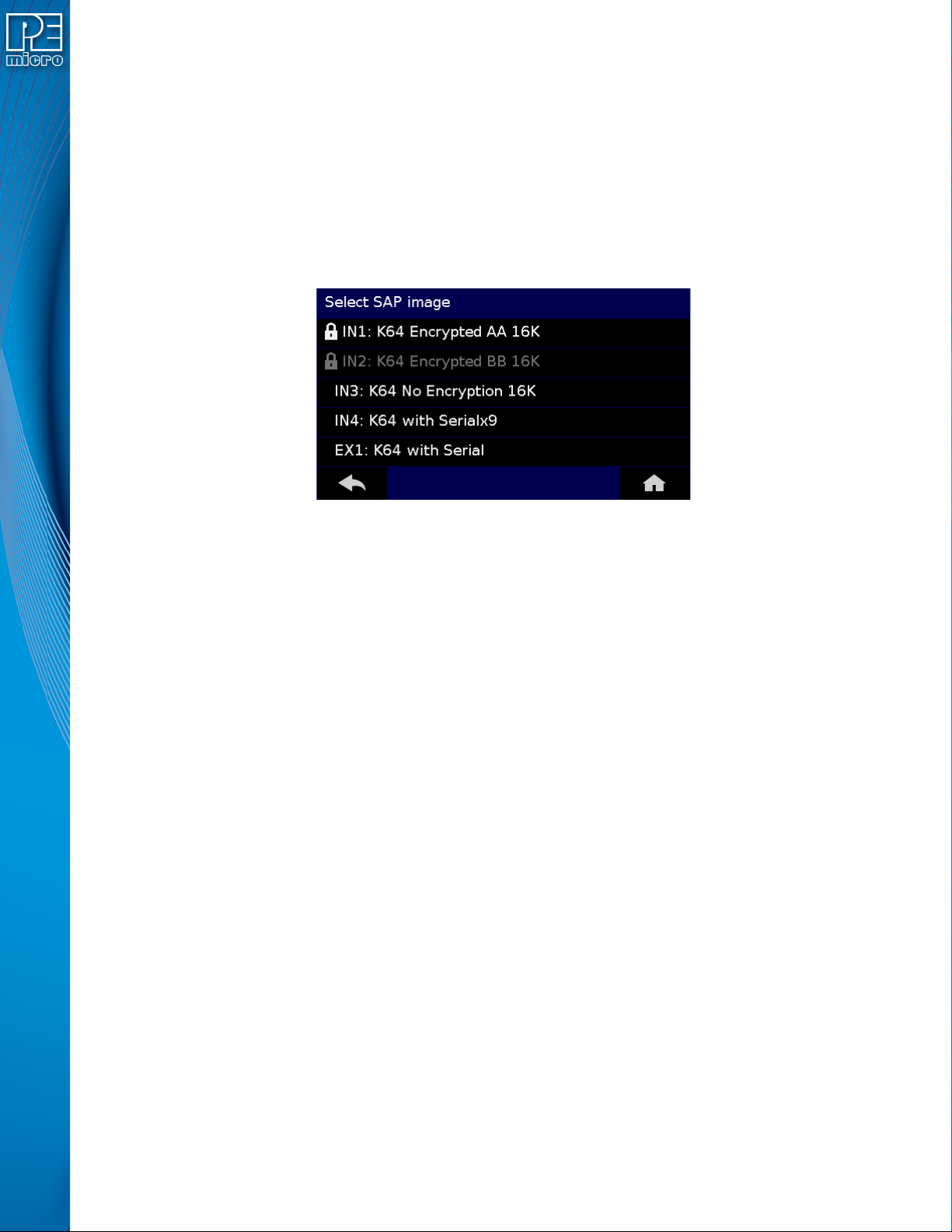
Encrypted (eSAP) images will display a lock icon to the left of the image description. If the
ImageKey needed to decrypt an eSAP image is missing from the Cyclone, the image will appear
grayed out. and cannot be selected for programming until the appropriate ImageKey is loaded onto
the Cyclone (see image #2 in Figure 5-3).
Figure 5-3: Lock Icon Denotes Encrypted Images
You may tap the appropriate image to select it. The image name shown is the one specified in the
Cyclone Configuration Utility when saving the image to the Cyclone/SD card.
5.2.2 Current Image Options
This menu presents options that allow the user to select or configure programming images on the
Cyclone LC.
5.2.2.1 Execute Image Function
Execute Specific SAP Function presents four Stand-Alone Programming functions that you may
execute by tapping the function that you wish to execute:
5.2.2.1.1 Launch Programming
This allows the user to execute the programming function. The Cyclone LC will program the target
device, if able, using the currently selected programming image. This is functionally equivalent to
pressing the Start button.
5.2.2.1.2 Verify Data In Target
Performs a verify function on the data that has been programmed into the target device.
5.2.2.1.3 Toggle Power
Toggles the target power and makes sure all ports are driven to debug mode level.
5.2.2.1.4 Power Cycle Device To Run User Code
Toggles the target power and maintains tri-state mode for all signals.
5.2.2.1.5 Validate Image CRC32
Allows the user to perform a CRC32 validation on the currently selected programming image.
User Manual For Cyclone LC Programmers 43
5.2.2.1.6 Launch Image Programming
Launches the selected programming image. Replaces the hardware Start Button.
5.2.2.2 Set Image Validation
Allows the user to choose between two validation settings: 1) validate the image each time the
Start button is pressed, or 2) do not validate the image.
5.2.2.3 Serial Numbers
Displays the serial number information associated with the currently selected programming image.
If there is none, it will display, “This Image Contains No Serial Numbers.” There may be one or
more Serial Files associated with the image. The user can click on a specific Serial File name to
see the following information about that Serial File:
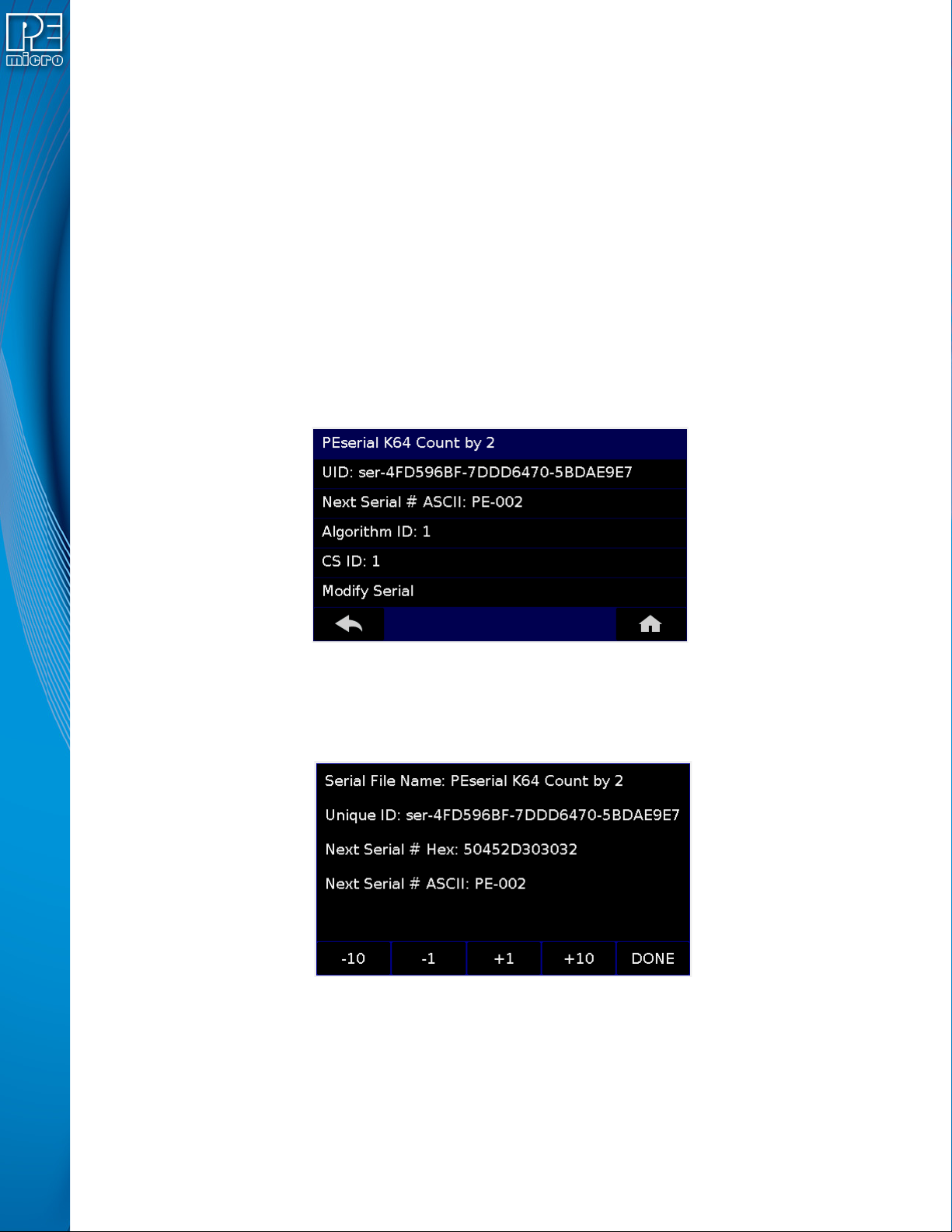
• UID - Unique identifier of the serial number
• Next Serial # ASCII - Next serial number to be programmed (shown in ASCII format)
• Algorithm ID - Displays the algorithm ID of the serial file
• CS ID - Displays the ID of the CS (Choose Serial) command in the SAP file.
Figure 5-4: Serial File Selection
The user can also click on “Modify Serial Number” to edit that serial number. It is possible to
Decrease or Increase the Next Serial by -10, -1, +1, +10. This is often done to address issues in
the production process, such as during initial setup.
Figure 5-5: Increase or Decrease Serial Number
The adjustment buttons will display “Increase Not Allowed” and “Decrease Not Allowed” if the
image/algorithm/CS file that the user has selected does not allow for this operation.
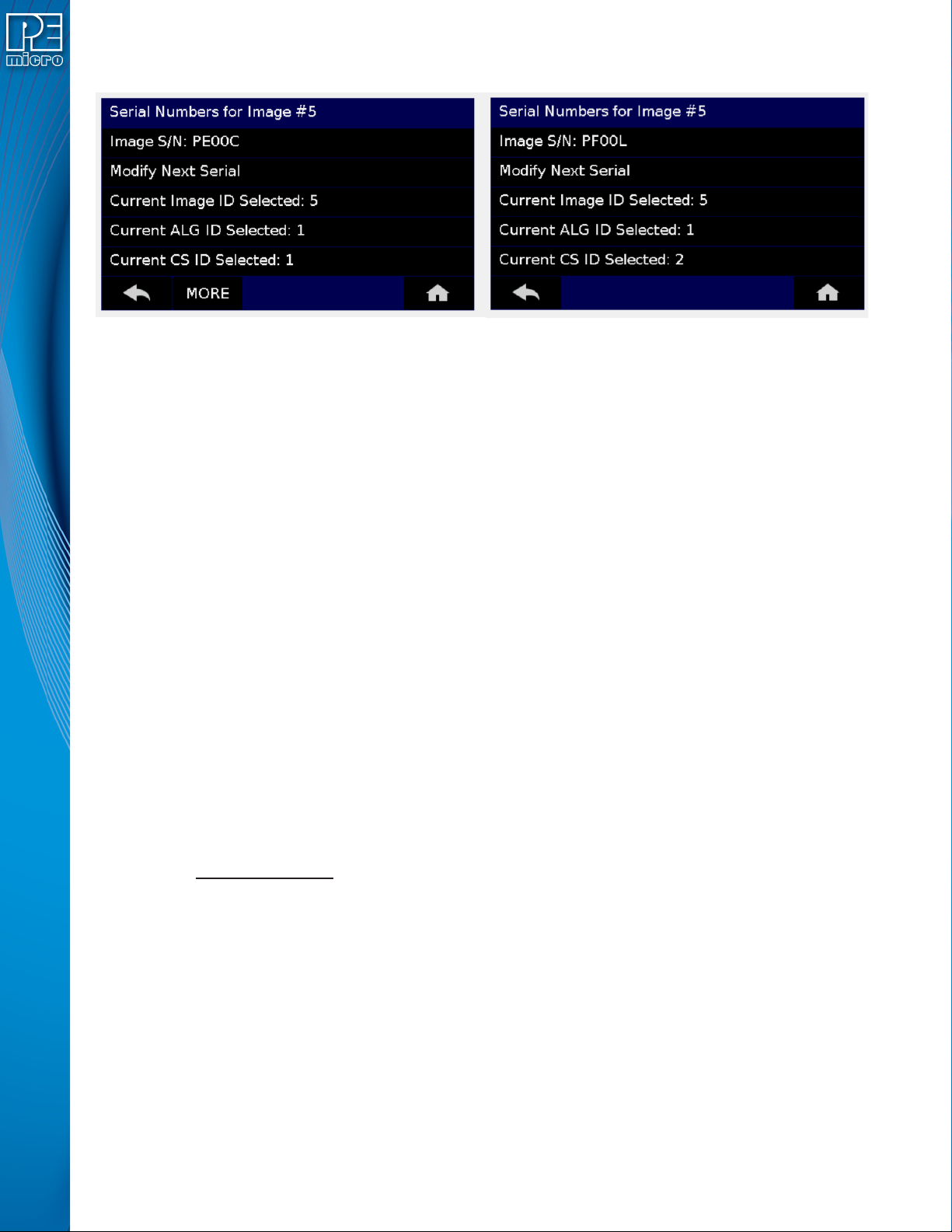
Note: Older serial files are specific to one programming image, unlike PEmicro’s current serial files. If
viewing Serial Number info for an image that references one or more older serial files, the Cyclone
will not show links to the serial files but will instead display serial number info for the first serial file.
The user can then Modify Next Serial to change the next serial number, or click MORE at the
User Manual For Cyclone LC Programmers 44
bottom to proceed to the next serial file (if any).
Figure 5-6: Serial Number View With Older Serial Files (CS IDs #1 & #2)
5.2.2.4 Show Image Restriction Stats (Requires FX or ProCryption Security License Activation)
Displays current statistics, if any, for Image Programmed Count & Maximum Allowed, Errors
Logged & Maximum Allowed, and Date Range Allowed. These limits can be set in the Security
Features section of the Cyclone Image Creation Utility (see Section 6.1.8.2 - Image
Restrictions).
Note: When Current Image Stats is displayed as a home screen item, only Image Programmed
Count & Maximum Allowed are displayed on the home screen.
5.2.3 Configure Cyclone Settings
Presents options that allow the user to choose to configure the Cyclone LC network settings, time/
date settings, and LCD touchscreen display settings, or to set the display to dynamic.
5.2.3.1 Edit Cyclone Name
Allows the user to edit the name of the Cyclone using the on-screen keyboard. Click “Done” to
save the new Cyclone name or “Cancel” to exit without saving a new Cyclone name. This name
will be displayed on the Cyclone LC home screen if the Cyclone is configured to do so.
5.2.3.2 Configure Network Settings
Presents options that allows the user to view or edit various IP settings, toggle the IP settings
between static and dynamic, and re-name the Cyclone LC.
5.2.3.2.1 Show Current IP Settings
This menu allows you to view the Cyclone LC IP address, Mask, and Gateway, and MAC address.
You may also tap these entries to edit, as long as the Cyclone is set to Static IP mode.
Dynamic vs. Static
There are two schemes for assigning IP addresses. One is the Static IP addressing mode. This
involves the user manually setting the IP address for every device on the network. In this case, it
falls to the user to ensure the IPs assigned do not conflict and are within the boundaries of the
network. The other is the Dynamic Host Configuration Protocol (DHCP). This involves setting up a
separate server to manage the IP addresses. The server is given a list of valid IP addresses for the
network. Using a predetermined set of rules, each new device that wishes to connect to the
network is given an IP address by the server. This takes the task of managing the validity and
uniqueness of IP addresses out of the user's hands and relegates it to the server. Cyclone LC
programmers are capable of using either Static IP addressing or DHCP.
5.2.3.2.2 Edit Static IP Settings
This menu allows you to edit the Cyclone’s IP address, Mask, and Gateway, and view the
Cyclone’s MAC address. If you are unable to edit these values, you may wish to check to be