Service Manual HS60.pdf - 第38页
2 O per ati onal sa fety S er vice Ma nual H S- 60 2.3 Las er clas sifi cat ion 03/ 200 3 U S Iss ue 36 Æ S wivel t he co mponent t rolley handl e u p. The latchin g disk will also s wivel up. PLEAS E NOTE: If you cannot…
Service Manual HS-60 2 Operational safety
03/2003 US Issue 2.3 Laser classification
35
WARNING 2
Never connect the connecting cable for the component trolley to the socket on the placement
system and then operate the component trolley outside the machine via the compressed air con-
trol unit (item 3 in Fig. 2.3 - 2)
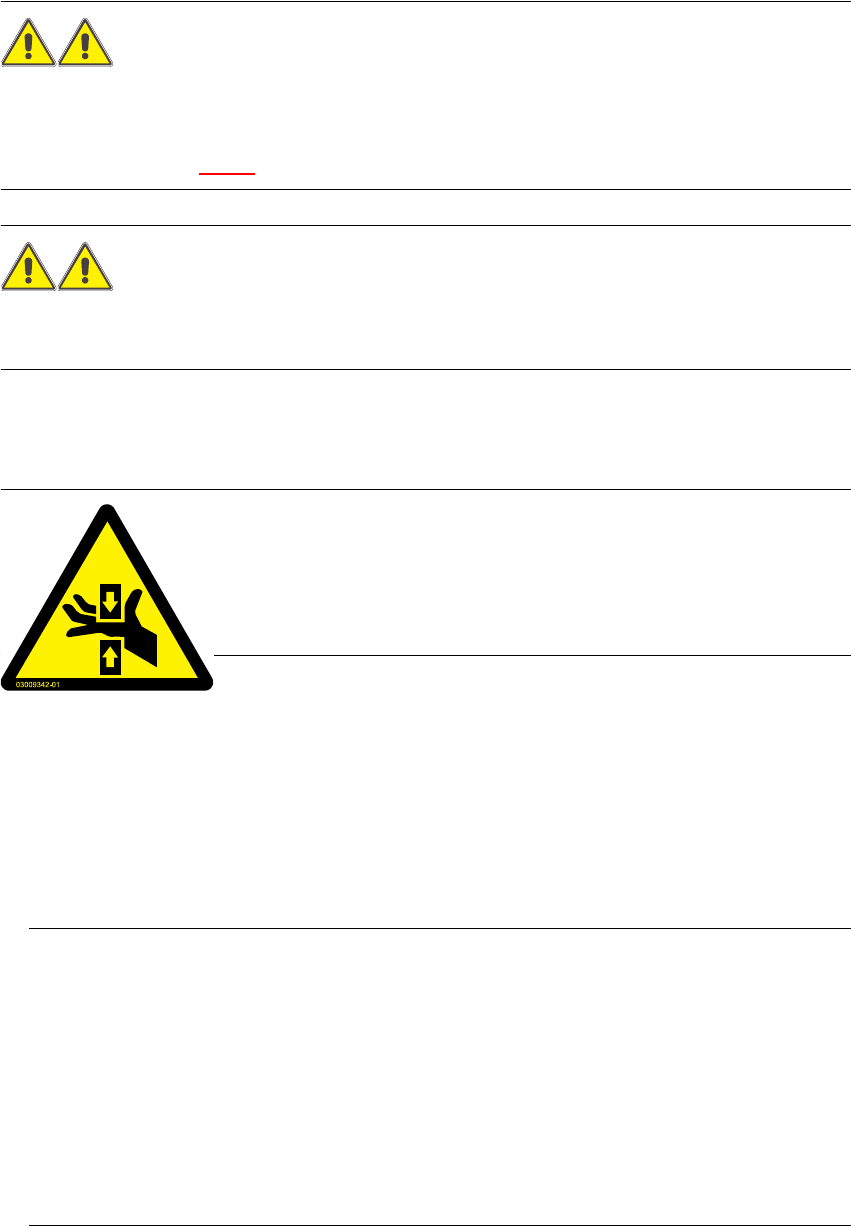
WARNING DANGER OF CRUSHING
You must always take hold of the bar with both hands whenever you want to move the component
trolley into the machine. 2
2.3.6 Safety instructions for changing the table height of component trolleys
WARNING RISK OF CRUSING CRUSHING
The component trolley must only be converted to modify the default ta-
ble height by trained Service personnel.
Act with considerable care during the conversion process since the sys-
tem contains large weights or compression springs (potential energy).2
Converting the component trolley to suit a different line height 2
Æ Use the placement system’s pneumatic controller to raise the table bed. Then insert a 120mm
spacer block between the table bed and crossbeam, and lower the bed onto the block.
Æ Dismantle the internal paneling.
Æ Swivel the handle down. The latching disk swivels down as well.
Æ Set the screw to the desired dimension and lock in place with the locknut.
PLEASE NOTE:
If you cannot loosen the adjusting screw far enough, the crossbeam must be raised. 2
Æ Fix the lifting device to the crossbeam.
Æ Carefully open the crossbeam clamp.
Æ Raise the crossbeam until the end of the tube projects approx. 1mm out of the clamp.
Æ Tighten the crossbeam clamp.
Æ Then turn the adjusting screw to the desired dimension and lock in place with the locknut.

2 Operational safety Service Manual HS-60
2.3 Laser classification 03/2003 US Issue
36
Æ Swivel the component trolley handle up. The latching disk will also swivel up.
PLEASE NOTE:
If you cannot swivel the latching disk up to its end position, the cross-beam must be raised. 2
Æ Fix the lifting device to the crossbeam.
Æ Carefully open the crossbeam clamp.
Æ Raise the crossbeam until the end of the tube projects approx. 1mm out of the clamp.
Æ Tighten the crossbeam clamp.
Æ Then turn the adjusting screw to the desired dimension and lock in place with the locknut.
Æ Then carefully open the crossbeam clamp.
Æ Lower the crossbeam until the adjusting screw comes into contact with the latching disk.
Æ Tighten the crossbeam clamp.
Æ Then check the distance between the crossbeam and floor.
Æ Refit the internal paneling.
Æ Raise the table bed and remove the spacer block.
2.3.7 Safety instructions for processing capacitors based on powdered metal
There is a risk associated with processing capacitors based on powdered metal (e.g. tantalum).
The risk is that
– an exothermic reaction, i.e. a sudden buildup of heat, may occur, if these components are dam-
aged. If the ambient conditions are unfavorable, and depending on the capacitance, this
buildup of heat can cause damage.
– This effect can occur when these components are cut.
Please contact your suppliers to clarify whether the components that you handle are affected.
In extremely rare cases, this risk can occur in the tape cutter of SIPLACE machines, with the
remote possibility of causing a smoldering fire in the waste tape.
The ambient conditions are unfavorable if:
(1) The components remain on the tape while the set tape cycle is checked (since the operator
can cycle the feeder onward without removing components during this check).
(2) The components remain on the tape, e.g. due to a tear in the cover foil.
(3) The components remain on the tape, and the components or tape do not conform to the
specification, thus increasing the pickup error rate.
Service Manual HS-60 2 Operational safety
03/2003 US Issue 2.3 Laser classification
37
Please follow the instructions given below to minimize the risk when placing capacitors based on
powdered metal.
(1) If the component tape is cycled onward manually, the operator must remove any components
remaining in the tape pocket.
(2) If the cover foil tears, the operator must remove any components remaining on the tape.
(3) The waste tape container must be emptied regularly (recommended interval: every hour).
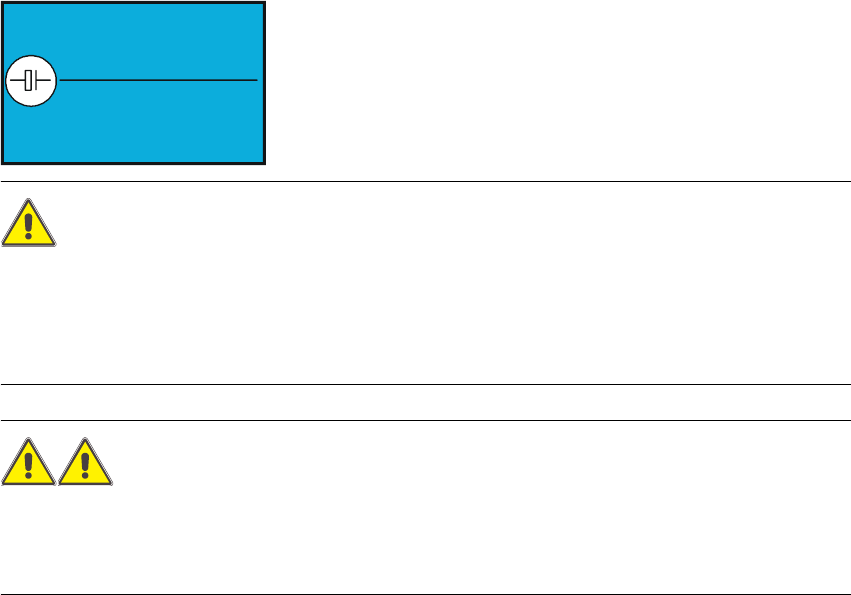
The feeders are labeled as shown below:
CAUTION 2
CAUTION To avoid the risk, it is essential to use only feeders that have been approved for plac-
ing such components, namely:
for model C/D item no.:00141118-01
for model E item no.:00141117-01
WARNING FIRE HAZARD 2
Æ Check and empty the waste tape container every hour.
Æ Only empty the waste tape container into suitable collection containers because of the risk of
fire. These containers must not be set up inside buildings.
2
Approved for
capacitors based on
metal-powder
Freigegeben für
Kondensatoren auf
Metallpulver-Basis