MIL-STD-202H.pdf - 第119页
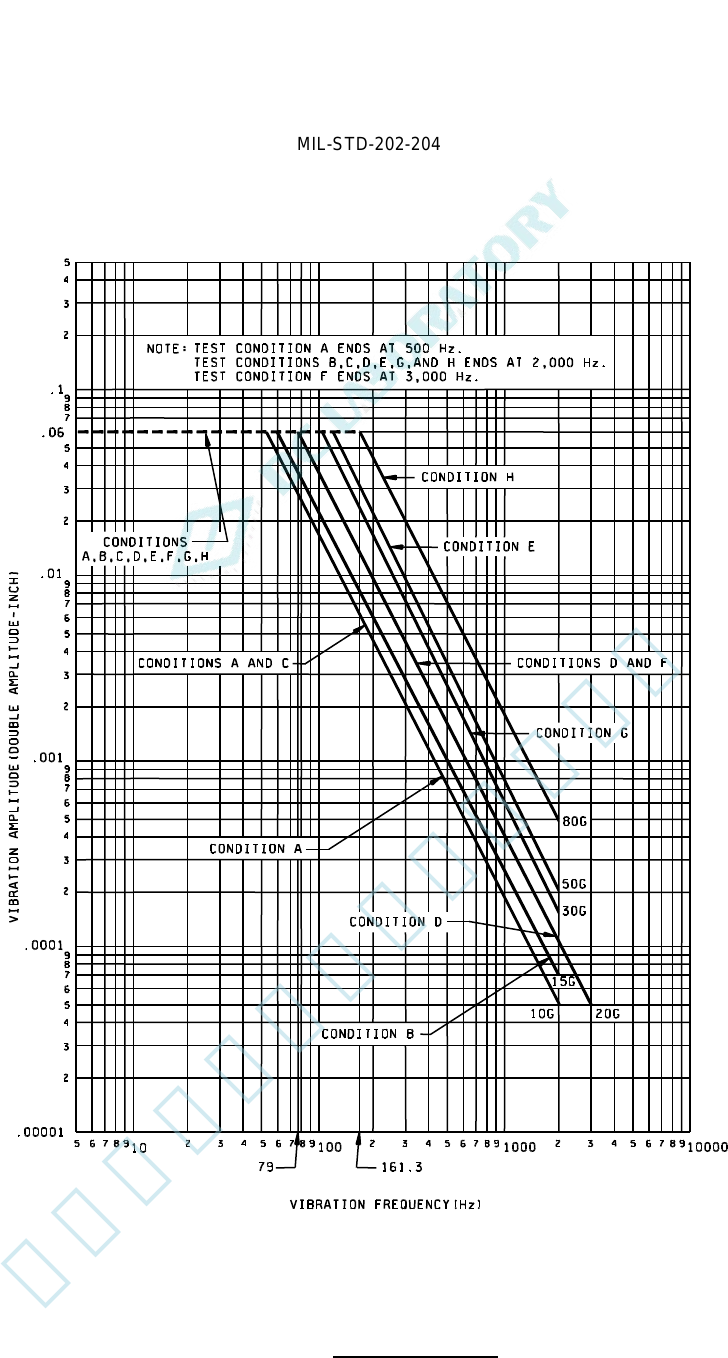
MI L - S TD - 202 - 20 4 G = .051 2f 2 DA (f = frequency i n hertz, DA = double amp litude in inc hes.) FIGURE 1. Vi br ati on - tes t cur ves . 3 北测(上海)电子科技有限公 司 联系方式:xuyj@beice-sh.com 13917165676
MIL-STD-202-204
4.3.3 Sweep time and duration. The entire frequency range of 10 to 2,000 Hz and return to 10 Hz shall be
traversed in 20 minutes. This cycle shall be performed 12 times in each of three mutually perpendicular directions
(total of 36 times), so that the motion shall be applied for a total period of approximately 12 hours. Interruptions are
permitted provided the requirements for rate of change and test duration are met. Completion of cycling within any
separate band is permissible before going to the next band. When the procedure of method 201 of this standard is
used for the 10 to 55 Hz band, the duration of this portion shall be the same as the duration for this band using
logarithmic cycling (approximately 1-1/3 hours in each of three mutually perpendicular directions).
4.4 Test condition C (10g peak). The specimens, while de-energized or operating under the load conditions
specified, shall be subjected to the vibration amplitude and frequency range shown on figure 1. The tolerance on
vibration amplitude shall be ±10 percent.
4.4.1 Part 1. The specimens shall be tested in accordance with method 201 of this standard for 6 hours; 2 hours in
each of three mutually perpendicular directions.
4.4.2 Part 2. The specimens shall be subjected to a simple harmonic motion having an amplitude varied to
maintain a constant peak acceleration of 10g (peak), the frequency being varied logarithmically between the
approximate limits of 55 and 2,000 Hz (see 4.10). The entire frequency range of 55 to 2,000 Hz (no return sweep)
shall be traversed in 35 ±5 minutes, except that in the vicinity of what appears to be resonance, and in order to
facilitate the establishment of a resonant frequency, the above rate may be decreased. If resonance is detected,
specimens shall be vibrated for 5 minutes at each critical resonant frequency observed. This procedure shall be
performed in each of three mutually perpendicular directions. Interruptions are permitted provided the requirements
for rate of change and test duration are met.
4.4.3 Resonance. A critical resonant frequency is that frequency at which any point on the specimen is observed
to have a maximum amplitude more than twice that of the support points. When specified, resonant frequencies shall
be determined either by monitoring parameters such as contact opening, or by use of resonance-detecting
instrumentation.
4.5 Test condition D (20g peak). The specimens, while de-energized or operating under the load conditions
specified, shall be subjected to the vibration amplitude, frequency, range, and duration specified in 4.5.1, 4.5.2, and
4.5.3, respectively (see fig. 1).
4.5.1 Amplitude. The specimens shall be subjected to a simple harmonic motion having an amplitude of either
0.06-inch double amplitude (maximum total excursion) or 20g (peak), whichever is less. The tolerance on vibration
amplitude shall be ±10 percent.
4.5.2 Frequency range. The vibration frequency shall be varied logarithmically between the approximate limits of
10 to 2,000 Hz (see 4.10), except that the procedure of method 201 of this standard may be applied during the 10 to
55 Hz band of the vibration frequency range.
4.5.3 Sweep time and duration. The entire frequency range of 10 to 2,000 Hz and return to 10 Hz shall be
traversed in 20 minutes. This cycle shall be performed 12 times in each of three mutually perpendicular directions
(total of 36 times), so that the motion shall be applied for a total period of approximately 12 hours. Interruptions are
permitted provided the requirements for rate of change and test duration are met. Completion of cycling within any
separate band is permissible before going to the next band. When the procedure of method 201 of this standard is
used for the 10 to 55 Hz band, the duration of this portion shall be the same as the duration for this band using
logarithmic cycling (approximately 1-1/3 hours in each of three mutually perpendicular directions).
4.6 Test condition E (50g peak). The specimens, while de-energized or operating under the load conditions
specified, shall be subjected to the vibration amplitude, frequency, range, and duration specified in 4.6.1, 4.6.2, and
4.6.3, respectively (see figure 1).
4.6.1 Amplitude. The specimens shall be subjected to a simple harmonic motion having an amplitude of either
0.06-inch double amplitude (maximum total excursion) or 50g (peak), whichever is less. The tolerance on vibration
amplitude shall be ±10 percent.
2
北测(上海)电子科技有限公司
联系方式:xuyj@beice-sh.com 13917165676
MIL-STD-202-204
G = .0512f
2
DA (f = frequency in hertz, DA = double amplitude in inches.)
FIGURE 1. Vibration-test curves.
3
北测(上海)电子科技有限公司
联系方式:xuyj@beice-sh.com 13917165676
MIL-STD-202-204
4.6.2 Frequency range. The vibration frequency shall be varied logarithmically between the approximate limits of
10 and 2,000 Hz (see 4.10), except that the procedure of method 201 of this standard may be applied during the 10
to 55 Hz band of the vibration frequency range.
4.6.3 Sweep time and duration. The entire frequency range of 10 to 2,000 Hz and return to 10 Hz shall be
traversed in 20 minutes. This cycle shall be performed 12 times in each of three mutually perpendicular directions
(total of 36 times), so that the motion shall be applied for a total period of approximately 12 hours. Interruptions are
permitted provided the requirements for rate of change and test duration are met. Completion of cycling within any
separate band is permissible before going to the next band. When the procedure of method 201 of this standard is
used for the 10 to 55 Hz band, the duration of this portion shall be the same as the duration for this band using
logarithmic cycling (approximately 1-1/3 hours in each of three mutually perpendicular directions).
4.7 Test condition F (20g peak). The specimens, while de-energized or operating under the load conditions
specified, shall be subjected to the vibration amplitude, frequency range, and duration specified in 4.7.1, 4.7.2, and
4.7.3, respectively (see figure 1).
4.7.1 Amplitude. The specimens shall be subjected to a simple harmonic motion having an amplitude of either
0.06-inch double amplitude (maximum total excursion) or 20g (peak), whichever is less. The tolerance on vibration
amplitude shall be ±10 percent.
4.7.2 Frequency range. The vibration frequency shall be varied logarithmically between the limits of 10 and 3,000
Hz (see 4.10), except that the procedure of method 201 of this standard may be applied during the 10 to 55 Hz band
of the vibration frequency range.
4.7.3 Sweep time and duration. The entire frequency range of 10 to 3,000 Hz and return to 10 Hz shall be
traversed in 20 minutes. This cycle shall be performed 12 times in each of three mutually perpendicular directions
(total of 36 times), so that the motion shall be applied for a total period of approximately 12 hours. Interruptions are
permitted provided the requirements for rate of change and test duration are met. Completion of cycling within any
separate band is permissible before going to the next band. When the procedure of method 201 of this standard is
used for the 10 to 55 Hz band, the duration of this portion shall be the same as the duration for this band using
logarithmic cycling (approximately) 1-1/3 hours in each of three mutually perpendicular directions.
4.8 Test condition G (30g peak). The specimens, while deenergized or operating under the load conditions
specified, shall be subjected to the vibration amplitude, frequency range, and duration specified in 4.8.1, 4.8.2, and
4.8.3, respectively (see figure 1).
4.8.1 Amplitude. The specimens shall be subjected to a simple harmonic motion having an amplitude of either
0.06-inch double amplitude (maximum total excursion) or 30g (peak), whichever is less. The tolerance on vibration
amplitude shall be ±10 percent.
4.8.2 Frequency range. The vibration frequency shall be varied logarithmically between the limits of 10 and 2,000
Hz (see 4.10), except that the procedure of method 201 of this standard may be applied during the 10 to 55 Hz band
of the vibration frequency range.
4.8.3 Sweep time and duration. The entire frequency range of 10 to 2,000 Hz and return to 10 Hz shall be
traversed in 20 minutes. This cycle shall be performed 12 times in each of three mutually perpendicular directions
(total of 36 times), so that the motion shall be applied for a total period of approximately 12 hours. Interruptions are
permitted provided the requirements for rate of change and test duration are met. Completion of cycling within any
separate band is permissible before going to the next band. When the procedure of method 201 of this standard is
used for the 10 to 55 Hz band, the duration of this portion shall be the same as the duration for this band using
logarithmic cycling (approximately) 1-1/3 hours in each of three mutually perpendicular directions.
4.9 Test condition H (80g peak). The specimens, while de-energized or operating under the load conditions
specified, shall be subjected to the vibration amplitude, frequency range, and duration specified in 4.9.1, 4.9.2, and
4.9.3, respectively (see figure 1).
4
北测(上海)电子科技有限公司
联系方式:xuyj@beice-sh.com 13917165676