MIL-STD-202H.pdf - 第153页
MI L - S TD - 202 - 20 8 M E TH O D 20 8 SO L D ER ABI L I T Y 1. SCOPE 1. 1 P urpose . T he pur po s e o f t hi s t es t m et ho d i s t o det er m i n e t he s ol der a bi l i t y of a l l t er m i n ations w hich are …
MIL-STD-202-208
CONTENTS
PARAGRAPH PAGE
FOREWORD…………………………………………………………. ii
1. SCOPE 1
1.1 Purpose………………………………………….……..…………. 1
2. APPLICABLE DOCUMENTS 1
3. DEFINTIONS 1
4. GENERAL REQUIREMENTS 1
4.1 J-STD exceptions.………………………..……………..………. 1
4.2 Contractual agreements…………………………………………. 1
4.3 Coating durability………………………..…………….…………. 1
4.4 Test method………………………………………………………. 1
4.5 Soldering iron test method………………...……………………. 2
4.5.1 Apparatus...………………………………………………………. 2
4.5.2 Materials…………………………………………………..……… 2
4.5.3 Procedure…………………………………………………………. 2
5. DETAILED REQUIREMENTS 3
5.1 Summary……………………………………………………….… 3
6. NOTES 3
6.1 Supersession data………………………………………………. 3
FIGURE PAGE
1. Soldering iron position and process diagram………………………….… 2
iii
北测(上海)电子科技有限公司
联系方式:xuyj@beice-sh.com 13917165676
MIL-STD-202-208
METHOD 208
SOLDERABILITY
1. SCOPE
1.1 Purpose. The purpose of this test method is to determine the solderability of all terminations which are
normally joined by a soldering operation. This determination is made on the basis of the ability of these terminations
to be wetted by solder and the predictability of a suitable fillet resulting from solder application. These procedures will
verify that the pre-assembly lead finish provides a solderable surface of sufficient quality to enable satisfactory
soldering.
2. APPLICABLE DOCUMENTS
2.1 Non-Government publications. The following documents form a part of this document to the extent specified
herein. Unless otherwise specified, the issues of these documents are those cited in the solicitation or contract.
ASSOCIATION CONNECTING ELECTRONIC INDUSTRIES (IPC)
J-STD-002 - Solderability Tests For Component Leads, Terminations, Lugs, Terminals and Wires
J-STD-006 - Requirements For Electronic Grade Solder Alloys and Fluxed and Non-Fluxed Solid Solders For
Electronic Soldering Applications
Copies of these documents are available online at www.IPC.org
3. DEFINITIONS
This section not applicable to this standard.
4. GENERAL REQUIREMENTS
4.1 J-STD exceptions. The solderability test shall be performed in accordance with J-STD-002
“Solderabiilty Tests
for Component Leads, Terminations, Lugs, Terminals and Wires” and herein. The following details and exceptions
shall apply:
4.2 Contractual agreements. The contractual agreements statement in J-STD-002 shall not apply. Any
exceptions to the requirements specified in J-STD-002 and this test method shall be documented in the individual
military procurement document or approved by the procuring military activity.
4.3 Coating durability. The coating durability category (from J-STD-002
) shall be as follows:
a. Category 2 - for stranded wire (1 hour ±5 minutes steam aging with insulation removed).
b. Category 3 - for all other components (8 hours ±15 minutes steam aging).
4.4 Test method. The test method used (from J-STD-002
) shall be as follows:
a. Test A - for through-hole mount and surface mount leaded components, solid wire less than .045 inch
diameter and stranded wire 18 AWG or smaller. If not otherwise specified in the procurement document,
angle of immersion for surface mount leaded components shall be 90°.
b. Test B - for surface mount leadless components.
c. Test C - for lugs, tabs, terminals, solid wire greater than .045 inch diameter and stranded wire larger than 18
AWG.
1
北测(上海)电子科技有限公司
联系方式:xuyj@beice-sh.com 13917165676
MIL-STD-202-208
4.5. Soldering iron test method. When specified in the individual specification, the soldering iron test
method shall be performed as specified herein.
4.5.1 Apparatus. The soldering iron used shall be temperature controlled and shall be capable of maintaining the
measured idling tip temperature within ±5.5°C. Three-wire cords and tip grounding shall be used. The solder iron
shall be of such design as to provide zero voltage switching. Solder guns of the transformer type shall not be used.
4.5.2 Materials. The solder shall be composition Sn60Pb40A or Sn63Pb37A of J-STD-006
“Requirements for
Electronic Grade Solder Alloys and Fluxed and Non-Fluxed Solid Solders for Electronic Soldering Applications”. The
solder shall be of form W, flux symbol A, flux percentage symbol 6 or 7 (see
J-STD-006).
4.5.3 Procedure. Preparation of terminations and aging shall be as specified in J-STD-002
and 4.4 above. Flux
shall be applied by a suitable method (e.g., brush) and allowed to drain for 5 to 20 seconds. Solder in accordance
with 4.5.2 shall be applied to the terminal along with the clean solder coated tip of an iron (unless otherwise specified
in the individual specification, iron temperature shall be 350°C) to a point ¼ inch from the nearest insulating material
or ½ the exposed length of the terminal, whichever is closer. The termination shall be positioned so that the iron can
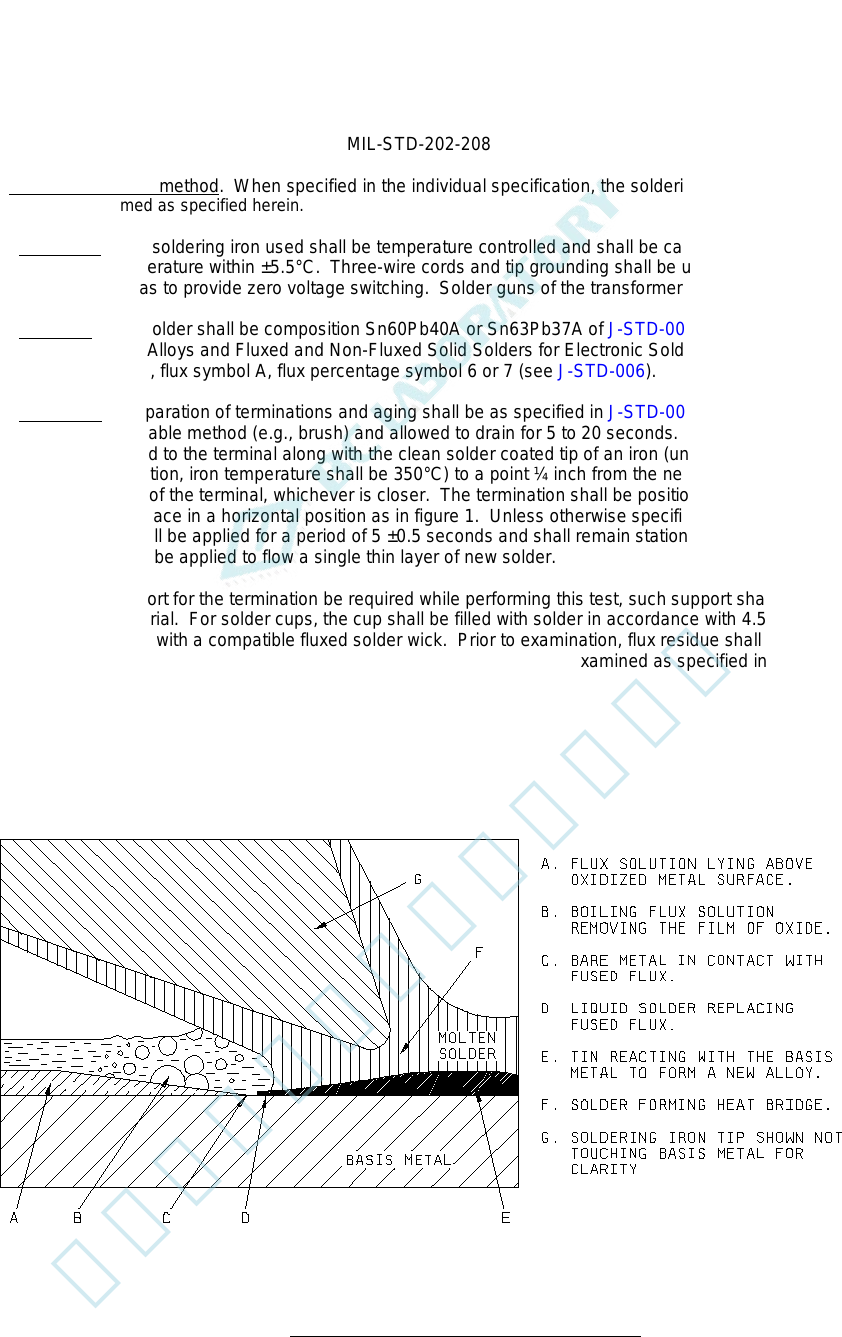
be applied to the test surface in a horizontal position as in figure 1. Unless otherwise specified in the individual
specification, the iron shall be applied for a period of 5 ±0.5 seconds and shall remain stationary during this period.
Only enough solder shall be applied to flow a single thin layer of new solder.
Should mechanical support for the termination be required while performing this test, such support shall be of
thermally insulating material. For solder cups, the cup shall be filled with solder in accordance with 4.5.2, and the
excess solder wicked out with a compatible fluxed solder wick. Prior to examination, flux residue shall be removed
from the terminations by cleaning in a suitable solvent. Terminations shall be examined as specified in
ANSI/J-STD-002.
FIGURE 1. Soldering iron position and process diagram.
2
北测(上海)电子科技有限公司
联系方式:xuyj@beice-sh.com 13917165676