MIL-STD-202H.pdf - 第89页
MI L - S TD - 202 - 112 4.4 .4.3.2. 2 Procedure I I I b . 4.4 . 4. 3.2.2. 1 Activatio n par a m et er s . T he ac t i v at i o n pr es s ur e and s oa k t i m e s ha l l be d et er mined in a ccordance with the fol lowin…
MIL-STD-202-112
4.4.4.2 Procedure II. The mass-spectrometer-type leak detector shall be coupled to the chamber. The specimen
shall be placed in the chamber, and a tube leading from the gas source and having a known percentage of tracer gas
shall be connected to the unsealed evacuation tube of the specimen. It is extremely important that the coupling
connections between the specimen and the leak detector be perfectly sealed. The chamber shall then be evacuated
and the gas forced under pressure into the specimen. If a leak exists, the gas passes through the specimen into the
chamber and then into the leak detector, which will read the leakage rate. If pressure cycling is required, the
individual specification shall specify the number of times that a pressure cycle shall be applied. When this portion of
the procedure is completed, the specimen shall be filled with air or gas at a specified pressure and having a known
percentage of tracer gas. The evacuation tube shall then be pinched off and sealed. After sealing, the seal of the
tube shall be verified by either procedure IIIa, IIIb, IIIc or IV, if filled with a tracer gas.
4.4.4.3 Procedure III. The tests shall be conducted in accordance with procedure IIIa, or IIIc. When bomb
pressure specified exceeds the device capability, alternate pressure, exposure time and dwell time may be used
provided they satisfy the leak rate pressure, time relationships which apply and provided no less than 30 psig bomb
pressure is applied in any case.
4.4.4.3.1 Testing precautions.
a. These precautions are applicable to procedures IIIa, IIIb, and IIIc. To avoid spurious indications,
contaminants and surface coatings that may conceal existing leaks, and tracer gas that may be absorbed or
adsorbed on the surfaces of the specimen, shall be removed. These test procedures shall not apply to
organic-coated parts.
b. Test procedure IIIa is a "fixed" method with specified conditions per table I that will insure the test sensitivity
necessary to detect the required leak rate (R1).
c. Test procedure IIIc is a "flexible" method that allows the variance of test conditions in accordance with the
formula of 4.4.4.3.2.3 to detect the specified equivalent standard leak rate at a predetermined leak rate (R1).
4.4.4.3.2 General procedure. For IIIa and IIIc the completed device(s) shall be placed in a sealed chamber which
is then pressurized with a tracer gas of 100 +0, -5 percent helium for the required time and pressure. The pressure
shall then be relieved and each specimen transferred to another chamber or chambers which are connected to the
evacuating system and a mass-spectrometer-type leak detector. When the chamber(s) is evacuated, any tracer gas
which was previously forced into the specimen will thus be drawn out and indicated by the leak detector as a
measured leak rate (R1). The number of devices removed from pressurization for leak testing shall be limited such
that the test of the last device can be completed within 60 minutes for procedure IIIa or within the chosen value of
dwell time (t
z
) for procedure IIIc.
4.4.4.3.2.1 Procedure IIIa. The device(s) shall be tested using the appropriate conditions specified in table I for
the internal cavity volume of the package under test. The time (t) is the time under pressure and time (t
z
) is the
maximum time allowed after release of pressure before the device(s) shall be read. This method shall not be used if
the maximum equivalent standard leak rate limit given in the procurement document is less than the limits specified
herein for procedure IIIc. Upon completion of this procedure, the specimen shall be checked for gross leaks by
subjecting the specimen either to test condition A, B, or D. Water, at room ambient temperature and a pressure of
2.5 inches (63.5 mm) of mercury, may be used in place of silicone oil, if test condition B is used to verify gross leaks.
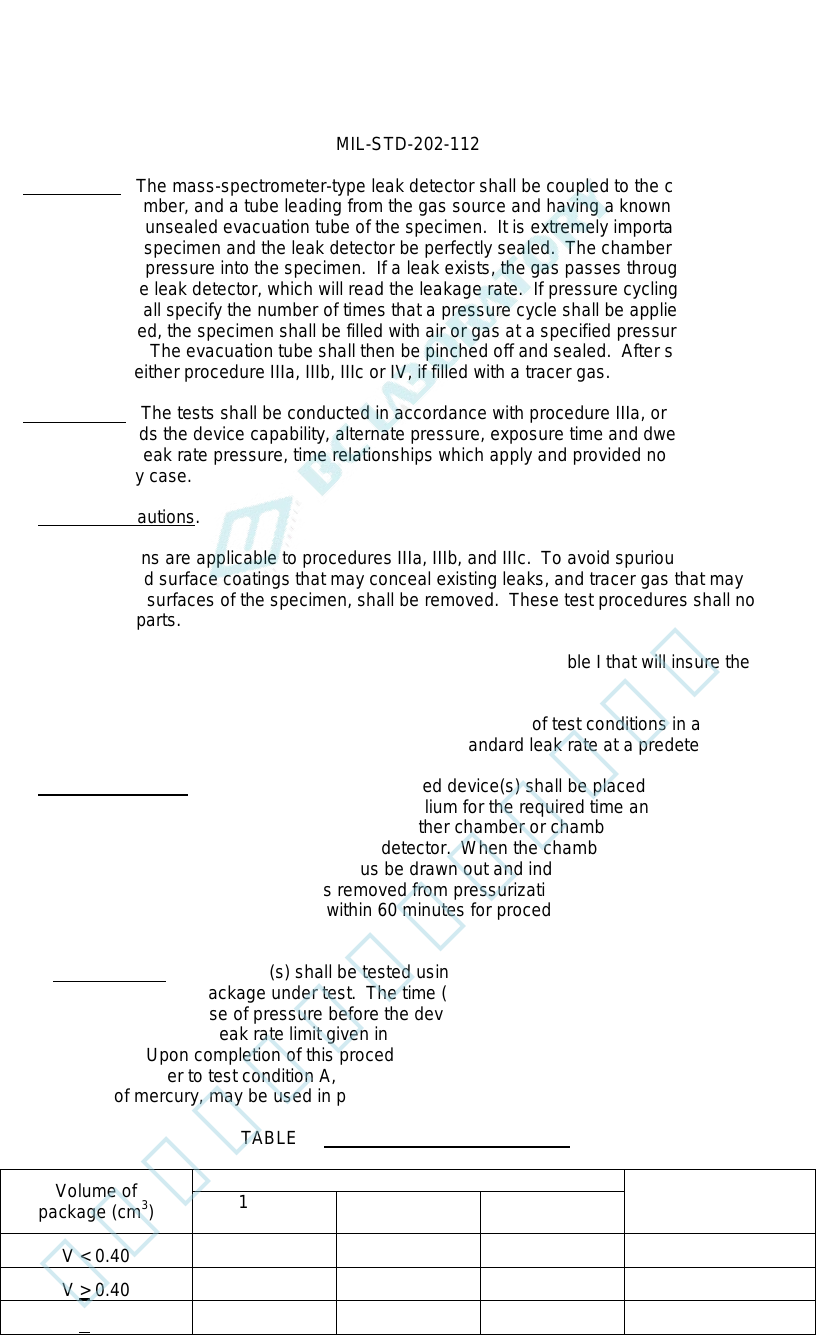
TABLE I. Fixed conditions procedure IIIa.
Volume of
package (cm
3
)
Bomb condition R1
Reject limit
(atm cm
3
/s He)
1bf/in
2
gage
Exposure time
hours
Maximum
dwell hours
V < 0.40 60 ±2 2 +0.2, -0 1 5 x 10
-8
V > 0.40 60 ±2 2 +0.2, -0 1 2 x 10
-7
V > 0.40 30 ±2 4 +0.4, -0 1 1 x 10
-7
6
北测(上海)电子科技有限公司
联系方式:xuyj@beice-sh.com 13917165676
MIL-STD-202-112
4.4.4.3.2.2 Procedure IIIb.
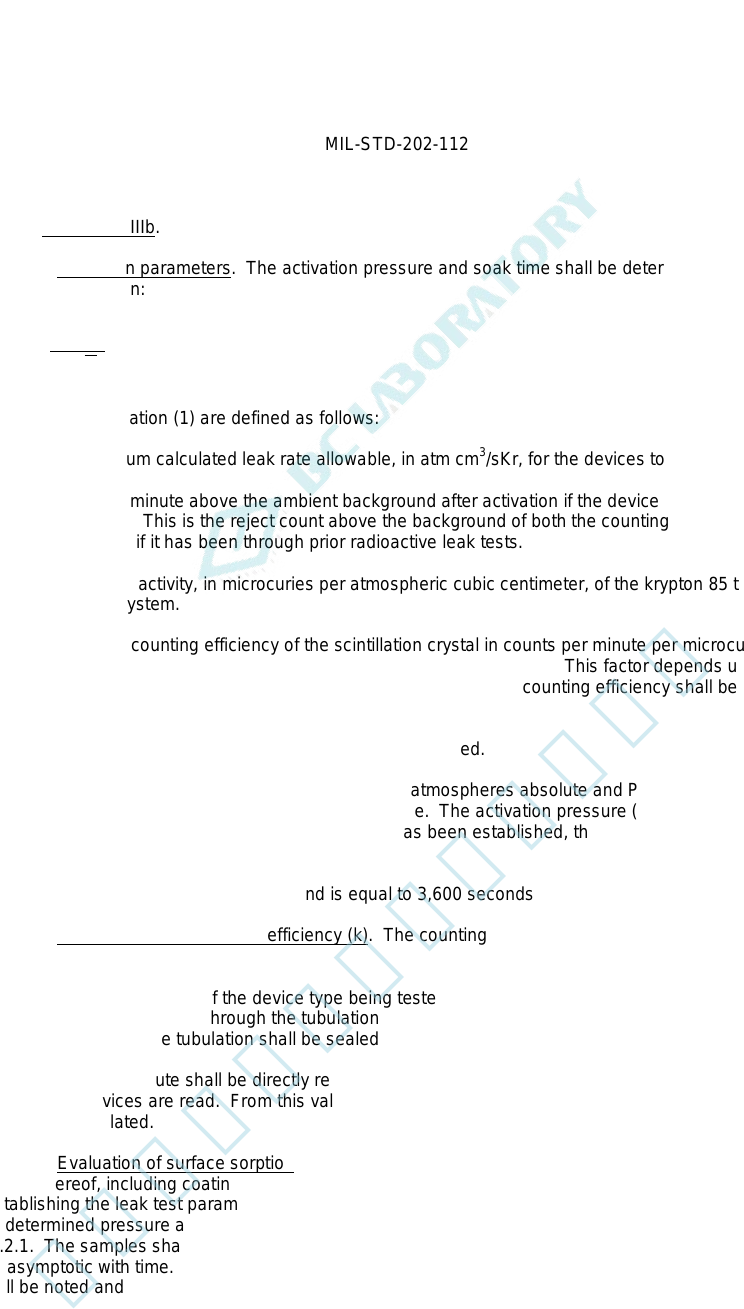
4.4.4.3.2.2.1 Activation parameters. The activation pressure and soak time shall be determined in accordance
with the following equation:
tPskT
R
s
Q =
The parameters of equation (1) are defined as follows:
Q
S
= The maximum calculated leak rate allowable, in atm cm
3
/sKr, for the devices to be tested.
R = Counts per minute above the ambient background after activation if the device leak rate were exactly
equal to Q
S
. This is the reject count above the background of both the counting equipment and the
component, if it has been through prior radioactive leak tests.
s = The specific activity, in microcuries per atmospheric cubic centimeter, of the krypton 85 tracer gas in the
activation system.
k = The overall counting efficiency of the scintillation crystal in counts per minute per microcurie of krypton
85 in the internal void of the specific component being evaluated. This factor depends upon component
configuration and dimensions of the scintillation crystal. The counting efficiency shall be determined in
accordance with 4.4.4.3.2.2.2.
T = Soak time, in hours, that the devices are to be activated.
_
P = P
e
2
- P
i
2
, where P
e
is the activation pressure in atmospheres absolute and P
i
is the original internal
pressure of the devices in atmospheres absolute. The activation pressure (P
e
) may be established by
specification or if a convenient soak time (T) has been established, the activation pressure (P
e
) can be
adjusted to satisfy equation (1).
t = Conversion of hours to seconds and is equal to 3,600 seconds per hour.
4.4.4.3.2.2.2 Determination of counting efficiency (k). The counting efficiency (k) of equation in 4.4.4.3.2.2.1 shall
be determined as follows:
a. Five representative units of the device type being tested shall be tubulated and the internal void of the
device shall be backfilled through the tubulation with a known volume and known specific activity of krypton
85 tracer gas and the tubulation shall be sealed off.
b. The counts per minute shall be directly read in the shielded scintillation crystal of the counting station in
which the devices are read. From this value, the counting efficiency, in counts per minute per microcurie,
shall be calculated.
4.4.4.3.2.2.3 Evaluation of surface sorption. All device encapsulations consisting of glass, metal, and ceramic or
combinations thereof, including coatings and external sealants, shall be evaluated for surface sorption of krypton 85
before establishing the leak test parameters. Representative samples of the questionable material shall be subjected
to the predetermined pressure and time conditions established for the device configuration as specified by
4.4.4.3.2.2.1. The samples shall then be counted every 10 minutes, with count rate noted, until the count rate
becomes asymptotic with time. (This is the point in time at which surface sorption is no longer a problem.) This time
lapse shall be noted and shall determine the "wait time" specified in 4.4.4.3.2.2.4.
7
北测(上海)电子科技有限公司
联系方式:xuyj@beice-sh.com 13917165676
MIL-STD-202-112
4.4.4.3.2.2.4 Specific procedure IIIb. The devices shall be placed in radioactive tracer gas activation tank. The
activation chamber may be partially filled with inert material to reduce pumpdown time. The tank shall be evacuated
to 0.5 torr. The devices shall be subjected to a minimum of 2 atmospheres absolute pressure of krypton 85/dry
nitrogen mixture for the time necessary to satisfy the equation. Actual pressure and soak time shall be determined in
accordance with 4.4.4.3.2.2.1. The R value in counts per minute shall be not less than 600 above ambient
background. The krypton 85/dry nitrogen gas mixture shall be evacuated to storage until 0.5 torr vacuum exists in the
activation tank. This evacuation shall be completed within 3 minutes maximum. The activation tank shall then be
backfilled with air (air wash). The devices shall then be removed from the activation tank and leak tested within 1
hour after gas exposure with a scintillation-crystal-equipped counting station. Device encapsulations that come under
the requirements of 4.4.4.3.2.2.3 shall be exposed to ambient air for a time not less than the "wait time" determined
by 4.4.4.3.2.2.3. In no case will the time between removal from the activation chamber and test exceed 1 hour. This
exposure shall be performed after gas exposure but before determining leak rate with the counting station. Device
encapsulations that do not come under the requirements of 4.4.4.3.2.2.3 may be tested without a "wait time". (The
number of devices removed from pressurization for leak testing shall be limited such that the test of the last device
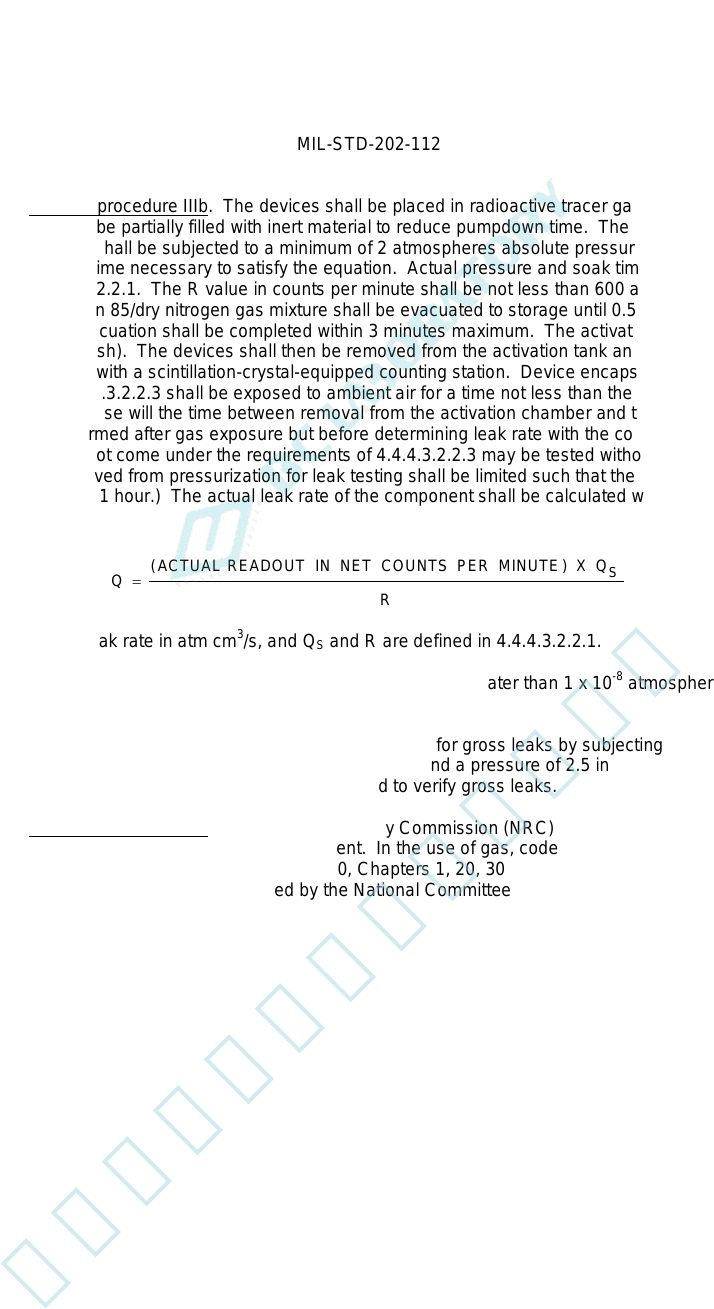
can be completed within 1 hour.) The actual leak rate of the component shall be calculated with the following
equation:
R
QXMINUTE
PERCOUNTSNETIN
READOUTACTUAL
Q
S
)(
=
Where Q = Actual leak rate in atm cm
3
/s, and Q
S
and R are defined in 4.4.4.3.2.2.1.
Unless otherwise specified, devices that exhibit a leak rate equal to or greater than 1 x 10
-8
atmospheric cubic
centimeters of krypton 85 per second shall be considered a failure.
Upon completion of this procedure, the specimen shall be checked for gross leaks by subjecting the specimen either
to test condition A, B, or D. Water, at room ambient temperature and a pressure of 2.5 inches (63.5 mm) of mercury,
may be used in place of silicone oil, if test condition B is used to verify gross leaks.
4.4.4.3.2.2.5 Personnel precautions. A Nuclear Regulatory Commission (NRC) license is necessary for
possession and use of the krypton 85 leak-test equipment. In the use of gas, code of Federal regulations Nuclear
Regulatory Commission Rules and Regulations, Title 10, Chapters 1, 20, 30, 31, and 32 should be followed and the
maximum permissible tolerance levels prescribed by the National Committee on Radiological Protection should be
observed.
8
北测(上海)电子科技有限公司
联系方式:xuyj@beice-sh.com 13917165676