MIL-STD-202H.pdf - 第46页
MI L - S TD - 202 - 107 4.2 . PROCEDURE. 4.2 .1 Environ mental c ha m ber s . S p ec i m en s s ha l l b e pl ac e d s o t h at t h er e i s s ub s t an t i a l l y n o obstructio n to the flow of air acr oss and around …
MIL-STD-202-107
METHOD 107
THERMAL SHOCK
1. SCOPE
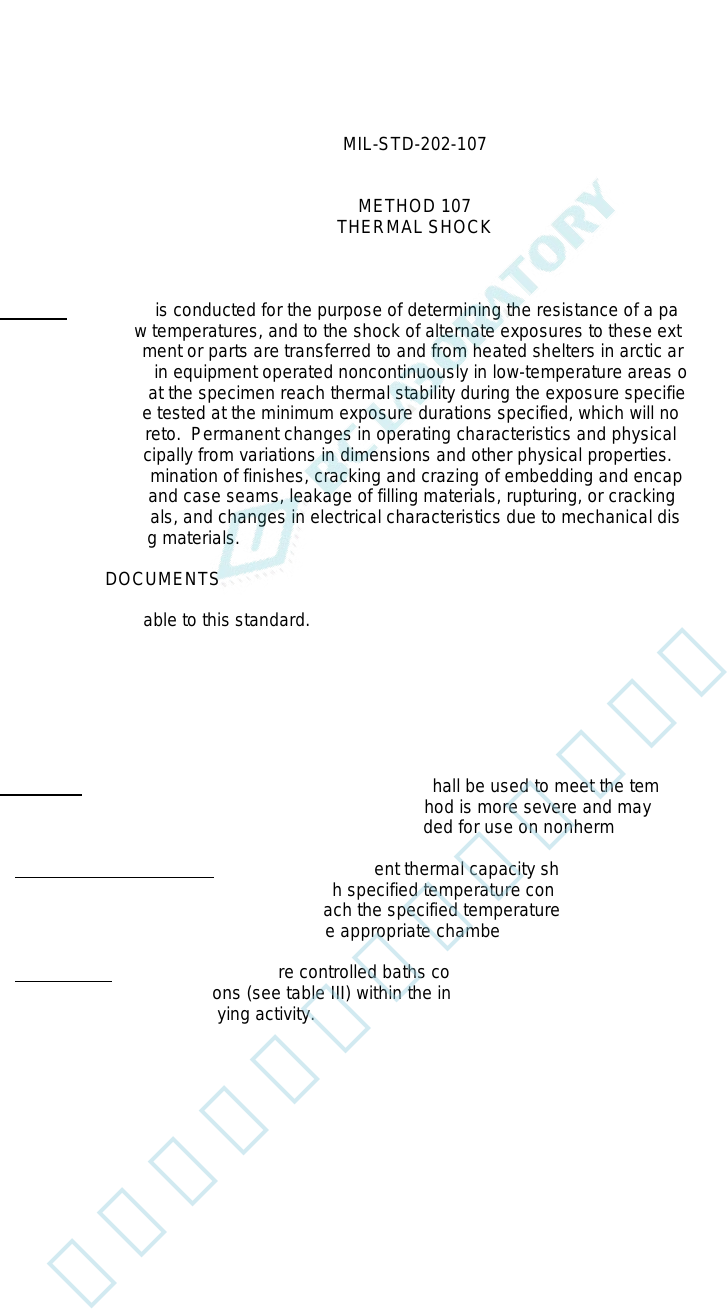
1.1 Purpose. This test is conducted for the purpose of determining the resistance of a part to exposures at
extremes of high and low temperatures, and to the shock of alternate exposures to these extremes, such as would be
experienced when equipment or parts are transferred to and from heated shelters in arctic areas. These conditions
may also be encountered in equipment operated noncontinuously in low-temperature areas or during transportation.
Although it is preferred that the specimen reach thermal stability during the exposure specified, in the interest of
saving time, parts may be tested at the minimum exposure durations specified, which will not insure thermal stability
but only an approach thereto. Permanent changes in operating characteristics and physical damage produced during
thermal shock result principally from variations in dimensions and other physical properties. Effects of thermal shock
include cracking and delamination of finishes, cracking and crazing of embedding and encapsulating compounds,
opening of thermal seals and case seams, leakage of filling materials, rupturing, or cracking of hermetic seals and
vacuum glass to metal seals, and changes in electrical characteristics due to mechanical displacement or rupture of
conductors or of insulating materials.
2. APPLICABLE DOCUMENTS
This section not applicable to this standard.
3. DEFINTIONS
This section not applicable to this standard.
4. GENERAL REQUIREMENTS
4.1 Apparatus. Suitable temperature controlled systems shall be used to meet the temperature requirements and
test conditions specified in table I or table III. The liquid method is more severe and may damage some components
that might not be degraded by the air method. It is not intended for use on nonhermetically sealed components.
4.1.1 Environmental chambers. A system of sufficient thermal capacity shall be used to change ambient chamber
conditions to meet test requirements and to reach specified temperature conditions of steps 1 and 3 of table I. The
supply air temperature of the chambers shall reach the specified temperature within a recovery time of 5 minutes
after the specimens have been transferred to the appropriate chamber.
4.1.2 Liquid baths. Suitable temperature controlled baths containing liquids (see table IV) shall be chosen to
maintain the specified test conditions (see table III) within the indicated tolerances. A liquid media shall not be used
without prior approval of the qualifying activity.
1
北测(上海)电子科技有限公司
联系方式:xuyj@beice-sh.com 13917165676
MIL-STD-202-107
4.2. PROCEDURE.
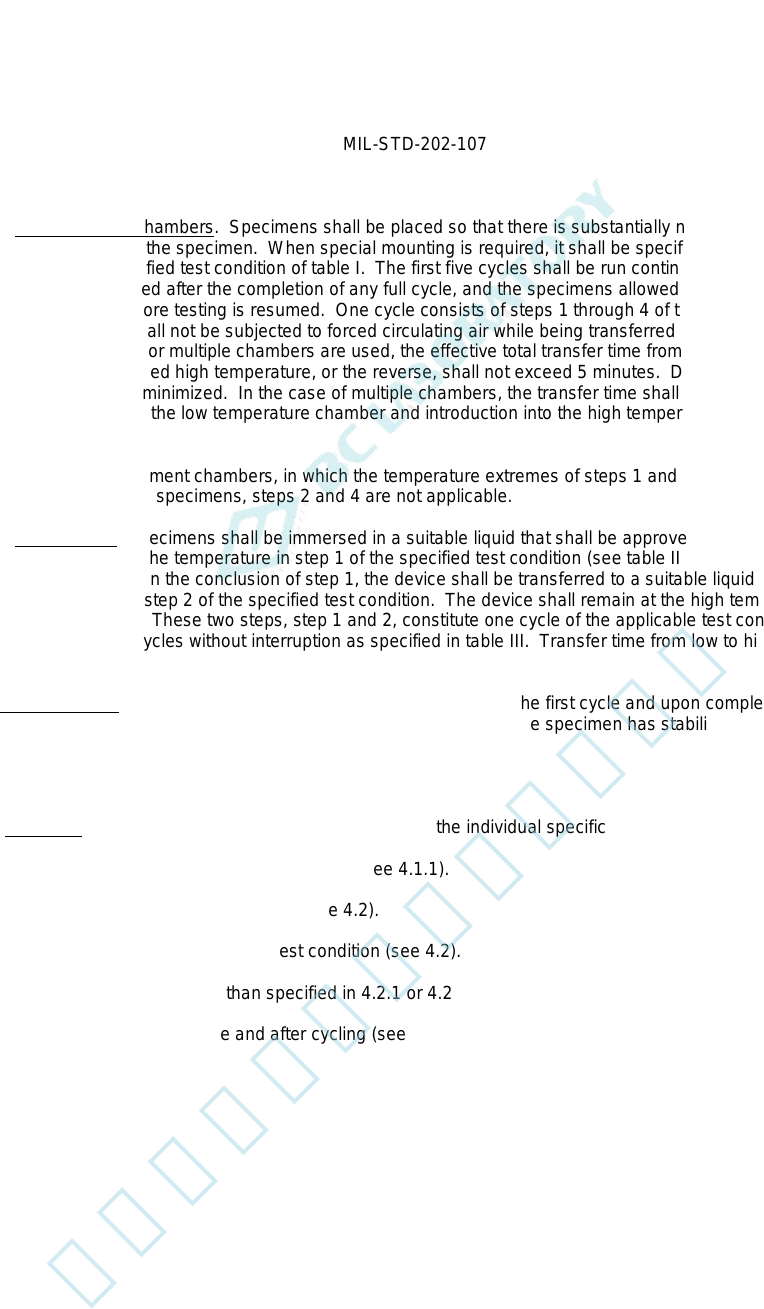
4.2.1 Environmental chambers. Specimens shall be placed so that there is substantially no obstruction to the flow
of air across and around the specimen. When special mounting is required, it shall be specified. The specimen shall
be subjected to the specified test condition of table I. The first five cycles shall be run continuously. After five cycles,
the test may be interrupted after the completion of any full cycle, and the specimens allowed to return to room
ambient temperature before testing is resumed. One cycle consists of steps 1 through 4 of the applicable test
condition. Specimens shall not be subjected to forced circulating air while being transferred from one chamber to
another. Whether single or multiple chambers are used, the effective total transfer time from the specified low
temperature to the specified high temperature, or the reverse, shall not exceed 5 minutes. Direct heat conduction to
the specimen should be minimized. In the case of multiple chambers, the transfer time shall be defined as the time
between withdrawal from the low temperature chamber and introduction into the high temperature chamber or the
reverse.
NOTE: In single compartment chambers, in which the temperature extremes of steps 1 and 3 are achieved without
physical movement of the specimens, steps 2 and 4 are not applicable.
4.2.2 Liquid baths. Specimens shall be immersed in a suitable liquid that shall be approved by the qualifying
activity (see table IV), at the temperature in step 1 of the specified test condition (see table III) for the time specified in
table V. Immediately upon the conclusion of step 1, the device shall be transferred to a suitable liquid at the
temperature specified in step 2 of the specified test condition. The device shall remain at the high temperature for the
time specified in table V. These two steps, step 1 and 2, constitute one cycle of the applicable test condition. Repeat
the required number of cycles without interruption as specified in table III. Transfer time from low to high temperature
and from high to low temperature shall be less than 10 seconds.
4.3 Measurements. Specified measurements shall be made prior to the first cycle and upon completion of the final
cycle, except that failures shall be based on measurements made after the specimen has stabilized at room
temperature following the final cycle.
5. DETAILED REQUIREMENTS
5.1. Summary. The following details are to be specified in the individual specification:
a. Recovery time if other than 5 minutes (see 4.1.1).
b. Special mounting, if applicable (see 4.2).
c. Type test (air or liquid) and test condition (see 4.2).
d. Transfer time if other than specified in 4.2.1 or 4.2.2.
e. Measurements before and after cycling (see 4.3).
2
北测(上海)电子科技有限公司
联系方式:xuyj@beice-sh.com 13917165676
MIL-STD-202-107
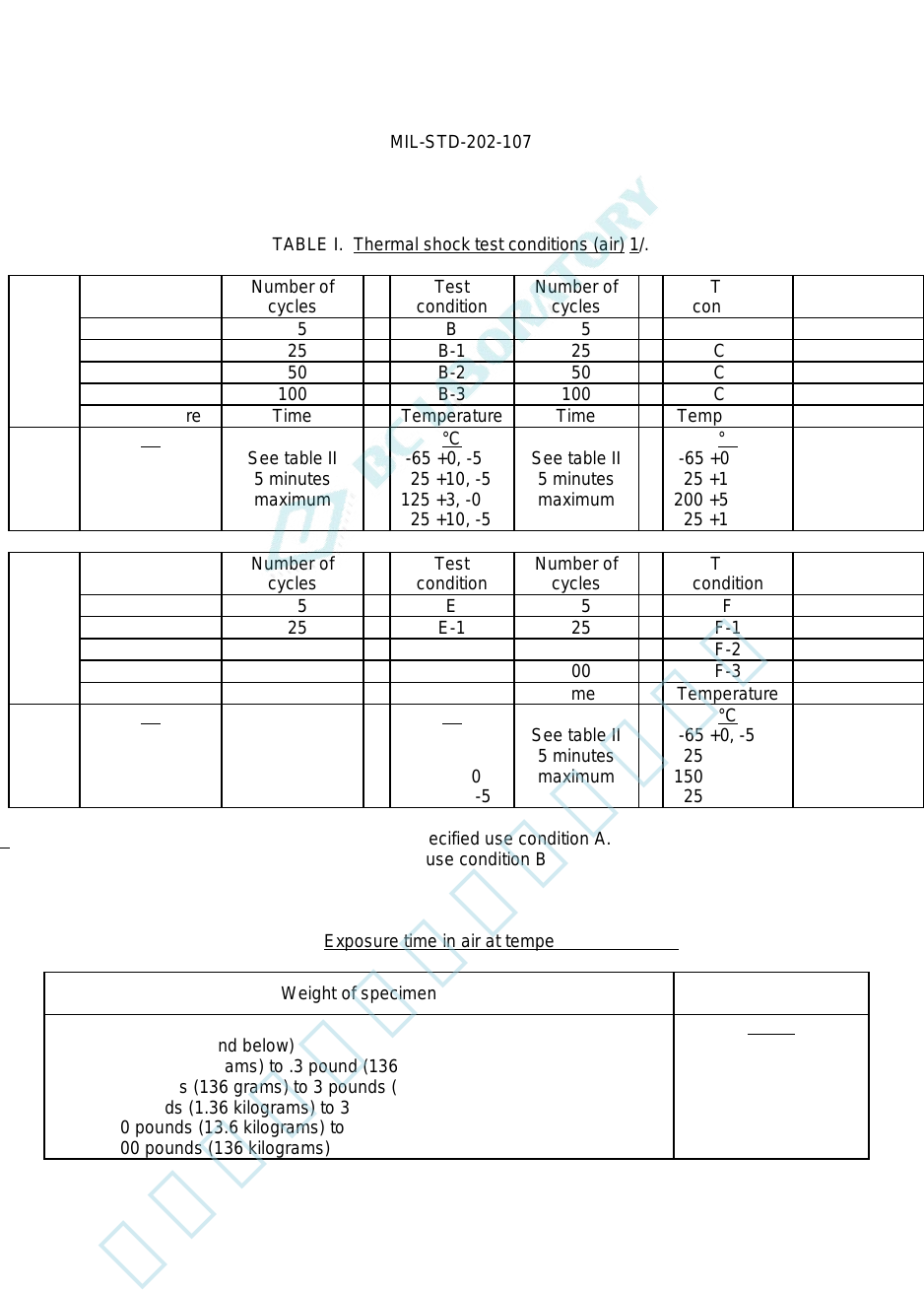
TABLE I. Thermal shock test conditions (air) 1/.
Test
condition
Number of
cycles
Test
condition
Number of
cycles
Test
condition
Number of
cycles
Step A 5 B 5 C 5
A-1 25 B-1 25 C-1 25
A-2 50 B-2 50 C-2 50
A-3 100 B-3 100 C-3 100
Temperature Time Temperature Time Temperature Time
1
2
3
4
°C
-55 +0, -3
25 +10, -5
85 +3, -0
25 +10, -5
See table II
5 minutes
maximum
°C
-65 +0, -5
25 +10, -5
125 +3, -0
25 +10, -5
See table II
5 minutes
maximum
°C
-65 +0, -5
25 +10, -5
200 +5, -0
25 +10, -5
See table II
5 minutes
maximum
Test
condition
Number of
cycles
Test
condition
Number of
cycles
Test
condition
Number of
cycles
Step D 5 E 5 F 5
D-1 25 E-1 25 F-1 25
D-2 50 E-2 50 F-2 50
D-3 100 E-3 100 F-3 100
Temperature Time Temperature Time Temperature Time
1
2
3
4
°C
-65 +0, -5
25 +10, -5
350 +5, -0
25 +10, -5
See table II
5 minutes
maximum
°C
-65 +0, -5
25 +10, -5
500 +5, -0
25 +10, -5
See table II
5 minutes
maximum
°C
-65 +0, -5
25 +10, -5
150 +3, -0
25 +10, -5
See table II
5 minutes
maximum
1/ When method 102, condition A, B or D has been specified use condition A.
When method 102, condition C has been specified use condition B
TABLE II. Exposure time in air at temperature extremes.
Weight of specimen
Minimum time
(for steps 1 and 3)
1 ounce (28 grams and below)
Above 1 ounce (28 grams) to .3 pound (136 grams), inclusive
Above .3 pounds (136 grams) to 3 pounds (1.36 kilograms), inclusive
Above 3 pounds (1.36 kilograms) to 30 pounds (13.6 kilograms), inclusive
Above 30 pounds (13.6 kilograms) to 300 pounds (136 kilograms), inclusive
Above 300 pounds (136 kilograms)
Hours
1/4 (or as specified)
½
1
2
4
8
3
北测(上海)电子科技有限公司
联系方式:xuyj@beice-sh.com 13917165676