MIL-STD-202H.pdf - 第54页
MI L - S TD - 202 - 10 8 4.2.2 Test te mperatur e . S pe c i m en s s hal l b e s u bj e c t e d t o on e of t h e f o l l ow i ng t es t t em per atures w ith accompany ing toleran ce s , a s s pe c i f i ed: T em per a…
MIL-STD-202-108
METHOD 108
LIFE (AT ELEVATED AMBIENT TEMPERATURE)
1. SCOPE
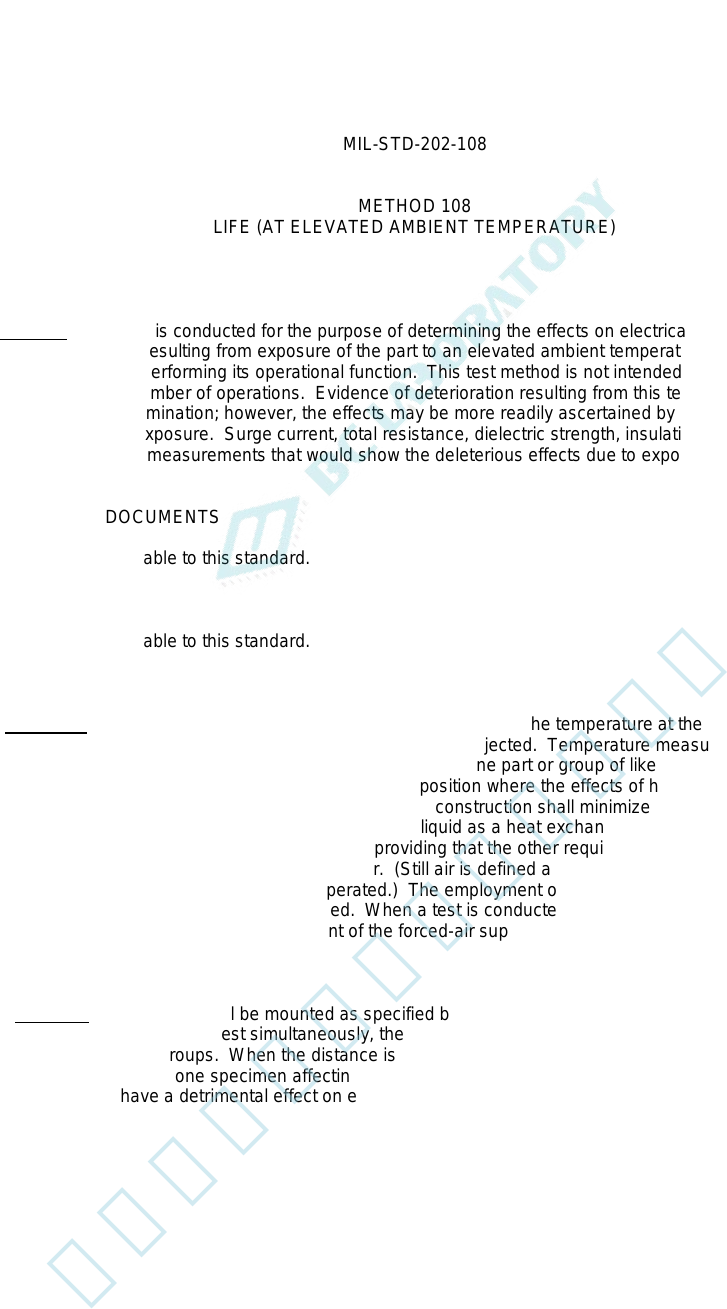
1.1 Purpose. This test is conducted for the purpose of determining the effects on electrical and mechanical
characteristics of a part, resulting from exposure of the part to an elevated ambient temperature for a specified length
of time, while the part is performing its operational function. This test method is not intended for testing parts whose
life is expressed in the number of operations. Evidence of deterioration resulting from this test can at times be
determined by visual examination; however, the effects may be more readily ascertained by measurements or tests
prior to, during, or after exposure. Surge current, total resistance, dielectric strength, insulation resistance, and
capacitance are types of measurements that would show the deleterious effects due to exposure to elevated ambient
temperatures.
2. APPLICABLE DOCUMENTS
This section not applicable to this standard.
3. DEFINTIONS
This section not applicable to this standard.
4. GENERAL REQUIREMENTS
4.1. Apparatus. A suitable chamber shall be used which will maintain the temperature at the required test
temperature and tolerance (see 4.2.2) to which the parts will be subjected. Temperature measurements shall be
made within a specified number of unobstructed inches from any one part or group of like parts under test. In
addition, the temperature measurement shall be made at a position where the effects of heat generated by the parts
have the least effect on the recorded temperature. Chamber construction shall minimize the influence of radiant heat
on the parts being tested. Chambers that utilize circulating liquid as a heat exchanger, free-convection (gravity type)
chambers, and circulating air chambers may be used providing that the other requirements of this test method are
met. When specified, this test shall be made in still air. (Still air is defined as surrounding air with no circulation other
than that created by the heat of the part being operated.) The employment of baffling devices and the coating of their
surfaces with a heat-absorbing finish are permitted. When a test is conducted on parts that do not have the still-air
requirement, there shall be no direct impingement of the forced-air supply upon the parts.
4.2. PROCEDURE.
4.2.1 Mounting. Specimens shall be mounted as specified by their normal mounting means. When groups of
specimens are to be subjected to test simultaneously, the mounting distance between specimens shall be as
specified for the individual groups. When the distance is not specified, the mounting distance shall be sufficient to
minimize the temperature of one specimen affecting the temperature of another. Specimens fabricated of different
materials, which may have a detrimental effect on each other and alter the results of this test, shall not be tested
simultaneously.
1
北测(上海)电子科技有限公司
联系方式:xuyj@beice-sh.com 13917165676
MIL-STD-202-108
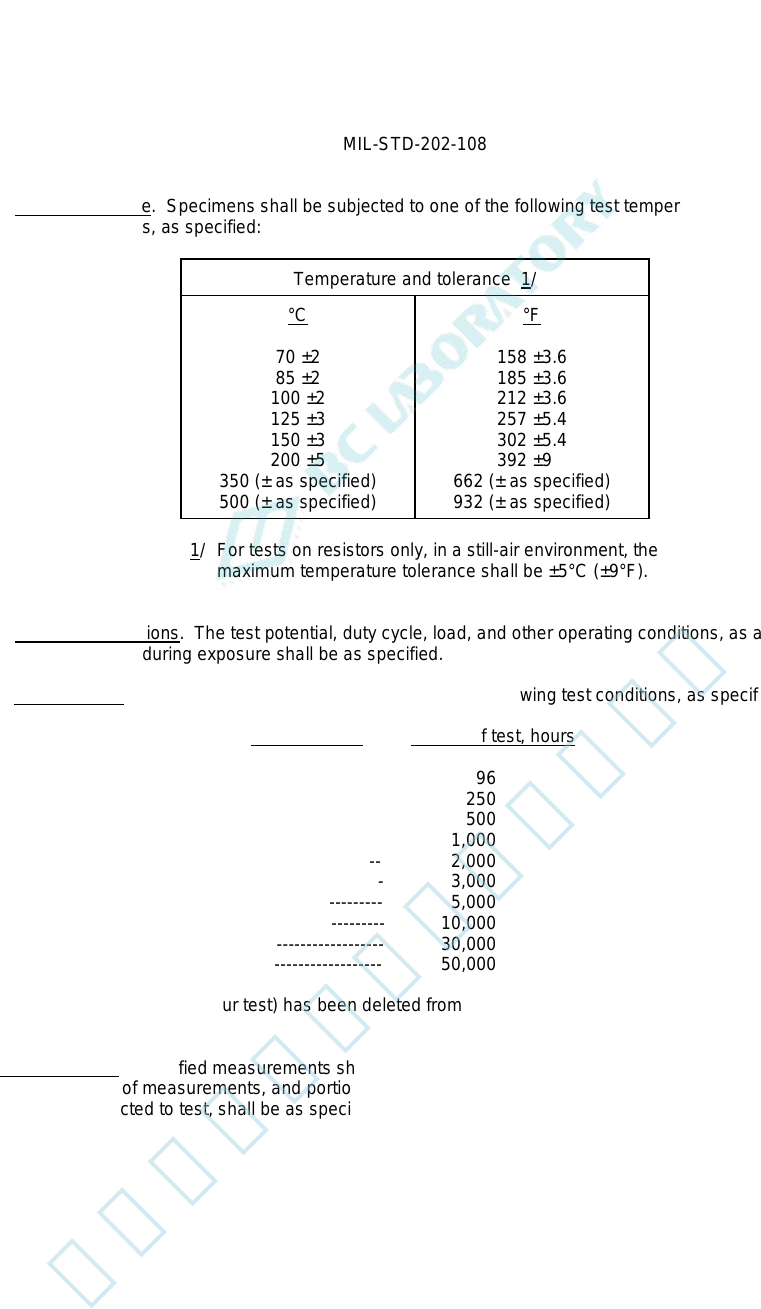
4.2.2 Test temperature. Specimens shall be subjected to one of the following test temperatures with
accompanying tolerances, as specified:
Temperature and tolerance 1/
°C
70 ±2
85 ±2
100 ±2
125 ±3
150 ±3
200 ±5
350 (± as specified)
500 (± as specified)
°F
158 ±3.6
185 ±3.6
212 ±3.6
257 ±5.4
302 ±5.4
392 ±9
662 (± as specified)
932 (± as specified)
1/ For tests on resistors only, in a still-air environment, the
maximum temperature tolerance shall be ±5°C (±9°F).
4.2.3 Operating conditions. The test potential, duty cycle, load, and other operating conditions, as applicable,
applied to the specimen during exposure shall be as specified.
4.2.4 Length of test. Specimens shall be subjected to one of the following test conditions, as specified:
Test condition Length of test, hours
A ------------------- 96
B ------------------- 250
C ------------------- 500
D ------------------- 1,000
F ------------------- 2,000
G ------------------- 3,000
H ------------------- 5,000
I ------------------- 10,000
J ------------------- 30,000
K ------------------- 50,000
NOTE: Test condition E (1,500 hour test) has been deleted from this test method.
4.3 Measurements. Specified measurements shall be made prior to, during, or after exposure, as specified. If
applicable, frequency of measurements, and portion of the duty cycle in which measurements are to be made, while
the specimen is subjected to test, shall be as specified.
2
北测(上海)电子科技有限公司
联系方式:xuyj@beice-sh.com 13917165676
MIL-STD-202-108
5. DETAILED REQUIREMENTS
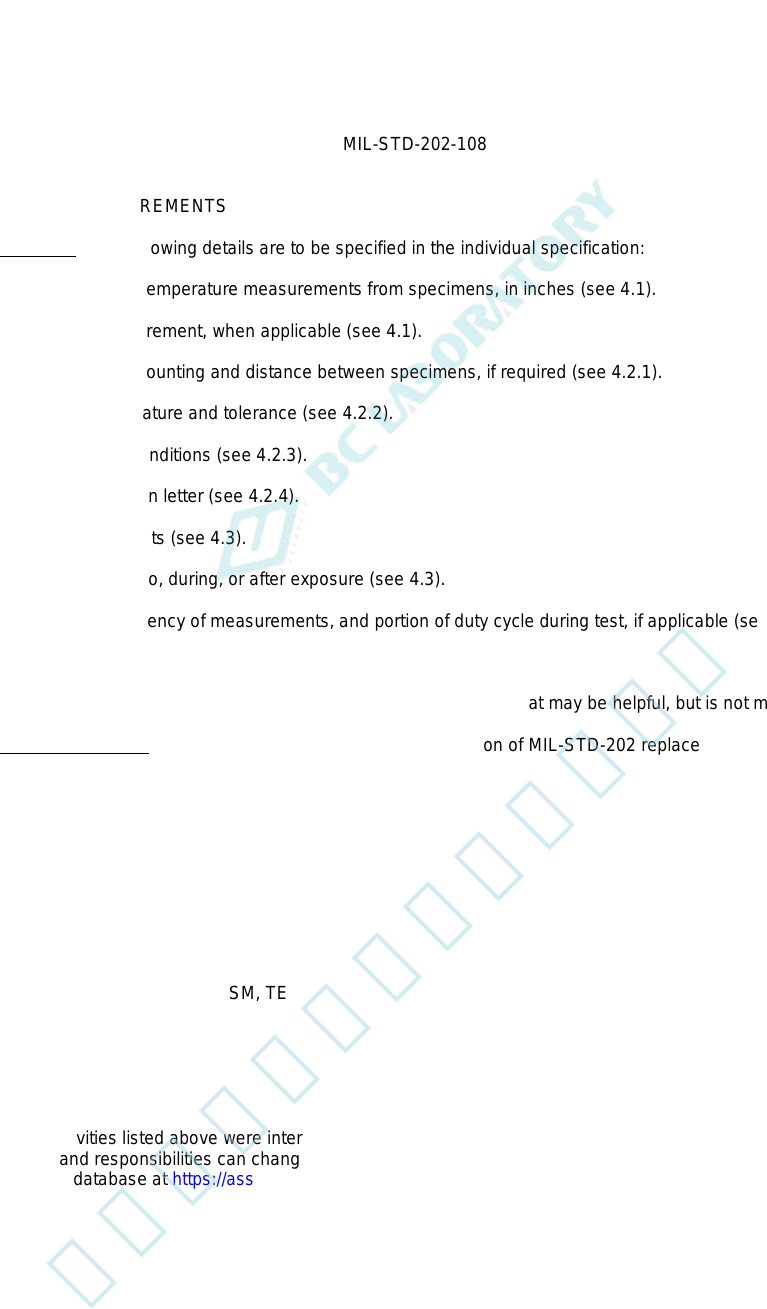
5.1 Summary. The following details are to be specified in the individual specification:
a. Distance of temperature measurements from specimens, in inches (see 4.1).
b. Still-air requirement, when applicable (see 4.1).
c. Method of mounting and distance between specimens, if required (see 4.2.1).
d. Test temperature and tolerance (see 4.2.2).
e. Operating conditions (see 4.2.3).
f. Test condition letter (see 4.2.4).
g. Measurements (see 4.3).
(1) Prior to, during, or after exposure (see 4.3).
(2) Frequency of measurements, and portion of duty cycle during test, if applicable (see 4.3).
6. NOTES
(This section contains information of a general or explanatory nature that may be helpful, but is not mandatory.)
6.1 Supersession data. The main body and 38 parts of this revision of MIL-STD-202 replace superseded MIL-STD-
202.
Custodians: Preparing activity:
Army - CR DLA – CC
Navy - EC
Air Force - 85 (Project 59GP-2015-012)
DLA - CC
Review activities:
Army - AR, AT, AV, CR4, MI, SM, TE
Navy - AS, OS, SH
Air Force - 19, 99
NSA - NS
NOTE: The activities listed above were interested in this document as of the date of this document. Since
organizations and responsibilities can change, you should verify the currency of the information above using the
ASSIST Online database at https://assist.dla.mil/
3
北测(上海)电子科技有限公司
联系方式:xuyj@beice-sh.com 13917165676