MIL-STD-202H.pdf - 第158页
MI L - S TD - 202 - 20 9 CO NT E N T S PARAGRAPH PAG E FOREW ORD … ………………………………………………………. ii 1. SCOPE 1 1.1 Purpose …… ………………… …………………. …… .. …………. 1 1.2 Precaution s …………………… ………………………………. …. 1 2. APPLICABLE D O C U M E…

MIL-STD-202-209
FOREWORD
1. This standard is approved for use by all Departments and Agencies of the Department of Defense.
2. This entire standard has been revised. This revision has resulted in many changes to the format, but the most
significant one is the splitting the document into test methods. See MIL-STD-202 for the change summary.
3. Comments, suggestions, or questions on this document should be emailed to std202@dla.mil or addressed to:
Commander, Defense Logistics Agency, DLA Land and Maritime, ATTN: VAT, P.O. Box 3990, Columbus, OH
43218–3990. Since contact information can change, you may want to verify the currency of this address
information using the ASSIST Online database at https://assist.dla.mil.
ii
北测(上海)电子科技有限公司
联系方式:xuyj@beice-sh.com 13917165676
MIL-STD-202-209
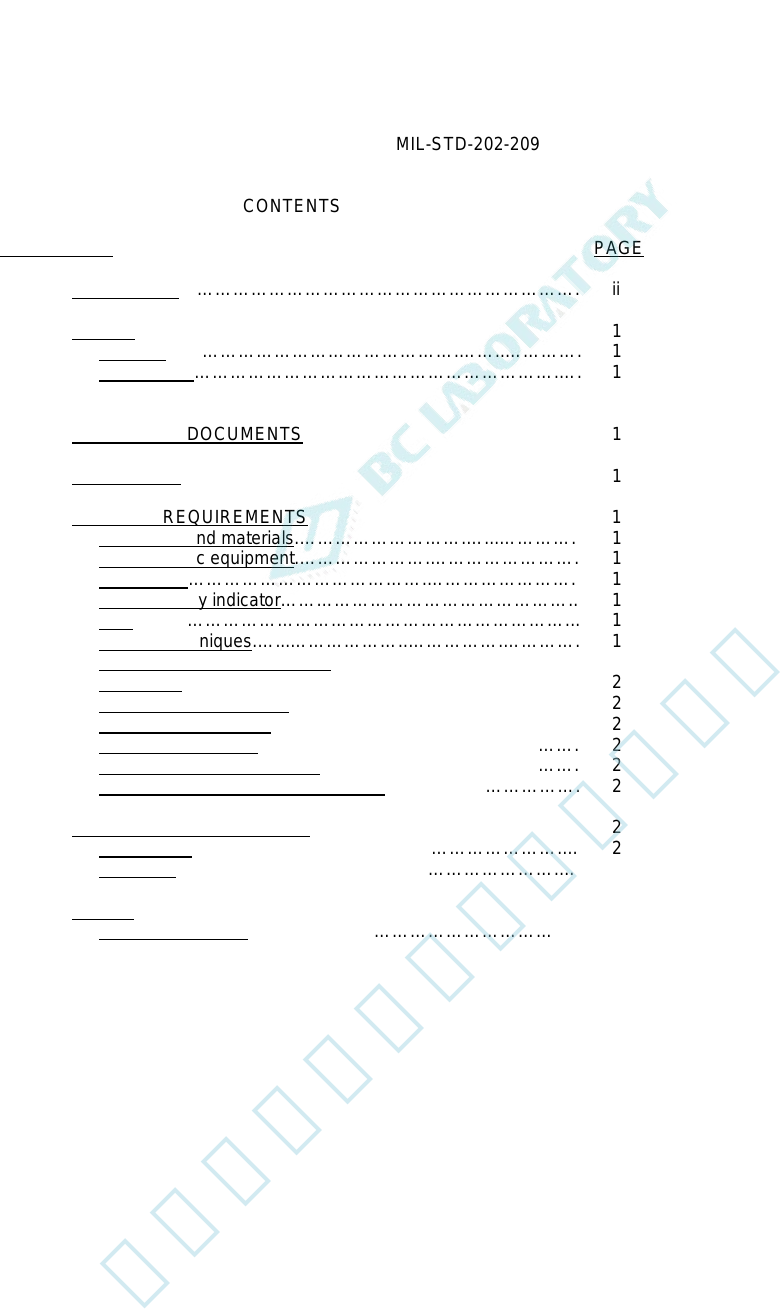
CONTENTS
PARAGRAPH PAGE
FOREWORD…………………………………………………………. ii
1. SCOPE 1
1.1 Purpose………………………………………….……..…………. 1
1.2 Precautions…………………………………………………….…. 1
2. APPLICABLE DOCUMENTS 1
3. DEFINTIONS 1
4. GENERAL REQUIREMENTS 1
4.1 Apparatus and materials.……………………….…...…………. 1
4.1.1 Radiographic equipment.………………….……………………. 1
4.1.2 Film holder………………………………….……………………. 1
4.1.3 Image-quality indicator………………………………………….. 1
4.1.4 Film………………………………………………………………... 1
4.2 Nonfilm techniques.…...………………..…………….…………. 1
4.3 Personnel safety precautions..…………………………………. 1
4.4 Procedure…………………………………………………………. 2
4.5 Positioning of specimen…………………………………………. 2
4.6 Exposure parameters……………………………………………. 2
4.7 Intensifying screens…………………………………..…………. 2
4.8 Identification of radiographs..………………………..…………. 2
4.9 Marking of radiographed specimens. …………………………. 2
5. DETAILED REQUIREMENTS 2
5.1 Evaluations………….………………………………………….… 2
5.2 Summary……………………………………………………….… 3
6. NOTES 3
6.1 Supersession data………………………………………………. 3
iii
北测(上海)电子科技有限公司
联系方式:xuyj@beice-sh.com 13917165676
MIL-STD-202-209
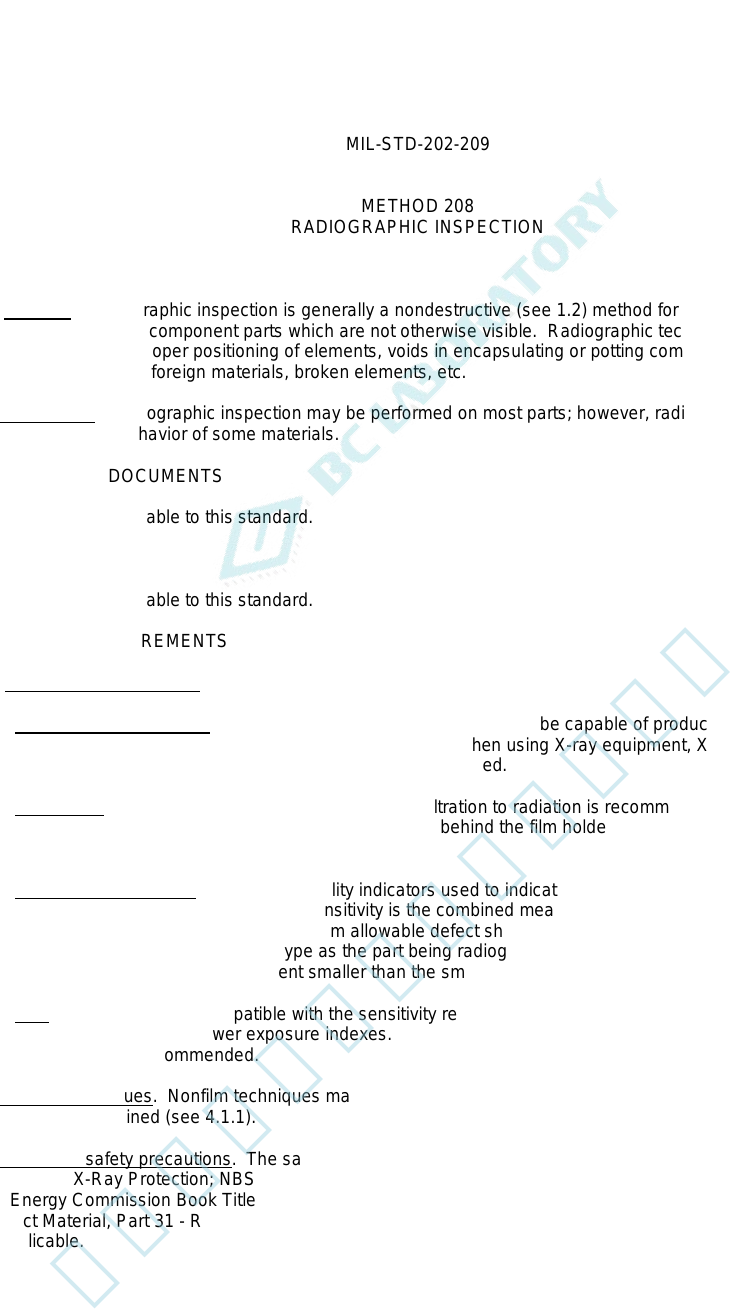
METHOD 208
RADIOGRAPHIC INSPECTION
1. SCOPE
1.1 Purpose. Radiographic inspection is generally a nondestructive (see 1.2) method for detecting internal
physical defects in small component parts which are not otherwise visible. Radiographic techniques are intended to
reveal such flaws as improper positioning of elements, voids in encapsulating or potting compounds, inhomogeneities
in materials, presence of foreign materials, broken elements, etc.
1.2 Precautions. Radiographic inspection may be performed on most parts; however, radiation may cause
changes in electrical behavior of some materials.
2. APPLICABLE DOCUMENTS
This section not applicable to this standard.
3. DEFINTIONS
This section not applicable to this standard.
4. GENERAL REQUIREMENTS
4.1. Apparatus and materials.
4.1.1 Radiographic equipment. The radiographic equipment used shall be capable of producing the required
radiographic quality as specified in the individual specification. When using X-ray equipment, X-ray tubes with small
effective focal-spot sizes and low inherent filtration are recommended.
4.1.2 Film holder. A lightproof film holder of low inherent filtration to radiation is recommended when using
voltages of 50 kilovolts. A lead backing plate should be used behind the film holder to minimize fogging due to
secondary back-scatter.
4.1.3 Image-quality indicator. The image-quality indicators used to indicate radiographic sensitivity shall be as
specified in the individual specification. The sensitivity is the combined measure of the definition and contrast of the
radiograph and should be such that the maximum allowable defect shall be shown. The image-quality indicator may
be made from a sample part of the same type as the part being radiographed and should contain either an actual or
simulated defect which is at least 10 percent smaller than the smallest defect to be detected.
4.1.4 Film. The film shall be compatible with the sensitivity required in 4.1.1. In general, finer detail is achieved by
the use of finer grain films with lower exposure indexes. If extreme magnification techniques are required, the use of
single emulsion films is recommended.
4.2 Nonfilm techniques. Nonfilm techniques may be used if required sensitivity levels, and records (when
specified) can be obtained (see 4.1.1).
4.3 Personnel safety precautions. The safety precautions described in National Bureau of Standards (NBS)
Handbook 76 - X-Ray Protection; NBS Handbook 73 - Protection Against Radiations From Sealed Gamma Sources;
Atomic Energy Commission Book Title 10, Part 20 - Standard for Protection Against Radiation, Part 30 - Licensing of
By-product Material, Part 31 - Radiation Safety Requirements for Radiographic Operations, shall be complied with
when applicable.
1
北测(上海)电子科技有限公司
联系方式:xuyj@beice-sh.com 13917165676