MIL-STD-202H.pdf - 第61页
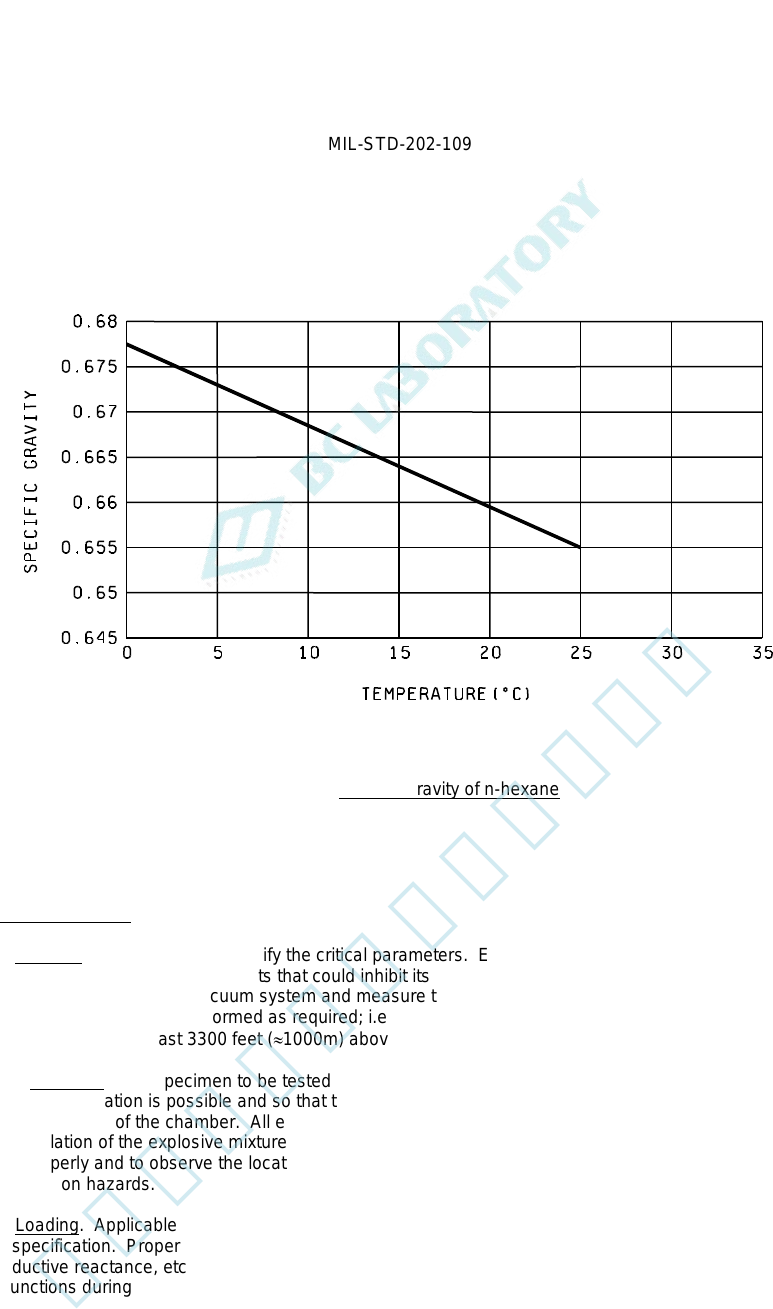
MI L - S TD - 202 - 10 9 FIGURE 1. Sp eci fic g r av i t y of n - hex ane 4.2. PROCEDURE 4.2 .1 Test pre paration . 4.2 .1.1 Contro ls . Before each test, ver i f y t he c r i t i c al p ar am et er s . E nsure spark dev…
MIL-STD-202-109
4.1.2 Fuel. Unless otherwise specified, the fuel for explosive atmosphere testing shall be the single-component
hydrocarbon n-hexane, either reagent grade or 95% n-hexane with 5% other hexane isomers. This fuel is used since
its ignition properties for flammable atmosphere testing are equal to or more sensitive than the similar properties of
both 100/130 octane aviation gasoline, JP-4, and JP-8 jet engine fuel. Optimum mixtures of n-hexane and air will
ignite from hot-spot temperatures as low as 223°C (433°F) while optimum JP-4 jet engine fuel-air mixtures require a
minimum temperature of 230°C (445°F) for auto-ignition, and 100/130 octane aviation gasoline and air requires
441°C (825°F) for hot-spot ignition. Minimum spark energy inputs for ignition of optimum fuel vapor and air mixtures
are essentially the same for n-hexane and for 100/130 octane aviation gasoline. Much higher minimum spark energy
input is required to ignite JP-4 or JP-8 jet engine fuel and air mixtures. Use of fuels other than hexane is not
recommended. CAUTION: If the individual specification allows the use of an alternate fuel, the specification must
also provide all the specific details associated with the alternate fuel, such as safety precautions and fuel-air mixture
equation.
4.1.3 Fuel vapor mixture. Use a homogeneous fuel-air mixture in the correct fuel-air ratios for the explosive
atmosphere test. Fuel weight calculated to total 3.8 percent by volume of the test atmosphere represents 1.8
stoichiometric equivalents of n-hexane in air, giving a mixture needing only minimum energy for ignition. This yields an
air/vapor ratio (AVR) of 8.33 by weight.
a. Required information to determine fuel weight:
(1) Chamber air temperature during the test
(2) Fuel temperature
(3) Specific gravity of n-hexane (see figure 1)
(4) Test altitude: (e.g. 20,000 feet (6100 meters)). Atmospheric pressure in pascals: 46.6 kPa (6.76 psia)
(5) Net volume of the test chamber, free volume less test item displacement expressed in liters or cubic
feet.
b. Calculation of the volume of liquid n-hexane fuel for each test altitude:
(1) In metric units:
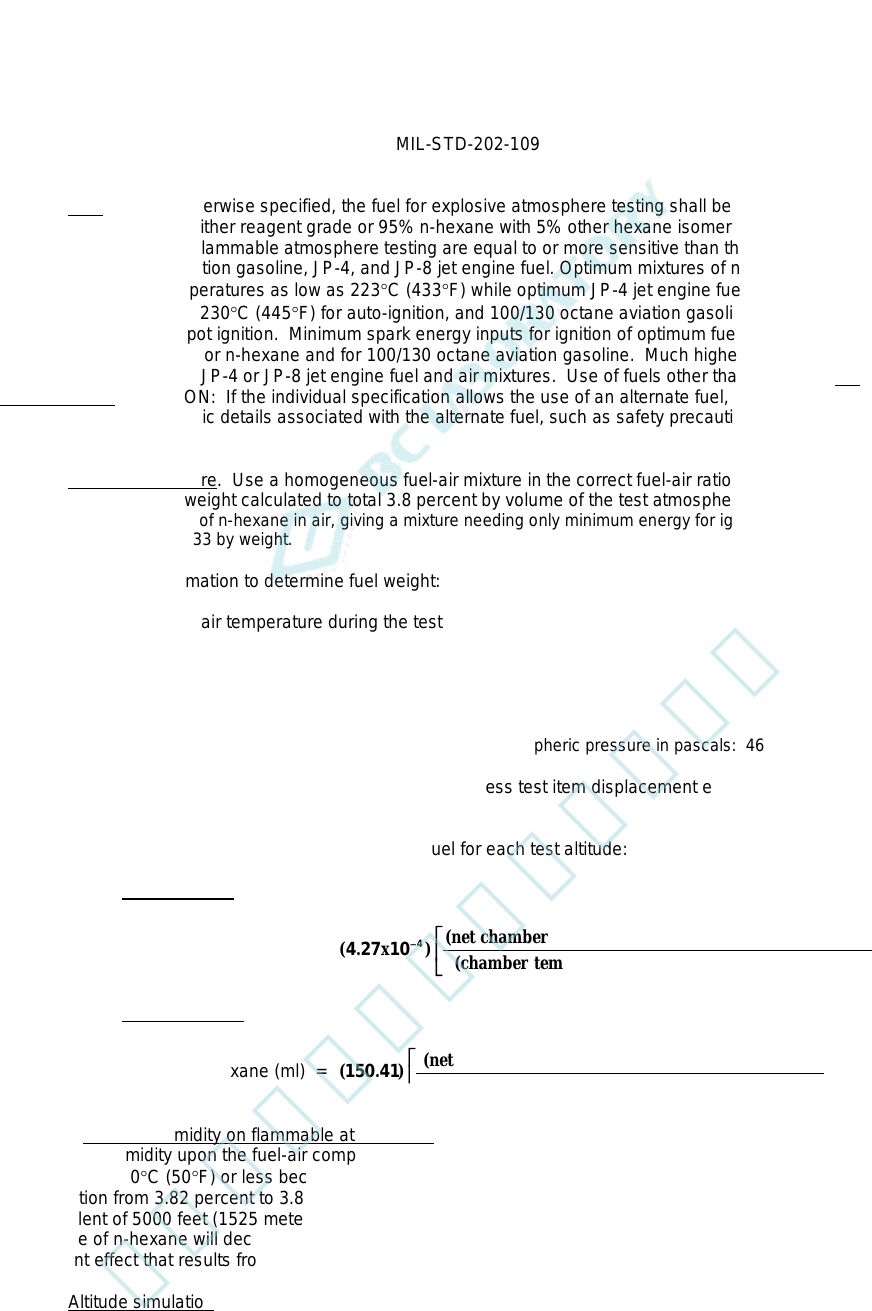
Volume of 95 percent n-hexane (ml) =
−
−
)hexanenof
gravityspecific(x)K(
tempchamber(
)
pascals(pressure
chamber(x
)liters(volchamber
net(
)x.
(
4
10
274
(2) In English units:
Volume of 95 percent n-hexane (ml) =
−
)hexanenofgravityspecific(x)R(tempchamber(
)psia(pressurechamber(
x))ft(volchambernet(
).(
3
41150
4.1.3.1 Effect of humidity on flammable atmosphere. Humidity is always present in an explosive atmosphere test.
The effect of humidity upon the fuel-air composition need not be considered in the test if the ambient air dewpoint
temperature is 10°C (50°F) or less because this concentration of water vapor only increases the n-hexane fuel
concentration from 3.82 percent to 3.85 percent of the test atmosphere. If the atmospheric pressure is cycled from
an equivalent of 5000 feet (1525 meters) above the test level to 5000 feet below (a 34 percent change in pressure),
the volume of n-hexane will decrease from 4.61 percent to 3.08 percent. This decrease will compensate for the fuel
enrichment effect that results from water vapor dilution of the test air supply.
4.1.4 Altitude simulation. The energy required to ignite a fuel-air mixture increases as pressure decreases.
Ignition energy does not drop significantly for test altitudes below sea level. This test is not appropriate for test
altitudes above approximately 52,000 feet (≈16,000 meters) where the lack of oxygen inhibits ignition.
2
北测(上海)电子科技有限公司
联系方式:xuyj@beice-sh.com 13917165676
MIL-STD-202-109
FIGURE 1. Specific gravity of n-hexane
4.2. PROCEDURE
4.2.1 Test preparation.
4.2.1.1 Controls. Before each test, verify the critical parameters. Ensure spark devices function properly and the
fuel atomizing system is free from deposits that could inhibit its functioning. Adjust the empty test chamber to the
highest test altitude, shut off the vacuum system and measure the rate of any air leakage. Verify that any leakage will
not prevent the test from being performed as required; i.e., introduce the test fuel and wait three minutes for full
vaporization, yet still be at least 3300 feet (≈1000m) above the test altitude.
4.2.1.1.2 Mounting. The specimen to be tested shall be mounted in the test chamber in such a manner that
normal electrical operation is possible and so that the mechanical controls may be operated through the pressure
seals from the exterior of the chamber. All external covers of the test specimen shall be removed or opened to insure
adequate circulation of the explosive mixture. The test specimen shall then be operated to determine that it is
functioning properly and to observe the location of any sparking or high temperature spots that may constitute
potential explosion hazards.
4.2.1.2 Loading. Applicable mechanical and electrical loads applied to the specimen shall be as specified in the
individual specification. Proper precaution shall be taken to duplicate the normal load in respect to torque, voltage,
current, inductive reactance, etc. In all instances it shall be considered preferable to operate the specimen as it
normally functions during service use.
3
北测(上海)电子科技有限公司
联系方式:xuyj@beice-sh.com 13917165676
MIL-STD-202-109
4.2.2 Test execution. The following provides the procedural steps for execution of the explosive atmosphere test;
a. With the test item installed, the test chamber shall be sealed and the test item and chamber inner walls stabilized to
71°C ±3°C (160°F ±5°F), or to a lower temperature as specified, if the specimen is designed to operate at a lower
temperature.
b. Adjust the chamber air pressure to simulate the desired test altitude (see 4.2.3) plus an additional
10,000 feet to allow for introducing, vaporizing, and mixing the fuel with the air as described in 4.1.3.
c. Slowly introduce the required volume of n-hexane into the test chamber.
d. Circulate the test atmosphere and continue to reduce the simulated chamber altitude for at least three
minutes to allow for complete vaporization of fuel and the development of a homogeneous mixture.
e. At a pressure equivalent to 5,000 feet (1525 meters) above the test altitude, verify the potential
explosiveness of the fuel-air vapor by attempting to ignite a sample of the mixture taken from the test
chamber by using a spark-gap device or glow plug ignition source with sufficient energy to ignite a 3.82
percent hexane mixture. If ignition does not occur, purge the chamber of the fuel vapor and repeat
steps a through e. (An alternative method of determining the explosive characteristics of the vapor is by
using a calibrated explosive gas meter that verifies the degree of explosiveness and the concentration
of the fuel-air mixture.)
f. Operate the test specimen and continue operation through step g. Make and break electrical contacts
as frequently and reasonably possible.
g. If no explosion occurs as a result of operation of the test specimen, slowly reduce the simulated
chamber altitude to 5,000 feet (1525 meters) below the test altitude (at a rate no faster than 330 feet
(100 meters) per minute by bleeding air into the chamber). Perform one last operational check and
switch off power to the test specimen.
h. If no explosion has occurred as the result of operation of the test specimen by the time the simulated
altitude has reached 5,000 feet (1525 meters) below the test altitude, verify the potential explosiveness
of the air-vapor mixture as in step e. If ignition does not occur with the sample, purge the chamber of
the fuel vapor, and repeat the test from step a.
i. Repeat steps b through h for the required test altitudes (see 4.2.3).
4.2.3 Test altitudes. Unless otherwise specified, the test shall be accomplished at simulated test altitudes of local
ground level to 5,000 feet, 20,000 feet, and 40,000 feet. However, if an explosion occurs at an altitude of less than
40,000 feet, further testing shall be discontinued.
5. DETAILED REQUIREMENTS
5.1 Summary. The following details are to be specified in the individual specification:
a. Fuel, if other than that specified and all specific details associated with the fuel (see 4.1.2).
b. Mechanical and electrical load (see 4.2.1.2).
c. Chamber temperature condition, if lower than 71°C ±3°C (160°F ±5°F) (see 4.2.2 a).
d. Test altitudes, if other than those specified (see 4.2.3).
4
北测(上海)电子科技有限公司
联系方式:xuyj@beice-sh.com 13917165676