MIL-STD-202H.pdf - 第127页
MI L - S TD - 202 - 20 6 M E TH O D 20 6 L I F E (R O T AT I O N AL ) 1. SCOPE 1. 1 P urpose . T his t e s t i s per f or m ed f or t he p ur po s e o f de t er m i ni ng t he e f f ec t s of s ubj ec ting ele ctronic an…
MIL-STD-202-206
CONTENTS
PARAGRAPH PAGE
FOREWORD…………………………………………………………. ii
1. SCOPE 1
1.1 Purpose………………………………………….……..…………. 1
2. APPLICABLE DOCUMENTS 1
3. DEFINTIONS 1
4. GENERAL REQUIREMENTS 1
4.1 Mounting………………………………………….…...…………. 1
4.2. Test potential and load………………………..……..…………. 1
4.3 Cycle………………………………………………………………. 1
4.4 Cycle rate…………………………………………………………. 1
4.5 Number of cycles...………………………………………………. 1
4.6 Temperature and atmospheric pressure………………………. 2
5. DETAILED REQUIREMENTS 2
5.1 Measurements………………………………………………….... 2
5.2. Summary……………………………………………………….… 2
6. NOTES 3
6.1 Supersession data………………………………………………. 3
FIGURE PAGE
1. Suggested mounting fixture for rotational-life test…………………….… 2
iii
北测(上海)电子科技有限公司
联系方式:xuyj@beice-sh.com 13917165676
MIL-STD-202-206
METHOD 206
LIFE (ROTATIONAL)
1. SCOPE
1.1 Purpose. This test is performed for the purpose of determining the effects of subjecting electronic and
electrical parts, which are actuated by rotational motion, to a number of operations approximating the life of the part.
Total resistance, contact resistance, and dielectric strength are samples of measurements which may be made prior
to, during, or after test, and which would show the effects of rotational actuation. Measurements prior to and after
test are generally made for comparison purposes and would indicate the amount of change that results from this test.
Parts with sealed shafts and bushings might have the effectiveness of the seal disturbed by rotation; a sealing test
performed after this test would disclose this inadequacy. A switch-life test may be performed in conjunction with this
test method.
2. APPLICABLE DOCUMENTS
This section not applicable to this standard.
3. DEFINTIONS
This section not applicable to this standard.
4. GENERAL REQUIREMENTS
4.1 Mounting. Specimens shall be mounted in their normal operating position by the intended means. Normal
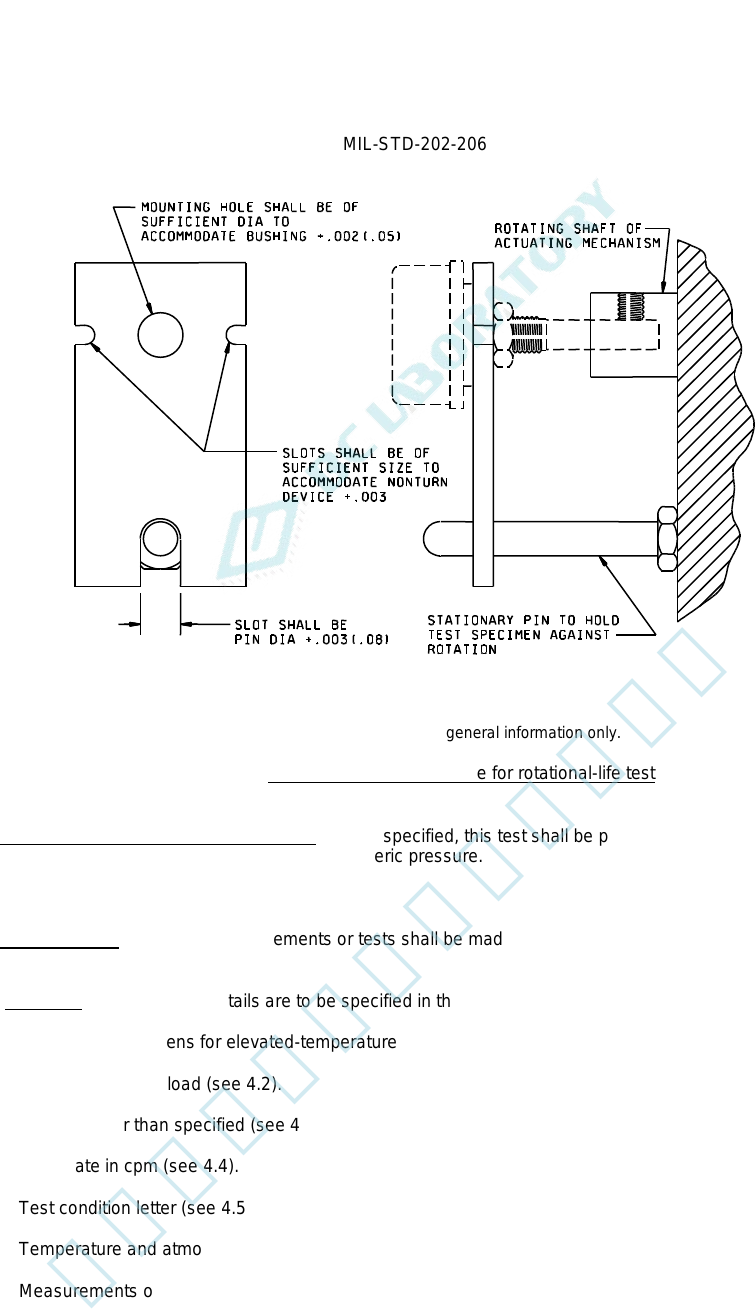
care shall be taken in the mounting procedure to prevent the binding of shafts during rotation. Figure 1 shows a
suggested means of preventing this condition, when applicable. Mechanisms such as slip clutches may be used to
prevent damage from the application of excessive torque to the specimens. When this test is conducted at an
elevated temperature (see 4.6), the spacing between a group of like specimens shall be as specified.
4.2 Test potential and load. The test potential and load applied to the specimens during rotation shall be as
specified.
4.3 Cycle. A cycle shall consist of a rotation of the shaft from one stop position to the other stop position (passing
through detent positions, if any), and return to the original position. For specimens not having stops, a cycle shall
consist of a rotation of the shaft 360° and return, unless otherwise specified. Specimens with adjustable stops shall
have the stops so placed as to permit maximum rotation. Specimens that are rotated by means other than a shaft
shall meet the requirements of this paragraph by rotation 360° and return, unless otherwise specified, or from stop to
stop.
4.4 Cycle rate. The cycle rate shall be expressed in cycles per minute (cpm), and shall be as specified.
4.5 Number of cycles. Specimens shall be subjected to one of the following test conditions, as specified:
Test condition Number of cycles Test condition Number of cycles
A -------------------- 500 H -------------------- 100,000
B -------------------- 2,000 J -------------------- 200,000
C -------------------- 5,000 K -------------------- 300,000
D -------------------- 10,000 L -------------------- 500,000
E -------------------- 15,000 M ------------------- 1,000,000
F -------------------- 25,000 N -------------------- 2,000,000
G ------------------- 50,000
1
北测(上海)电子科技有限公司
联系方式:xuyj@beice-sh.com 13917165676
MIL-STD-202-206
FIGURE 1. Suggested mounting fixture for rotational-life test.
4.6 Temperature and atmospheric pressure. When specified, this test shall be performed at elevated or reduced
temperature and at other than room ambient atmospheric pressure.
5. DETAILED REQUIREMENTS
5.1 Measurements. Specified measurements or tests shall be made prior to, during, or after rotations, as
specified.
5.2. Summary. The following details are to be specified in the individual specification:
a. Spacing of specimens for elevated-temperature testing, when applicable (see 4.1).
b. Test potential and load (see 4.2).
c. Cycle, if other than specified (see 4.3).
d. Cycle rate in cpm (see 4.4).
e. Test condition letter (see 4.5).
f. Temperature and atmospheric conditions, when applicable (see 4.6).
g. Measurements or tests prior to, during, or after rotations, as applicable (see 5.1).
NOTES:
1. Dimensions are in inches.
2. Metric equivalents are in parentheses and are given for general information only.
2
北测(上海)电子科技有限公司
联系方式:xuyj@beice-sh.com 13917165676