MIL-STD-202H.pdf - 第122页
MI L - S TD - 202 - 20 4 5. DETAILED REQUI RE M E N T S 5.1 Measurement s . M eas ur e m ent s s hal l be m a de a s s pe c i f i ed. 5.2 . SUMMARY . The f ol l ow i ng det a i l s ar e t o b e s pec i f i ed i n t he i …
MIL-STD-202-204
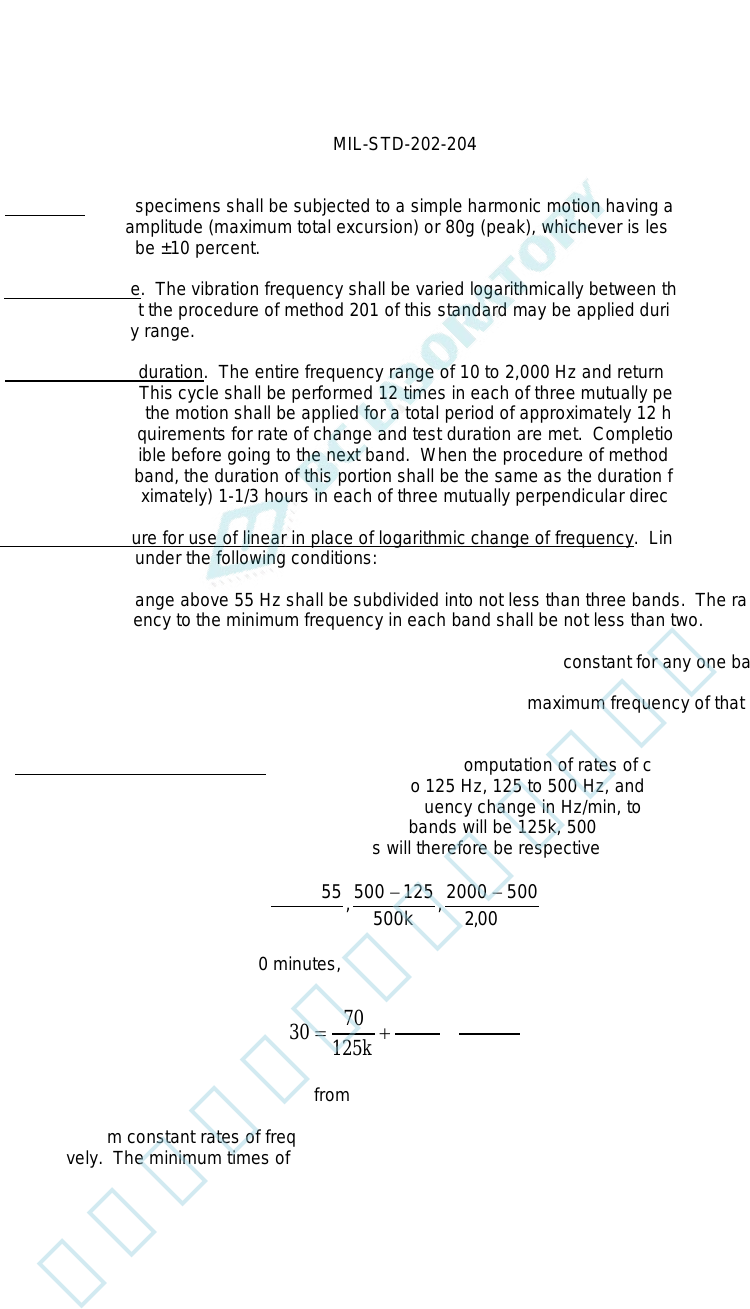
4.9.1 Amplitude. The specimens shall be subjected to a simple harmonic motion having a constant amplitude of
either 0.06-inch double amplitude (maximum total excursion) or 80g (peak), whichever is less. The tolerance on
vibration amplitude shall be ±10 percent.
4.9.2 Frequency range. The vibration frequency shall be varied logarithmically between the limits of 10 and 2,000
Hz (see 4.10), except that the procedure of method 201 of this standard may be applied during the 10 to 55 Hz band
of the vibration frequency range.
4.9.3 Sweep time and duration. The entire frequency range of 10 to 2,000 Hz and return to 10 Hz shall be
traversed in 20 minutes. This cycle shall be performed 12 times in each of three mutually perpendicular directions
(total of 36 times), so that the motion shall be applied for a total period of approximately 12 hours. Interruptions are
permitted provided the requirements for rate of change and test duration are met. Completion of cycling within any
separate band is permissible before going to the next band. When the procedure of method 201 of this standard is
used for the 10 to 55 Hz band, the duration of this portion shall be the same as the duration for this band using
logarithmic cycling (approximately) 1-1/3 hours in each of three mutually perpendicular directions.
4.10 Alternate procedure for use of linear in place of logarithmic change of frequency. Linear rate of change of
frequency is permissible under the following conditions:
a. The frequency range above 55 Hz shall be subdivided into not less than three bands. The ratio of the
maximum frequency to the minimum frequency in each band shall be not less than two.
b. The rate of change of frequency in hertz per minute (Hz/min) shall be constant for any one band.
c. The ratios of the rate of change of frequency of each band to the maximum frequency of that band shall be
approximately equal.
4.10.1 Example of alternate procedure. As an example of the computation of rates of change, assume that the
frequency spectrum has been divided into three bands, 55 to 125 Hz, 125 to 500 Hz, and 500 to 2,000 Hz, in
accordance with 4.10a. Let the (constant) ratio of rate of frequency change in Hz/min, to maximum frequency in Hz
be k for each band. Then the rates of change for the three bands will be 125k, 500k, and 2,000k, respectively. The
times, in minutes, to traverse the three frequency bands will therefore be respectively:
k
kk 000
,2
5002000
,
500
125
500
,
55
55125
−−−
Since the minimum total sweep time is 30 minutes,
kkk 000,2
500,1
500
375
125
70
30 ++=
from which: k = 0.0687
The required maximum constant rates of frequency change for the three bands are therefore 8.54, 34.4, and 136.6
Hz/min, respectively. The minimum times of traverse of the bands are 8.2, 10.9, and 10.9 minutes, respectively.
5
北测(上海)电子科技有限公司
联系方式:xuyj@beice-sh.com 13917165676
MIL-STD-202-204
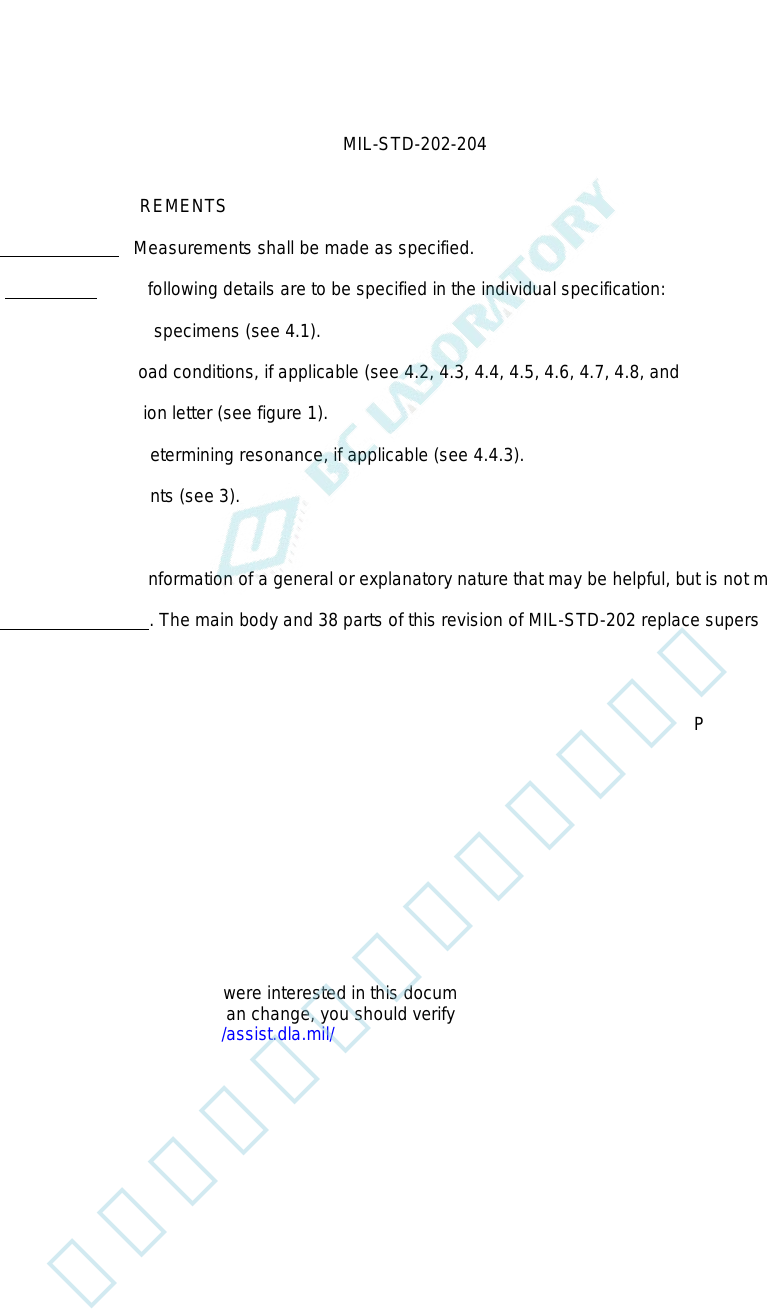
5. DETAILED REQUIREMENTS
5.1 Measurements. Measurements shall be made as specified.
5.2. SUMMARY. The following details are to be specified in the individual specification:
a. Mounting of specimens (see 4.1).
b. Electrical-load conditions, if applicable (see 4.2, 4.3, 4.4, 4.5, 4.6, 4.7, 4.8, and 4.9).
c. Test condition letter (see figure 1).
d. Method of determining resonance, if applicable (see 4.4.3).
e. Measurements (see 3).
6. NOTES
(This section contains information of a general or explanatory nature that may be helpful, but is not mandatory.)
6.1 Supersession data. The main body and 38 parts of this revision of MIL-STD-202 replace superseded MIL-STD-
202.
Custodians: Preparing activity:
Army - CR DLA – CC
Navy - EC
Air Force - 85 (Project 59GP-2015-019)
DLA - CC
Review activities:
Army - AR, AT, AV, CR4, MI, SM, TE
Navy - AS, OS, SH
Air Force - 19, 99
NSA - NS
NOTE: The activities listed above were interested in this document as of the date of this document. Since
organizations and responsibilities can change, you should verify the currency of the information above using the
ASSIST Online database at https://assist.dla.mil/
6
北测(上海)电子科技有限公司
联系方式:xuyj@beice-sh.com 13917165676
MIL-STD-202G
w/CHANGE 2
1
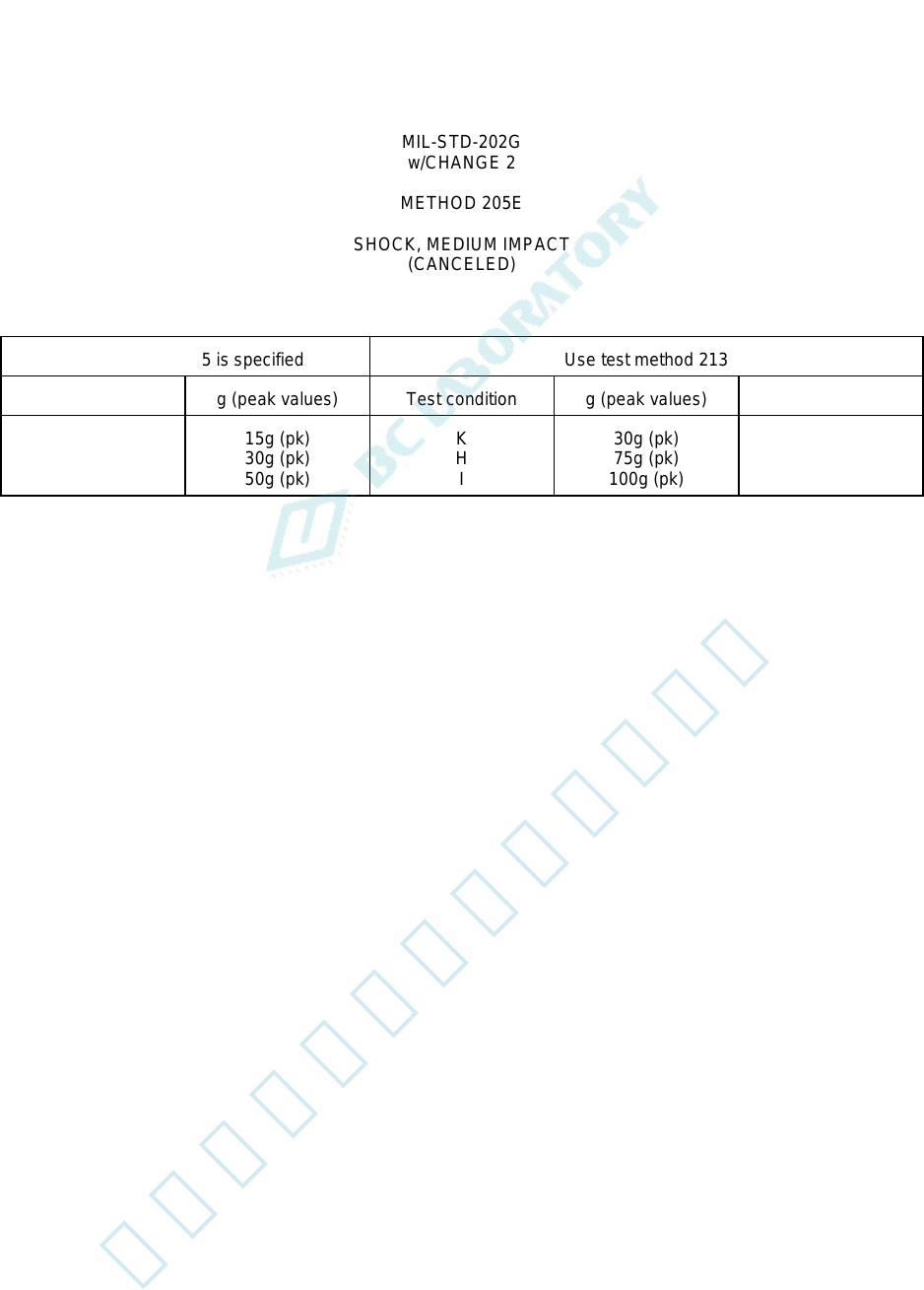
METHOD 205E
SHOCK, MEDIUM IMPACT
(CANCELED)
When method 205 is specified
Use test method 213
Test condition
g (peak values)
Test condition
g (peak values)
Waveform
A
B
C
15g (pk)
30g (pk)
50g (pk)
K
H
I
30g (pk)
75g (pk)
100g (pk)
Sawtooth
Sawtooth
Sawtooth
METHOD 205E
16 April 1973
北测(上海)电子科技有限公司
联系方式:xuyj@beice-sh.com 13917165676