MIL-STD-202H.pdf - 第258页
MI L - S TD - 202 - 30 6 CO NT E N T S PARAGRAPH PAG E FOREW ORD … ………………………………………………………. ii 1. SCOPE 1 1.1 Purpose …… ………………… …………………. …… .. …………. 1 2. APPLICABLE D O C U M EN T S 1 3. DEFINTIONS 1 4. GENERAL RE Q UI R …

MIL-STD-202-306
FOREWORD
1. This standard is approved for use by all Departments and Agencies of the Department of Defense.
2. This entire standard has been revised. This revision has resulted in many changes to the format, but the most
significant one is the splitting the document into test methods. See MIL-STD-202 for the change summary.
3. Comments, suggestions, or questions on this document should be emailed to std202@dla.mil or addressed to:
Commander, Defense Logistics Agency, DLA Land and Maritime, ATTN: VAT, P.O. Box 3990, Columbus, OH
43218–3990. Since contact information can change, you may want to verify the currency of this address
information using the ASSIST Online database at https://assist.dla.mil.
ii
北测(上海)电子科技有限公司
联系方式:xuyj@beice-sh.com 13917165676
MIL-STD-202-306
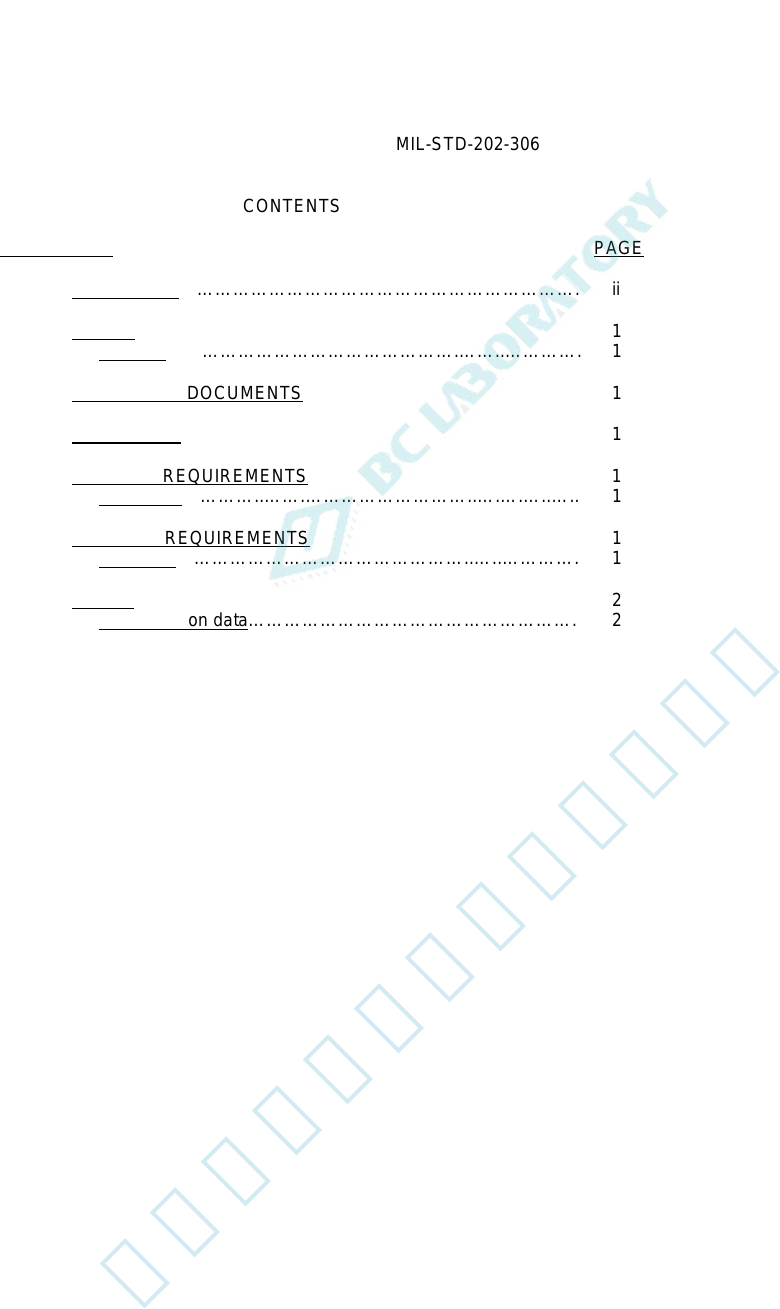
CONTENTS
PARAGRAPH PAGE
FOREWORD…………………………………………………………. ii
1. SCOPE 1
1.1 Purpose………………………………………….……..…………. 1
2. APPLICABLE DOCUMENTS 1
3. DEFINTIONS 1
4. GENERAL REQUIREMENTS 1
4.1 Procedure…………..…….………………………..….….…..….. 1
5. DETAILED REQUIREMENTS 1
5.1 Summary…………………………………………..…..…………. 1
6. NOTES 2
6.1 Supersession data………………………………………………. 2
iii
北测(上海)电子科技有限公司
联系方式:xuyj@beice-sh.com 13917165676
MIL-STD-202-306
METHOD 306
QUALITY FACTOR (Q)
1. SCOPE
1.1 Purpose. The purpose of this test is to measure the quality factor, commonly called Q, of electronic parts such
as capacitors and inductors. By definition, the factor Q expresses the ratio of reactance to effective resistance of a
circuit element. This numerical ratio is considered a "figure of merit" for a reactive component (or a resonant circuit
utilizing such components) as it is a measure of the ability of the component (or circuit) to store energy compared to
the energy it wastes. For this reason, Q is called "storage factor". Q is thus equal to the inverse of the dissipation
factor. Relationship also exists between Q and the properties of a tuned circuit, such as the resonant rise in voltage
phenomena. Each of the relationships involving Q mentioned above can be applied to the direct or indirect
measurement of Q.
2. APPLICABLE DOCUMENTS
This section not applicable to this standard.
3. DEFINTIONS
This section not applicable to this standard.
4. GENERAL REQUIREMENTS
4.1. Procedure. The quality factor or Q of the specimen shall be measured using a suitable instrument providing
an accuracy of measurement within 10 percent of the specified value of Q. Measurements shall be made at the
specified frequency. Suitable measurement techniques shall be used to minimize errors due to the connections
between the measuring apparatus and the specimen.
5. DETAILED REQUIREMENTS
5.1. Summary. The following details are to be specified in the individual specification:
a. Test frequency (see 4.1).
1
北测(上海)电子科技有限公司
联系方式:xuyj@beice-sh.com 13917165676