MIL-STD-202H.pdf - 第202页
MI L - S TD - 202 -2 1 4 CO NT E N T S PARAGRAPH PAG E FOREW ORD … ………………………………………………………. ii 1. SCOPE 1 1.1 Purpose …… ………………… …………………. …… .. …………. 1 2. APPLICABLE D O C U M EN T S 1 3. DEFINTIONS 1 4. GENERAL RE Q UI R …

MIL-STD-202-214
FOREWORD
1. This standard is approved for use by all Departments and Agencies of the Department of Defense.
2. This entire standard has been revised. This revision has resulted in many changes to the format, but the most
significant one is the splitting the document into test methods. See MIL-STD-202 for the change summary.
3. Comments, suggestions, or questions on this document should be emailed to std202@dla.mil or addressed to:
Commander, Defense Logistics Agency, DLA Land and Maritime, ATTN: VAT, P.O. Box 3990, Columbus, OH
43218–3990. Since contact information can change, you may want to verify the currency of this address
information using the ASSIST Online database at https://assist.dla.mil.
ii
北测(上海)电子科技有限公司
联系方式:xuyj@beice-sh.com 13917165676
MIL-STD-202-214
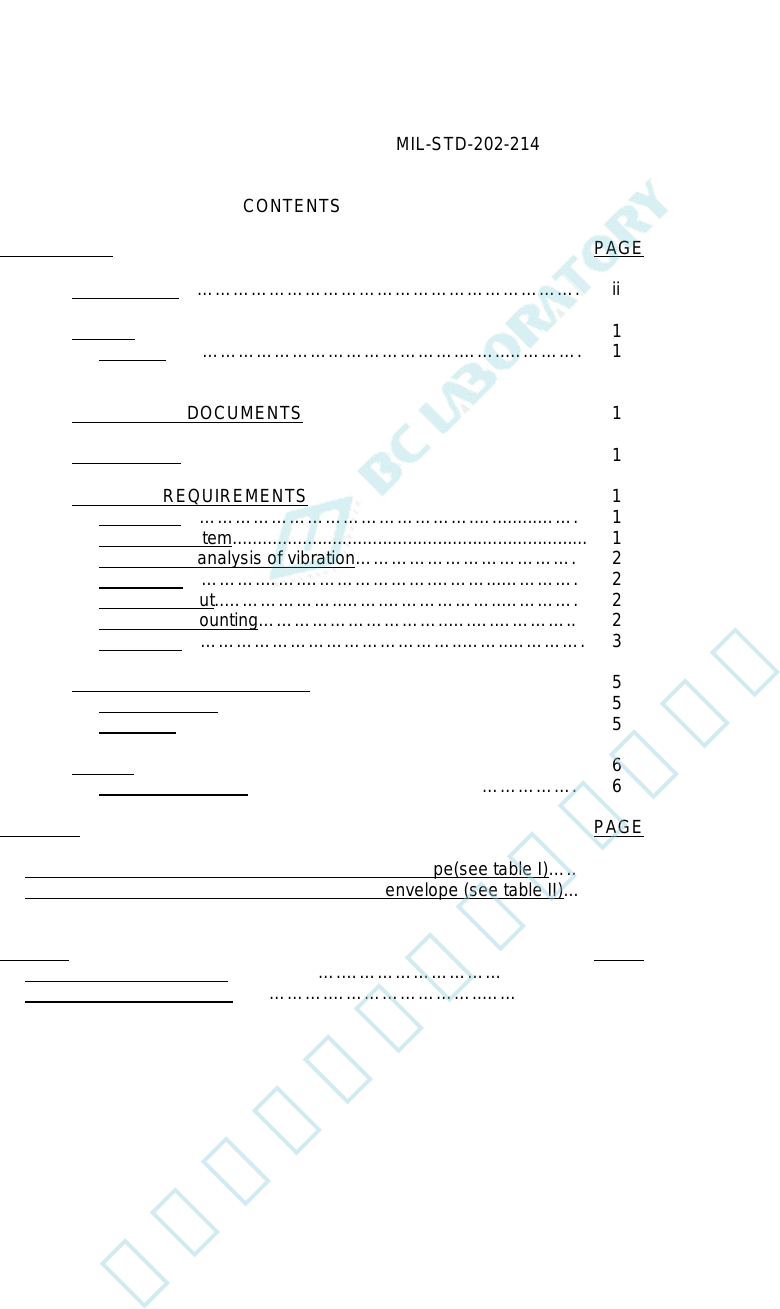
CONTENTS
PARAGRAPH PAGE
FOREWORD…………………………………………………………. ii
1. SCOPE 1
1.1 Purpose………………………………………….……..…………. 1
2. APPLICABLE DOCUMENTS 1
3. DEFINTIONS 1
4. GENERAL REQUIREMENTS 1
4.1 Apparatus………………………………………….….........……. 1
4.1.1 Vibration system....................................................................... 1
4.1.1.1 Control and analysis of vibration………………………………. 2
4.1.2 Monitoring………….…….………………….………...…………. 2
4.1.2.1 Vibration input..………………..…….………………..…………. 2
4.2. Method of mounting…………………………..….….………….. 2
4.3. Procedure………………………………………..……..…………. 3
5. DETAILED REQUIREMENTS 5
5.1 Measurements ……………………………………..……………. 5
5.2. Summary…………………………………………..…..…………. 5
6. NOTES 6
6.1 Supersession data………………………………………………. 6
FIGURES PAGE
1. Test condition I, random vibration test-curve envelope(see table I)….. 3
2. Test condition II, random vibration test-curve envelope (see table II)... 4
TABLES PAGE
I. Values for test-condition I……………….…………………………….…… 4
II. Values for test-condition II…………….……………………..……….…… 5
iii
北测(上海)电子科技有限公司
联系方式:xuyj@beice-sh.com 13917165676
MIL-STD-202-214
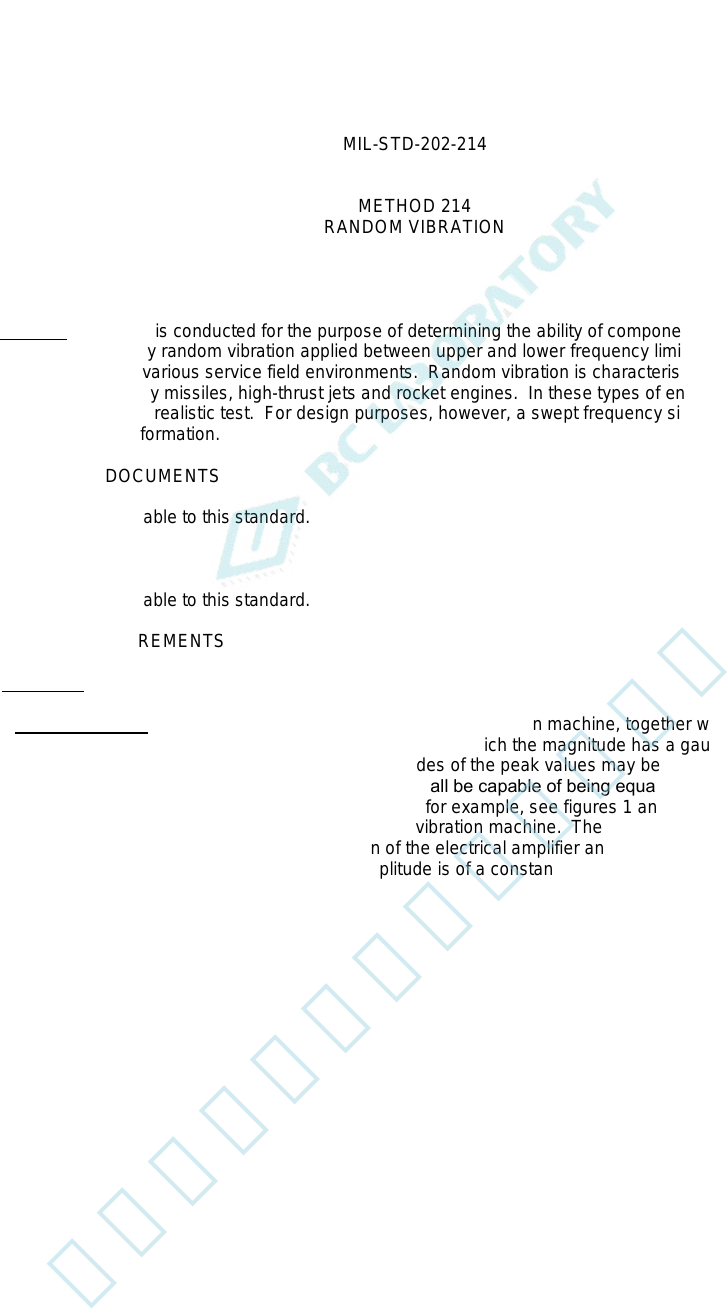
METHOD 214
RANDOM VIBRATION
1. SCOPE
1.1 Purpose. This test is conducted for the purpose of determining the ability of component parts to withstand the
dynamic stress exerted by random vibration applied between upper and lower frequency limits to simulate the
vibration experienced in various service field environments. Random vibration is characteristic of modern field
environments produced by missiles, high-thrust jets and rocket engines. In these types of environments, the random
vibration provides a more realistic test. For design purposes, however, a swept frequency sinusoidal test may yield
more pertinent design information.
2. APPLICABLE DOCUMENTS
This section not applicable to this standard.
3. DEFINTIONS
This section not applicable to this standard.
4. GENERAL REQUIREMENTS
4.1. Appartaus.
4.1.1 Vibration system. The vibration system, consisting of the vibration machine, together with its auxiliary
equipment shall be capable of generating a random vibration for which the magnitude has a gaussian (normal)
amplitude distribution, except that the acceleration magnitudes of the peak values may be limited to a minimum of
three times the rms (three-sigma (σ) limits). The machine shall be capable of being equalized so that the magnitude
of its spectral density curve will be between specified limits (for example, see figures 1 and 2) when the test item, or a
substitute equivalent mass, is appropriately secured to the vibration machine. The equalization of an electro-dynamic
vibration machine system is the adjustment of the gain of the electrical amplifier and control system so that the ratio
of the output vibration amplitude to the input signal amplitude is of a constant value (or given values) throughout the
required frequency spectrum.
1
北测(上海)电子科技有限公司
联系方式:xuyj@beice-sh.com 13917165676