MIL-STD-202H.pdf - 第17页
MI L - S TD - 202 - 101 5.2 . Measure ments . U pon c o m pl e t i on of t he s al t ex pos ur e, t he t e s t s pe c i m ens s h al l be i m medi ately washed w ith free flow ing deionized wa t er ( n ot w ar m er t ha …
MIL-STD-202-101
4.3.2 Location of specimens. Unless otherwise specified, flat specimens and, where practicable, other specimens
shall be supported in such a position that the significant surface is approximately 15 degrees from the vertical and
parallel to the principal direction of horizontal flow of the fog through the chamber. Other specimens shall be
positioned so as to insure most uniform exposure. Whenever practicable, the specimens shall be supported from the
bottom or from the side. When specimens are suspended from the top, suspension shall be by means of glass or
plastic hooks or wax string; if plastic hooks are used, they shall be fabricated of material that is non-reactive to the
salt solution such as lucite. The use of metal hooks is not permitted. Specimens shall be positioned so that they do
not contact each other, so that they do not shield each other from the freely settling fog, and so that corrosion
products and condensate from one specimen do not fall upon another.
4.3.3 Chamber operation. A salt fog having a temperature of 95°F minimum (35°C minimum) shall be passed
through the chamber for the specified test duration (see 5.1). The exposure zone of the chamber shall be maintained
at a temperature of 95°F ±5°F (35°C ±3°C). The conditions maintained in all parts of the exposure zone shall be
such that a suitable receptacle placed at any point in the exposure zone will collect from 0.5 to 3.0 milliliters of
solution per hour for each 80 square centimeters (0.5-3ml/hr/80cm
2
) of horizontal collecting area (10 centimeters
diameter). At least two clean fog-collecting receptacles shall be used; one placed at the perimeter of the test
specimens nearest to the (any) nozzle, and the other at the perimeter of the test specimens farthest from the
nozzle(s). Receptacles shall be fastened in such a manner that they are not shielded by specimens and so that no
drops of solution from specimens or other sources will be collected. The 5 percent solution thus collected shall have
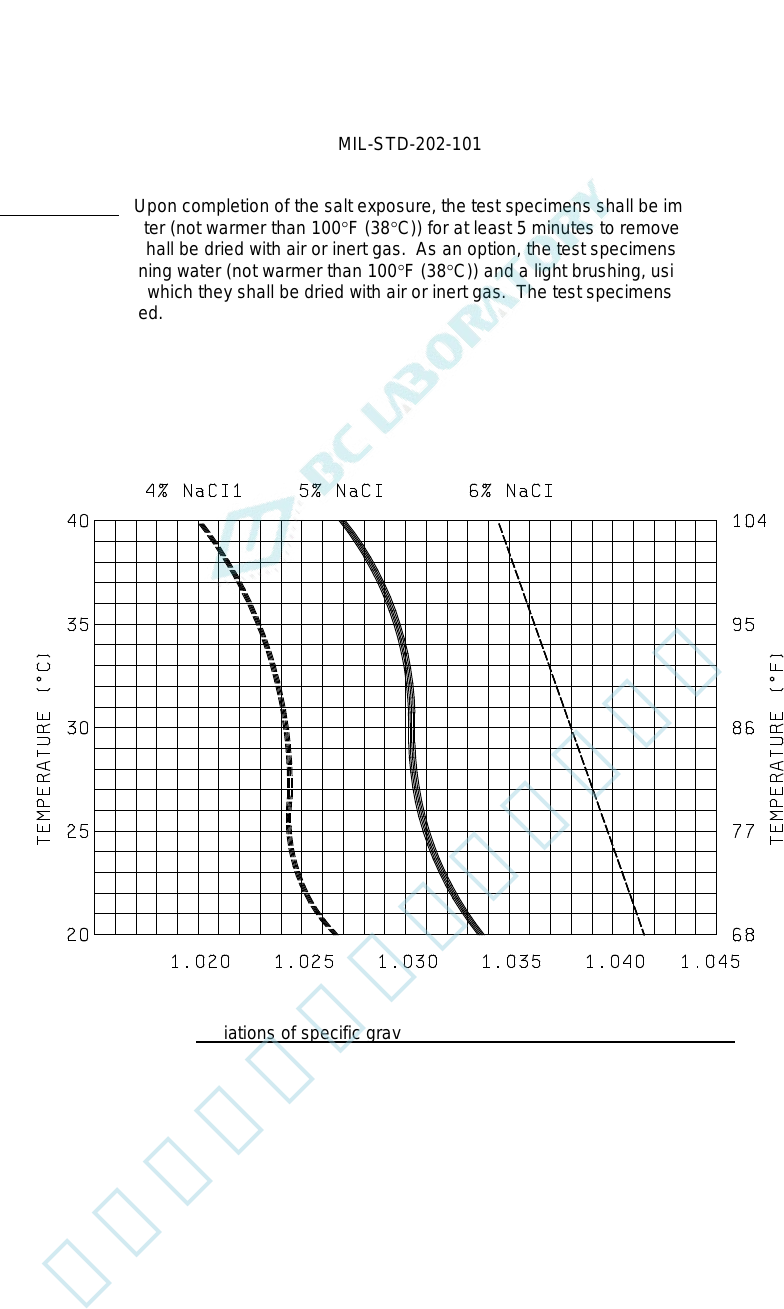
a sodium chloride (NaCl) content of from 4 to 6 percent (specific gravity in accordance with figure 1) when measured
at a temperature of 95°F ±5°F (35°C ±3°C). The specific gravity and quantity of the solution collected shall be
checked following each salt atmosphere test. Suitable atomization has been obtained in boxes having a volume of
less than 12 cubic feet with the following conditions:
a. Nozzle pressure of from 12 to 18 pounds psi.
b. Orifices of from 0.02 to 0.03 inch in diameter.
c. Atomization of approximately 3 quarts of the salt solution per 10 cubic feet of box volume for each 24 hour
period of test.
When using large-size boxes having a volume considerably in excess of 12 cubic feet, the above conditions may
have to be modified in order to meet the requirements for operating conditions.
4.4 Summary. The following details are to be specified in the individual specification:
a. Special mounting and details, if applicable (see 4.3.2).
b. Test condition letter (see 5.1).
c. Measurements after exposure (see 5.2).
5. DETAILED REQUIREMENTS
5.1 Length of test. The length of the salt atmosphere test shall be that indicated in one of the following test
conditions, as specified:
Test condition Length of test
A - - - - - - - - - - - 96 hours
B - - - - - - - - - - - 48 hours
C - - - - - - - - - - - 24 hours
D - - - - - - - - - - - 240 hours
Unless otherwise specified, the test shall be run continuously for the time indicated or until definite indication of failure
is observed, with no interruption except for adjustment of the apparatus and inspection of the specimen.
3
北测(上海)电子科技有限公司
联系方式:xuyj@beice-sh.com 13917165676
MIL-STD-202-101
5.2. Measurements. Upon completion of the salt exposure, the test specimens shall be immediately washed with
free flowing deionized water (not warmer than 100°F (38°C)) for at least 5 minutes to remove salt deposits from their
surface after which they shall be dried with air or inert gas. As an option, the test specimens may be subjected to a
gentle wash or dip in running water (not warmer than 100°F (38°C)) and a light brushing, using a soft hair brush or
plastic bristle brush, after which they shall be dried with air or inert gas. The test specimens shall then be subjected
to the inspections specified.
FIGURE 1. Variations of specific gravity of salt (NaCl) solution with temperature.
4
北测(上海)电子科技有限公司
联系方式:xuyj@beice-sh.com 13917165676
MIL-STD-202-101
6. NOTES
(This section contains information of a general or explanatory nature that may be helpful, but is not mandatory.)
6.1 Supersession data. The main body and 38 parts of this revision of MIL-STD-202 replace superseded MIL-STD-
202.
Custodians: Preparing activity:
Army - CR DLA – CC
Navy - EC
Air Force - 85 (Project 59GP-2015-006)
DLA - CC
Review activities:
Army - AR, AT, AV, CR4, MI, SM, TE
Navy - AS, OS, SH
Air Force - 19, 99
NSA - NS
NOTE: The activities listed above were interested in this document as of the date of this document. Since
organizations and responsibilities can change, you should verify the currency of the information above using the
ASSIST Online database at https://assist.dla.mil/
5
北测(上海)电子科技有限公司
联系方式:xuyj@beice-sh.com 13917165676