MIL-STD-202H.pdf - 第9页
MIL - S TD - 202H 6.6 Numeri cal index of test m et hod s Test M ethod Number T it le E nv i r onm e nt a l t es t s - 101 - 102 - 103 - 104 - 105 - 106 - 107 - 108 - 109 - 110 - 111 - 112 S al t at m o s ph er e ( c or …
MIL-STD-202H
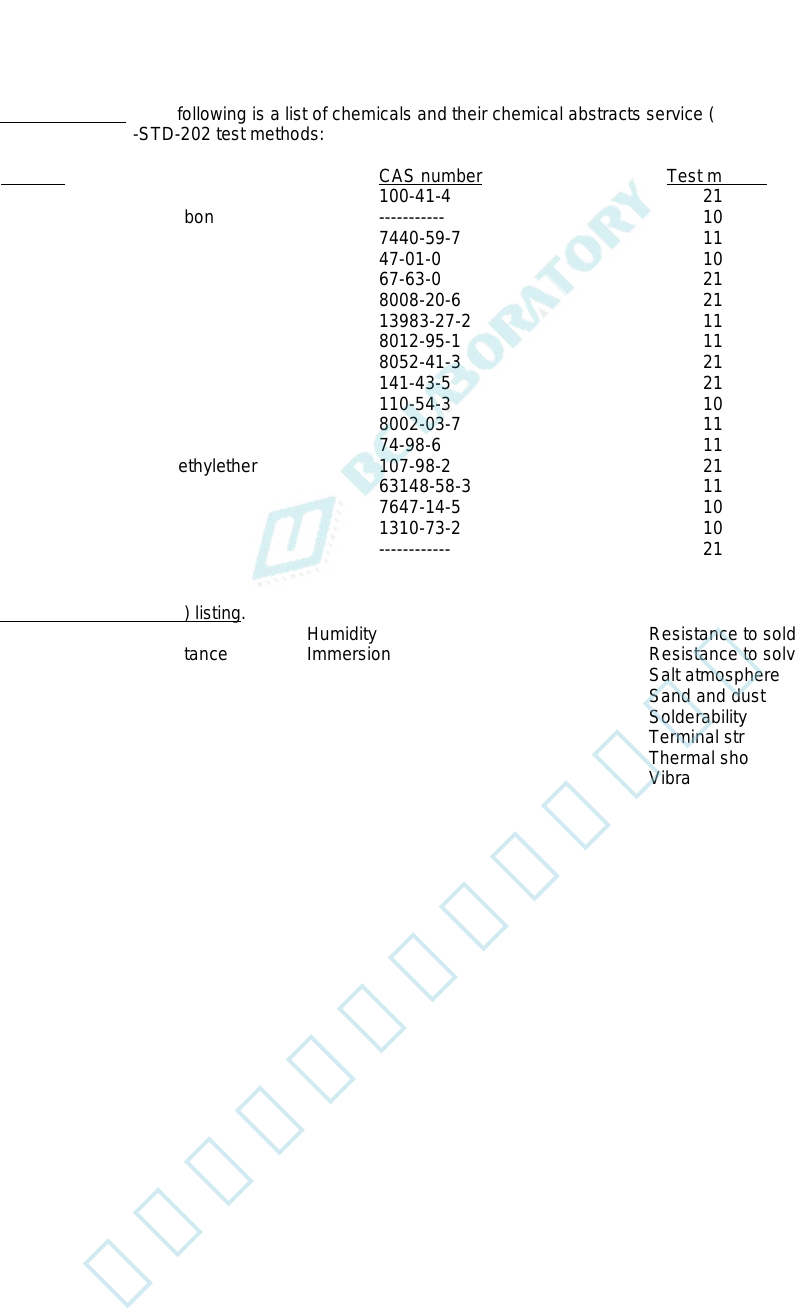
6.4 Chemical listing. The following is a list of chemicals and their chemical abstracts service (CAS) registry number
identified for use in MIL-STD-202 test methods:
Material CAS number Test method
ethylbenzene 100-41-4 215
fluorocarbon/perfluorocarbon ----------- 107, 112, 210
helium 7440-59-7 112
hydrochloric acid 47-01-0 101
isopropyl alcohol 67-63-0 215
kerosene 8008-20-6 215
krypton-85 13983-27-2 112
mineral oil 8012-95-1 112
mineral spirits 8052-41-3 215
monoethanolamine 141-43-5 215
n-hexane 110-54-3 109
peanut oil 8002-03-7 112
propane 74-98-6 111
propylene glycol monomethylether 107-98-2 215
silicone oil 63148-58-3 112
sodium chloride 7647-14-5 104
sodium hydroxide 1310-73-2 101
terpene ------------ 215
6.5 Subject term (key word) listing.
Barometric pressure
Contact chatter/resistance
Current noise
Current switching
DC resistance
Dielectric withstanding voltage
Explosion
Flammability
Humidity
Immersion
Insulation resistance
Life
Moisture resistance
PIND
Radiographic inspection
Random drop
Resistance to soldering heat
Resistance to solvents
Salt atmosphere
Sand and dust
Solderability
Terminal strength
Thermal shock
Vibration
4
北测(上海)电子科技有限公司
联系方式:xuyj@beice-sh.com 13917165676
MIL-STD-202H
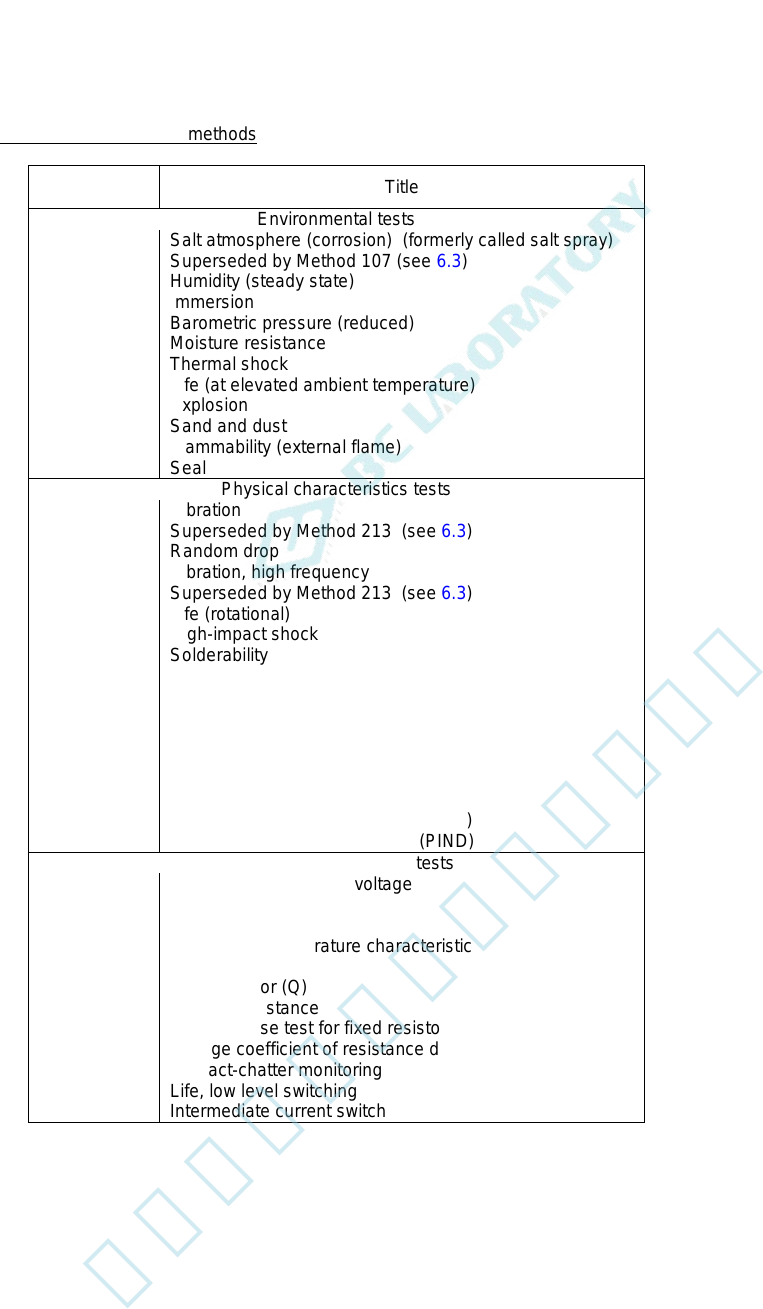
6.6 Numerical index of test methods
Test Method
Number
Title
Environmental tests
-101
-102
-103
-104
-105
-106
-107
-108
-109
-110
-111
-112
Salt atmosphere (corrosion) (formerly called salt spray)
Superseded by Method 107 (see 6.3)
Humidity (steady state)
Immersion
Barometric pressure (reduced)
Moisture resistance
Thermal shock
Life (at elevated ambient temperature)
Explosion
Sand and dust
Flammability (external flame)
Seal
Physical characteristics tests
-201
-202
-203
-204
-205
-206
-207
-208
-209
-210
-211
-212
-213
-214
-215
-216
-217
Vibration
Superseded by Method 213 (see 6.3)
Random drop
Vibration, high frequency
Superseded by Method 213 (see 6.3)
Life (rotational)
High-impact shock
Solderability
Radiographic inspection
Resistance to soldering heat
Terminal strength
Acceleration
Shock (specified pulse)
Random vibration
Resistance to solvents
Superseded by Method 210 (see 6.3)
Particle impact noise detection (PIND)
Electrical characteristics tests
-301
-302
-303
-304
-305
-306
-307
-308
-309
-310
-311
-312
Dielectric withstanding voltage
Insulation resistance
DC resistance
Resistance temperature characteristic
Capacitance
Quality factor (Q)
Contact resistance
Current-noise test for fixed resistors
Voltage coefficient of resistance determination procedure
Contact-chatter monitoring
Life, low level switching
Intermediate current switching
5
北测(上海)电子科技有限公司
联系方式:xuyj@beice-sh.com 13917165676
MIL-STD-202H
6.7 Changes from previous issue. The margins of this standard are marked with vertical lines to indicate where changes
from the previous issue were made. This was done as a convenience only and the Government assumes no liability
whatsoever for any inaccuracies in these notations. Bidders and contractors are cautioned to evaluate the requirements of
this document based on the entire content irrespective of the marginal notations.
Custodians: Preparing activity:
Army - CR DLA – CC
Navy - EC
Air Force - 85 (Project 59GP-2015-005)
DLA - CC
Review activities:
Army - AR, AT, AV, CR4, MI, SM, TE
Navy - AS, OS, SH
Air Force - 19, 99
NSA - NS
NOTE: The activities listed above were interested in this document as of the date of this document. Since organizations and
responsibilities can change, you should verify the currency of the information above using the ASSIST Online database at
https://assist.dla.mil/.
6
北测(上海)电子科技有限公司
联系方式:xuyj@beice-sh.com 13917165676