MIL-STD-202H.pdf - 第249页
MI L - S TD - 202 - 30 4 M E TH O D 30 4 R ESI ST AN C E- T E M P E RA T UR E CHA RA CT E RI S T I C 1. SCOPE 1. 1 P urpose . It is the pur p os e of t h i s t es t t o d et er m i n e t he p er c en t age c h ange i n d…
MIL-STD-202-304
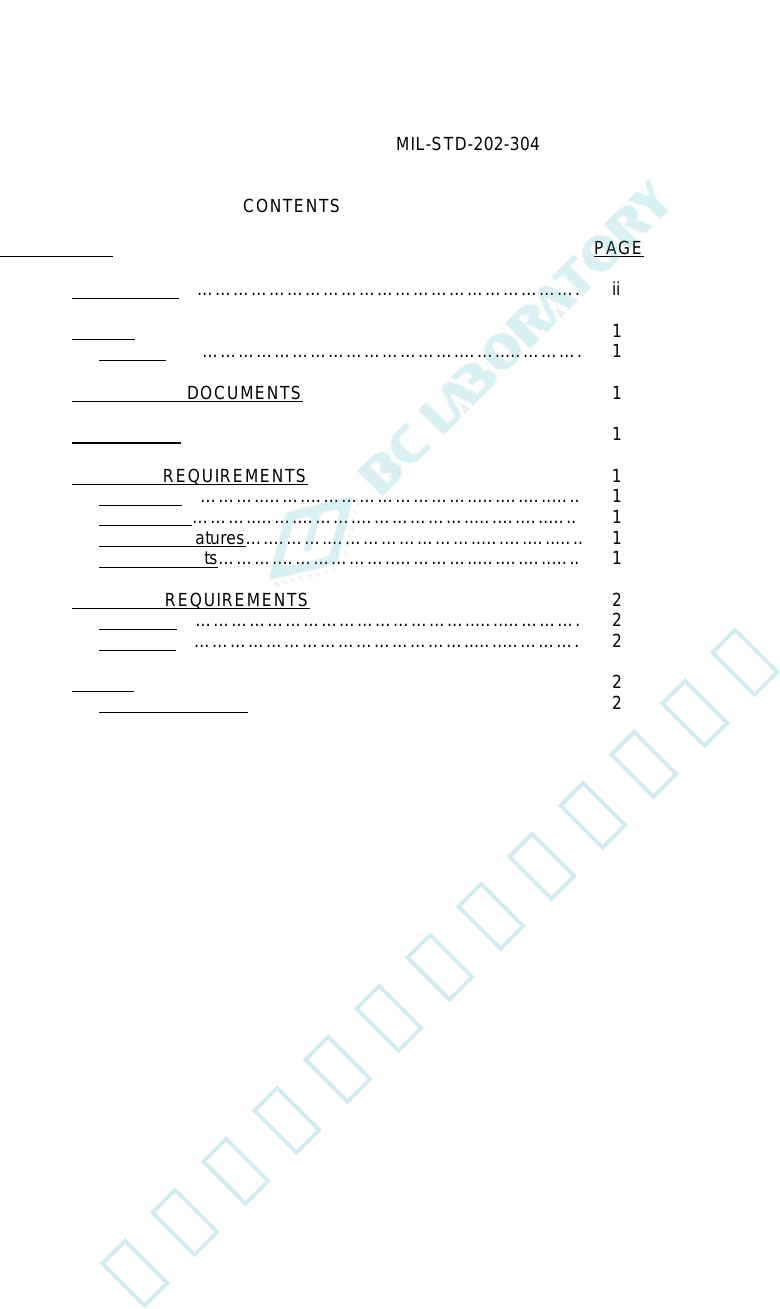
CONTENTS
PARAGRAPH PAGE
FOREWORD…………………………………………………………. ii
1. SCOPE 1
1.1 Purpose………………………………………….……..…………. 1
2. APPLICABLE DOCUMENTS 1
3. DEFINTIONS 1
4. GENERAL REQUIREMENTS 1
4.1 Procedure…………..…….………………………..….….…..….. 1
4.1.1 Preparation………..…….……….………………..….….…..….. 1
4.1.2 Test temperatures….……….……………………..….….…..….. 1
4.1.3 Measurements……….………………..…………..….….…..….. 1
5. DETAILED REQUIREMENTS 2
5.1 Results……………………………………………..…..…………. 2
5.2 Summary…………………………………………..…..…………. 2
6. NOTES 2
6.1 Supersession data………………………………………………. 2
iii
北测(上海)电子科技有限公司
联系方式:xuyj@beice-sh.com 13917165676
MIL-STD-202-304
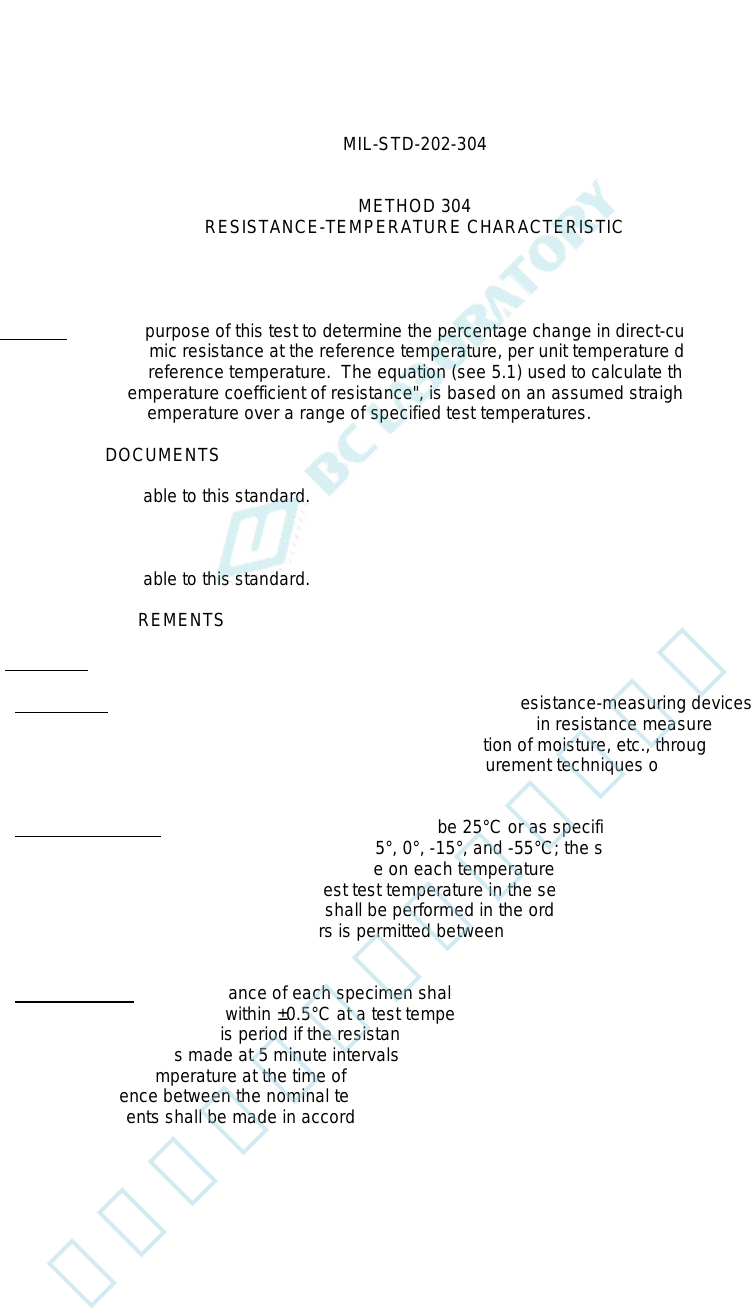
METHOD 304
RESISTANCE-TEMPERATURE CHARACTERISTIC
1. SCOPE
1.1 Purpose. It is the purpose of this test to determine the percentage change in direct-current (dc) ohmic
resistance from the dc ohmic resistance at the reference temperature, per unit temperature difference between the
test temperature and the reference temperature. The equation (see 5.1) used to calculate this characteristic,
commonly called the "temperature coefficient of resistance", is based on an assumed straight-line relationship
between resistance and temperature over a range of specified test temperatures.
2. APPLICABLE DOCUMENTS
This section not applicable to this standard.
3. DEFINTIONS
This section not applicable to this standard.
4. GENERAL REQUIREMENTS
4.1. Procedure.
4.1.1 Preparation. Test leads used to connect the specimens to the resistance-measuring devices shall be firmly
fastened to the specimens. Precautions shall be taken to minimize errors in resistance measurement due to such
factors as lead resistance, spurious electromotive forces, condensation of moisture, etc., throughout the range of test
temperatures, by utilization of suitable test-lead materials and measurement techniques or by applying appropriate
corrections.
4.1.2 Test temperatures. The reference temperature shall be 25°C or as specified. There shall be two standard
series of test temperatures. The first series shall be 25°, 0°, -15°, and -55°C; the second series shall be 25°, 50°,
75°, 100°, 125°, 200°, 275°, and 350°C. The tolerance on each temperature in both series shall be ±3°C. The lowest
test temperature in the first series, and the highest test temperature in the second series, shall be as specified.
Measurements for each series of temperatures shall be performed in the order shown without interruption.
However, a lapse of time not to exceed 24 hours is permitted between the end of the first series and the start of the
second series.
4.1.3 Measurements. The resistance of each specimen shall be measured 30 to 45 minutes after the chamber
temperature has become stable to within ±0.5°C at a test temperature. However, it will be permissible to measure
the resistance before the end of this period if the resistance has become stable to within ±0.1 percent as determined
by preliminary measurements made at 5 minute intervals after stabilization of the chamber temperature. Unless
otherwise specified, the temperature at the time of measurement shall be measured to an accuracy of ±1 percent of
the temperature difference between the nominal test temperature and the nominal reference temperature +0.5°C.
Resistance measurements shall be made in accordance with MIL-STD-202-303.
1
北测(上海)电子科技有限公司
联系方式:xuyj@beice-sh.com 13917165676
MIL-STD-202-304
5. DETAILED REQUIREMENTS
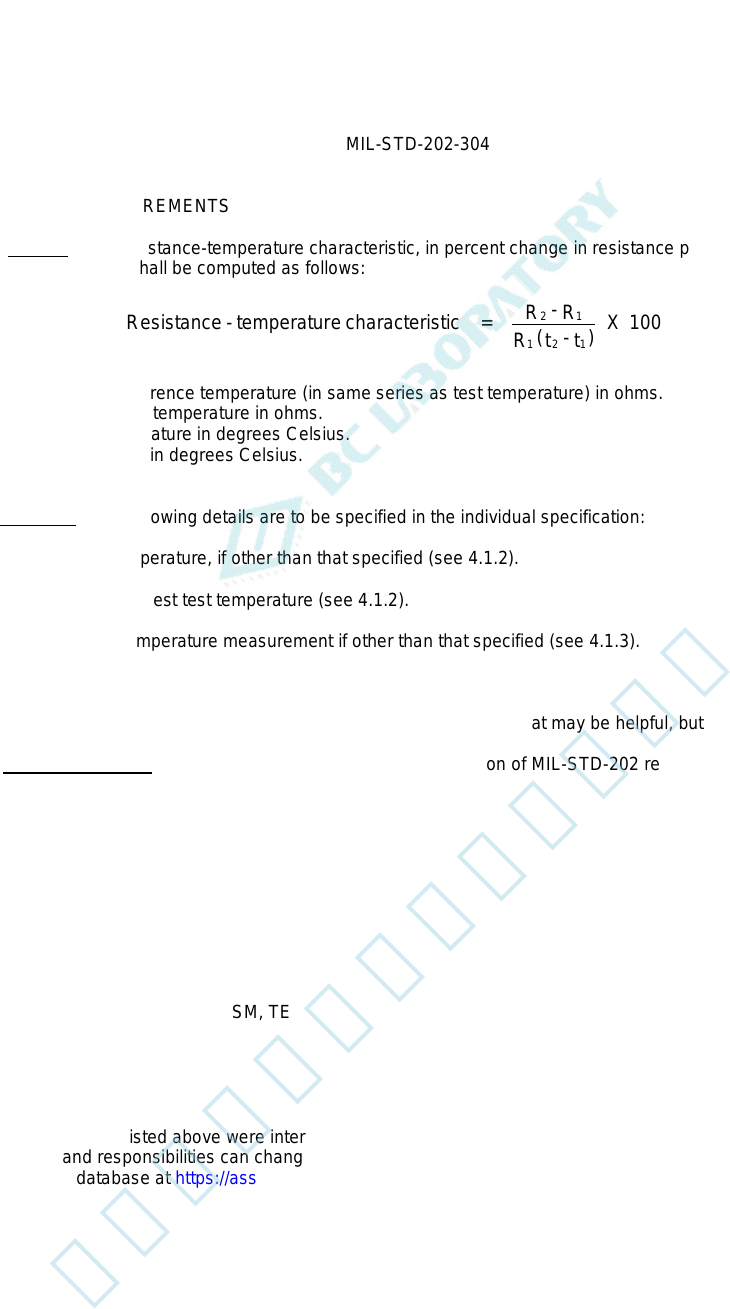
5.1. Results. The resistance-temperature characteristic, in percent change in resistance per degree centigrade, at
each test temperature shall be computed as follows:
Where:
R
1
= resistance at reference temperature (in same series as test temperature) in ohms.
R
2
= resistance at test temperature in ohms.
t
1
= reference temperature in degrees Celsius.
t
2
= test temperature in degrees Celsius.
5.2 Summary. The following details are to be specified in the individual specification:
a. Reference temperature, if other than that specified (see 4.1.2).
b. Lowest and highest test temperature (see 4.1.2).
c. Accuracy of temperature measurement if other than that specified (see 4.1.3).
6. NOTES
(This section contains information of a general or explanatory nature that may be helpful, but is not mandatory.)
6.1 Supersession data. The main body and 38 parts of this revision of MIL-STD-202 replace superseded MIL-STD-
202.
Custodians: Preparing activity:
Army - CR DLA – CC
Navy - EC
Air Force - 85 (Project 59GP-2015-034)
DLA - CC
Review activities:
Army - AR, AT, AV, CR4, MI, SM, TE
Navy - AS, OS, SH
Air Force - 19, 99
NSA - NS
NOTE: The activities listed above were interested in this document as of the date of this document. Since
organizations and responsibilities can change, you should verify the currency of the information above using the
ASSIST Online database at https://assist.dla.mil/
100 X
)
t
-
t
(
R
R
-
R
= sticcharacteri etemperatur-Resistance
12
1
12
2
北测(上海)电子科技有限公司
联系方式:xuyj@beice-sh.com 13917165676