MIL-STD-202H.pdf - 第232页
MI L - S TD - 202 - 301 M E TH O D 301 DI E L E CT RI C W I T HS T A NDI N G V O L T A G E 1. SCOPE 1. 1 P urpose . T he die l ec t r i c w i t hs t and i ng v ol t age t e s t ( a l s o c al l e d hi gh - po t ent i al …
MIL-STD-202-301
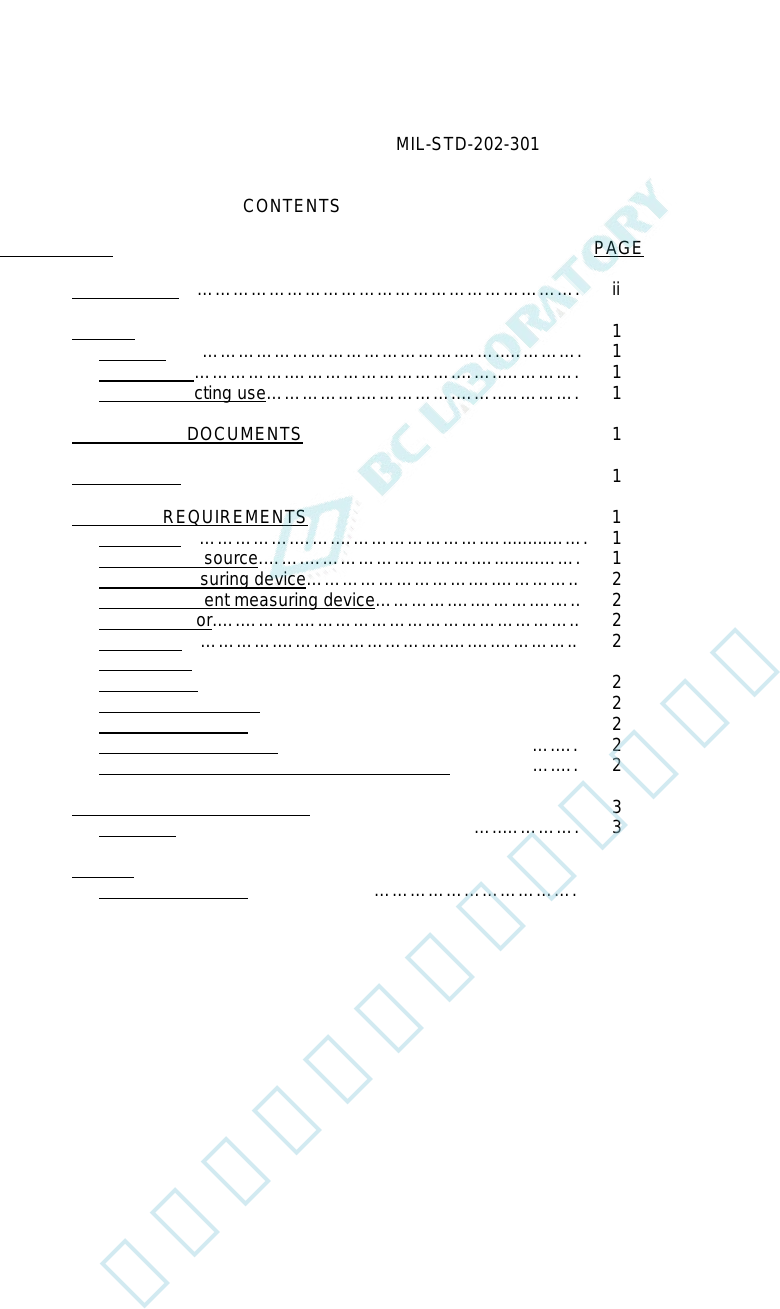
CONTENTS
PARAGRAPH PAGE
FOREWORD…………………………………………………………. ii
1. SCOPE 1
1.1 Purpose………………………………………….……..…………. 1
1.2 Precautions…………….……………………….……..…………. 1
1.3 Factors affecting use…………….…………….……..…………. 1
2. APPLICABLE DOCUMENTS 1
3. DEFINTIONS 1
4. GENERAL REQUIREMENTS 1
4.1 Apparatus……………….…….…………………….….........……. 1
4.1.1 High voltage source.…….…………….………….….........……. 1
4.1.2 Voltage measuring device……………………….….………….. 2
4.1.3 Leakage current measuring device………….….……….…….. 2
4.1.4 Fault indicator.….……….……………………………………….. 2
4.2. Procedure…………….………………………..….….………….. 2
4.2.1 Preparation..……………..…………………..……..……………. 2
4.2.2 Test voltage…….…………………………………….………….. 2
4.2.3 Points of application…………………………..……..……….…. 2
4.2.4 Rate of application……..……………………..……..……….…. 2
4.2.5 Duration of application………………………..……..……….…. 2
4.2.6 Examination and measurement of specimen……..……….…. 2
5. DETAILED REQUIREMENTS 3
5.1 Summary…………………………………………..…..…………. 3
6. NOTES 3
6.1 Supersession data………………………………………………. 3
iii
北测(上海)电子科技有限公司
联系方式:xuyj@beice-sh.com 13917165676
MIL-STD-202-301
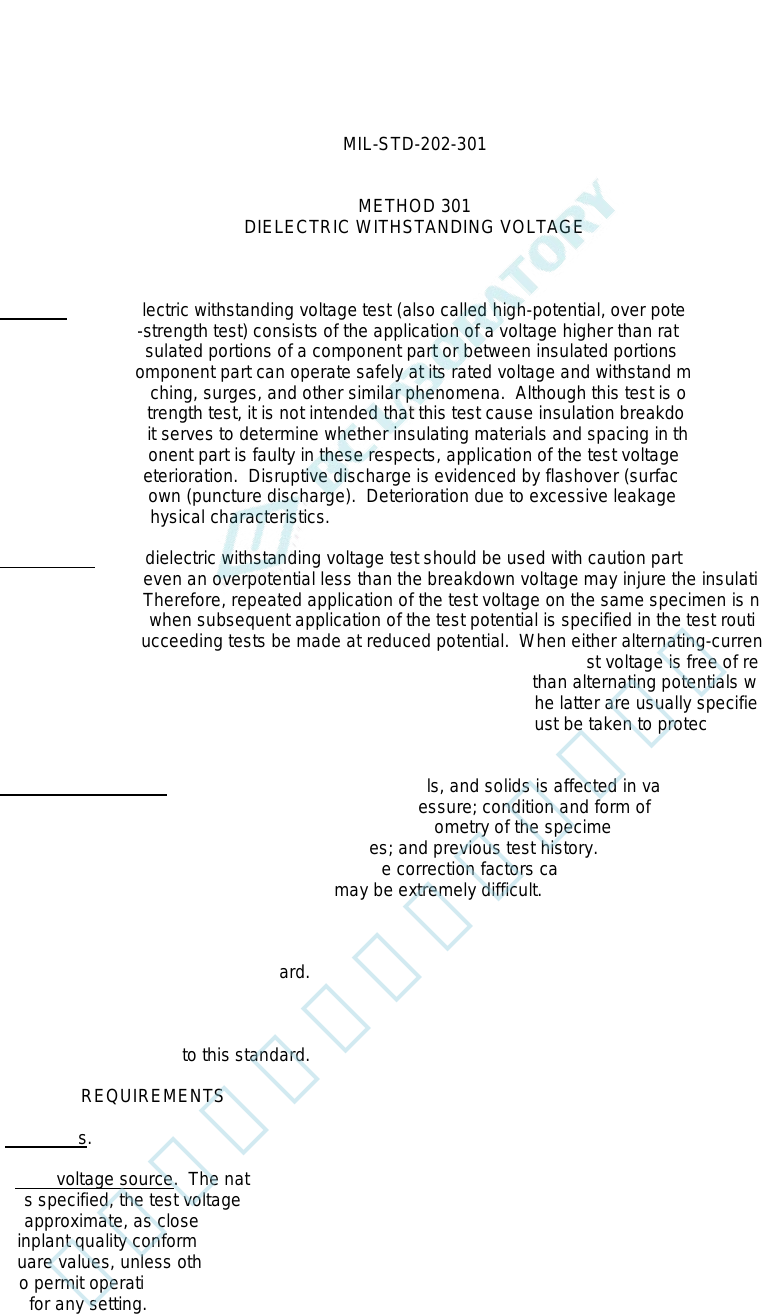
METHOD 301
DIELECTRIC WITHSTANDING VOLTAGE
1. SCOPE
1.1 Purpose. The dielectric withstanding voltage test (also called high-potential, over potential, voltage-
breakdown, or dielectric-strength test) consists of the application of a voltage higher than rated voltage for a specific
time between mutually insulated portions of a component part or between insulated portions and ground. This is
used to prove that the component part can operate safely at its rated voltage and withstand momentary
overpotentials due to switching, surges, and other similar phenomena. Although this test is often called a voltage
breakdown or dielectric-strength test, it is not intended that this test cause insulation breakdown or that it be used for
detecting corona, rather, it serves to determine whether insulating materials and spacing in the component part are
adequate. When a component part is faulty in these respects, application of the test voltage will result in either
disruptive discharge or deterioration. Disruptive discharge is evidenced by flashover (surface discharge), sparkover
(air discharge), or breakdown (puncture discharge). Deterioration due to excessive leakage currents may change
electrical parameters or physical characteristics.
1.2 Precautions. The dielectric withstanding voltage test should be used with caution particularly in inplant quality
conformance testing, as even an overpotential less than the breakdown voltage may injure the insulation and thereby
reduce its safety factor. Therefore, repeated application of the test voltage on the same specimen is not
recommended. In cases when subsequent application of the test potential is specified in the test routine, it is
recommended that the succeeding tests be made at reduced potential. When either alternating-current (ac) or direct-
current (dc) test voltages are used, care should be taken to be certain that the test voltage is free of recurring
transients or high peaks. Direct potentials are considered less damaging than alternating potentials which are
equivalent in ability to detect flaws in design and construction. However, the latter are usually specified because high
alternating potentials are more readily obtainable. Suitable precautions must be taken to protect test personnel and
apparatus because of the high potentials used.
1.3 Factors affecting use. Dielectric behavior of gases, oils, and solids is affected in various degrees by many
factors, such as atmospheric temperature, moisture, and pressure; condition and form of electrodes; frequency,
waveform, rate of application, and duration of test voltage; geometry of the specimen; position of the specimen
(particularly oil-filled components); mechanical stresses; and previous test history. Unless these factors are properly
selected as required by the type of dielectric, or suitable correction factors can be applied, comparison of the results
of individual dielectric withstanding voltage tests may be extremely difficult.
2. APPLICABLE DOCUMENTS
This section not applicable to this standard.
3. DEFINTIONS
This section not applicable to this standard.
4. GENERAL REQUIREMENTS
4.1. Apparatus.
4.1.1 High voltage source. The nature of the potential (ac or dc) shall be as specified. When an alternating
potential is specified, the test voltage provided by the high voltage source shall be nominally 60 hertz in frequency
and shall approximate, as closely as possible, a true sine wave in form. Other commercial power frequencies may be
used for inplant quality conformance testing, when specified. All alternating potentials shall be expressed as root-
mean-square values, unless otherwise specified. The kilovolt-ampere rating and impedance of the source shall be
such as to permit operation at all testing loads without serious distortion of the waveform and without serious change
in voltage for any setting. When the test specimen demands substantial test source power capacity, the regulation of
the source shall be specified. When a minimum kilovoltampere rating is required, it shall be specified. When a direct
potential is specified, the ripple content shall not exceed 5 percent rms of the test potential. When required, a
suitable current-limiting device shall be used to limit current surges to the value specified.
1
北测(上海)电子科技有限公司
联系方式:xuyj@beice-sh.com 13917165676
MIL-STD-202-301
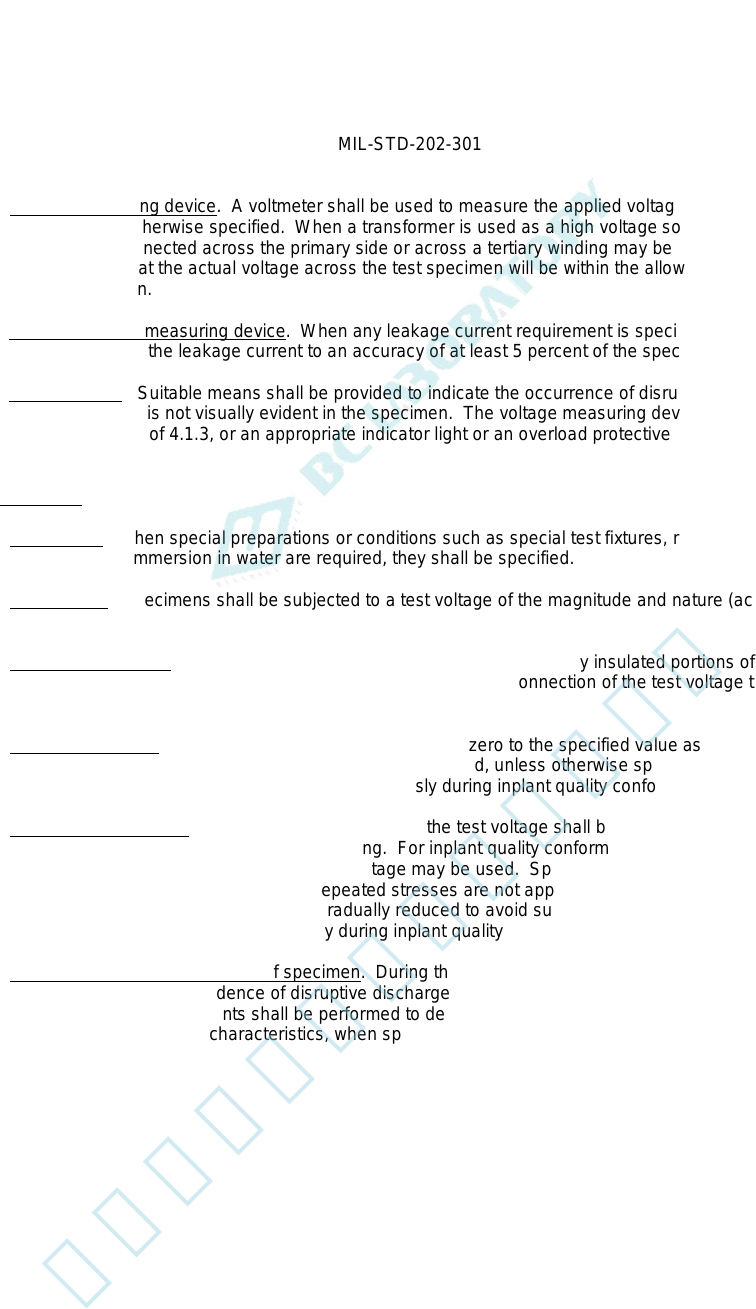
4.1.2 Voltage measuring device. A voltmeter shall be used to measure the applied voltage to an accuracy of at
least 5 percent, unless otherwise specified. When a transformer is used as a high voltage source of alternating
potential, a voltmeter connected across the primary side or across a tertiary winding may be used provided it is
previously determined that the actual voltage across the test specimen will be within the allowable tolerance under
any normal load condition.
4.1.3 Leakage current measuring device. When any leakage current requirement is specified, a suitable method
shall be used to measure the leakage current to an accuracy of at least 5 percent of the specified requirement.
4.1.4 Fault indicator. Suitable means shall be provided to indicate the occurrence of disruptive discharge and
leakage current in case it is not visually evident in the specimen. The voltage measuring device of 4.1.2, the leakage
current measuring device of 4.1.3, or an appropriate indicator light or an overload protective device may be used for
this purpose.
4.2. Procedure
4.2.1 Preparation. When special preparations or conditions such as special test fixtures, reconnections,
grounding, isolation, or immersion in water are required, they shall be specified.
4.2.2 Test voltage. Specimens shall be subjected to a test voltage of the magnitude and nature (ac or dc)
specified.
4.2.3 Points of application. The test voltage shall be applied between mutually insulated portions of the specimen
or between insulated portions and ground as specified. The method of connection of the test voltage to the specimen
should be specified only when it is a significant factor.
4.2.4 Rate of application. The test voltage shall be raised from zero to the specified value as uniformly as
possible, at a rate of approximately 500 volts (rms or dc) per second, unless otherwise specified. At the option of the
manufacturer, the test voltage may be applied instantaneously during inplant quality conformance testing.
4.2.5 Duration of application. Unless otherwise specified, the test voltage shall be maintained at the specified
value for a period of 60 seconds for qualification testing. For inplant quality conformance testing, when specified,
reduced time with a possible correlated higher test voltage may be used. Specimens with movable parts shall be
tested as specified, in a manner to assure that repeated stresses are not applied to the same dielectric. Upon
completion of the test, the test voltage shall be gradually reduced to avoid surges. At the option of the manufacturer,
the test voltage may be removed instantaneously during inplant quality conformance testing.
4.2.6 Examination and measurement of specimen. During the dielectric withstanding voltage test, the fault
indicator shall be monitored for evidence of disruptive discharge and leakage current. Following this, the specimen
shall be examined and measurements shall be performed to determine the effect of the dielectric withstanding
voltage test on specific operating characteristics, when specified.
2
北测(上海)电子科技有限公司
联系方式:xuyj@beice-sh.com 13917165676