MIL-STD-202H.pdf - 第216页
MI L - S TD - 202 -2 1 5 T ABL E I . S um m ar y t ab l e f or r es i s t an c e t o s ol v ent s . Solvent 1 S ol v ent 2 S ol v ent 3 Solvent 4 1 part (by volume) of is o pr opy l alcohol (ACS) reagent gra de or TT -I-…
MIL-STD-202-215
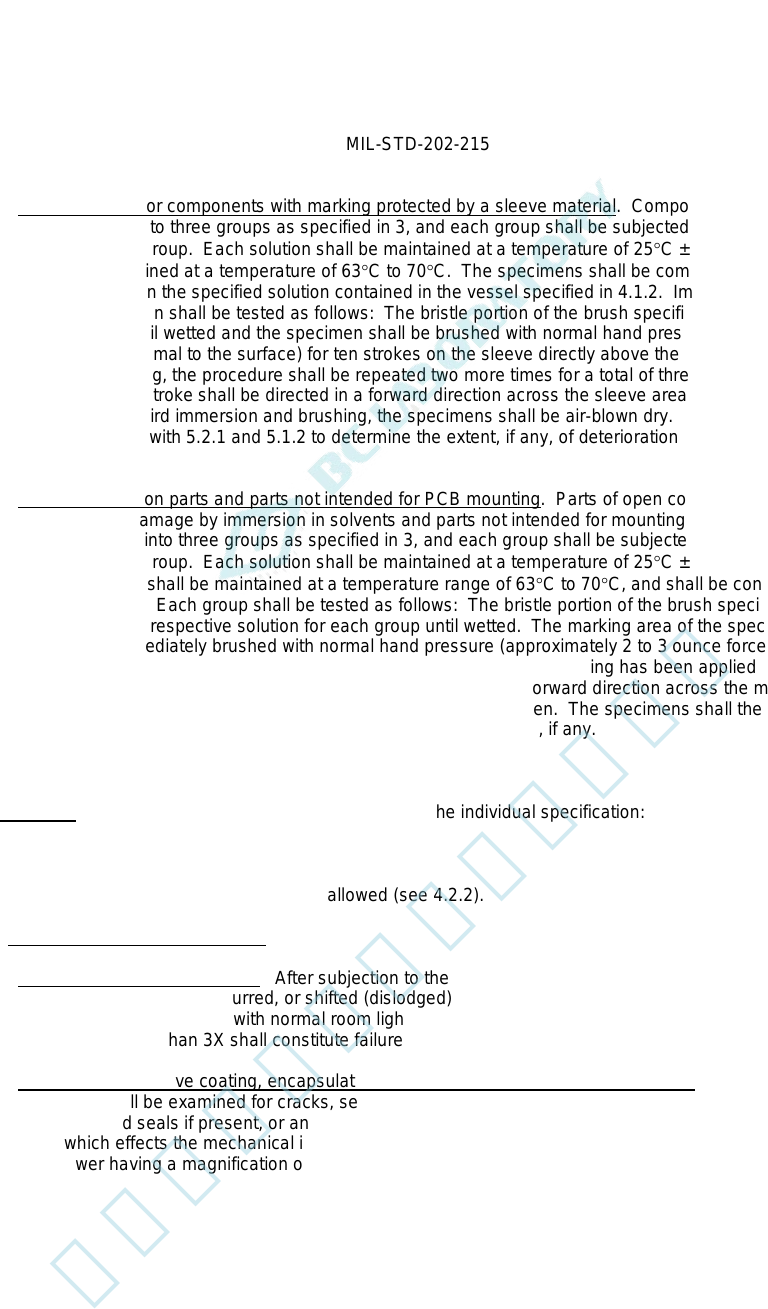
4.2.3 Immersion test for components with marking protected by a sleeve material. Components with a protective
sleeve shall be divided into three groups as specified in 3, and each group shall be subjected to testing using the
solution defined for that group. Each solution shall be maintained at a temperature of 25°C ±5°C, except the solution
in 4.1.1d shall be maintained at a temperature of 63°C to 70°C. The specimens shall be completely immersed for 3
minutes +.5, -0 minutes in the specified solution contained in the vessel specified in 4.1.2. Immediately following
immersion, each specimen shall be tested as follows: The bristle portion of the brush specified in 4.1.3 shall be
dipped in the solution until wetted and the specimen shall be brushed with normal hand pressure (approximately 2 to
3 ounce force applied normal to the surface) for ten strokes on the sleeve directly above the area of the marking.
Immediately after brushing, the procedure shall be repeated two more times for a total of three immersions followed
by brushing. The brush stroke shall be directed in a forward direction across the sleeve area above the marking.
After completion of the third immersion and brushing, the specimens shall be air-blown dry. The specimens shall be
inspected in accordance with 5.2.1 and 5.1.2 to determine the extent, if any, of deterioration that has occurred,
including the sleeve.
4.2.4 Open construction parts and parts not intended for PCB mounting. Parts of open construction which are
susceptible to internal damage by immersion in solvents and parts not intended for mounting on printed circuit
boards, shall be divided into three groups as specified in 3, and each group shall be subjected to testing using the
solution defined for that group. Each solution shall be maintained at a temperature of 25°C ±5°C, except for the
solution in 4.1.1d, which shall be maintained at a temperature range of 63°C to 70°C, and shall be contained in the
vessel specified in 4.1.2. Each group shall be tested as follows: The bristle portion of the brush specified in 4.1.3
shall be immersed in the respective solution for each group until wetted. The marking area of the specimen to be
tested shall then be immediately brushed with normal hand pressure (approximately 2 to 3 ounce force applied
normal to the surface) for ten strokes on the portion of the specimen where marking has been applied (test area not
to exceed one-half inch square). The brush stroke shall be directed in a forward direction across the marked surface.
This test shall be repeated twice for a total of three times for each specimen. The specimens shall then be inspected
in accordance with 5.2.1 and 5.2.2 to determine the extent of deterioration, if any.
5. DETAILED REQUIREMENTS
5.1 Summary. The following details are to be specified in the individual specification:
a. The number of specimens to be tested.
b. Optional procedure for the third group allowed (see 4.2.2).
5.2. Examination and measurements
5.2.1 Marking resistance to solvents. After subjection to the test, any specified markings which are missing in
whole or in part, faded, smeared, blurred, or shifted (dislodged) to the extent that they cannot be readily identified
from a distance of at least 6 inches with normal room lighting without the aid of magnification or with a viewer having
a magnification no greater than 3X shall constitute failure.
5.2.2 Component protective coating, encapsulation material and sleeve material resistance. After subjection to the
test, the specimen shall be examined for cracks, separations, crazing, swelling, softening, and degradation of body
material, end caps and seals if present, or any other damage or degradation that has occurred due to solvent
exposure and which effects the mechanical integrity or reliability shall constitute a failure. The examination shall be
made with a viewer having a magnification of 10X maximum.
4
北测(上海)电子科技有限公司
联系方式:xuyj@beice-sh.com 13917165676
MIL-STD-202-215
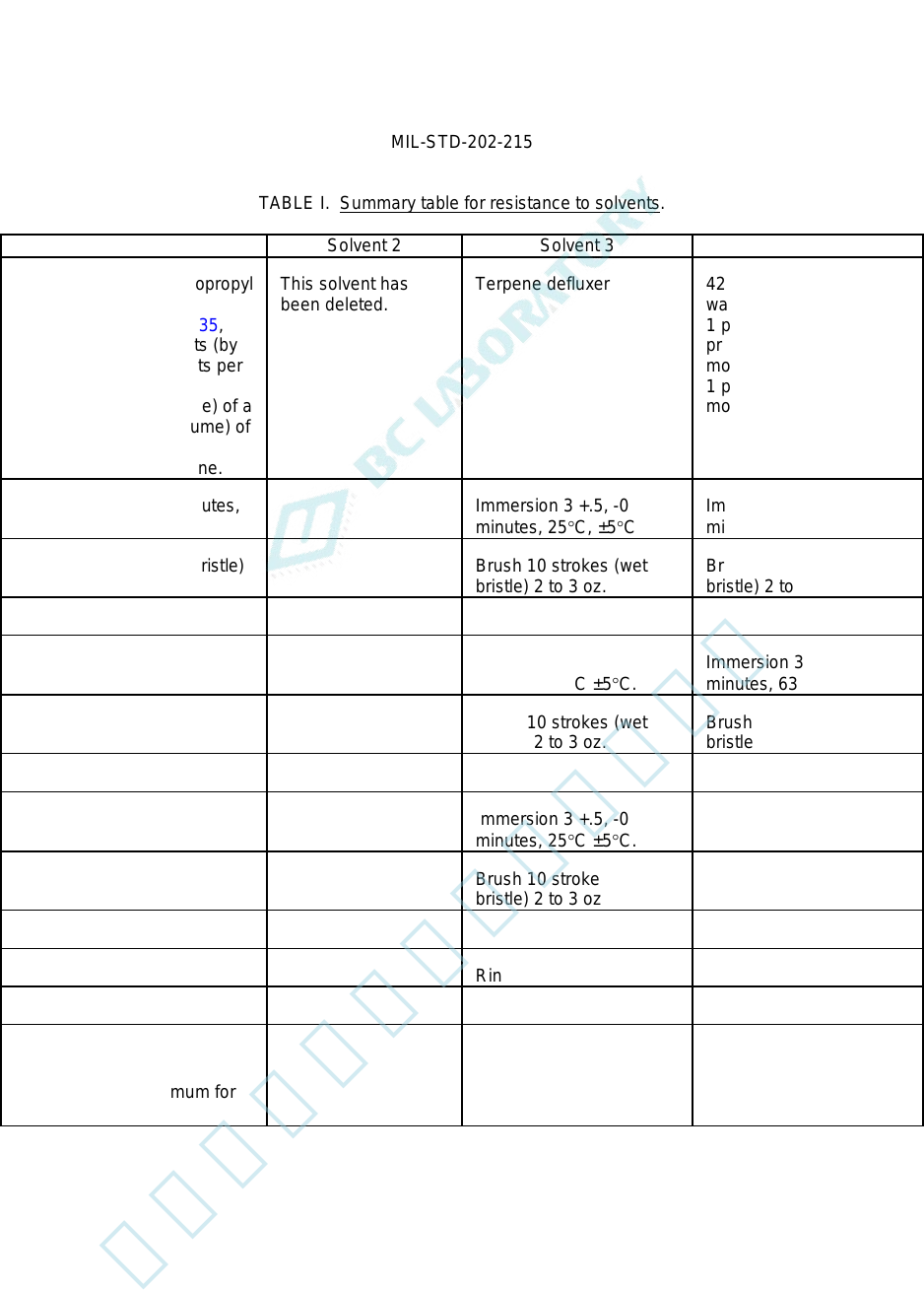
TABLE I. Summary table for resistance to solvents.
Solvent 1 Solvent 2 Solvent 3 Solvent 4
1 part (by volume) of isopropyl
alcohol (ACS)
reagent grade or TT-I-735,
grade A or B and 3 parts (by
volume) of mineral spirits per
MIL-PRF-680, type I,
or three parts (by volume) of a
mixture of 80% (by volume) of
kerosene and 20%
(by volume) ethylbenzene.
This solvent has
been deleted.
Terpene defluxer
42 parts (by volume) of
water
1 part (by volume) of
propylene glycol
monomethyl ether
1 part (by volume) of
monoethanolamine
Immersion 3 +.5, -0 minutes,
25°C ±5°C
Immersion 3 +.5, -0
minutes, 25°C, ±5°C
Immersion 3 +.5, -0
minutes, 63°C to 70°C
Brush 10 strokes (wet bristle)
2 to 3 oz.
Brush 10 strokes (wet
bristle) 2 to 3 oz.
Brush 10 strokes (wet
bristle) 2 to 3 oz.
Immersion 3 +.5, -0 minutes,
25°C ±5°C.
Immersion 3 +.5, -0
minutes, 25°C ±5°C.
Immersion 3 +.5, -0
minutes, 63°C to 70°C.
Brush 10 strokes (wet bristle)
2 to 3 oz.
Brush 10 strokes (wet
bristle) 2 to 3 oz.
Brush 10 strokes (wet
bristle) 2 to 3 oz.
Immersion 3 +.5, -0 minutes,
25°C ±5°C.
Immersion 3 +.5, -0
minutes, 25°C ±5°C.
Immersion 3 +.5, -0
minutes, 63°C to 70°C.
Brush 10 strokes (wet bristle)
2 to 3 oz.
Brush 10 strokes (wet
bristle) 2 to 3 oz.
Brush 10 strokes (wet
bristle) 2 to 3 oz.
Rinse in water
Rinse in water.
Air blow dry.
Air blow dry
Air blow dry.
Inspect at 3X maximum for
marking.
Inspect at 10X maximum for
part damage.
Inspect at 3X maximum
for marking.
Inspect at 10X maximum
for part damage.
Inspect at 3X maximum
for marking.
Inspect at 10X maximum
for part damage.
5
北测(上海)电子科技有限公司
联系方式:xuyj@beice-sh.com 13917165676
MIL-STD-202-215
6. NOTES
(This section contains information of a general or explanatory nature that may be helpful, but is not mandatory.)
6.1 Supersession data. The main body and 38 parts of this revision of MIL-STD-202 replace superseded MIL-STD-
202.
Custodians: Preparing activity:
Army - CR DLA – CC
Navy - EC
Air Force - 85 (Project 59GP-2015-029)
DLA - CC
Review activities:
Army - AR, AT, AV, CR4, MI, SM, TE
Navy - AS, OS, SH
Air Force - 19, 99
NSA - NS
NOTE: The activities listed above were interested in this document as of the date of this document. Since
organizations and responsibilities can change, you should verify the currency of the information above using the
ASSIST Online database at https://assist.dla.mil/
6
北测(上海)电子科技有限公司
联系方式:xuyj@beice-sh.com 13917165676