MIL-STD-202H.pdf - 第8页
MIL - S TD - 202H 6. 4 Chem ica l lis tin g . The f ol l o w i ng i s a l i s t of c h em i c al s a nd t hei r c he m i c al ab s t r ac t s s er v i c e ( CAS) regi stry number identifie d for use in M IL - S TD - 2 02…
MIL-STD-202H
5. DETAILED REQUIREMENTS
This section is not applicable to this standard.
6. NOTES
(This section contains information of a general or explanatory nature which may be helpful, but is not mandatory).
6.1 Intended use. This test method standard specifies uniform procedures for the environmental, physical, and electrical
testing of electronic and electrical component piece parts. It is intended as a reference document for test requirements called
out in military component specifications and when specified, in other procurement specifications and drawings.
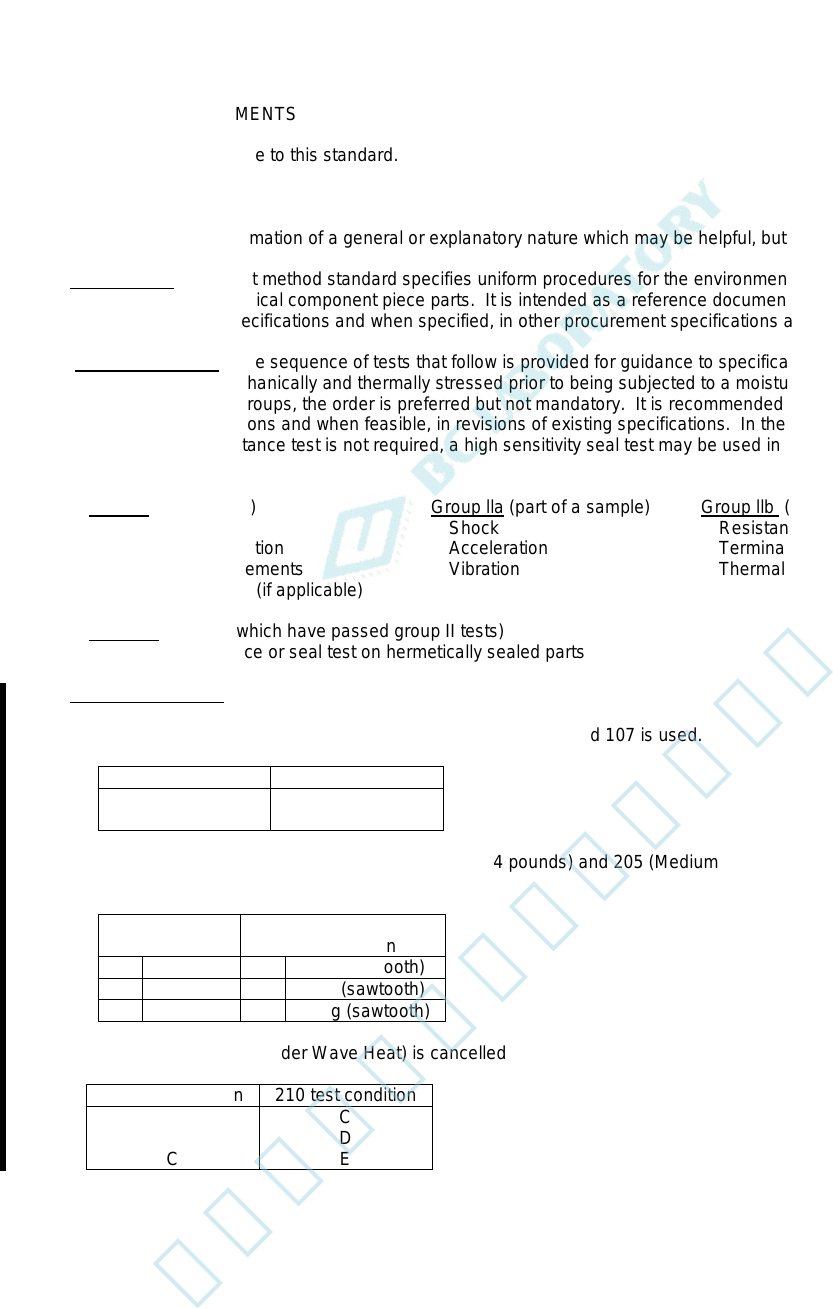
6.2 Sequence of tests. The sequence of tests that follow is provided for guidance to specification writers to emphasize the
philosophy that parts be mechanically and thermally stressed prior to being subjected to a moisture resistance test. Within any
of the three groups and subgroups, the order is preferred but not mandatory. It is recommended that this sequence be
followed in all new specifications and when feasible, in revisions of existing specifications. In the case of hermetically sealed
parts, when a moisture resistance test is not required, a high sensitivity seal test may be used in lieu of the moisture resistance
test.
Group I (all samples) Group lla (part of a sample) Group llb (part of a sample)
Visual inspection Shock Resistance to soldering heat
Mechanical inspection Acceleration Terminal Strength
Electrical measurements Vibration Thermal Shock
Hermetic seal test (if applicable)
Group III (all units which have passed group II tests)
Moisture resistance or seal test on hermetically sealed parts
6.3 Cancelled methods
Method 102, Temperature Cycling is cancelled, when specified Method 107 is used.
102 test condition 107 test condition
A, B, and D
C
A
B
Methods 202 (Shock, specimens weighing not more than 4 pounds) and 205 (Medium Impact) are cancelled, when specified
use Method 213.
202 or 205
test condition
213
test condition
A 15g (pk) K 30g (sawtooth)
B 30g (pk) H 75g (sawtooth)
C 50g (pk) I 100g (sawtooth)
Method 216 (Resistance to Solder Wave Heat) is cancelled, when specified Method 210 is used.
216 test condition 210 test condition
A
B
C
C
D
E
3
北测(上海)电子科技有限公司
联系方式:xuyj@beice-sh.com 13917165676
MIL-STD-202H
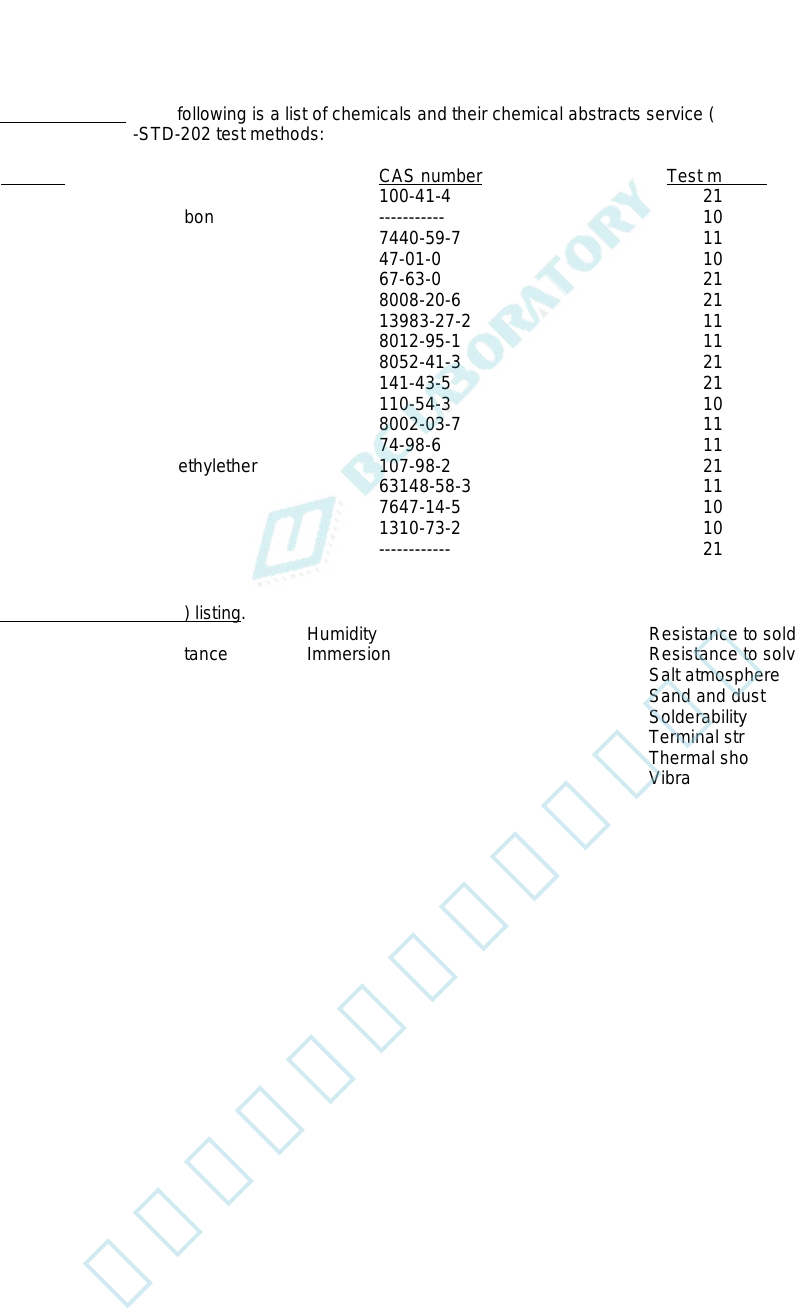
6.4 Chemical listing. The following is a list of chemicals and their chemical abstracts service (CAS) registry number
identified for use in MIL-STD-202 test methods:
Material CAS number Test method
ethylbenzene 100-41-4 215
fluorocarbon/perfluorocarbon ----------- 107, 112, 210
helium 7440-59-7 112
hydrochloric acid 47-01-0 101
isopropyl alcohol 67-63-0 215
kerosene 8008-20-6 215
krypton-85 13983-27-2 112
mineral oil 8012-95-1 112
mineral spirits 8052-41-3 215
monoethanolamine 141-43-5 215
n-hexane 110-54-3 109
peanut oil 8002-03-7 112
propane 74-98-6 111
propylene glycol monomethylether 107-98-2 215
silicone oil 63148-58-3 112
sodium chloride 7647-14-5 104
sodium hydroxide 1310-73-2 101
terpene ------------ 215
6.5 Subject term (key word) listing.
Barometric pressure
Contact chatter/resistance
Current noise
Current switching
DC resistance
Dielectric withstanding voltage
Explosion
Flammability
Humidity
Immersion
Insulation resistance
Life
Moisture resistance
PIND
Radiographic inspection
Random drop
Resistance to soldering heat
Resistance to solvents
Salt atmosphere
Sand and dust
Solderability
Terminal strength
Thermal shock
Vibration
4
北测(上海)电子科技有限公司
联系方式:xuyj@beice-sh.com 13917165676
MIL-STD-202H
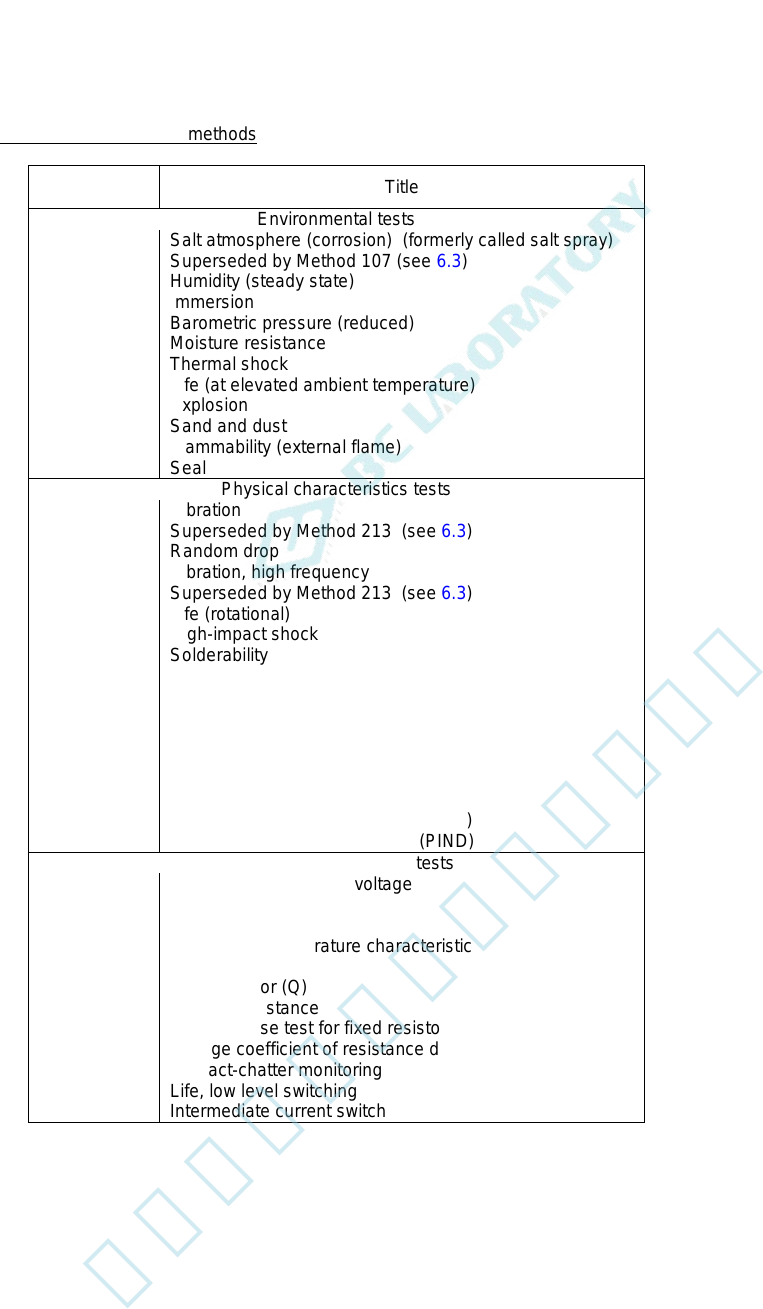
6.6 Numerical index of test methods
Test Method
Number
Title
Environmental tests
-101
-102
-103
-104
-105
-106
-107
-108
-109
-110
-111
-112
Salt atmosphere (corrosion) (formerly called salt spray)
Superseded by Method 107 (see 6.3)
Humidity (steady state)
Immersion
Barometric pressure (reduced)
Moisture resistance
Thermal shock
Life (at elevated ambient temperature)
Explosion
Sand and dust
Flammability (external flame)
Seal
Physical characteristics tests
-201
-202
-203
-204
-205
-206
-207
-208
-209
-210
-211
-212
-213
-214
-215
-216
-217
Vibration
Superseded by Method 213 (see 6.3)
Random drop
Vibration, high frequency
Superseded by Method 213 (see 6.3)
Life (rotational)
High-impact shock
Solderability
Radiographic inspection
Resistance to soldering heat
Terminal strength
Acceleration
Shock (specified pulse)
Random vibration
Resistance to solvents
Superseded by Method 210 (see 6.3)
Particle impact noise detection (PIND)
Electrical characteristics tests
-301
-302
-303
-304
-305
-306
-307
-308
-309
-310
-311
-312
Dielectric withstanding voltage
Insulation resistance
DC resistance
Resistance temperature characteristic
Capacitance
Quality factor (Q)
Contact resistance
Current-noise test for fixed resistors
Voltage coefficient of resistance determination procedure
Contact-chatter monitoring
Life, low level switching
Intermediate current switching
5
北测(上海)电子科技有限公司
联系方式:xuyj@beice-sh.com 13917165676