MIL-STD-202H.pdf - 第264页
MI L - S TD - 202 - 30 7 M E TH O D 30 7 C O N T AC T R ESI ST AN C E 1. SCOPE 1. 1 P urpose . T he pur po s e o f t he c ont a c t r es i s t a nc e t es t i s t o det er m i ne t he r e s i s t an c e of f ered to a fl…
MIL-STD-202-307
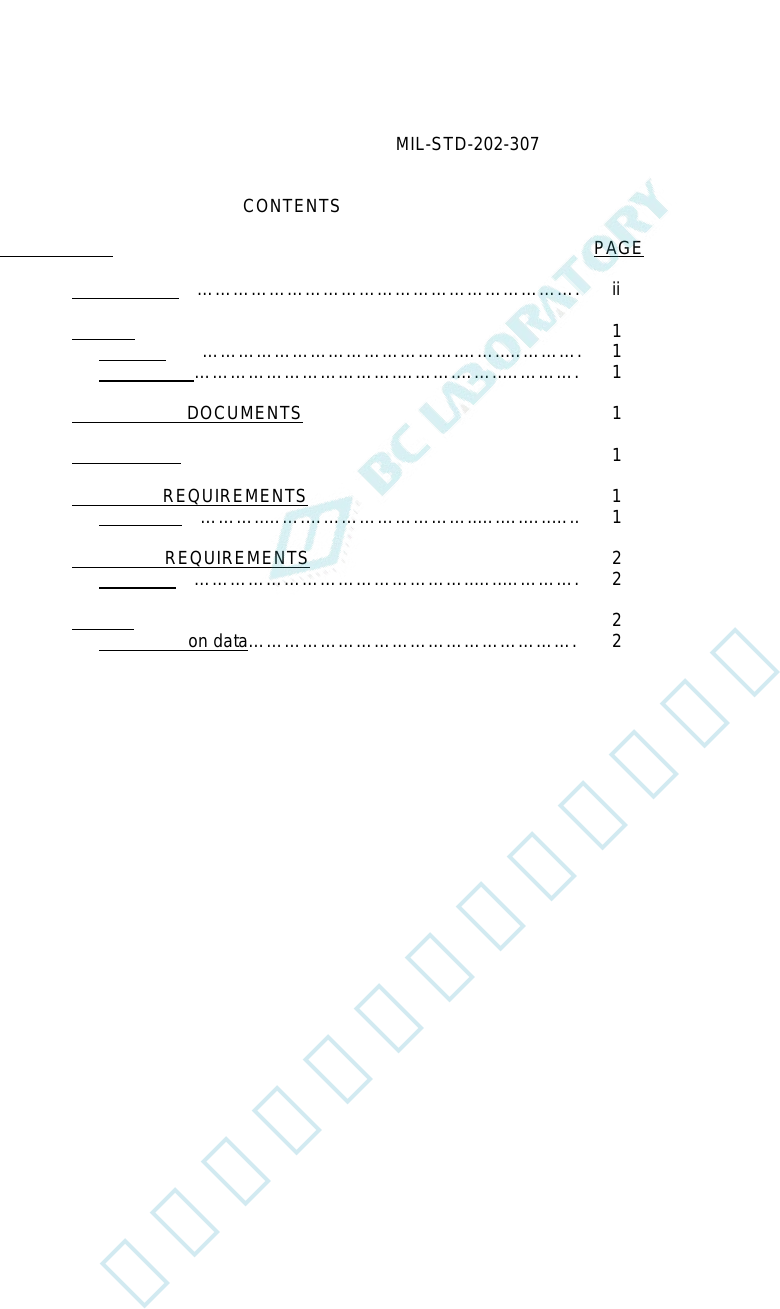
CONTENTS
PARAGRAPH PAGE
FOREWORD…………………………………………………………. ii
1. SCOPE 1
1.1 Purpose………………………………………….……..…………. 1
1.2 Precautions…………………………….……….……..…………. 1
2. APPLICABLE DOCUMENTS 1
3. DEFINTIONS 1
4. GENERAL REQUIREMENTS 1
4.1 Procedure…………..…….………………………..….….…..….. 1
5. DETAILED REQUIREMENTS 2
5.1 Summary…………………………………………..…..…………. 2
6. NOTES 2
6.1 Supersession data………………………………………………. 2
iii
北测(上海)电子科技有限公司
联系方式:xuyj@beice-sh.com 13917165676
MIL-STD-202-307
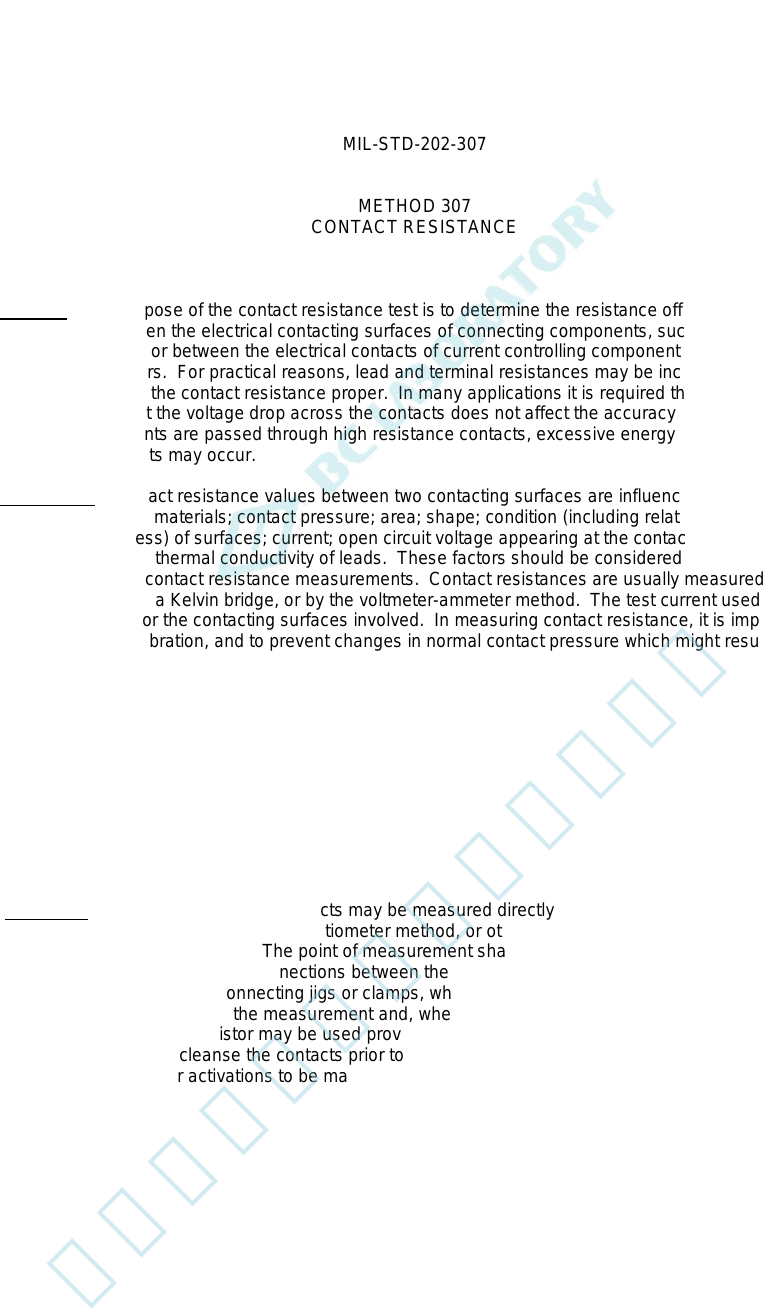
METHOD 307
CONTACT RESISTANCE
1. SCOPE
1.1 Purpose. The purpose of the contact resistance test is to determine the resistance offered to a flow of current
during its passage between the electrical contacting surfaces of connecting components, such as plugs, jacks,
connectors, and sockets, or between the electrical contacts of current controlling components, such as switches,
relays, and circuit breakers. For practical reasons, lead and terminal resistances may be included in the actual
measurement, as well as the contact resistance proper. In many applications it is required that the contact resistance
be low and stable, so that the voltage drop across the contacts does not affect the accuracy of the general circuit
conditions. If large currents are passed through high resistance contacts, excessive energy losses and dangerous
overheating of the contacts may occur.
1.2 Precautions. Contact resistance values between two contacting surfaces are influenced by such factors as the
resistivities of the surface materials; contact pressure; area; shape; condition (including relative cleanliness,
smoothness, and hardness) of surfaces; current; open circuit voltage appearing at the contacts during interruption of
current; temperature; and thermal conductivity of leads. These factors should be considered in designing test jigs or
clamps, or in performing contact resistance measurements. Contact resistances are usually measured by a 4-
terminal procedure, using a Kelvin bridge, or by the voltmeter-ammeter method. The test current used is usually the
maximum rated current for the contacting surfaces involved. In measuring contact resistance, it is important to keep
the specimen free from vibration, and to prevent changes in normal contact pressure which might result from
improper application of test jigs or clamps.
2. APPLICABLE DOCUMENTS
This section not applicable to this standard.
3. DEFINTIONS
This section not applicable to this standard.
4. GENERAL REQUIREMENTS
4.1. Procedure. The resistance of the contacts may be measured directly using a Kelvin bridge, or indirectly using
the voltmeter-ammeter method, ammeter-potentiometer method, or other suitable means. The maximum allowable
measurement error shall be 5 percent. The point of measurement shall be the point at which the external leads are
normally connected to the terminals. Connections between the specimens and the measuring apparatus shall be
made as specified, using suitable connecting jigs or clamps, where required. The magnitude of direct current to be
passed through the contacts during the measurement and, when necessary, the maximum open circuit test voltage
shall be as specified. A series resistor may be used provided the specified open circuit test voltage is not exceeded.
The number of activations to cleanse the contacts prior to measurement, the number of test activations, and the
number of measurements per activations to be made on each contact shall be as specified.
1
北测(上海)电子科技有限公司
联系方式:xuyj@beice-sh.com 13917165676
MIL-STD-202-307
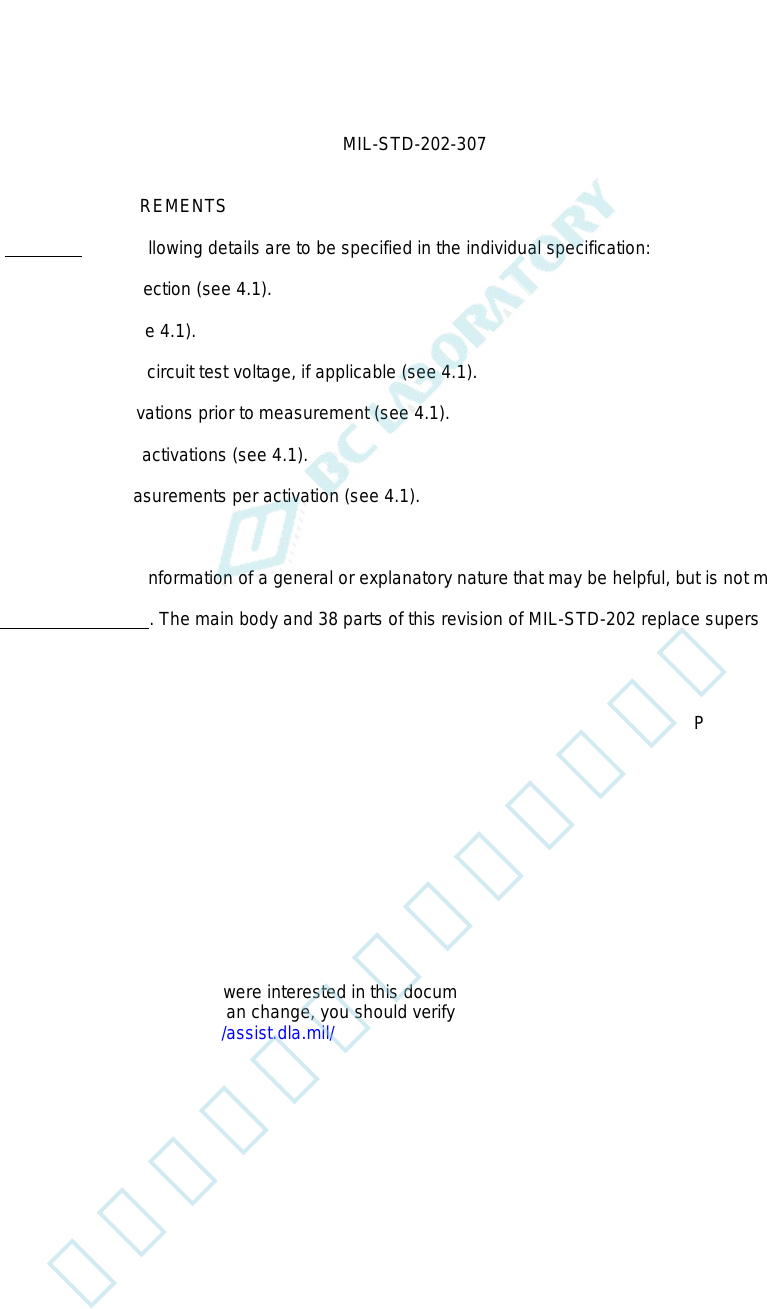
5. DETAILED REQUIREMENTS
5.1. Summary. The following details are to be specified in the individual specification:
a. Method of connection (see 4.1).
b. Test current (see 4.1).
c. Maximum open circuit test voltage, if applicable (see 4.1).
d. Number of activations prior to measurement (see 4.1).
e. Number of test activations (see 4.1).
f. Number of measurements per activation (see 4.1).
6. NOTES
(This section contains information of a general or explanatory nature that may be helpful, but is not mandatory.)
6.1 Supersession data. The main body and 38 parts of this revision of MIL-STD-202 replace superseded MIL-STD-
202.
Custodians: Preparing activity:
Army - CR DLA – CC
Navy - EC
Air Force - 85 (Project 59GP-2015-037)
DLA - CC
Review activities:
Army - AR, AT, AV, CR4, MI, SM, TE
Navy - AS, OS, SH
Air Force - 19, 99
NSA - NS
NOTE: The activities listed above were interested in this document as of the date of this document. Since
organizations and responsibilities can change, you should verify the currency of the information above using the
ASSIST Online database at https://assist.dla.mil/
2
北测(上海)电子科技有限公司
联系方式:xuyj@beice-sh.com 13917165676