MIL-STD-202H.pdf - 第7页
MIL - S TD - 202H 5. DETAILED REQUIRE M E N T S This secti on is not ap plicabl e t o t hi s s t and ar d. 6. NOTES (This secti on contain s infor m at i on o f a g ener al or ex pl anat or y nat ur e w hi c h m ay be he…
MIL-STD-202H
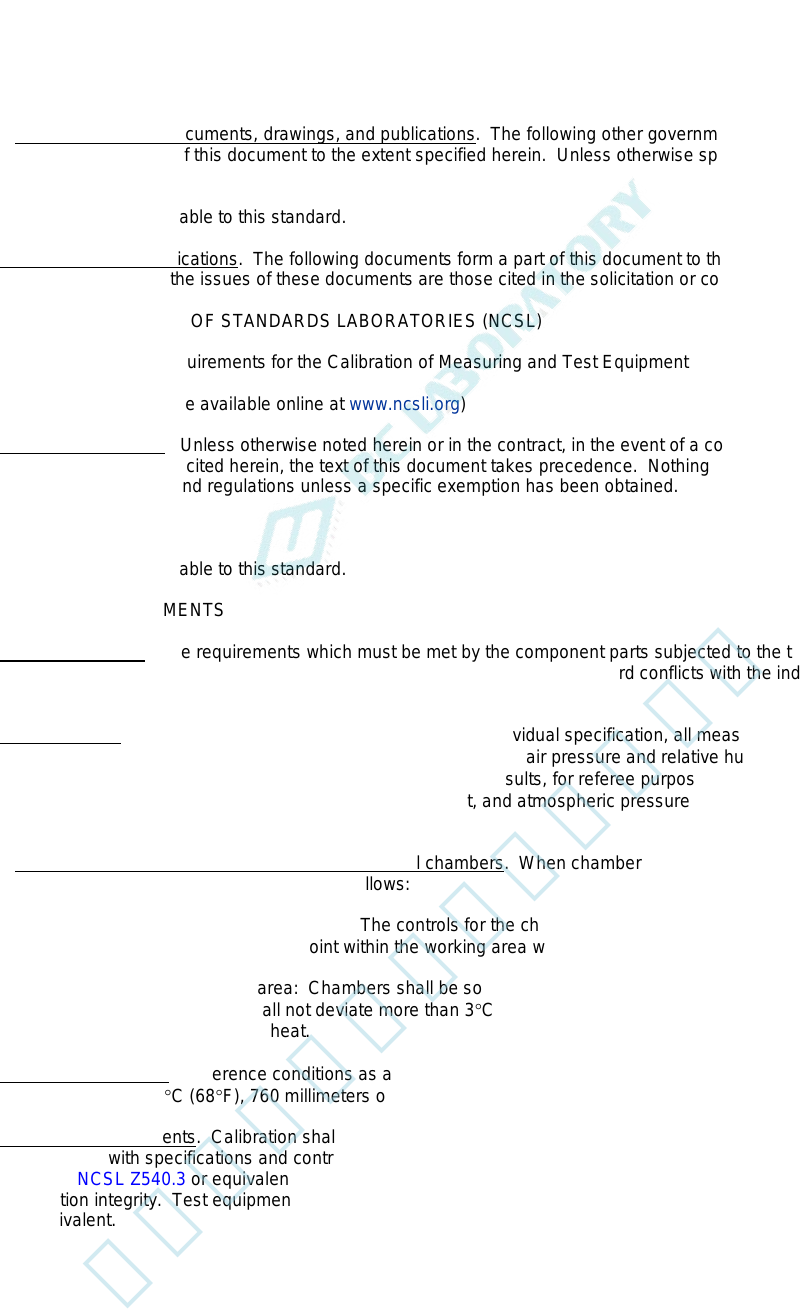
2.2.2 Other government documents, drawings, and publications. The following other government documents, drawings,
and publications form a part of this document to the extent specified herein. Unless otherwise specified, the issues are those
cited in the solicitation.
This section is not applicable to this standard.
2.3 Non-Government publications. The following documents form a part of this document to the extent specified herein.
Unless otherwise specified, the issues of these documents are those cited in the solicitation or contract.
NATIONAL CONFERENCE OF STANDARDS LABORATORIES (NCSL)
NCSL Z540.3 - Requirements for the Calibration of Measuring and Test Equipment
(Copies of this document are available online at www.ncsli.org)
2.4 Order of precedence. Unless otherwise noted herein or in the contract, in the event of a conflict between the text of this
document and the references cited herein, the text of this document takes precedence. Nothing in this document, however,
supersedes applicable laws and regulations unless a specific exemption has been obtained.
3. DEFINITIONS
This section is not applicable to this standard.
4. GENERAL REQUIREMENTS
4.1 Test requirements. The requirements which must be met by the component parts subjected to the test methods
described herein are specified in the individual specifications. Whenever this standard conflicts with the individual
specification, the latter shall govern.
4.2 Test conditions. Unless otherwise specified herein, or in the individual specification, all measurements and tests shall
be made at temperatures of 15°C to 35°C (59°F to 95°F) and at ambient air pressure and relative humidity. Whenever these
conditions must be closely controlled in order to obtain reproducible results, for referee purposes, a temperature of 25°C,
+0°C, -2°C (77°F, +0°F, -3.6°F), relative humidity of 50 ±2 percent, and atmospheric pressure of 650 to 800 millimeters of
mercury shall be specified.
4.2.1 Permissible temperature variation in environmental chambers. When chambers are used, specimens under test shall
be located only within the working area defined as follows:
a. Temperature variation within working area: The controls for the chamber shall be capable of maintaining the
temperature of any single reference point within the working area within ±2°C (3.6°F).
b. Space variation within working area: Chambers shall be so constructed that, at any given time, the temperature of any
point within the working area shall not deviate more than 3°C (5.4°F) from the reference point except for the immediate
vicinity of specimens generating heat.
4.3 Reference conditions. Reference conditions as a base for calculations shall be 25°C (77°F) for temperature, or an
alternate temperature of 20°C (68°F), 760 millimeters of mercury for air pressure, and a relative humidity of 50 percent.
4.4 Calibration requirements. Calibration shall be applied to those items of measuring and test equipment used to assure
product compliance with specifications and contractual requirements. Calibration shall be performed in accordance with the
requirements of
NCSL Z540.3 or equivalent. Calibrated items shall be controlled, used, and stored in a manner suitable to
protect calibration integrity. Test equipment requiring calibration shall be identified and labeled in accordance with NCSL
Z540.3 or equivalent.
2
北测(上海)电子科技有限公司
联系方式:xuyj@beice-sh.com 13917165676
MIL-STD-202H
5. DETAILED REQUIREMENTS
This section is not applicable to this standard.
6. NOTES
(This section contains information of a general or explanatory nature which may be helpful, but is not mandatory).
6.1 Intended use. This test method standard specifies uniform procedures for the environmental, physical, and electrical
testing of electronic and electrical component piece parts. It is intended as a reference document for test requirements called
out in military component specifications and when specified, in other procurement specifications and drawings.
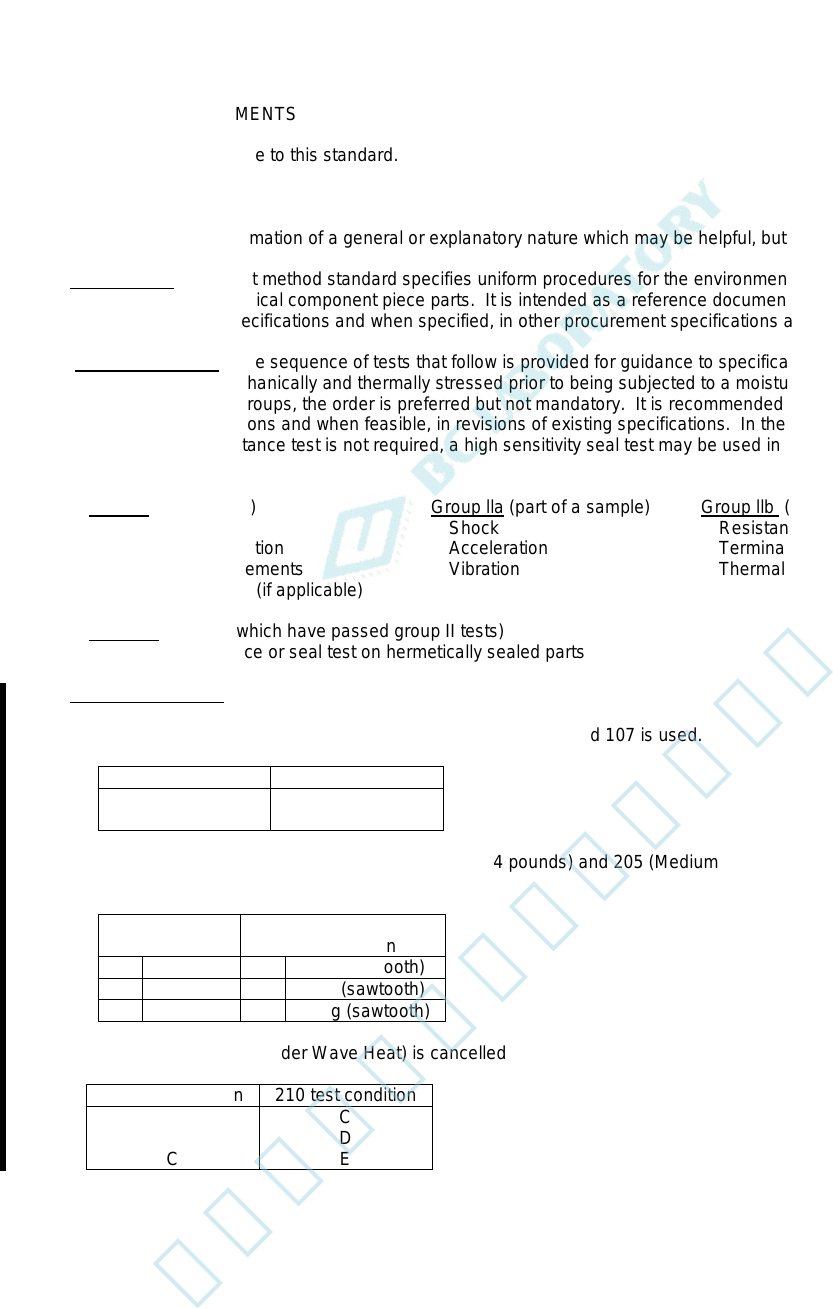
6.2 Sequence of tests. The sequence of tests that follow is provided for guidance to specification writers to emphasize the
philosophy that parts be mechanically and thermally stressed prior to being subjected to a moisture resistance test. Within any
of the three groups and subgroups, the order is preferred but not mandatory. It is recommended that this sequence be
followed in all new specifications and when feasible, in revisions of existing specifications. In the case of hermetically sealed
parts, when a moisture resistance test is not required, a high sensitivity seal test may be used in lieu of the moisture resistance
test.
Group I (all samples) Group lla (part of a sample) Group llb (part of a sample)
Visual inspection Shock Resistance to soldering heat
Mechanical inspection Acceleration Terminal Strength
Electrical measurements Vibration Thermal Shock
Hermetic seal test (if applicable)
Group III (all units which have passed group II tests)
Moisture resistance or seal test on hermetically sealed parts
6.3 Cancelled methods
Method 102, Temperature Cycling is cancelled, when specified Method 107 is used.
102 test condition 107 test condition
A, B, and D
C
A
B
Methods 202 (Shock, specimens weighing not more than 4 pounds) and 205 (Medium Impact) are cancelled, when specified
use Method 213.
202 or 205
test condition
213
test condition
A 15g (pk) K 30g (sawtooth)
B 30g (pk) H 75g (sawtooth)
C 50g (pk) I 100g (sawtooth)
Method 216 (Resistance to Solder Wave Heat) is cancelled, when specified Method 210 is used.
216 test condition 210 test condition
A
B
C
C
D
E
3
北测(上海)电子科技有限公司
联系方式:xuyj@beice-sh.com 13917165676
MIL-STD-202H
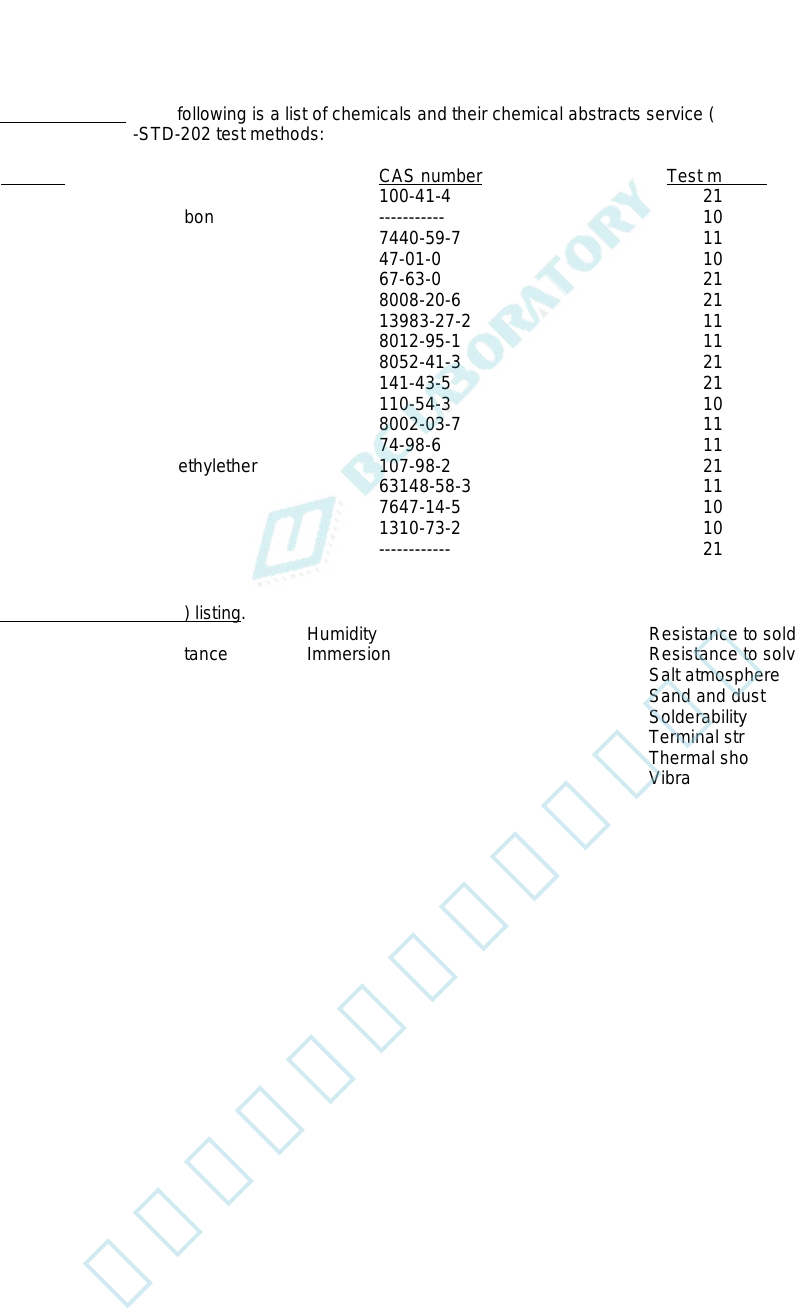
6.4 Chemical listing. The following is a list of chemicals and their chemical abstracts service (CAS) registry number
identified for use in MIL-STD-202 test methods:
Material CAS number Test method
ethylbenzene 100-41-4 215
fluorocarbon/perfluorocarbon ----------- 107, 112, 210
helium 7440-59-7 112
hydrochloric acid 47-01-0 101
isopropyl alcohol 67-63-0 215
kerosene 8008-20-6 215
krypton-85 13983-27-2 112
mineral oil 8012-95-1 112
mineral spirits 8052-41-3 215
monoethanolamine 141-43-5 215
n-hexane 110-54-3 109
peanut oil 8002-03-7 112
propane 74-98-6 111
propylene glycol monomethylether 107-98-2 215
silicone oil 63148-58-3 112
sodium chloride 7647-14-5 104
sodium hydroxide 1310-73-2 101
terpene ------------ 215
6.5 Subject term (key word) listing.
Barometric pressure
Contact chatter/resistance
Current noise
Current switching
DC resistance
Dielectric withstanding voltage
Explosion
Flammability
Humidity
Immersion
Insulation resistance
Life
Moisture resistance
PIND
Radiographic inspection
Random drop
Resistance to soldering heat
Resistance to solvents
Salt atmosphere
Sand and dust
Solderability
Terminal strength
Thermal shock
Vibration
4
北测(上海)电子科技有限公司
联系方式:xuyj@beice-sh.com 13917165676