MIL-STD-202H.pdf - 第212页
MI L - S TD - 202 -2 1 5 M E TH O D 21 5 R ESI ST AN C E T O S O L VEN T S 1. SCOPE 1. 1 P urpose . T he pur po s e o f t hi s t es t i s as f ol l ow s : a. To ver ify that m ar k i ngs or c ol o r c od i ng w i l l not…
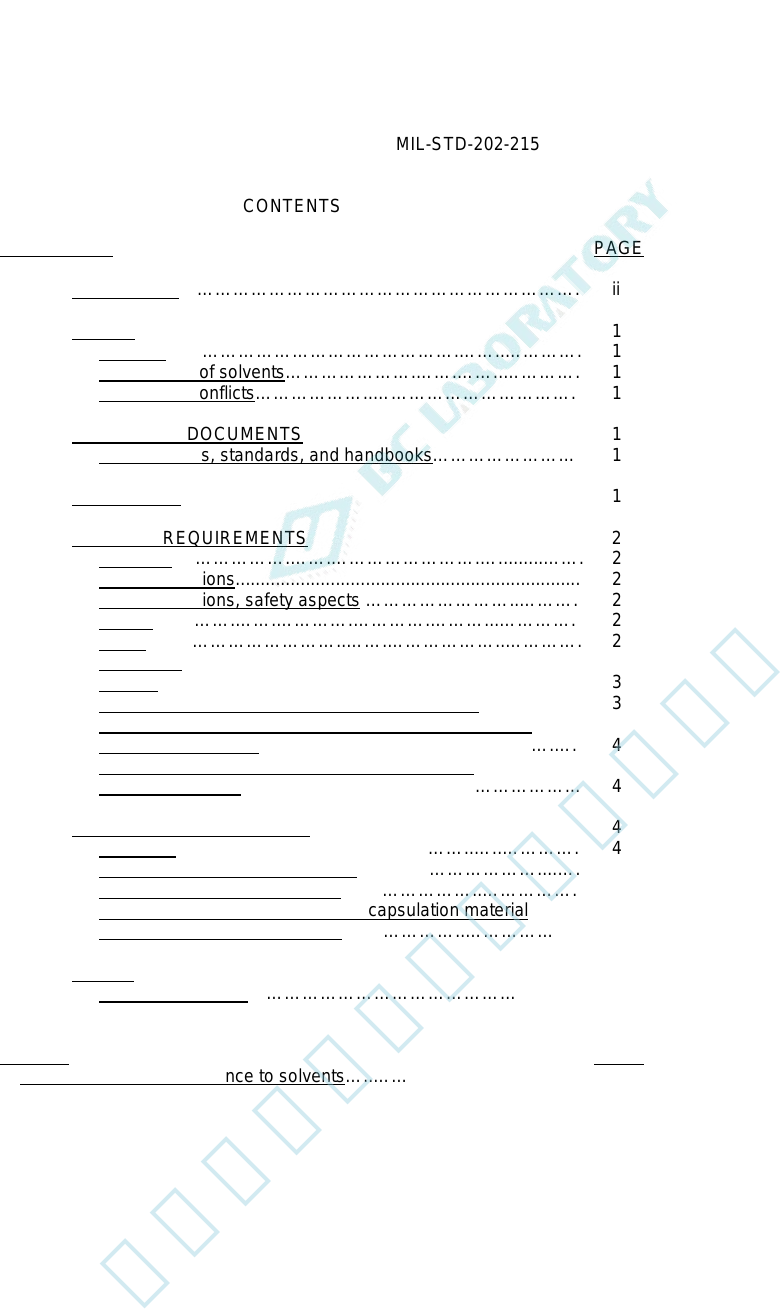
MIL-STD-202-215
CONTENTS
PARAGRAPH PAGE
FOREWORD…………………………………………………………. ii
1. SCOPE 1
1.1 Purpose………………………………………….……..…………. 1
1.2 Formulation of solvents………………….…….……..…………. 1
1.3 Checks for conflicts………………..……………………………. 1
2. APPLICABLE DOCUMENTS 1
2.1 Specifications, standards, and handbooks…………………… 1
3. DEFINTIONS 1
4. GENERAL REQUIREMENTS 2
4.1 Materials ……………….…….…………………….….........……. 2
4.1.1 Solvent solutions..................................................................... 2
4.1.1.1 Solvent solutions, safety aspects ……………………..………. 2
4.1.2 Vessel….……….…….………….………….………...…………. 2
4.1.3 Brush..…………………………..…….………………..…………. 2
4.2. Procedure…………….………………………..….….………….. 3
4.2.1 Groups………………………………………..……..……………. 3
4.2.2 Optional exposure procedure for the third group…………….. 3
4.2.3 Immersion test for components with marking protected
by a sleeve material…………………………..……..……….…. 4
4.2.4 Open construction parts and parts not intended
for PCB mounting………………………………………………... 4
5. DETAILED REQUIREMENTS 4
5.1 Summary…………………………………………..…..…………. 4
5.2. Examination and measurements…………………………....…. 4
5.2.1 Marking resistance to solvents…….……………..……………. 4
5.2.2 Component protective coating, encapsulation material
and sleeve material resistance….……………..………………. 4
6. NOTES 6
6.1 Supersession data………………………………………………. 6
TABLES PAGE
I. Summary table for resistance to solvents…..……………………….…… 5
iii
北测(上海)电子科技有限公司
联系方式:xuyj@beice-sh.com 13917165676
MIL-STD-202-215
METHOD 215
RESISTANCE TO SOLVENTS
1. SCOPE
1.1 Purpose. The purpose of this test is as follows:
a. To verify that markings or color coding will not become illegible or discolored on the parts (including printed
wiring boards) when subjected to solvents and processes normally used to clean solder flux, fingerprints,
and other contaminants from printed-wiring and terminal-board assemblies, etc.
b. To verify that component protective coatings and encapsulant materials are not degraded to the point
where electrical or mechanical integrity is disturbed when subjected to solvents and processes normally
used to clean solder flux, fingerprints, and other contaminants from printed wiring and terminal board
assemblies, etc.
1.2 Formulation of solvents. The formulation of solvents is considered typical and representative of the solvents
used in printed wiring assembly processing of electronic components. Processing conditions are representative of
processes used for printed wiring assembly.
1.3 Checks for conflicts. When this test is referenced, care should be exercised to assure that conflicting
requirements, as far as the properties of the specified finishes and markings are concerned, are not invoked.
2. APPLICABLE DOCUMENTS
2.1 Specifications, standards, and handbooks. The following specifications, standards, and handbooks form a part
of this document to the extent specified herein. Unless otherwise specified, the issues of these documents are those
cited in the solicitation or contract.
FEDERAL SPECIFICATIONS
TT-I-735 - Isopropyl Alcohol
DEPARTMENT OF DEFENSE SPECIFICATIONS
MIL-PRF-680 - Degreasing Solvent
(Copies of these documents are available online at http://quicksearch.dla.mil)
3. DEFINTIONS
This section not applicable to this standard.
1
北测(上海)电子科技有限公司
联系方式:xuyj@beice-sh.com 13917165676
MIL-STD-202-215
4. GENERAL REQUIREMENTS
4.1. Materials
4.1.1 Solvent solutions. The solvent solutions used in this test shall consist of the following (see table I for
summary).
a. A mixture consisting of the following:
1. One part by volume of isopropyl alcohol, American Chemical Society (ACS) reagent grade, or isopropyl
alcohol in accordance with TT-I-735, grade A or B, and
2. Three parts by volume of mineral spirits in accordance with MIL-PRF-680, type I, or three parts by volume of
a mixture of 80 percent by volume of kerosene and 20 percent by volume ethylbenzene.
b. This solvent has been deleted. When a suitable replacement solvent has been determined, it will be added as
solution b.
c. A terpene defluxer consisting of a minimum of 90 percent d-limonene and 10 percent surfactant. 1/
d. A mixture consisting of the following:
1. Forty-two parts by volume water, 1 megohm-cm minimum resistivity.
2. One part by volume of propylene glycol monomethyl ether (glycol ether PM, 1-methoxy-2-propanol).
3. One part by volume of monoethanolamine. 2/
4.1.1.1 Solvent solutions, safety aspects. Solvent solutions listed in 4.1.1a through 4.1.1d exhibit some potential
for health and safety hazards. Safety precautions as listed in the appropriate manufacturers material safety data
sheet shall be observed.
4.1.2 Vessel. The vessel for solvent immersion shall be a container made of non-reactive material and of sufficient
size to permit complete immersion of the specimens in the solvent solutions specified in 4.1.1.
4.1.3 Brush. The brush shall be a toothbrush with a handle made of a non-reactive material. The brush shall have
three or four long rows, 1 and 1/8 ±1/8 inch in length, of hard bristles. Each row shall contain eight to twelve tufts, the
free ends of which shall lie substantially in the same plane. The brush shall be used with a single solvent and when
there is any evidence of softening, bending, wear, or loss of bristles, it shall be discarded.
1/ A commonly used terpene defluxer is BIOACT EC-7R. "BIOACT" is a registered Trademark of Petroferm INC;
"EC-7 and EC-7R" are trademarks of Petroferm INC.
2/ Normal safety precaution for handling this solution (e.g., same as those for diluted ammonium hydroxide)
based on O.S.H.A. rules for monoethanolamine.
2
北测(上海)电子科技有限公司
联系方式:xuyj@beice-sh.com 13917165676