MIL-STD-202H.pdf - 第22页
MI L - S TD - 202 - 10 3 CO NT E N T S PARAGRAPH PAG E FOREW ORD … ………………………………………………………. ii 1. SCOPE 1 1.1 Purpose …… ………………… …………………. …… .. …………. 1 2. APPLICABLE D O C U M EN T S 1 3. DEFINTIONS 1 4. GENERAL RE Q UI R …

MIL-STD-202-103
FOREWORD
1. This standard is approved for use by all Departments and Agencies of the Department of Defense.
2. This entire standard has been revised. This revision has resulted in many changes to the format, but the most
significant one is the splitting the document into test methods. See MIL-STD-202 for the change summary.
3. Comments, suggestions, or questions on this document should be emailed to std202@dla.mil or addressed to:
Commander, Defense Logistics Agency, DLA Land and Maritime, ATTN: VAT, P.O. Box 3990, Columbus, OH
43218–3990. Since contact information can change, you may want to verify the currency of this address
information using the ASSIST Online database at https://assist.dla.mil.
ii
北测(上海)电子科技有限公司
联系方式:xuyj@beice-sh.com 13917165676
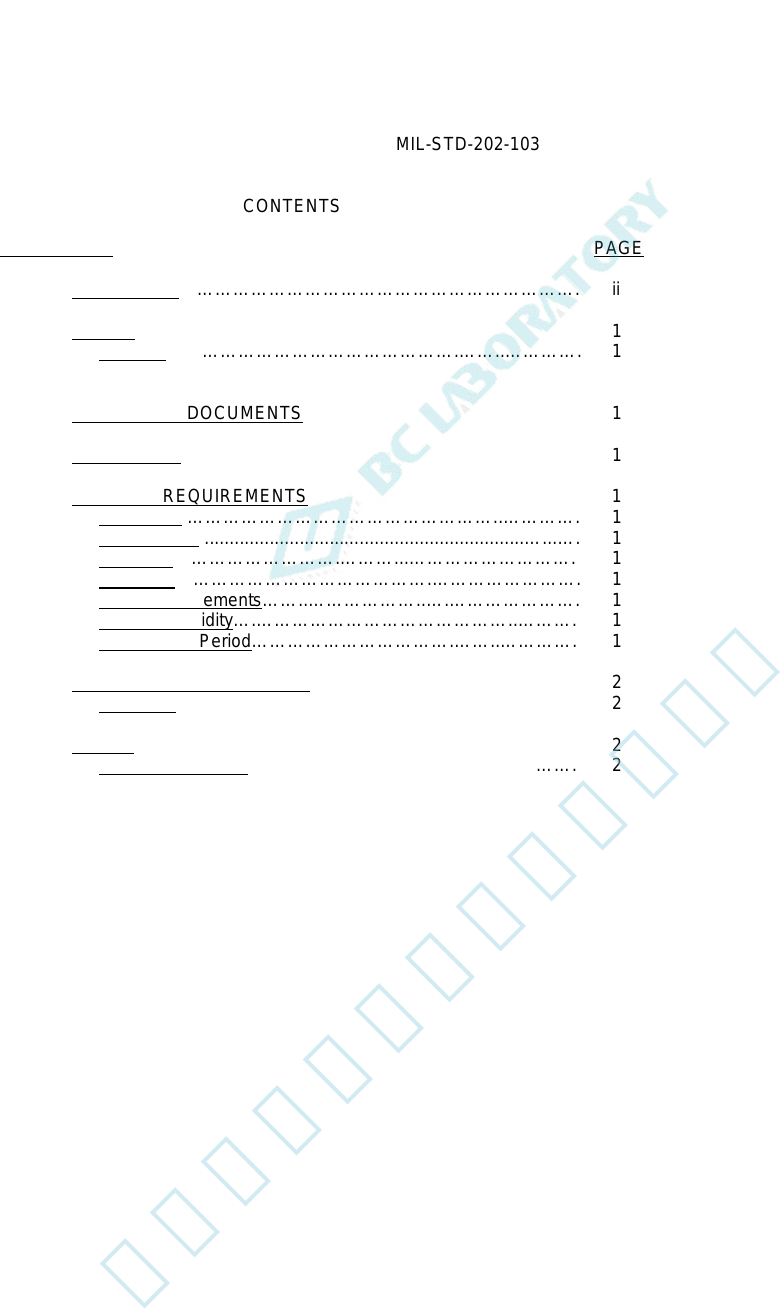
MIL-STD-202-103
CONTENTS
PARAGRAPH PAGE
FOREWORD…………………………………………………………. ii
1. SCOPE 1
1.1 Purpose………………………………………….……..…………. 1
2. APPLICABLE DOCUMENTS 1
3. DEFINTIONS 1
4. GENERAL REQUIREMENTS 1
4.1 Procedure ……………………………………………..…………. 1
4.1.1 Conditioning.................................................................…...…. 1
4.1.2 Chamber……………………….………...………………………. 1
4.1.3 Exposure…………………………………….……………………. 1
4.2. Final Measurements……..………………..….…………………. 1
4.2.1 At High Humidity….……………………………………..………. 1
4.2.2 After Drying Period…………………………….……..…………. 1
5. DETAILED REQUIREMENTS 2
5.1 Summary……………..…………………………..………………. 2
6. NOTES 2
6.1 Supersession data………………………………………………. 2
iii
北测(上海)电子科技有限公司
联系方式:xuyj@beice-sh.com 13917165676
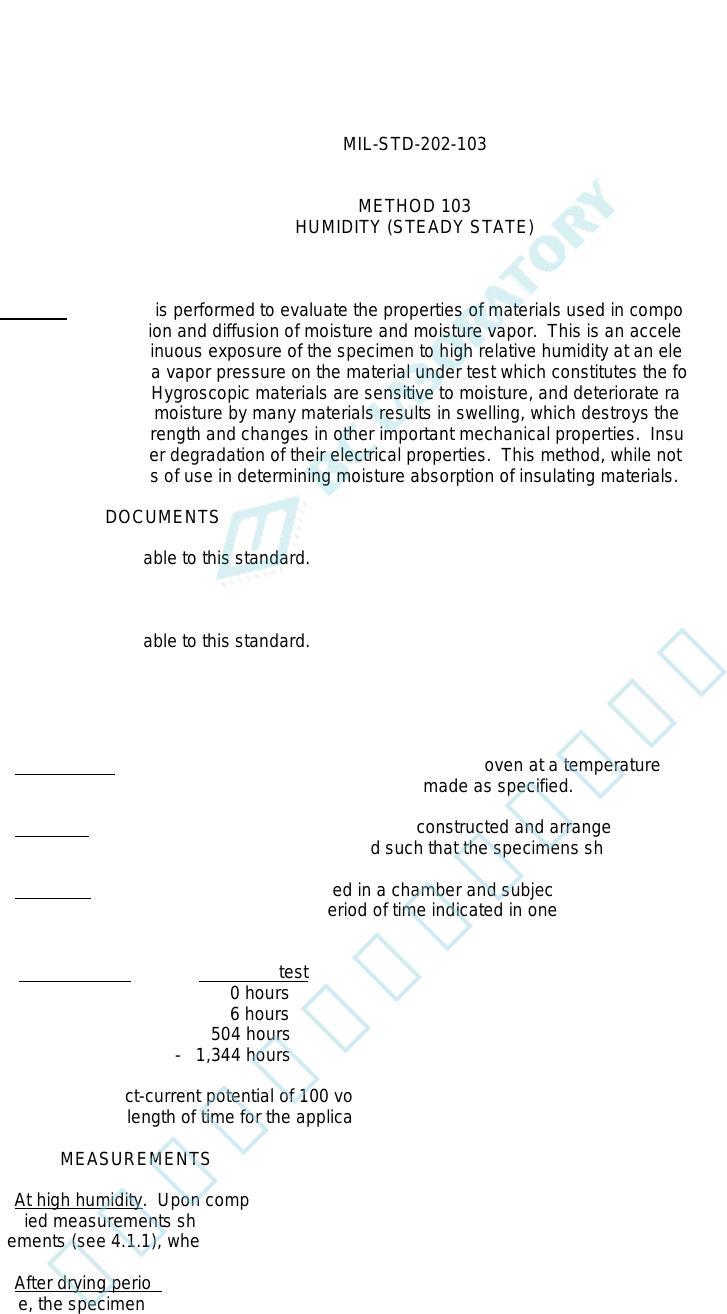
MIL-STD-202-103
METHOD 103
HUMIDITY (STEADY STATE)
1. SCOPE
1.1 Purpose. This test is performed to evaluate the properties of materials used in components as they are
influenced by the absorption and diffusion of moisture and moisture vapor. This is an accelerated environmental test,
accomplished by the continuous exposure of the specimen to high relative humidity at an elevated temperature.
These conditions impose a vapor pressure on the material under test which constitutes the force behind the moisture
igration and penetration. Hygroscopic materials are sensitive to moisture, and deteriorate rapidly under humid
conditions. Absorption of moisture by many materials results in swelling, which destroys their functional utility, and
causes loss of physical strength and changes in other important mechanical properties. Insulating materials that
absorb moisture may suffer degradation of their electrical properties. This method, while not necessarily intended as
a simulated tropical test, is of use in determining moisture absorption of insulating materials.
2. APPLICABLE DOCUMENTS
This section not applicable to this standard.
3. DEFINTIONS
This section not applicable to this standard.
4. GENERAL REQUIREMENTS
4.1. PROCEDURE.
4.1.1 Conditioning. The specimens shall be conditioned in a dry oven at a temperature of 40° ±5°C for a period of
24 hours. At the end of this period, measurements shall be made as specified.
4.1.2 Chamber. The chamber and accessories shall be constructed and arranged in such a manner as to avoid
condensate dripping on the specimens under test, and such that the specimens shall be exposed to circulating air.
4.1.3 Exposure. The specimens shall be placed in a chamber and subjected to a relative humidity of 90 to 95
percent and a temperature of 40° ±2°C for the period of time indicated in one of the following test conditions, as
specified:
Test condition Length of test
A - - - - - - - - - 240 hours
B - - - - - - - - - 96 hours
C - - - - - - - - - 504 hours
D - - - - - - - - - 1,344 hours
When specified, a direct-current potential of 100 volts or as specified shall be applied to the specimens during the
exposure period. The length of time for the application of voltage and the points of application shall be as specified.
4.2. FINAL MEASUREMENTS
4.2.1 At high humidity. Upon completion of the exposure period, and while the specimens are still in the chamber,
the specified measurements shall be performed. These measurements may be compared to the initial
measurements (see 4.1.1), when applicable.
4.2.2 After drying period. Upon completion of the exposure period or following measurements at high humidity if
applicable, the specimens shall be conditioned at room ambient conditions for not less than 1 hour, nor more than 2
hours unless otherwise specified, after which the specified measurements shall be performed at room ambient
conditions.
1
北测(上海)电子科技有限公司
联系方式:xuyj@beice-sh.com 13917165676