MIL-STD-202H.pdf - 第203页
MI L - S TD - 202 -2 1 4 M E TH O D 21 4 RA NDO M V I B RA T I O N 1. SCOPE 1. 1 P urpose . T his test i s c on duc t ed f or t he pur p os e of d et e r m i ni ng t he a bi l i t y of c om pon e nt part s to withstan d …
MIL-STD-202-214
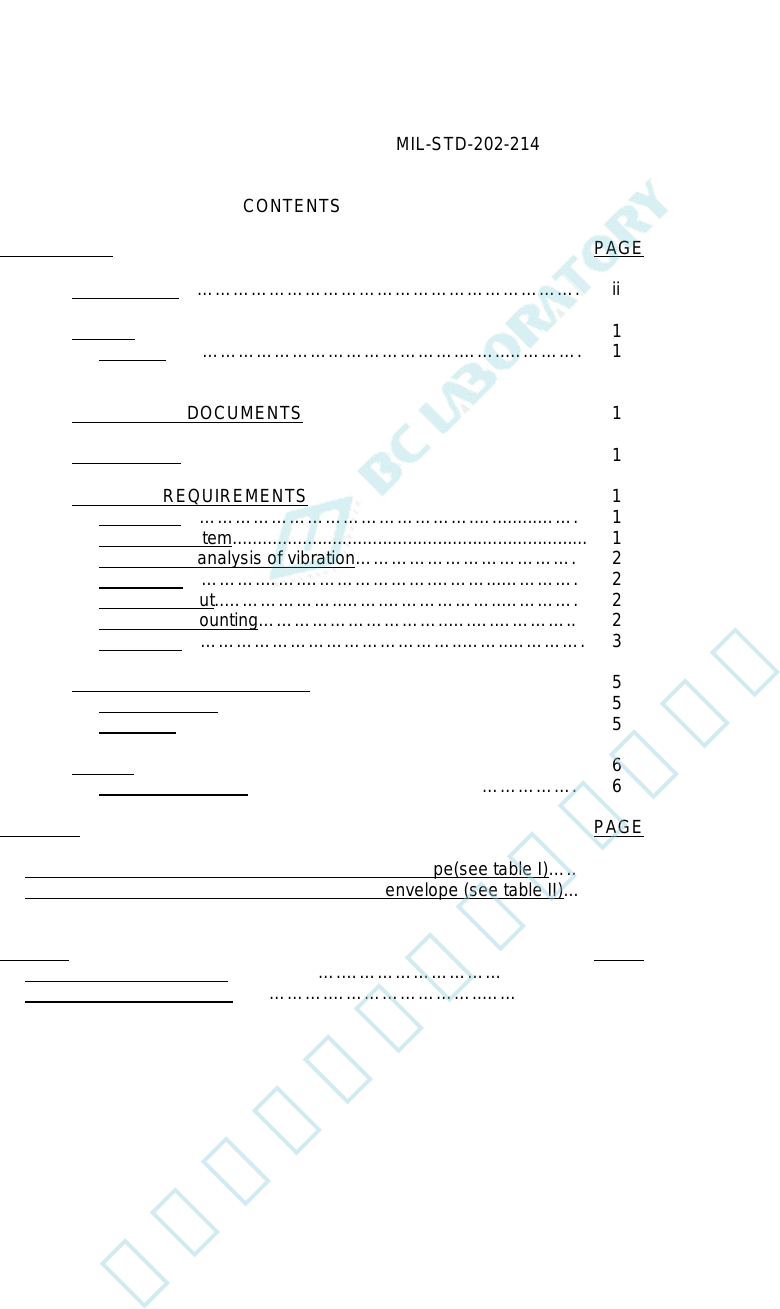
CONTENTS
PARAGRAPH PAGE
FOREWORD…………………………………………………………. ii
1. SCOPE 1
1.1 Purpose………………………………………….……..…………. 1
2. APPLICABLE DOCUMENTS 1
3. DEFINTIONS 1
4. GENERAL REQUIREMENTS 1
4.1 Apparatus………………………………………….….........……. 1
4.1.1 Vibration system....................................................................... 1
4.1.1.1 Control and analysis of vibration………………………………. 2
4.1.2 Monitoring………….…….………………….………...…………. 2
4.1.2.1 Vibration input..………………..…….………………..…………. 2
4.2. Method of mounting…………………………..….….………….. 2
4.3. Procedure………………………………………..……..…………. 3
5. DETAILED REQUIREMENTS 5
5.1 Measurements ……………………………………..……………. 5
5.2. Summary…………………………………………..…..…………. 5
6. NOTES 6
6.1 Supersession data………………………………………………. 6
FIGURES PAGE
1. Test condition I, random vibration test-curve envelope(see table I)….. 3
2. Test condition II, random vibration test-curve envelope (see table II)... 4
TABLES PAGE
I. Values for test-condition I……………….…………………………….…… 4
II. Values for test-condition II…………….……………………..……….…… 5
iii
北测(上海)电子科技有限公司
联系方式:xuyj@beice-sh.com 13917165676
MIL-STD-202-214
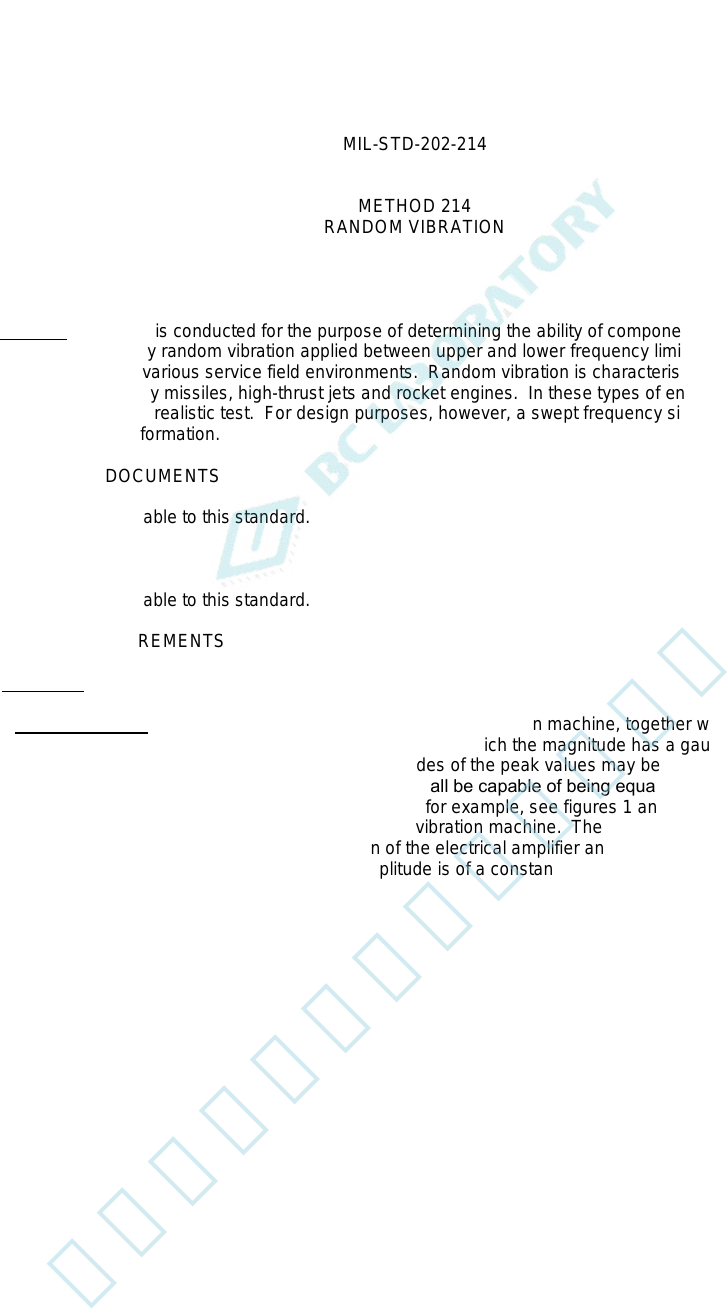
METHOD 214
RANDOM VIBRATION
1. SCOPE
1.1 Purpose. This test is conducted for the purpose of determining the ability of component parts to withstand the
dynamic stress exerted by random vibration applied between upper and lower frequency limits to simulate the
vibration experienced in various service field environments. Random vibration is characteristic of modern field
environments produced by missiles, high-thrust jets and rocket engines. In these types of environments, the random
vibration provides a more realistic test. For design purposes, however, a swept frequency sinusoidal test may yield
more pertinent design information.
2. APPLICABLE DOCUMENTS
This section not applicable to this standard.
3. DEFINTIONS
This section not applicable to this standard.
4. GENERAL REQUIREMENTS
4.1. Appartaus.
4.1.1 Vibration system. The vibration system, consisting of the vibration machine, together with its auxiliary
equipment shall be capable of generating a random vibration for which the magnitude has a gaussian (normal)
amplitude distribution, except that the acceleration magnitudes of the peak values may be limited to a minimum of
three times the rms (three-sigma (σ) limits). The machine shall be capable of being equalized so that the magnitude
of its spectral density curve will be between specified limits (for example, see figures 1 and 2) when the test item, or a
substitute equivalent mass, is appropriately secured to the vibration machine. The equalization of an electro-dynamic
vibration machine system is the adjustment of the gain of the electrical amplifier and control system so that the ratio
of the output vibration amplitude to the input signal amplitude is of a constant value (or given values) throughout the
required frequency spectrum.
1
北测(上海)电子科技有限公司
联系方式:xuyj@beice-sh.com 13917165676
MIL-STD-202-214
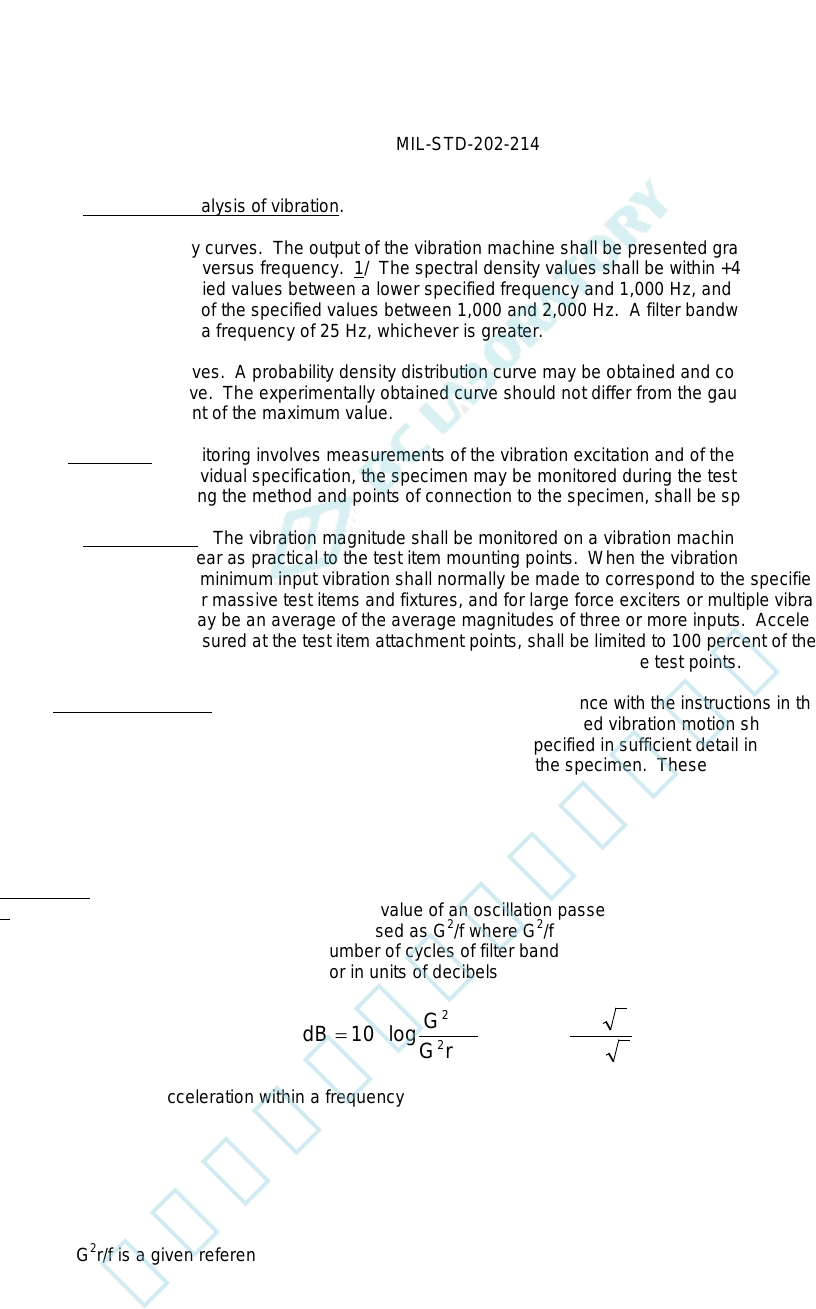
4.1.1.1 Control and analysis of vibration.
a. Spectral density curves. The output of the vibration machine shall be presented graphically as power
spectral density versus frequency. 1/ The spectral density values shall be within +40 and -30 percent (±1.5
dB) of the specified values between a lower specified frequency and 1,000 Hz, and within +100 and -50
percent (±3 dB) of the specified values between 1,000 and 2,000 Hz. A filter bandwidth will be a maximum
of 1/3 octave or a frequency of 25 Hz, whichever is greater.
b. Distribution curves. A probability density distribution curve may be obtained and compared with a gaussian
distribution curve. The experimentally obtained curve should not differ from the gaussian curve by more
than ±10 percent of the maximum value.
4.1.2 Monitoring. Monitoring involves measurements of the vibration excitation and of the test item performance.
When required in the individual specification, the specimen may be monitored during the test. The details of the
monitoring circuit, including the method and points of connection to the specimen, shall be specified.
4.1.2.1 Vibration input. The vibration magnitude shall be monitored on a vibration machine, on mounting fixtures,
at locations that are as near as practical to the test item mounting points. When the vibration input is measured at
more than one point, the minimum input vibration shall normally be made to correspond to the specified test curve
(see figures 1 and 2). For massive test items and fixtures, and for large force exciters or multiple vibration exciters,
the input-control value may be an average of the average magnitudes of three or more inputs. Accelerations in the
transverse direction, measured at the test item attachment points, shall be limited to 100 percent of the applied
vibration. The individual specification shall specify the number and location of the test points.
4.2 Method of mounting. The specimens shall be mounted in accordance with the instructions in the individual
specifications. The orientation of the specimen or direction(s) of the applied vibration motion shall be as specified.
Any special test fixtures or jigs required to run the test shall be as specified in sufficient detail in the individual
specification to assure reproducibility of the input motion applied to the specimen. These details shall include the
dimensions, the materials, temper, etc., as applicable.
1/ Power spectral density is the mean square value of an oscillation passed by a narrow-band filter per unit filter
bandwidth. For this application it is expressed as G
2
/f where G
2
/f is the mean square value of acceleration
expressed in gravitational units per number of cycles of filter bandwidth. The spectral density curves are usually
plotted either on a logarithmic scale, or in units of decibels (dB). The number of decibels is defined by the
equation:
fG
fG
frG
fG
dB
r
/
/
log20
/
/
log
10
2
2
==
The rms value of acceleration within a frequency band between f
1
and f
2
is:
1/2
2
2
1
=
∫
dff
G
Grms
f
f
Where G
2
r/f is a given reference value of power spectral density, usually the maximum specified value.
2
北测(上海)电子科技有限公司
联系方式:xuyj@beice-sh.com 13917165676