MIL-STD-202H.pdf - 第237页
MI L - S TD - 202 - 302 CO NT E N T S PARAGRAPH PAG E FOREW ORD … ………………………………………………………. ii 1. SCOPE 1 1.1 Purpose …… ………………… …………………. …… .. …………. 1 1.2 Factors a ffe c t i n g us e ………… ……………. ………. . …………. 1 2. APPLICAB…
MIL-STD-202-302
FOREWORD
1. This standard is approved for use by all Departments and Agencies of the Department of Defense.
2. This entire standard has been revised. This revision has resulted in many changes to the format, but the most
significant one is the splitting the document into test methods. See MIL-STD-202 for the change summary.
3. Comments, suggestions, or questions on this document should be emailed to std202@dla.mil or addressed to:
Commander, Defense Logistics Agency, DLA Land and Maritime, ATTN: VAT, P.O. Box 3990, Columbus, OH
43218–3990. Since contact information can change, you may want to verify the currency of this address
information using the ASSIST Online database at https://assist.dla.mil.
ii
北测(上海)电子科技有限公司
联系方式:xuyj@beice-sh.com 13917165676
MIL-STD-202-302
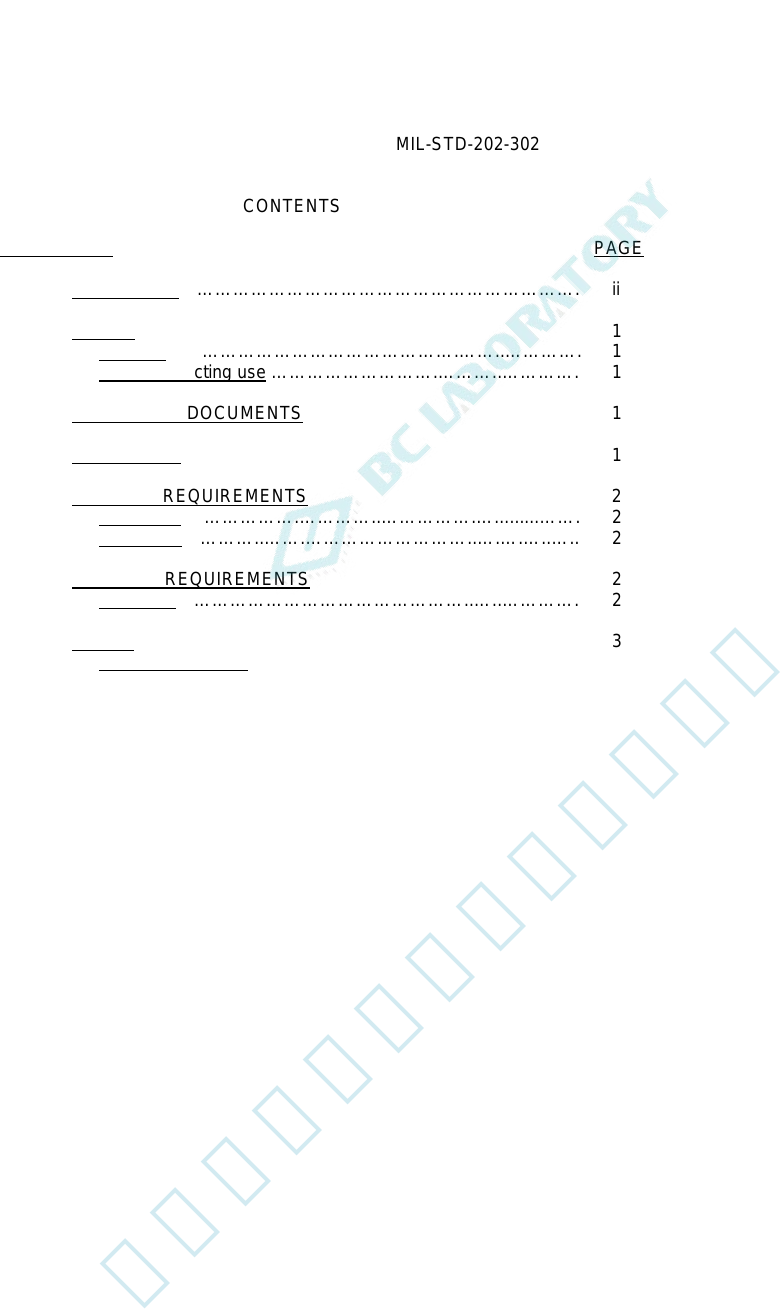
CONTENTS
PARAGRAPH PAGE
FOREWORD…………………………………………………………. ii
1. SCOPE 1
1.1 Purpose………………………………………….……..…………. 1
1.2 Factors affecting use ……………………….………..…………. 1
2. APPLICABLE DOCUMENTS 1
3. DEFINTIONS 1
4. GENERAL REQUIREMENTS 2
4.1 Apparatus….…………….…………..…………….….........……. 2
4.2. Procedure…………..…….………………………..….….…..….. 2
5. DETAILED REQUIREMENTS 2
5.1 Summary…………………………………………..…..…………. 2
6. NOTES 3
6.1 Supersession data………………………………………………. 3
iii
北测(上海)电子科技有限公司
联系方式:xuyj@beice-sh.com 13917165676
MIL-STD-202-302
METHOD 302
INSULATION RESISTANCE
1. SCOPE
1.1 Purpose. This test is to measure the resistance offered by the insulating members of a component part to an
impressed direct voltage tending to produce a leakage of current through or on the surface of these members. A
knowledge of insulation resistance is important, even when the values are comparatively high, as these values may
be limiting factors in the design of high-impedance circuits. Low insulation resistances, by permitting the flow of large
leakage currents, can disturb the operation of circuits intended to be isolated, for example, by forming feedback
loops. Excessive leakage currents can eventually lead to deterioration of the insulation by heating or by direct-
current electrolysis. Insulation resistance measurements should not be considered the equivalent of dielectric
withstanding voltage or electric breakdown tests. A clean, dry insulation may have a high insulation resistance, and
yet possess a mechanical fault that would cause failure in the dielectric withstanding voltage test. Conversely, a dirty,
deteriorated insulation with a low insulation resistance might not break down under a high potential. Since insulating
members composed of different materials or combinations of materials may have inherently different insulation
resistances, the numerical value of measured insulation resistance cannot properly be taken as a direct measure of
the degree of cleanliness or absence of deterioration. The test is especially helpful in determining the extent to which
insulating properties are affected by deteriorative influences, such as heat, moisture, dirt, oxidation, or loss of volatile
materials.
1.2 Factors affecting use. Factors affecting insulation resistance measurements include temperature, humidity,
residual charges, charging currents of time constant of instrument and measured circuit, test voltage, previous
conditioning, and duration of uninterrupted test voltage application (electrification time). In connection with this last-
named factor, it is characteristic of certain components (for example, capacitors and cables) for the current to usually
fall from an instantaneous high value to a steady lower value at a rate of decay which depends on such factors as
test voltage, temperature, insulating materials, capacitance, and external circuit resistance. Consequently, the
measured insulation resistance will increase for an appreciable time as test voltage is applied uninterruptedly.
Because of this phenomenon, it may take many minutes to approach maximum insulation resistance readings, but
specifications usually require that readings be made after a specified time, such as 1 or 2 minutes. This shortens the
testing time considerably while still permitting significant test results, provided the insulation resistance is reasonably
close to steady-state value, the current versus time curve is known, or suitable correction factors are applied to these
measurements. For certain components, a steady instrument reading may be obtained in a matter of seconds.
When insulation resistance measurements are made before and after a test, both measurements should be made
under the same conditions.
2. APPLICABLE DOCUMENTS
This section not applicable to this standard.
3. DEFINTIONS
This section not applicable to this standard.
1
北测(上海)电子科技有限公司
联系方式:xuyj@beice-sh.com 13917165676