QP-242E 工程师培训手册 (6.0).pdf.pdf - 第34页
FK-9F98-07 QP242E Training Text for Service Engineers 6th edition 4. Axis Zero Setting Adjustment [ 5 / 6 ] Fuji Machine Mfg. Co., Ltd. Okazaki SMT Equipment Quality Assurance Dept. Technical Support Div. Section No.2 4-…
FK-9F98-07 QP242E Training Text for Service Engineers
6th edition 4. Axis Zero Setting Adjustment [4/6]
Fuji Machine Mfg. Co., Ltd. Okazaki
SMT Equipment Quality Assurance Dept.
Technical Support Div. Section No.2
4-4
[Old adjustment]
1) Adjust in the same manner as for the X-axis (see above), so that the distance from the zero
setting completion position to the mechanical stopper is 6000 ± 170 pulses, and so that the
deceleration sensor switches on at the – 5000 ± 100 pulse position.
Belt tension tolerance :
434HZ ± 10HZ
2) Set the "PLM Zero Offset Z" in Proper data to "2000".
3) Perform another zero setting and verify that the distance from the zero setting completion
position to the mechanical stopper is 4000 ± 170 pulses, and that the deceleration sensor
switches on at – 7000 ± 100 pulses.
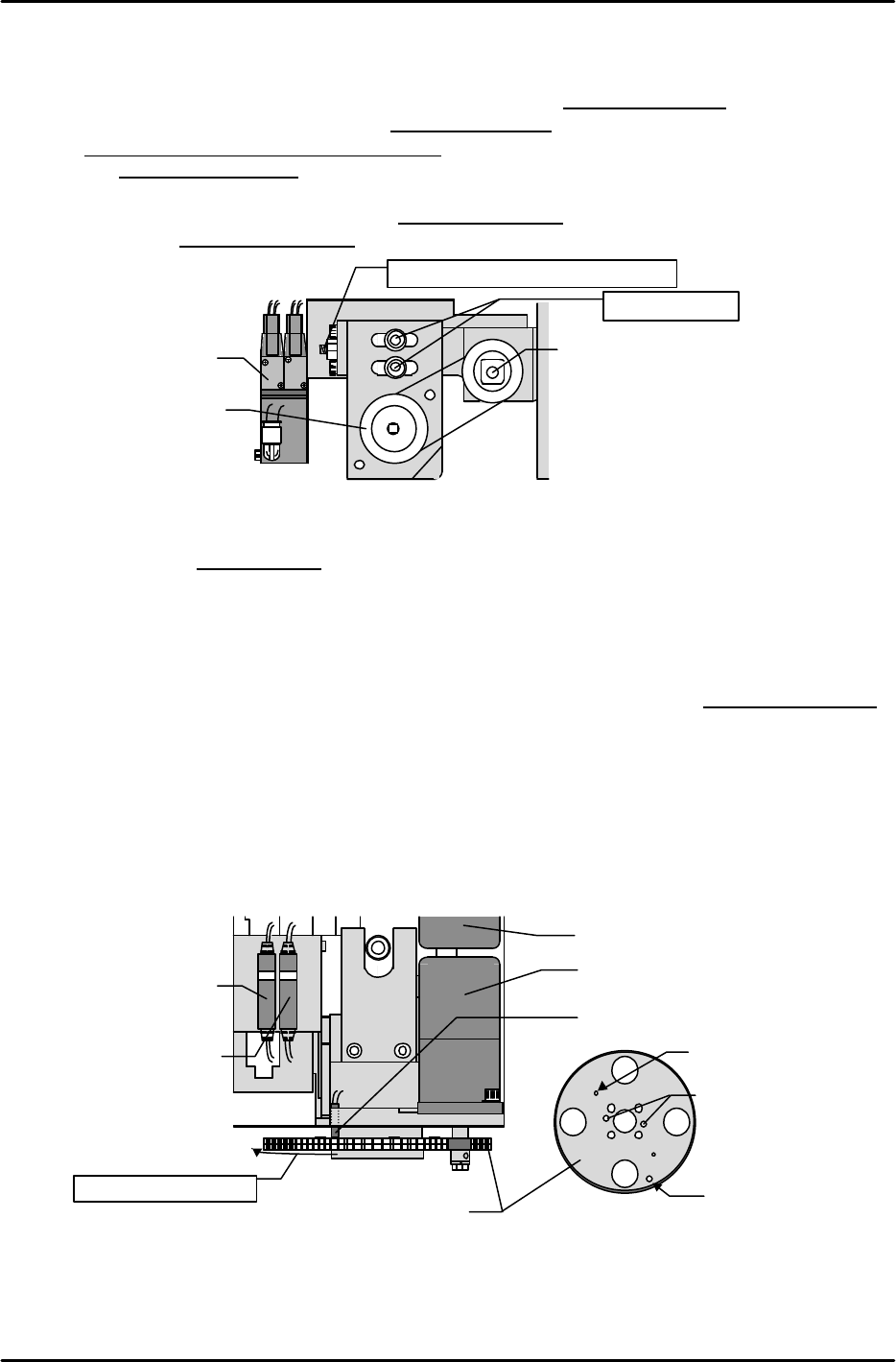
[4-8] Q-Axis Zero Setting Adjustment (Same Procedure for all Module Types)
1) Loosen the hollow bolt beside the Q-axis deceleration sensor and adjust the sensor height so
that there is a 0.2 to 0.3mm gap between the sensor and the gear. After making this
adjustment, slowly turn the gear 1 complete revolution to verify that the sensor activates only
at the dog hole position.
2) After the zero setting is completed, turn the gear back until the dog is past the sensor.
Slowly turn the gear in the zero setting direction, stopping at the point where the sensor
switches on (sensor LED changes from green to red). Use the [STROKE] è [NEXT AXIS]
commands to select the Q-axis. If the Q-axis counter reading is in the 4500 to 6000 pulse
range, the adjustment is complete.
* If the counter reading is not within this range, make an alignment mark on the gear (scissors
gear), then turn the motor back to the 4500 to 6000 pulse range and disengage the motor from
the gear. Re-engage the motor at the position where the sensor amplifier's red lamp goes off.
After re-engaging the motor, verify that the scissors gear engagement position is deviated by
the amount of one gear tooth (this is done by looking at the aligning holes from below the
gear).
Q axis motor
Q-axis deceleration sensor
Pressure sensor amplifier
Z-axis deceleration
sensor amplifier
Q scissors gear
Z axis motor
Q-deceleration dog
Holder Installing hole
Aligning holes
Zero setting direction
Belt tension adjusting bolt
Z-axis Ball screw
Z-axis motor pulley
Installing bolt
Solenoid valve
FK-9F98-07 QP242E Training Text for Service Engineers
6th edition 4. Axis Zero Setting Adjustment [5/6]
Fuji Machine Mfg. Co., Ltd. Okazaki
SMT Equipment Quality Assurance Dept.
Technical Support Div. Section No.2
4-5
[4-9] Proper Data Zero Offset Q-Measurement
1) Verify that the "Center_Offset_X,Y", "Final_Offset_X,Y,Q", and "Zero_Offset_Q" Proper data
items are set to "0" at all modules. At systems with MTUs, also verify that
"Zero_Offset_TY,TZ" is set to "0".
2) Following the Q-axis zero setting adjustment, perform another Q-axis zero setting.
3) Following the zero setting operation, lower the Z-axis to a position where interference will not
occur when the jig (described at the following step) is mounted.
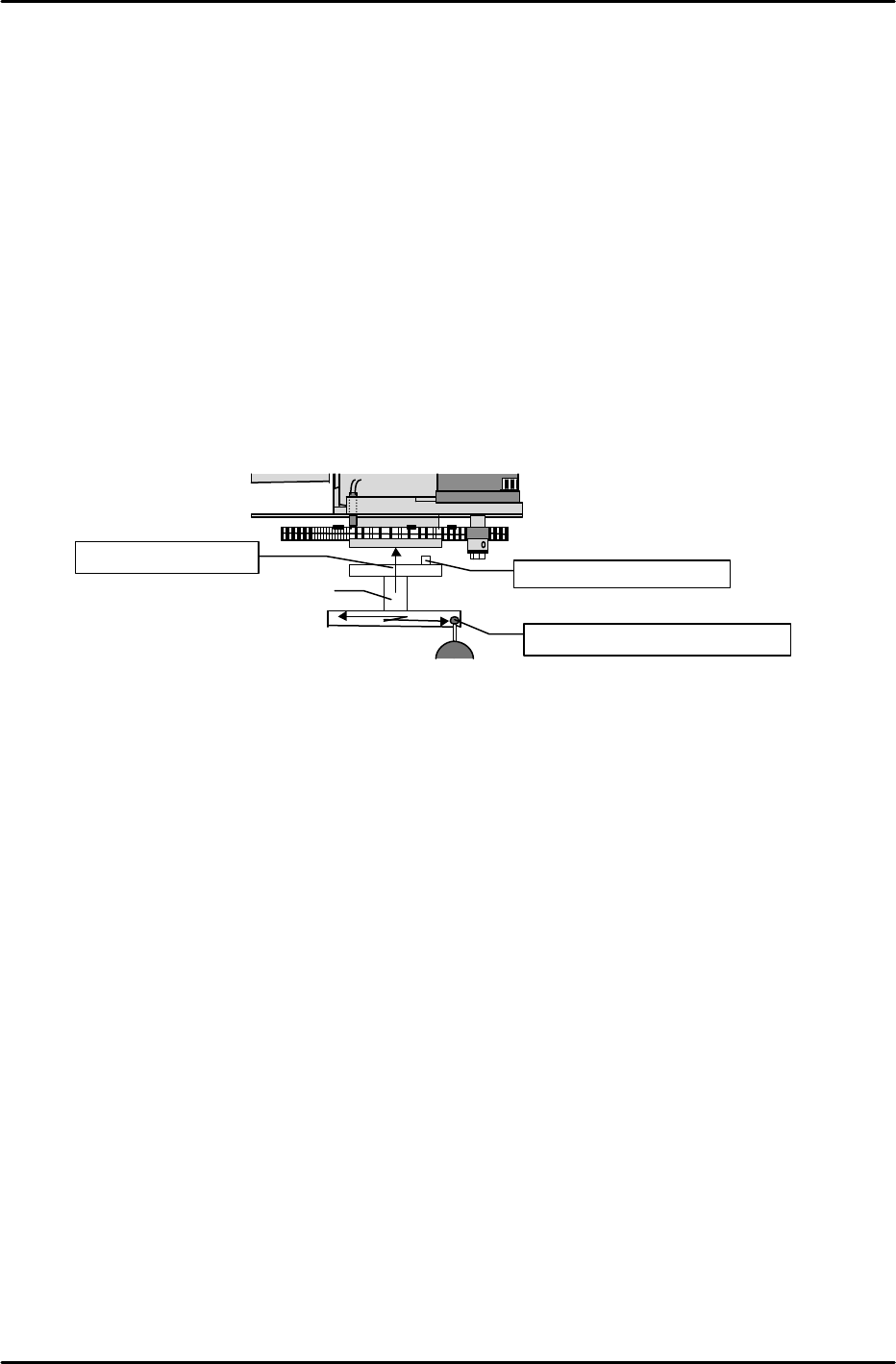
4) Mount a Q-axis zero measurement jig at the holder mounting position (bottom of gear). The
jig's mounting orientation is indicated on the top face of the jig. The jig can only be mounted
on the gear when oriented in this direction.
5) Turn the Q-axis in the zero setting direction until the jig's measuring face is parallel to the
X-axis.
6) Set a dial gauge against the jig's measuring face and turn the Q-axis until a reading of "0" is
obtained at both ends.
7) The servo counter reading at the point where the dial gauge reading is "0" is the Q-axis zero
offset.
8) Enter the PLM1 to PLM6 "Zero Offset Q" values to the F4G, then transmit this data to the
machine.
[4-10 ] Other Module Adjustments
* [Select other modules to be adjusted by using the following command sequence: [MODULE
FIX]è[Number of module to be adjusted]è [CR] Perform zero setting adjustments for all axes.
Note pin orientation
Secured by 2 bolts
Dial gauge reading of "0"
Jig

FK-9F98-07 QP242E Training Text for Service Engineers
6th edition 4. Axis Zero Setting Adjustment [6/6]
Fuji Machine Mfg. Co., Ltd. Okazaki
SMT Equipment Quality Assurance Dept.
Technical Support Div. Section No.2
4-6
Axis Zero Setting Adjustments in the Mechanical Check Mode
[4-11]
Before Beginning the Axis Zero Setting Adjustments
1) Start up the machine in the "Mechanical Check" mode.
2) If the coupling and belt are removed with the 200V power on,
the motor will vibrate. To prevent this, press the Emergency
Stop button (200V off), then connect a digital operator to
ch3 of each axis amplifier and lower the CN-04 gain to " 80" .
[4-12]
X-Axis Zero Setting Adjustment and Belt Tension Adjustment
1) Remove the X-axis timing belt.
2) Use the following command sequence to select module 1: [MODULE FIX]è[Number of
module to be adjusted (Ex.)]è [CR]. Next, execute a return using the [RETURN] command.
Continue by selecting the X-axis as follows: [MOVE]è[ZERO SETUP]è[NEXT AXIS].
Press [START] to begin the zero setting operation.
3) Block the X-axis deceleration sensor beam and end the zero setting operation.
4) Execute the [RETURN] è [STROKE] è [NEXT AXIS] commands to select the X-axis, then
move (by inching) the X-axis to the 4000 pulse position (-4000 at rear part-supply machines)
while watching the displayed counter reading.
5) Move the head to the mechanical stopper at the machine's right side (as viewed from the part
supply side), then attach the timing belt and adjust its tension.
Belt tension tolerance : 227HZ ± 10HZ
After adjusting the belt tension, move the head back to right-side mechanical stopper position
and verify that the counter reading is within 4000 ± 200 pulses (-4000 pulse position at rear
part-supply machines).
* Flip chip modules have a coupling drive system rather than a belt drive. At these
modules, adjust the X-axis to a 4000 ± 100 pulse position
6) After completing the above adjustment, adjust the X-axis deceleration sensor position so that
the sensor switches on at the -5500 pulse position. Following this adjustment, use the
"CHECK, X006, X AXIS ZERO" I/O to verify that the sensor switches on at the -5500 ± 100
pulse position (5500 pulse position at rear part-supply machines).
7) After the adjustment, connect a digital operator to CN-04 again and return the gain to "500"
from "80".
[4-13] Y-Axis Zero Setting Adjustment
1) Perform the Y-axis zero setting adjustment in the same manner as that described for the X-
axis, adjusting until the values shown in section [4- 6] are obtained.
2) After the adjustment, connect a digital operator to CN-04 again and return the gain to "500"
from "80".
[4-14] Z-Axis Zero Setting Adjustment and Belt Tension Adjustment
1) Perform the Z-axis zero setting adjustment in the same manner as that described for the X-
axis, adjusting until the values shown in section [4- 7] are obtained.
2) After the adjustment, connect a digital operator to CN-04 again and return the gain to "450"
from "80".
[4-15 ] Q-Axis Zero Setting Adjustment
1) Perform the Q-axis zero setting adjustment in the same manner as that described for the X-
axis, adjusting until the values shown in section [4 - 8] are obtained.
2) After the adjustment, connect a digital operator to CN-04 again and return the gain to "300"
from "80".
SAV1
SAV2
SAV3
SAV4
X
Y
Q
Z