QP-242E 工程师培训手册 (6.0).pdf.pdf - 第59页
FK-9F98-07 QP242E Training Text for Service Engineers 6th edition 6. Proper Data Measurement [ 18 /20] Fuji Machine Mfg. Co., Ltd. Okazaki SMT Equipment Quality Assurance Dept. Technical Support Div. Section No.2 6- 18 5…
FK-9F98-07 QP242E Training Text for Service Engineers
6th edition 6. Proper Data Measurement [17/20]
Fuji Machine Mfg. Co., Ltd. Okazaki
SMT Equipment Quality Assurance Dept.
Technical Support Div. Section No.2
6-17
【
6-20
】
Nozzle_Check_Pos.X,Y,Z (Single Types Only)
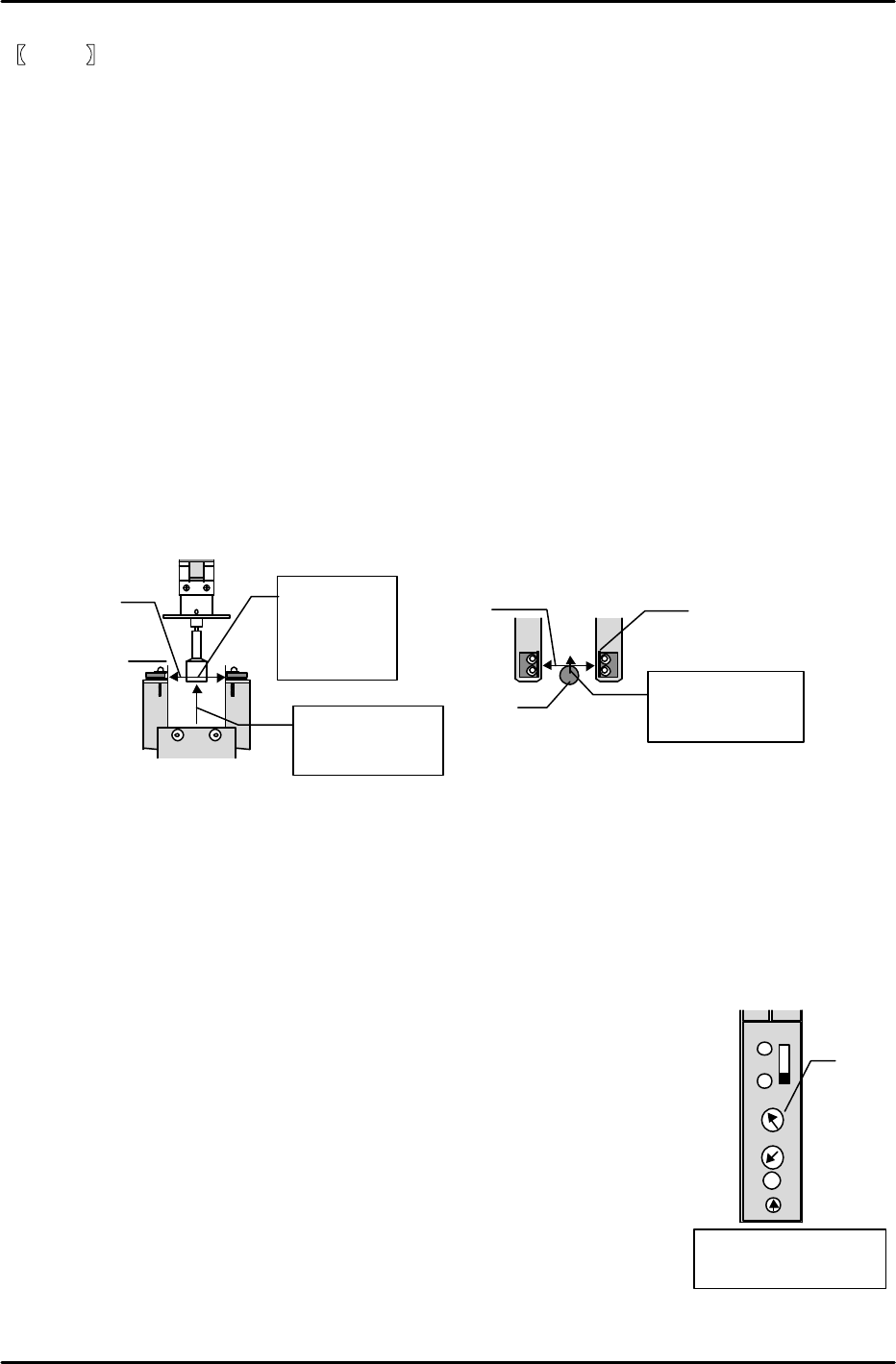
Note: As shown in the figure below, the slits are sandwiched between the sensor and sensor
bracket. Mount so that the sensor emitter and receptor are directly opposite (on a
straight line) the slits (sensor beam aligned). This can be gauged by eye.
1) Mount a 10mm front light nozzle on the single shaft.
2) Turn on the “OUT Y018 NZL CHNGR UP” I/O to raise the nozzle changer unit.
3) Move each axis to the prescribed position and lock the servos.
X-axis: Move the nozzle tip midway (centered) between the nozzle check sensors.
Y-axis: While watching the “IN X00D NOZZLE CHECK” I/O, use the Y-axis
inching button to retract the nozzle. Retract the Y-axis 2000 pulses
beyond the point where the I/O switches ON. (2000P1s = 5mm: nozzle
center)
Z-axis: While watching the “IN X00D NOZZLE CHECK” I/O, use the Z-axis
inching button to lower the nozzle. Lower the Z-axis 1000 pulses beyond
the point where the I/O switches ON. (1000P1s = 1.5mm)
4) After moving each axis to its prescribed position, execute the following command sequence
to automatically enter the data:
[NZZLE SELECT] à [Check Pos.] à [SET].
[6-21] Nozzle_Diameter Check, Adjustment (Single Types Only)
1) After completing the [7-20] adjustment, adjust the sensitivity
of the nozzle sensor amplifier using the following 4 nozzle sizes: 0.7, 1.3, 10, 20.
2) Begin by increasing the amplifier sensitivity until the sensor beam from the emitter side is
received by the receptor side. (The green LED lights when the sensor beam is received.) If the
sensor beam is not received even when the sensitivity is increased, adjust the sensor and slit
positions until the sensor beam is received.
3) Verify that the 4 nozzle types listed above are present at the nozzle changer.
(The “NOZZLE TYPE” item must be “1”.)
[Nozzle data settings in program]
Module/Head# à Enter the module number.
Nozzle No. à Enter the nozzle number.
Size X à Enter the nozzle diameters.
Size Y à Enter the nozzle diameters.
BackLight Size X à 300
BackLight Size Y à 300
Nozzle Type à 1
Nozzle Length à 0
4) Begin by performing a nozzle change in order to mount a 10mm nozzle at the head.
Sensor beam
Z-axis
1.5mm (1000
pulses) below
nozzle bottom
face
X-axis
Centered between
sensors
Sensor
Nozzle
Y-axis
2000 pulses from
sensor on position
Slit
Slit
OUT
TIME
SEC
Located beside nozzle
changer (left side)
5
Use this
volume to
adjust the
sensor
ALM

FK-9F98-07 QP242E Training Text for Service Engineers
6th edition 6. Proper Data Measurement [18/20]
Fuji Machine Mfg. Co., Ltd. Okazaki
SMT Equipment Quality Assurance Dept.
Technical Support Div. Section No.2
6-18
5) Next, perform a nozzle size check by executing the following command sequence: [SET] à
[POSITION] à [Select Module] à [NOZZLE] à [CHECK] à [START].
Adjust the sensor amplifier volume (located to the left of the nozzle changer) until the
measured value is within 10000 +/- 150.
6) Perform about 20 nozzle size checks, verifying that there are no significant fluctuations in the
measured values. (Guideline: +/-10 )
7) Repeat the above steps for nozzle sizes 0.7, 1.3, and 20, and adjust so that the size check
results for all 4 nozzles are within +/-150.
If not, repeat the sensitivity adjustment with that nozzle mounted. When adjusted to within
+/-150, repeat step 6 (above) for the remaining 3 nozzles.
[6-22] Nozzle Change Operation Check
1) Mount the user nozzles in all of the index holders and single nozzle changers, verifying that
nozzle changes occur properly at every position and with every nozzle size.
2) Also verify that the nozzle size check sensor (for single nozzle changers) operates properly
with the user nozzles.
3) Verify that operation also occurs properly with the spares.
[6-23] Parts_Eject_Pos_X,Y
1) Mount a 10mm nozzle in the holder.
2) Lock the servo at the position where the reject box center is aligned with the nozzle center.
3) This is the Parts_Eject_Pos_X,Y position. Execute the following command sequence to
automatically enter this data:
[ETC] à [REJECT POS.] à [REJECT BOX] à [SET].
[6-24] Device_Origin_IPD0_X,Y
* Measure all MFUs at module 1, then use the MFU where the measured result was closest to
the average value to measure all modules. This measurement should also be performed at
modules with MTUs.
1) Connect the MFU to the module which is being measured.
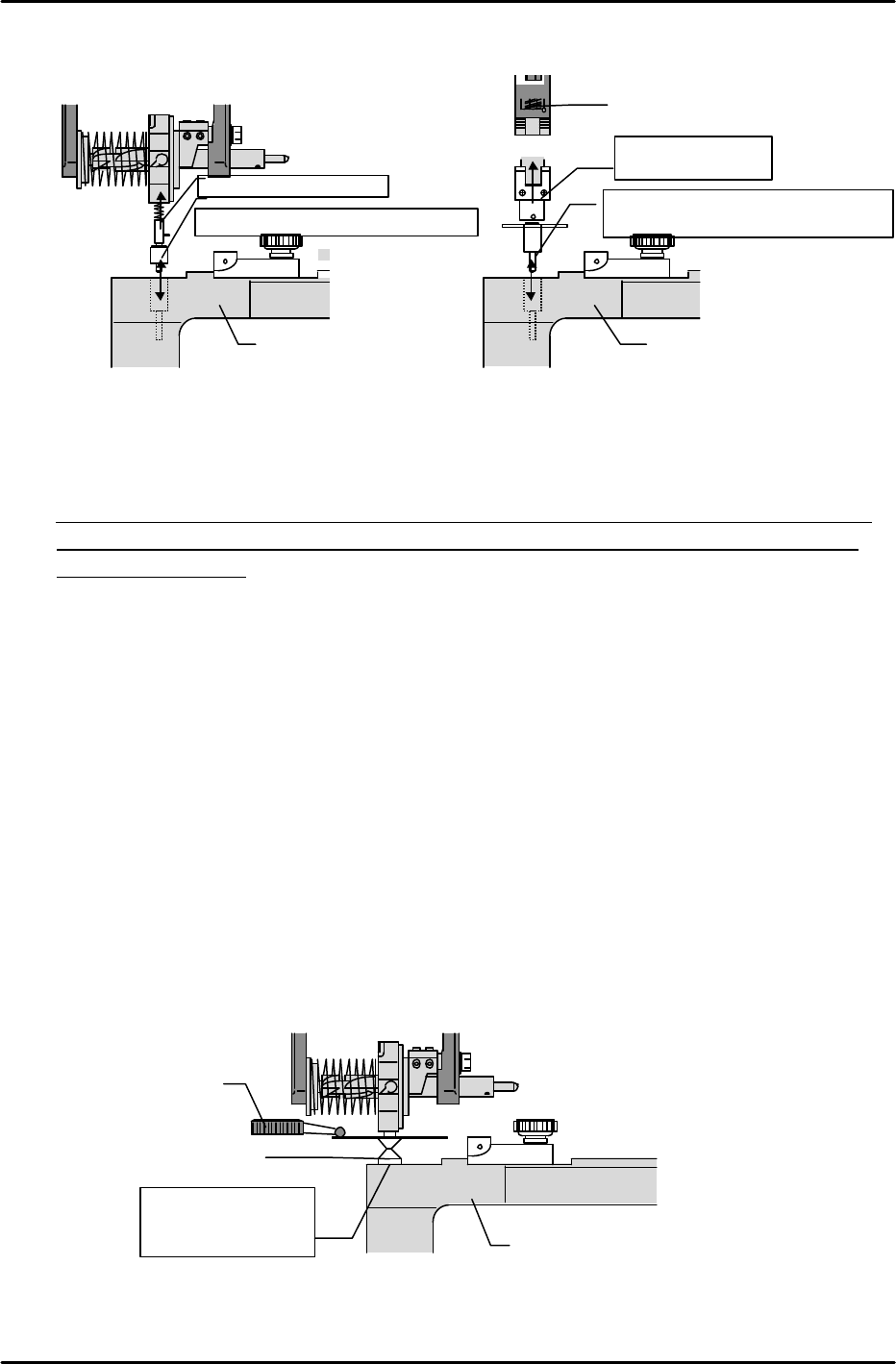
2) Place a device jig at the MFU’s D1 position.
3) Mount a nozzle jig (for the device jig) in the holder.
4) Turn off the 200V power supply, then move the head by hand to find the position where the
nozzle jig can be inserted smoothly into the device jig hole. Lock the servo at this position. (Do
not force the nozzle jig into the hole if it cannot be inserted smoothly.)
5) Execute the following command sequence to automatically enter the data: [DEVICE] à
[ORG.POS.X/Y] à [SET].
* The Proper data value is the average value for all MFUs.
6) Turn off the 200V power supply, raise the Z-axis by hand to extract the nozzle jig from the
device jig hole.
FK-9F98-07 QP242E Training Text for Service Engineers
6th edition 6. Proper Data Measurement [19/20]
Fuji Machine Mfg. Co., Ltd. Okazaki
SMT Equipment Quality Assurance Dept.
Technical Support Div. Section No.2
6-19
[6-25] Pickup_Height_IPD_Z0
* If measuring with a dial gauge, be sure that the gauge is calibrated.
* Measure all MFUs at module 1, then use the MFU where the measured result was closest to
the average value to measure all modules. This measurement should also be performed at
modules with MTUs.
1) Mount a 10mm adjusting nozzle in the holder.
2) Place a device jig at the MFU’s number 1 position (left end).
3) Lower the Z-axis until the bottom of the nozzle makes contact with the surface of the device
jig which was mounted at the previous step. At this position, set a dial gauge on top of the
nozzle disk.
4) Slowly lower the Z-axis to find the point where the dial gauge begins to move.
5) The point where the dial gauge begins to move is the Z0 position. Execute the following
command sequence to automatically enter this data (Pickup_Height_IPZ0): [DEVICE] à
[ORG.POS.Z] à [SET].
6) Place the device jig at the MFU’s number 21 position (right end), then repeat steps 3 and 4
above to verify the Z0 position.
7) Verify that the positional difference between the MFU’s number 1 and number 21 (number 31
at 800mm module) positions is 46 pulses or less.
* The Proper data value is the average value for all MFUs (numbers 1 and 21, or numbers 1
and 31).
Device jig
Dial gauge
10mm nozzle
Position where
nozzle is in contact
with the jig.
Device jig
Jig for Index type
Position where insertion is smooth
Index jig
Device jig
Jig for single type
Position where insertion is smooth
Nozzle shaft
Single jig