a3369b.pdf - 第139页
Cleaning 130 VTK - TR -BA- 171e - 1 - User Man u al MDS 3080 -V 9.2 Heat Resis tance of Sealing Materia ls The follow ing table show s the ma ximum temperatu re to wh ich the respect ive seali n g mat er ials may b e exp…
Cleaning
VTK-TR-BA-171e-1 - User Manual MDS 3080-V
129
9 Cleaning
After every dispensing process involving aggressive or self-curing substances, a cleaning
procedure is recommended. It should involve the valve and all other surfaces in contact with the
fluid. Different methods of cleaning are described in the following chapter. The proper choice
depends on the degree of contamination and the dispense medium used.
9.1 Preliminary Notes
IMPORTANT NOTE
Prepare cleaning in advance
It is recommended to prepare the cleaning procedure in advance. Do not drop the device or its
subcomponents.
CAUTION
Liquid spurts possible
Residual liquids may spurt when handling components during the cleaning process. Therefore,
protective clothes are recommended:
• Safety goggles
• Gloves (chemical resistant)
• Overall (chemical resistant)
• Surgical mask
Remember that the surface of the valve is sensitive to abrasion, so do not use wire brushes and
other inappropriate tools. A specially developed cleaning tool kit (CTK 2.5) is available upon
request (order no. 1014632), which is of particular interest for all surfaces in direct contact with
the fluid.
WARNING
Potential chemical reaction!
The dispensed medium and the cleaning agent must be compatible to each other. Otherwise,
they might cause unwanted chemical reactions, toxic vapor, increase of temperature etc. Consult
the manufacturer in case of doubt.
Before introducing aggressive purifying agents or solvents to the system, verify compatibility
with the material of all adjacent parts. Refer to the list in paragraph 9.3, page 131.
In case of materials you cannot find on the list, please consult the manufacturer or the Technical
Support of VERMES Microdispensing (see Page 7).
CAUTION
Keep actuator clean
No liquid may penetrate into the actuator (e.g. through the plug); otherwise the whole element
could be damaged.
Cleaning
130
VTK-TR-BA-171e-1 - User Manual MDS 3080-V
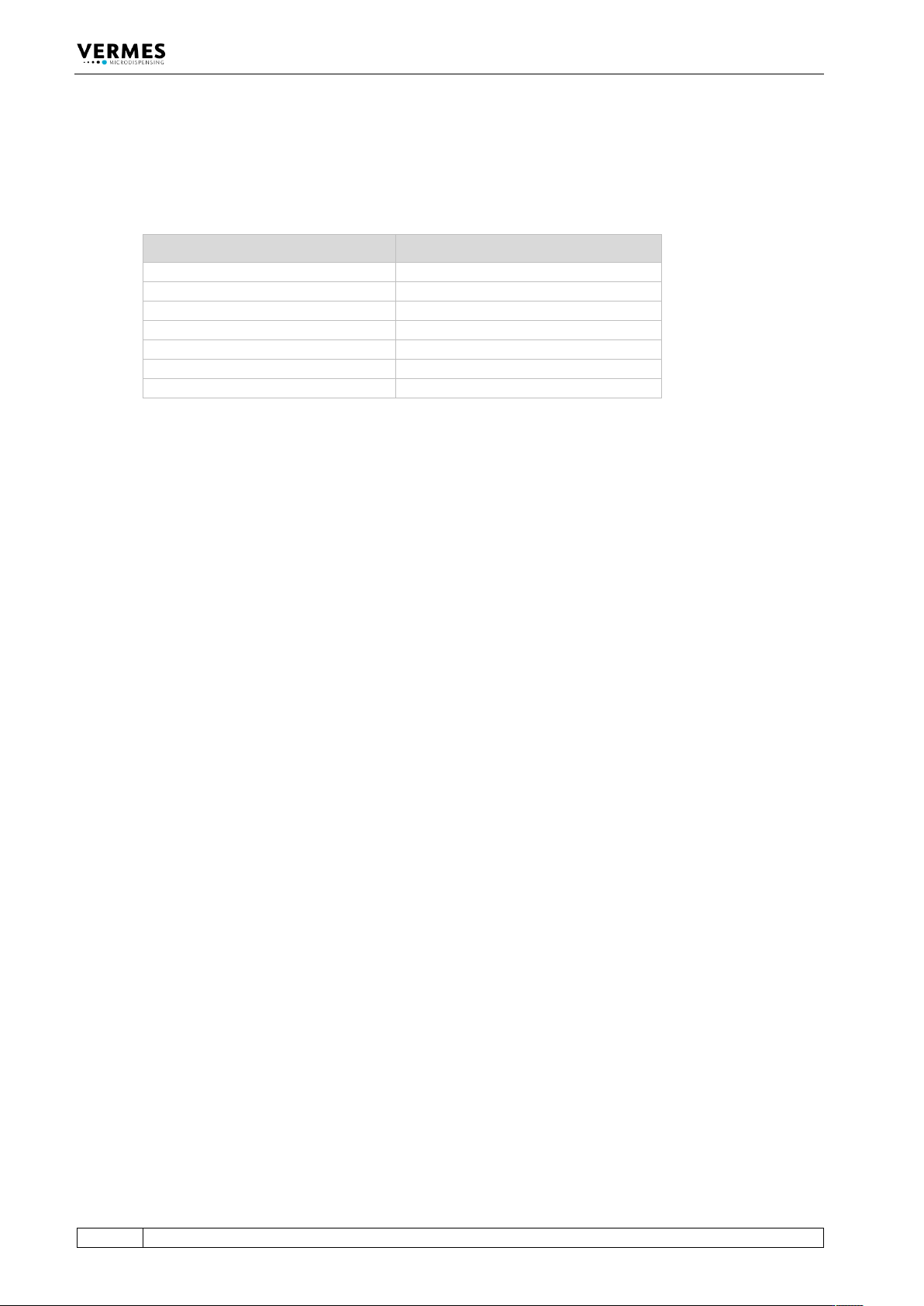
9.2 Heat Resistance of Sealing Materials
The following table shows the maximum temperature to which the respective sealing materials
may be exposed.
Material Max. Temperature [in °C]
PE
80
PTFE
230
NBR
100
EPDM
140
Silicone
200
Viton
220
CeTeDur
250
Tab. 27: Heat Resistance of Sealing Materials
Cleaning
VTK-TR-BA-171e-1 - User Manual MDS 3080-V
131
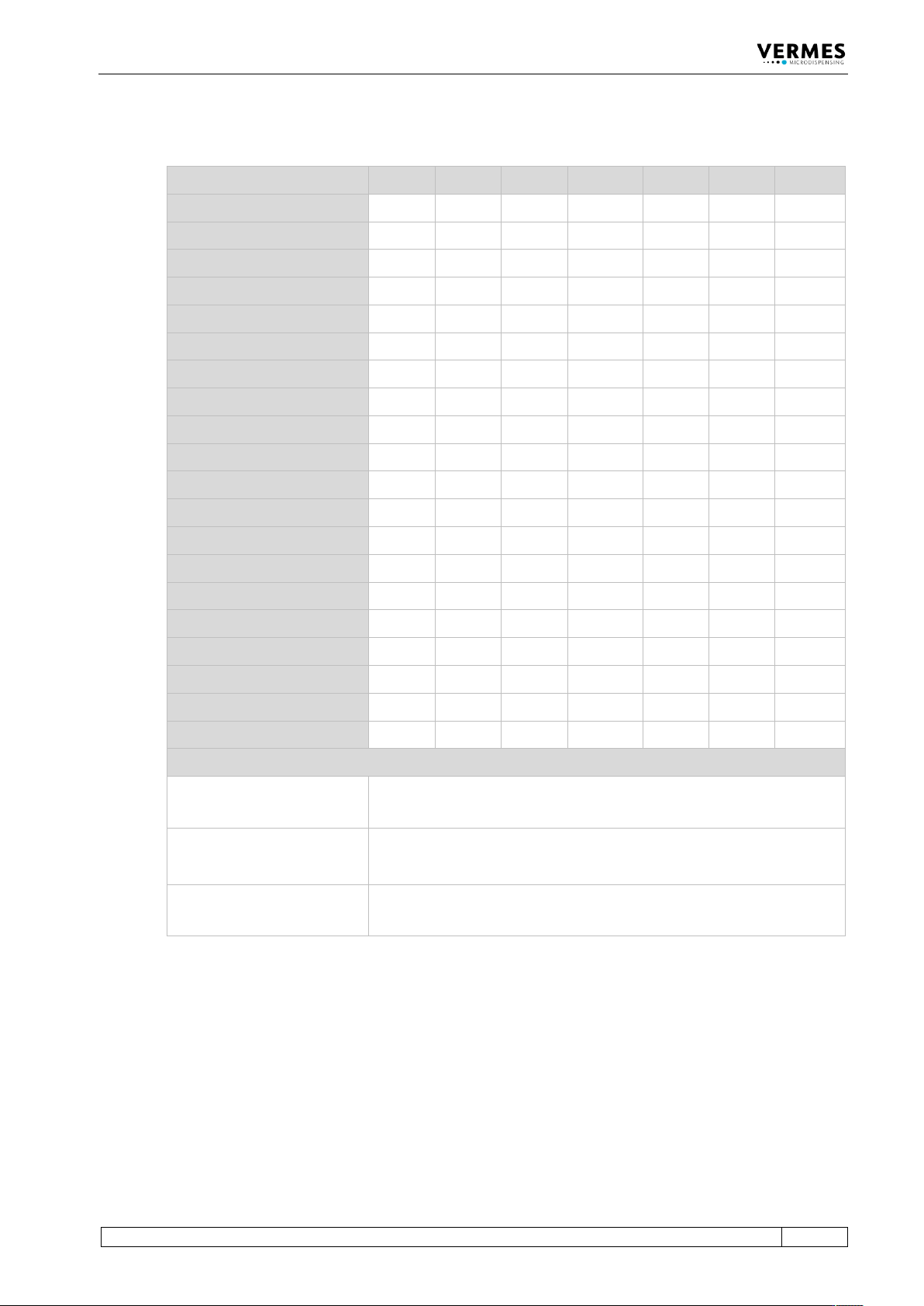
9.3 Compatibility between Sealing Materials and Selected Media
NBR EPDM VITON SILICONE PE PTFE CeTeDur
Acetone
---
+++
---
- +
+++
+++
+++
Ammonia
---
---
---
+++
+++
+++
+++
Chloroform
---
---
+++
---
+++
+++
+++
Cyclohexane
+++
---
+++
---
+++
+++
+++
Cyclohexanol
+++
---
+++
- +
+++
+++
+++
Cyclohexanone
---
---
---
---
---
+++
+++
Dimethylformamide
---
+++
---
- +
+++
+++
+++
Acetic acid
---
---
---
- +
+++
+++
+++
Ethanol
+++
+++
---
+++
+++
+++
+++
Heptane
+++
---
+++
---
- +
+++
+++
Hexane
+++
---
+++
---
- +
+++
+++
Isopropanol
- +
+++
+++
+++
+++
+++
+++
Methylene Chloride
---
---
- +
---
---
+++
+++
Nitromethane
---
- +
---
---
+++
+++
+++
Pentane
+++
---
+++
---
---
+++
+++
Mercury
+++
+++
+++
+++
+++
+++
+++
Silicone Oil
+++
+++
+++
- +
+++
+++
+++
Toluene
---
---
---
---
- +
+++
+++
Water
+++
+++
+++
+++
+++
+++
+++
Xylene
---
---
+++
---
- +
+++
+++
Legend
Excellent compatibility
+++
No or only a marginal influence on the component.
Moderate compatibility
- +
Limited contact and sporadic exposure to the media will allow some
usability, but long term it will lead to malfunctions of the component. If
possible, use materials with a higher compatibility.
No compatibility
---
Usage is not recommended.
Tab. 28: Compatibility between Sealing Material and Selected Media