a3369b.pdf - 第155页
Cleaning 146 VTK - TR -BA- 171e - 1 - User Man u al MDS 3080 -V – Final ly , connect the ac tuator and sensor c ables as well as t he compress ed air. Y ou can fi nd m ore deta iled i nformati on in para graph 6 .2 , pag…
Cleaning
VTK-TR-BA-171e-1 - User Manual MDS 3080-V
145
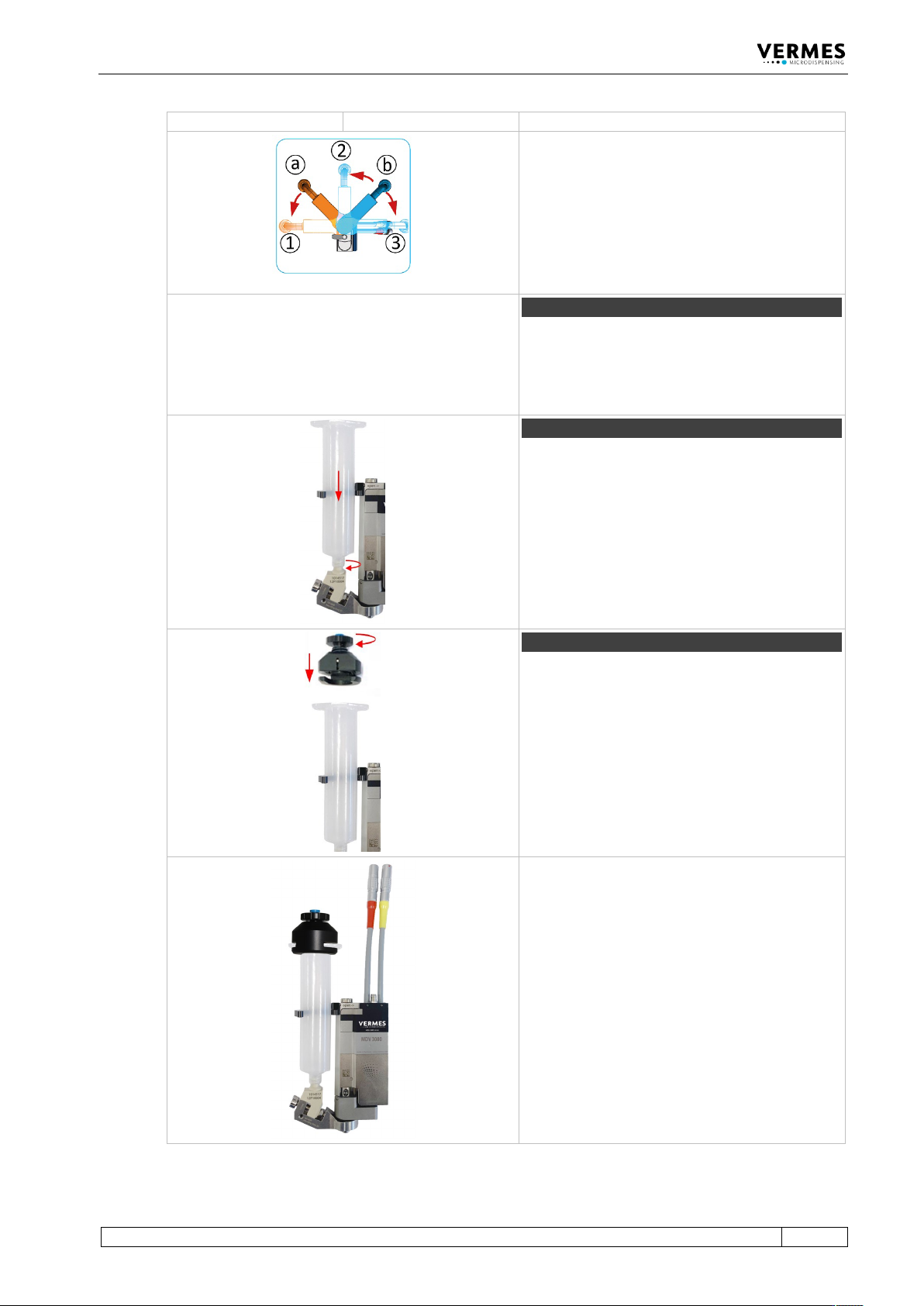
Straighten the fluid box until it latches in.
Optional positions
The bayonet fluid box has three locking
positions (1: -90°, 2: 0°, 3: +90°) in which the
valve can be operated. To fix in locking position
1, mount the fluid box at position a. To fix in
locking position 2 or 3, mount the fluid box at
position b. Currently, no cartridge holder is
available for locking position 1 and 3.
Perform the adjust
You need to perform the adjust now. For details
of the adjust process, see paragraph 6.5,
page 52.
After the adjust is successfully completed,
continue with the following steps.
Step 10 (cartridge)
Push the cartridge into the cartridge holder and
screw it onto the fluid box (clockwise).
Step 11 (Adapter for compressed air)
Screw the Adapter for Compressed Air onto the
cartridge (clockwise). Make sure it sits tight.
Assembling completed
The completely assembled valve with the fluid
box in straight position.
Tab. 32: Re-assembling of the valve

Maintenance
VTK-TR-BA-171e-1 - User Manual MDS 3080-V
147
10 Maintenance
We suggest to clean and to maintain your system regularly, especially for wearing parts such as
tappets, tappet sealings and nozzle inserts. This chapter gives you an overview of the wearing
parts that require high attention. You can check the cycle count of the dispensing cycles, which is
shown at the MDC (see paragraph 4.5.4, page 31). To learn how to demount, clean and remount
each part, see the chapter “Cleaning” (see chapter 9, page 129).
10.1 Maintenance of Tappet, Tappet Sealing and Nozzle Insert
As the tappet, the tappet sealing and the nozzle insert belong to the wearing parts of the system,
they need to be cleaned and exchanged regularly.
10.1.1 Maintenance of the Tappet
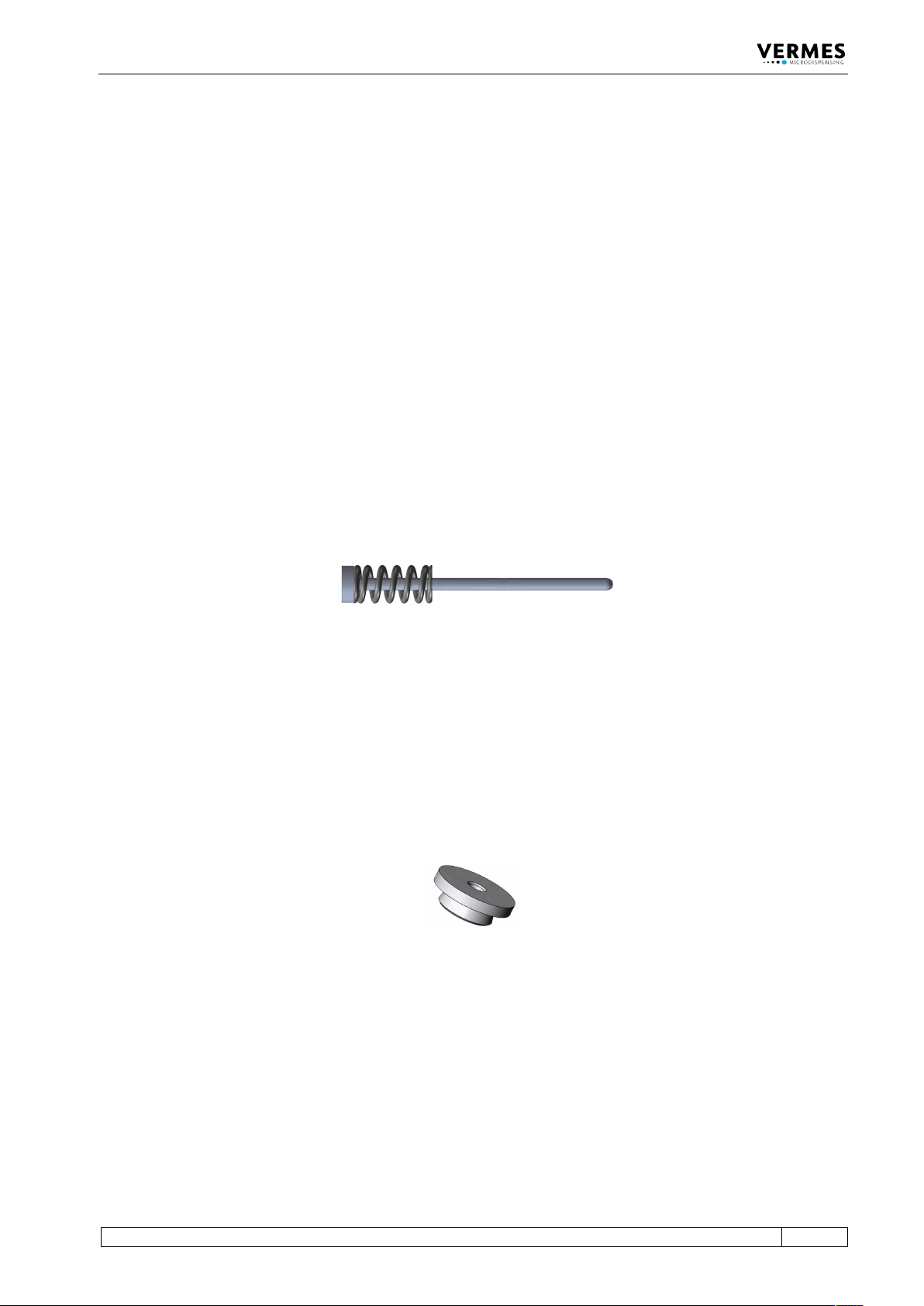
The tappet has to be cleaned and exchanged in regular intervals (at least every 40 million shots)
or in the case of problems (as soon as it starts to move in a sluggish way). Please be aware that
the lifespan of the tappet not only varies by the material and size, but also depends on your
application. Ceramics (CTF, SNTF), tungsten carbide (TTF) and diamond (PDTF) items are
available. The tappet consists of the tappet rod and the tappet spring.
Fig. 41: Example - TTF Tappet (consists of tappet rod and tappet spring)
10.1.2 Maintenance of the Tappet Sealing
For replacement of tappet sealings a particular counter is not provided, as the necessity depends
on current applications, substances to be dispensed etc. Caused by the tappet movement, some
materials tend to penetrate between tappet and tappet sealing, giving rise to abrasion.
Therefore, you have to inspect the tappet sealing from time to time. To continue working with a
damaged tappet sealing inevitably entails unexpected interruptions, loss of material and an
increased need of cleaning.
Fig. 42: Example - Tappet Sealing PE
10.1.3 Maintenance of the Nozzle Insert
The nozzle insert has to be cleaned and exchanged in regular intervals or in the case of problems.
Please be aware that the lifespan of the nozzle insert depends on your application. After
disassembling the nozzle insert, immediately use a cleaning wire to push through the channel of
the nozzle insert, to avoid hardening of residue medium. Do not use a clogged nozzle insert,
since it would strongly compromise your dispensing results. Exchange the nozzle insert as soon
as it is worn out, since otherwise it can cause a leakage problem.