a3369b.pdf - 第47页
Micro disp en sing Va lve 38 VTK - TR -BA- 171e - 1 - User Man u al MDS 3080 -V 5.3 Technical Data Parameter Value Dispensable Quantity Minimum 3 nl per cycl e Inlet Pressure Range Dependi n g on t he supp ly unit (e.g. …
Microdispensing Valve
VTK-TR-BA-171e-1 - User Manual MDS 3080-V
37
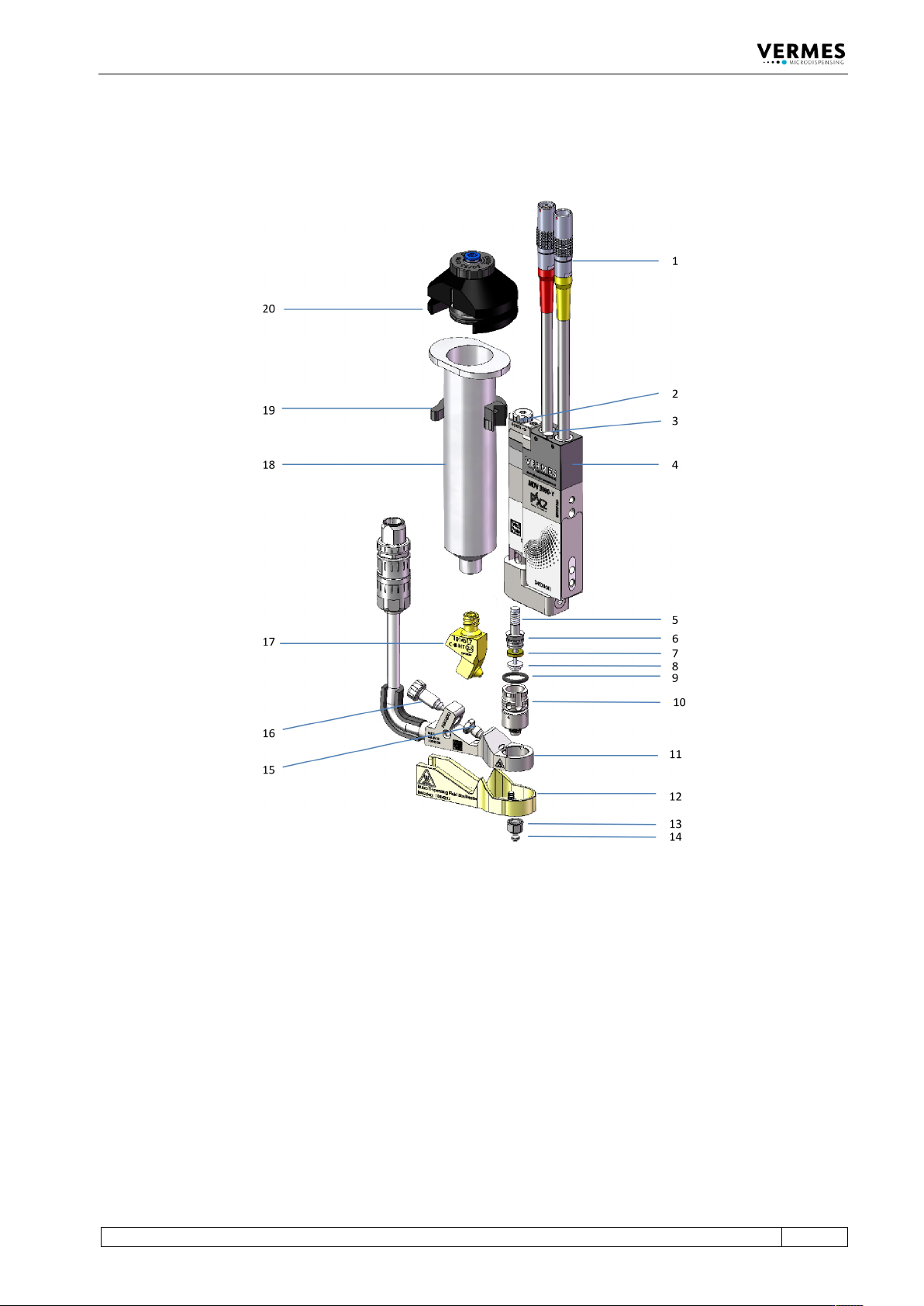
5.2 Explosion View Valve
The explosion view of an MDV 3080-V.
Fig. 13: Explosion view valve
1 Cable connections (red actuator,
yellow sensor)
2 Adjust screw
3 Compressed air (in and out)
4 Valve MDV 3080-V
5 Tappet rod with tappet spring
6 Tappet centering screw BY
7 Tappet centering piece
8 Tappet sealing
9 O-ring BY
10 Fluid box body MDF 1500-BY
11 Heater MDH-48-BY
12 Isolation body
13 Nozzle fixation nut
14 Nozzle insert
15 Connector BY
16 Tightening screw
17 Cartridge base CHI
18 Cartridge
19 Cartridge holder
20 Adapter Safe for compressed air
(connection for cartridge)
Microdispensing Valve
38
VTK-TR-BA-171e-1 - User Manual MDS 3080-V
5.3 Technical Data
Parameter Value
Dispensable Quantity
Minimum 3 nl per cycle
Inlet Pressure Range
Depending on the supply unit
(e.g. cartridge or pressure tank)
Dynamic Viscosity of Fluids
Low to medium viscosity up to 8000 mPas
Response Time (PLC-interface)
ca. 96 µs
Dispensing Frequency (max.)
< 2 kHz
Dispensing Frequency (average)
450 Hz
Compatibility
all aqueous fluids, organic solvents, weak acids and
bases
Dimensions (basic model)
103 mm x 44 mm x 15 mm
Weight
ca. 260 g (depending on configuration)
Position of Tappet in Absence of Voltage
closed

Microdispensing Valve
VTK-TR-BA-171e-1 - User Manual MDS 3080-V
39
5.4 Special Features of the Valve
Normally Closed
In its not energized state, i.e. in absence of voltage, the valve remains in closed position, so that
the channel of the nozzle insert is blocked by the tappet tip. The liquid in such a situation
therefore cannot flow.
With Bayonet Fluid Box
Thanks to the bayonet system, you can remove the fluid box easily from the valve. There are no
screws. This allows for a very quick exchange of nozzle fixation nut and nozzle insert or of the
tappet for cleaning or maintenance purposes. Afterwards you have to carry out the adjust, in
order to establish a convenient position of the nozzle insert with respect to the tappet. This way a
reproducible process remains ensured.
Highest Flexibility
Due to the modular design of the series, nozzle units and fluid boxes can be exchanged easily.
This allows at any time for a quick adaption of the system configuration to new applications. A
comprehensive choice of accessories is also available for special circumstances.
These modifications can be performed in no time, avoiding downtimes for the process.
Functionality Independent of the Position
The functionality of the valves does not depend on the fitting position, considerably simplifying
the integration into an existing process.
User-friendly Design
The control unit does not give rise to compatibility problems with respect to the other
components of a complex process structure. Service is possible by keypad or, thanks to the
integrated RS-232C, by remote PC.
Secure Wiring
The valves are equipped with high-quality Lemo connectors. Those can be connected and
disconnected easily, but hold secure against any accidental opening.
Comprehensive Material Selection
Only the best materials are used for the production of Vermes Microdispensing valves.
• All parts in contact with the transported medium consist of high-alloy special steel, rust- and
acid-resisting, or modifications of high-duty polymers of the PE (Polyethylene), PEEK
(Polyetheretherketone) and PTFE (Polytetrafluoroethylene) family.
• Sealings can be made of different materials. You can find notes regarding heat resistance and
chemical resistance in paragraph 9.2, page 130 and paragraph 9.3, page 131.
• For nozzle inserts, special steel, stainless steel and ceramics options are permanently in store,
allowing for perfect tailoring of the configuration to the needs of the particular application.
E.g. do we recommend using mounting bodies and tightening screws of stainless steel for
very low viscosity media.