IPC-D-279 EN.pdf - 第18页
3.1.7 Environmental Stresses The operating life of a surface mounted assembly is dependent upon a number of factors which include intended usage, usage environments, strength of the materials and components to withstand …

This damage should be minimized by keeping the number
of excursions to a minimum; and the damage needs to be
considered in the overall reliability estimates for the assem-
blies. See IPC-PE-740 for trouble-shooting information.
3.1.3 Burn-In and Environmental Stress Screening
(ESS)
Burn-in tests and ESS have the potential of identi-
fying latent defects that may cause early failures in prod-
uct, but they also have a negative impact on the good
assemblies. The degree of the detrimental impact on reli-
ability depends on the severity of the burn-in and/or ESS
procedures.
Burn-in testing generally should be a complete environ-
mental test involving perhaps worst case but still realistic
operational environments.
ESS should never be employed routinely. ESS needs to be
specifically designed to cause the failure of ‘‘weak’’ ele-
ments in the assemblies for which a strong suspicion of
processing defects exists.
The assembly elements that are typically most affected by
these procedures are the surface mount solder attachments.
The effect of extended solder joint temperature cycling can
use up a significant amount of solder joint life.
3.1.4 Transport While transport conditions like vibra-
tion, mechanical shock and moisture are routinely consid-
ered and accommodated, little is done about the thermal
conditions. Electronic product can sit on loading docks or
in warehouses, or be in cargo holds of ships, airplanes
and/or trucks, in temperatures ranging from −40 to +70°C.
For some applications, e.g. medical implants, these trans-
port conditions would be significantly more severe than the
operational environments.
3.1.5 Storage For some product applications, the envi-
ronmental conditions during storage become significant in
the total life cycle environment. In particular, military
applications, such as munitions (proximity fuses, etc.), and
space applications can require long storage periods, fre-
quently in uncontrolled environments, before final use.
The user should consult with the vendor to determine the
shelf life and special storage conditions.
3.1.6 Use Environments The use environments are
highly dependent upon the product application. In Table
3-1, typical worst case use environments for 9 product cat-
egories are given. These use environments should be
regarded as guidelines only; the actual use environment as
well as the environmental conditions of the SM assembly
being designed may be significantly different.
Table 3−1 Realistic Representative
(1)
Use Environments, Service Lives, and Acceptable Failure Probabilities for Surface
Mounted Electronics Attachments by Use Categories
Worst-Case Environment
Use Category
Tmin
°C
Tmax
°C
∆T
(2)
°C
Dwell Time
t
D
hrs Cycles/Year
Typical Years
of Service
Accept.
Failure
Risk
(3)
,%
Consumer 0 +60 35 12 365 1-3 ~1
Computers +15 +60 20 2 1460 ~5 ~0.1
Telecom -40 +85 35 12 365 7-20 ~0.01
Commercial Aircraft -55 +95 20 12 365 ~20 ~0.001
Industrial
and Automotive
Passenger
Compartment
−55 +96 20
&40
&60
&80
12
12
12
12
185
100
60
20
~10 ~0.1
Military
Grounds and
Ship
−55 +95 40
&60
12
12
100
265
~10 ~0.1
Space leo
geo
−55 +95 3 to 100 1
12
8760
365
5-30 ~0.001
Military a
Avionics b
c
Maintenance
−55 +95 40
60
80
&20
2
2
2
1
365
365
365
365
~10 ~0.01
Automotive
under hood
−55 +125 60
&100
&140
1
1
2
1000
300
40
~5 ~0.1
& = in addition
1 Does not cover all possible use environments, but only most common.
2 ∆T represents the maximum temperature swing, but does not include power dissipation effects for components; for reliability estimations the actual local tem-
perature swings for components and substrate, including power dissipation should be used.
3 The ‘Acceptable Failure Risk’ is the percentage of product in the field that has failed, due to wearout mechanisms, at the end of the ‘Typical Years of Service.’
IPC-D-279 July 1996
6

3.1.7 Environmental Stresses The operating life of a
surface mounted assembly is dependent upon a number of
factors which include intended usage, usage environments,
strength of the materials and components to withstand the
stresses imposed by the usage and the environments, mate-
rial (variables), etc. In a surface mounted assembly, the
most critical element from the life cycle viewpoint are the
solder joints and PTVs. Cyclic (or fatigue) displacements
experienced during various phases of the product’s life
cycle are responsible for consumption of useful life of
material elements.
One of the major contributors to the cyclic loading is ther-
mal cycling due to the internal power cycling and external
environmental changes. Another important contributor is
vibration during the operational use, transportation, han-
dling, etc. An estimate of the fatigue life of the solder
assembly that will be consumed by these fatigue cycles
during the product’s life cycle can be obtained by perform-
ing a cumulative damage analysis.
It should be noted that the cumulative damage analysis
requires the knowledge of fatigue characteristics of the
materials involved. Also, a thorough understanding of how
the product will be used, handled and maintained, by the
user and under what environments, is necessary. See
Appendix E.
3.1.8 Temperature/Thermal Temperature is one of the
most important parameters in the use environment that
must be considered in the SM PWA design process. Tem-
perature history is the most significant parameter affecting
the reliability of SM solder joints. For some product appli-
cations, the use environment consumes the most significant
portions of the required fatigue life; this is typically the
case where the product development cycle includes produc-
ing a prototype prior to the ‘‘final build.’’
Therefore, DfR depends to a large extent on the thermal
design for the assembly, as well as the external thermal
environment. Temperature is also important, since many
materials in electronic assemblies have properties which
change significantly with temperature.
3.1.9 Cyclic Temperature Swings Cyclic thermal excur-
sions, ∆T, cause thermal expansion mismatches due to dif-
ferent parts of the assemblies having materials with differ-
ent CTEs and/or being at different temperatures. Thus, the
size of the cyclic temperature swing is proportional to the
resulting loading. The larger the ∆T, the larger the threat to
reliability.
During cyclic temperature excursions, these cycles can
have different profiles, e.g., sinusoidal, trapezoidal, saw-
tooth, square-wave, etc. These differences are important in
understanding time-dependent and rate-dependent pro-
cesses. The transient parts of the profile give the ramping
rates of the temperature change which can cause transient
temperature gradients and over-stress conditions. The
steady-state, or near steady-state, parts of the profile deter-
mine the duration of the temperature dwells which are
important for time-dependent processes like creep and
stress relaxation.
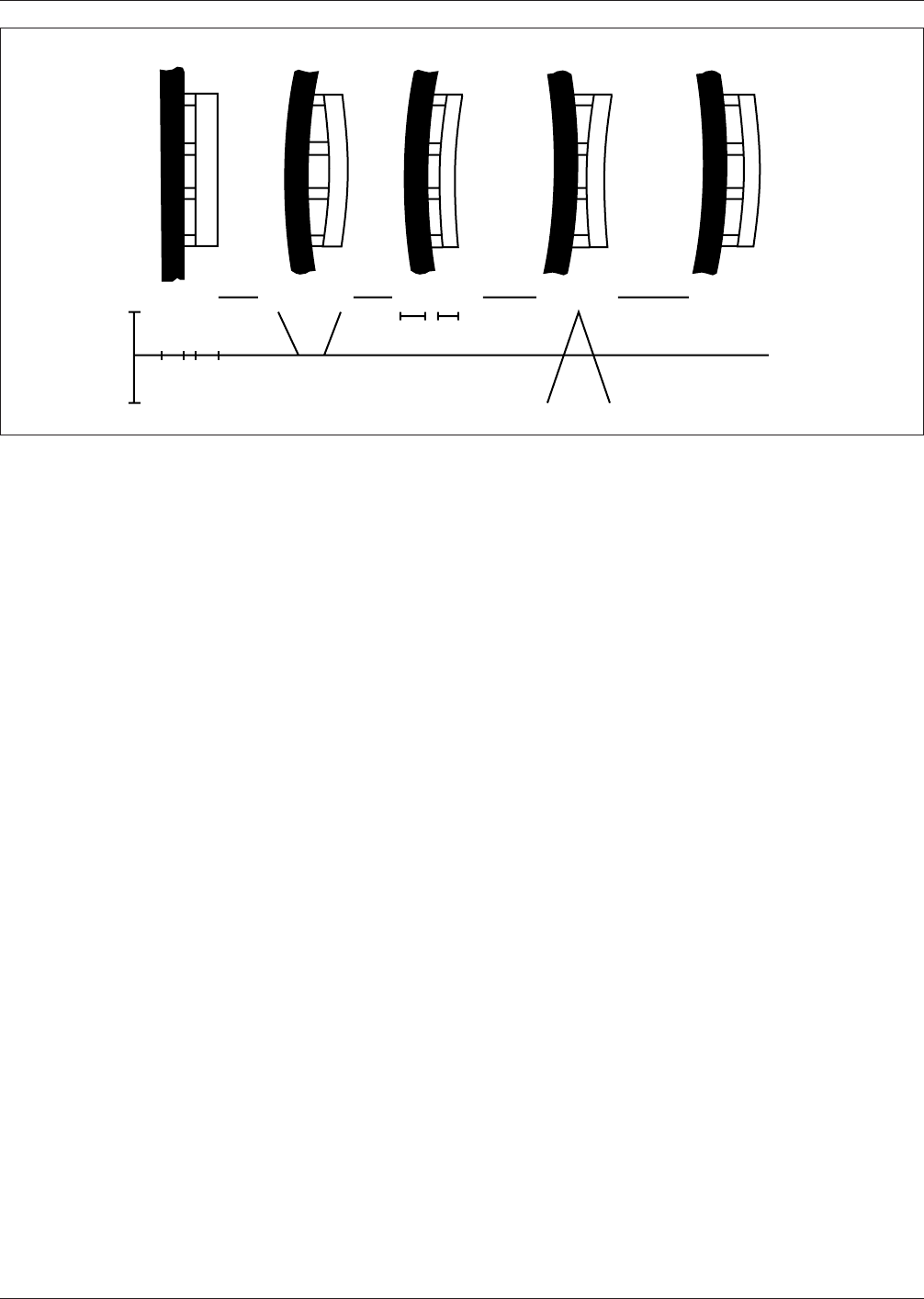
3.1.10 Thermal Shock In thermal shock, the extremely
rapid temperature changes (∼30°C/minute and above)
result in warping of the surface mount assembly. The
warpage is caused by large transient thermal gradients
induced by the rapid temperature change when the boards
are plunged into a new thermal environment. The warpages
result in tensile and shear stresses where the tensile load-
ing dominates over the steady state expansion mismatch.
Thus, even assemblies with matched coefficients of thermal
expansion will exhibit solder joint failures when subjected
to thermal shock. The thermal shock loading mechanism is
summarized in Figure 3-1.
Thermal shock conditions can arise from several sources.
Examples of these are:
1) Rapid changes in external environment, e.g., sun-to-
shade in space, missile launch, wing-mounted avion-
ics, automobile start-up from very cold.
2) Rapid changes in power dissipation.
3) Various manufacturing/repair processes, e.g., reflow,
vapor degrease, rework, etc.
The distinction between thermal shock and thermal cycling
is not always addressed in designing reliability experi-
ments. There is a fundamental difference between thermal
shock and thermal cycling. The primary differences arise
from the mechanism of loading. Thermal shock tends to
result in multiaxial states of stress dominated by tensile
overstresses and tensile fatigue. On the other hand, as pre-
viously discussed, thermal cycling results in shear loads
and failure occurs from an interaction of shear fatigue and
stress relaxation.
Thermal shock is usually performed in dual chamber
arrangements or with liquid nitrogen injection whereas
thermal cycling is performed in single chamber cycling
equipment. Dual chamber arrangements will produce tem-
perature transition rates in excess of 50°C/minute.
Single chambers generally do not produce transition rates
even close to 30°C/minute which is the rate necessary to
induce thermal shock. The results of these two types of
testing are generally incompatible. Finally, thermal shock
testing for purposes of evaluating surface mount solder
joint reliability is only appropriate if thermal shock is
indeed a field condition encountered by the product.
In some specifications, the definitions of thermal cycling
and thermal shock are not fully differentiated; the rates of
change are more closely associated with what we are call-
ing thermal shock.
July 1996 IPC-D-279
7
3.1.11 Electrical
3.1.11.1 ESD Susceptibility and Damage Prevention
All electronic components containing thin conducting or
insulating films are susceptible to electrostatic discharge
(ESD) damage. These components include those fabricated
in high speed technologies (MOS, bipolar, GaAs), thin film
technologies (resistors, integrated circuits, magnetic heads,
MOS capacitors), and in future, wafer scale integration and
multichip modules.
3.1.12 EMC/EMI The electromagnetic spectrum is usu-
ally divided into categories ranging from the long-
wavelength radiation from power lines through radio, infra-
red, visible, ultraviolet, and x-rays, to gamma rays at the
short-wave end. All electromagnetic waves consist of an
electric field and a magnetic field. The relative magnitude
of these fields depend on the emitter (EM source), wave
propagation medium, and the proximity of the emitter to
the subject assembly.
Many electronic circuits are susceptible to electromagnetic
radiation and must be shielded to ensure proper operation.
One of the most important effects of the electromagnetic
radiation in the environment is electromagnetic interfer-
ence (EMI). EMI is the electro-magnetic disturbances that
impair the desired signal. In practice, EMI is often divided
into two categories: conducted EMI and radiated EMI.
Conducted EMI is an interfering signal resulting from an
undesirable voltage or current coupled into a signal or
other pertinent conductor. Radiated EMI is an interfering
signal resulting from an electric and/or magnetic field
amplitude and frequency spectra intentionally or uninten-
tionally radiated by an electrical source. Examples of radi-
ated emission sources are radio and TV transmitters, light-
ning, digital system noise from electronic control systems,
etc. In military applications, an important effect is the inter-
action of electromagnetic radiation with electroexplosive
devices used as detonators. Improper EMI could acciden-
tally initiate the explosion.
EMC is the ability of electronic systems to operate in the
intended electromagnetic environment at designed levels of
performance and efficiency. The most direct approach to
protection is, in most cases, to avoid the limited region in
which high radiation levels are found. When exposure can-
not be avoided, shielding is the important protective mea-
sure. The material selected for shielding can be an impor-
tant factor. Ideal materials include steel, copper and nickel
coating. In the design process, apertures for cooling venti-
lation and cable connections on the shielding box should be
properly designed so that the EMI will have no influence
inside the shielded space.
3.1.13 Mechanical Shock and Vibration Shock and
vibration are common accelerators of failure in electronic
packaging. The most frequent vibration-induced failures in
surface mount are:
1. Flexing of leads and interconnects.
2. Dislodging or damaging of parts and structures.
Methods have been developed to counter the destructive
effects of shock and vibration. Generally, isolation of a
printed board against the effects of shock and vibration
requires that the natural frequency of the printed board be
substantially lower than the undesired frequency of vibra-
tion to avoid the resonance.
The basic system level isolators available are:
1. Natural or synthetic rubber, used to damp the vibra-
tion.
IPC-279-03
Figure 3−1 SMT Assembly Response to Thermal Shock
THERMAL
STEADY
STATE
THERMAL
STEADY
STATE
+ 125°CAT – 65°C
+ 125°C
AT
– 65°C
IPC-D-279 July 1996
8