00196504-02_UM_X-Serie_SR70X_EN.pdf - 第312页
Tasks on the machine User manual SIPLACE X-series Alarm information and online help From software version SR.70x.xx 01/2011 EN edition 312 5.6 Alarm information and online help If alarms occur while work is in progress o…
User manual SIPLACE X-series Tasks on the machine
From software version SR.70x.xx 01/2011 EN edition The user interface
311
5.5.6 Application-oriented operation through the use of color marking
On the user interface, symbols, buttons and views can be highlighted in color. The various colors
used immediately show when, for example, intervention by the operator is required or when a
warning has been issued.
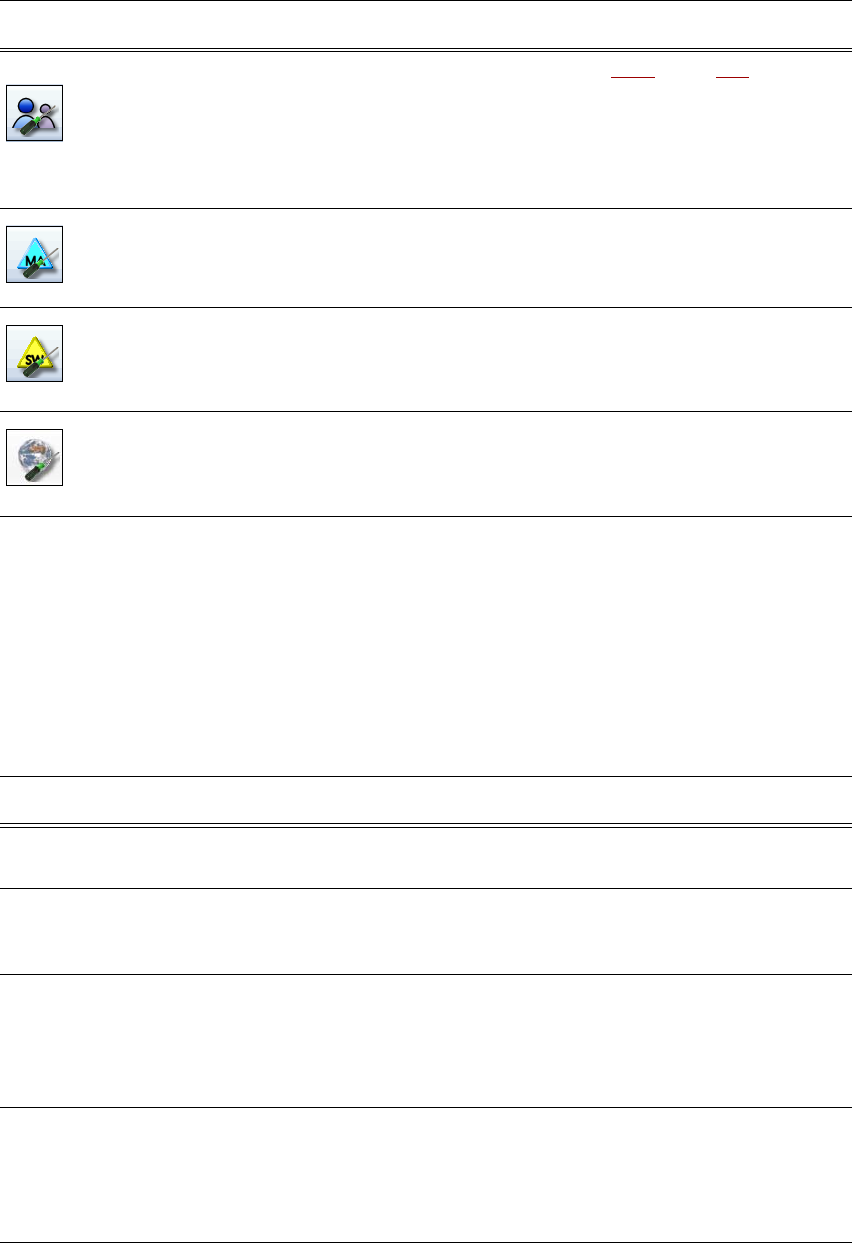
The following color markings are used in the station software:
5
User
settings
Setting the operator level (see Section 5.3.3, page 300).
Setting the language. You can choose between "Deutsch" and
"English" as standard. There is also a language CD available for
installing additional languages.
Other options can be set at the "Advanced production" operator
level or above.
Machine options You cannot change any options at the "Basic production" operator
level.
Configure machine options.
Software options For Machine service or SIPLACE service only.
Here you can activate various test functions.
Overview of the
connected exter-
nal systems
Displays all connected external systems (e.g. OIS, SetupCenter).
Displays the connection status and the memory in use. Also used
to clear the connected systems.
Symbol Settings Description
Color Status Meaning
Red Alarm Operator intervention is needed.
In the "Feeders, components and nozzles" view only.
Orange Warning There is a note for the operator.
Immediate operator intervention is not needed, however.
In the "Feeders, components and nozzles" view only.
Green Busy The symbol or button has control of the machine and the status
is OK.
Only available in the "Basic production", "Feeders, compo-
nents and nozzles", "Board", "Check sensors and functions"
and "Service" views.
Green flashing Waiting for board Replaces "Busy" status if the machine is ready in basic pro-
duction mode, but is not actually producing because there is
no board present.
Insert a PCB.
In the "Basic production" view only.
Tasks on the machine User manual SIPLACE X-series
Alarm information and online help From software version SR.70x.xx 01/2011 EN edition
312
5.6 Alarm information and online help
If alarms occur while work is in progress on the placement machine, the alarm message is dis-
played in red in the status field on the user interface. The Alarm information symbol is active.
The red highlighted button on the toolbar signals that operator intervention is required.
5
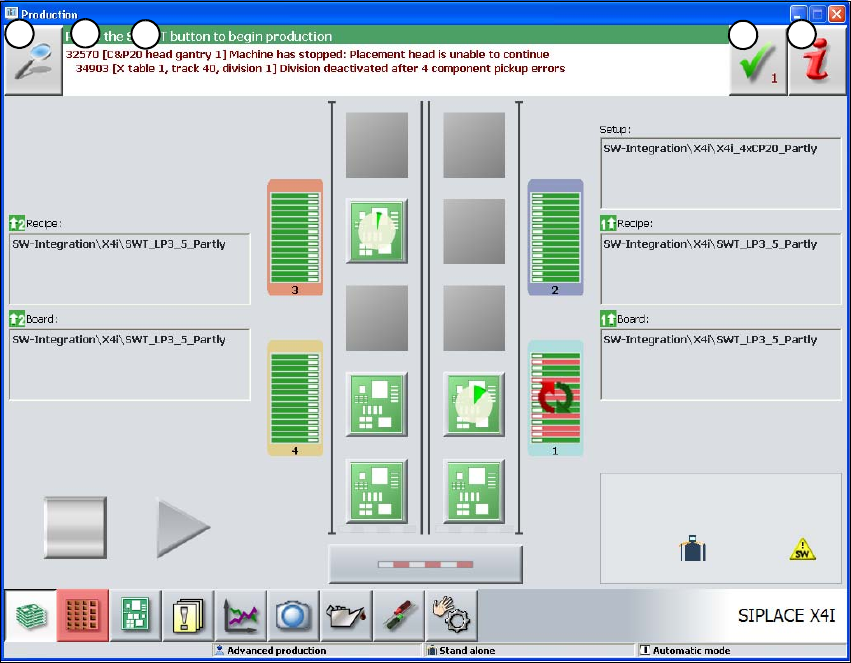
Fig. 5.6 - 1 "Basic production" view with alarm message (with reference to the SIPLACE X4I)
(1) Alarm number
(2) Alarm message: brief information about the alarm
(3) "Details" symbol: for calling up detailed information (e.g. source of the error, time at which it
occurred)
(4) "Acknowledge alarm" symbol: for clearing the alarm display
(5) "Alarm information" symbol: for calling up help about the current alarm
1
2
3
4
5
User manual SIPLACE X-series Tasks on the machine
From software version SR.70x.xx 01/2011 EN edition Alarm information and online help
313
5.6.1 Display information about the current alarm
To display information about the current alarm, click the symbol to start the help system for
the station computer. The main help system window opens with the -alarm information. This in-
formation relates to the currently-displayed alarm from which the help was started.
When an alarm is eliminated and this has been automatically detected by the machine, the alarm
is automatically deleted from the status field.
If elimination is not automatically detected, the alarm may be cleared manually from the -status
field.
To do this, click on the -symbol. The alarm -message will no longer appear in the status
field.
5.6.2 Display information about the selected alarm
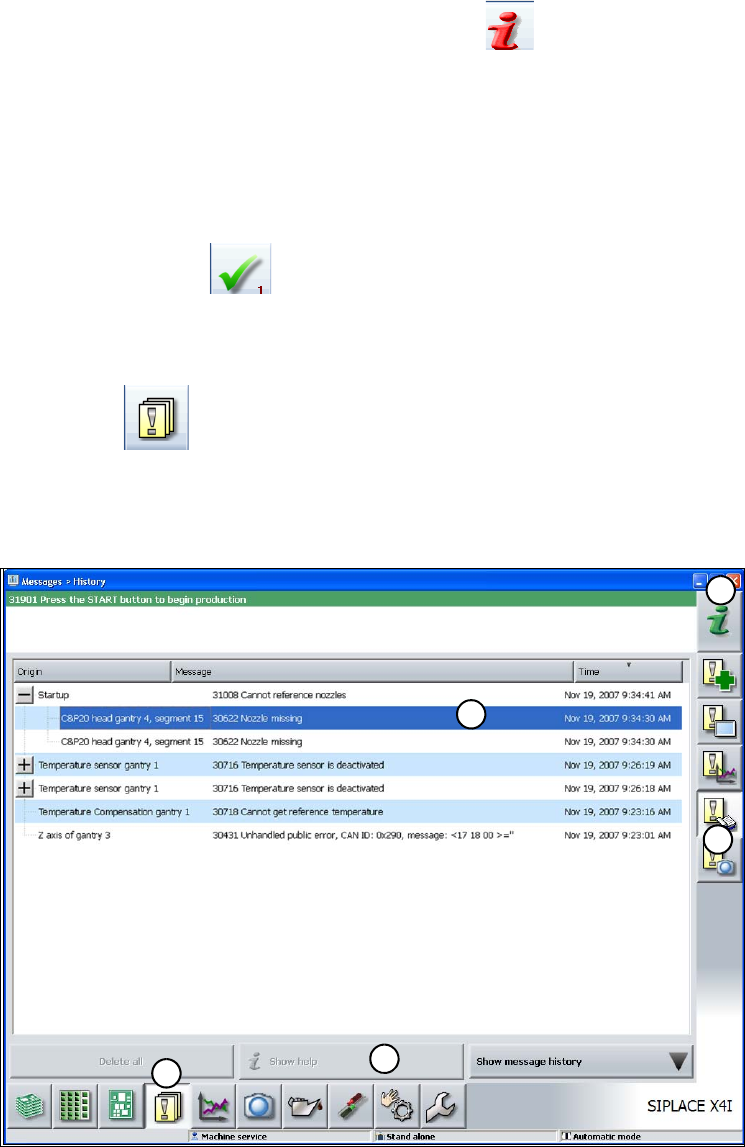
Click the button on the toolbar (1).
All alarms that have occurred are displayed.
Click the "Display recorded messages" button (2).
Click through the alarm list tree (3) to open detailed alarm messages.
. 5
Fig. 5.6 - 2 Example: Alarm list (with reference to the SIPLACE X4I)
In the alarm list, select the alarm display for which you want to read the information.
1
2
3
4
5