bnp-b2365(eng)b.pdf - 第22页
1. Installation 1 - 6 [4] Do not use the unit with the cable submerged in oil or water. (Refer to right drawing.) [5] Make sure that oil and water do not flow along the cable into the motor or detector. (Refer to right d…
1. Installation
1 - 5
1-1-6 Oil/water standards
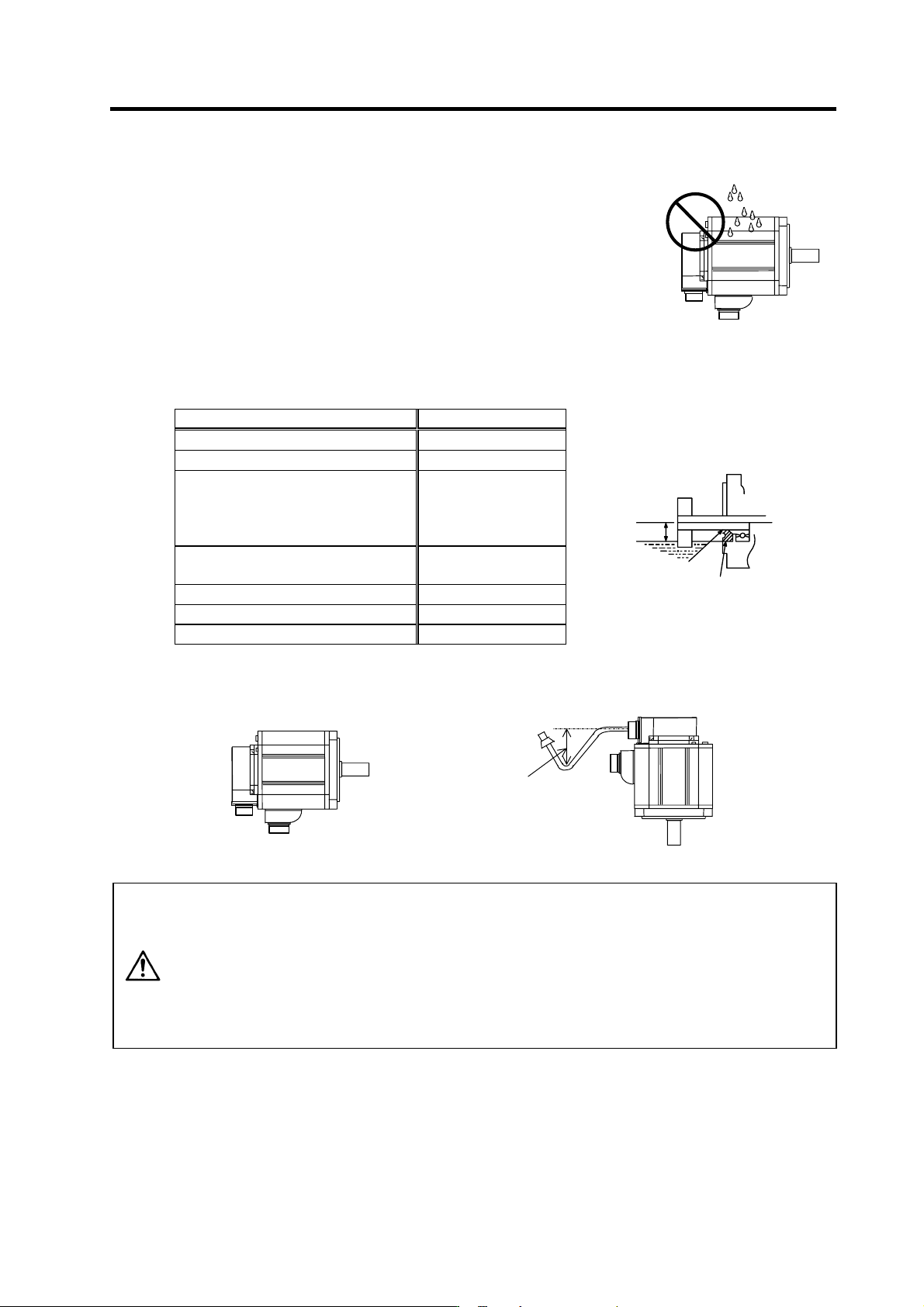
[1] The motor protective format uses the IP type, which complies with IEC
Standard. However, these Standards are short-term performance
specifications. They do not guarantee continuous environmental
protection characteristics. Measures such as covers, etc., must be
taken if there is any possibility that oil or water will fall on the motor,
and the motor will be constantly wet and permeated by water. Note
that the motor’s IP-type is not indicated as corrosion-resistant.
[2] When a gear box is installed on the servomotor, make sure that the oil
level height from the center of the shaft is higher than the values given below. Open a breathing
hole on the gear box so that the inner pressure does not rise.
Servomotor Oil level (mm)
HA053N, HA13N 8
HA23N, HA33N 10
HC52, HC102, HC152
HC53, HC103, HC153
HC103R, HC153R, HC203R
HC353R, HC503R
20
HC202, HC352, HC452, HC702
HC203, HC353, HC453, HC703
25
HC902 30
HA-LF11K2-S8 34
HA-LF15K2-S8 48
Oil level
Lip
V-ring
Servomoto
r
Gea
r
[3] When installing the servomotor horizontally, set the power cable and detector cable to face
downward. When installing vertically or on an inclination, provide a cable trap.
Cable trap
CAUTION
1. The servomotors, including those having IP65 specifications, do not have a
completely waterproof (oil-proof) structure. Do not allow oil or water to
constantly contact the motor, enter the motor, or accumulate on the motor. Oil
can also enter the motor through cutting chip accumulation, so be careful of
this also.
2. When the motor is installed facing upwards, take measures on the machine
side so that gear oil, etc., does not flow onto the motor shaft.
3. Do not remove the detector from the motor. (The detector installation screw is
treated for sealing.)
Oil or water
Servomotor
1. Installation
1 - 6
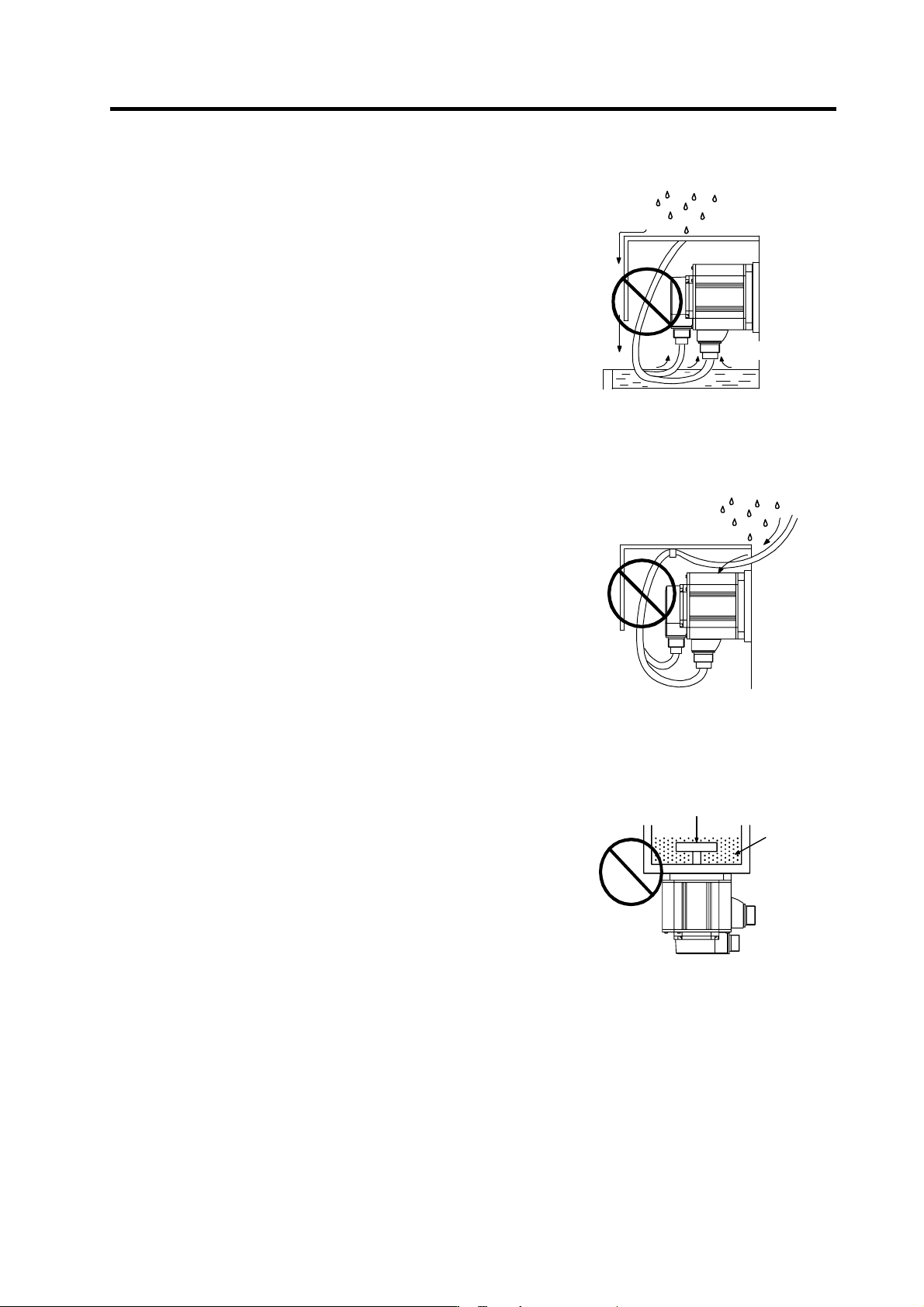
[4] Do not use the unit with the cable submerged in oil or
water.
(Refer to right drawing.)
[5] Make sure that oil and water do not flow along the cable
into the motor or detector. (Refer to right drawing.)
[6] When installing on the top of the shaft end, make sure
that oil from the gear box, etc., does not enter the
servomotor. The servomotor does not have a waterproof
structure.
Cover
Oil water
<Fault> Capillary tube phenomenon
Servomotor
<Fa ult> Respiration
Cover
Servomotor
Servomotor
Gear
Lubricating oil
1. Installation
1 - 7
1-1-7 Cable stress
[1] Sufficiently consider the cable clamping method so that bending stress and the stress from the
cable's own weight is not applied on the cable connection part.
[2] In applications where the servomotor moves, make sure that excessive stress is not applied on the
cable.
If the detector cable and servomotor wiring are stored in a cable bear and the servomotor moves,
make sure that the cable bending part is within the range of the optional detector cable.
Fix the detector cable and power cable enclosed with the servomotor.
[3] Make sure that the cable sheathes will not be cut by sharp cutting chips, worn by contacting the
machine corners, or stepped on by workers or vehicles.
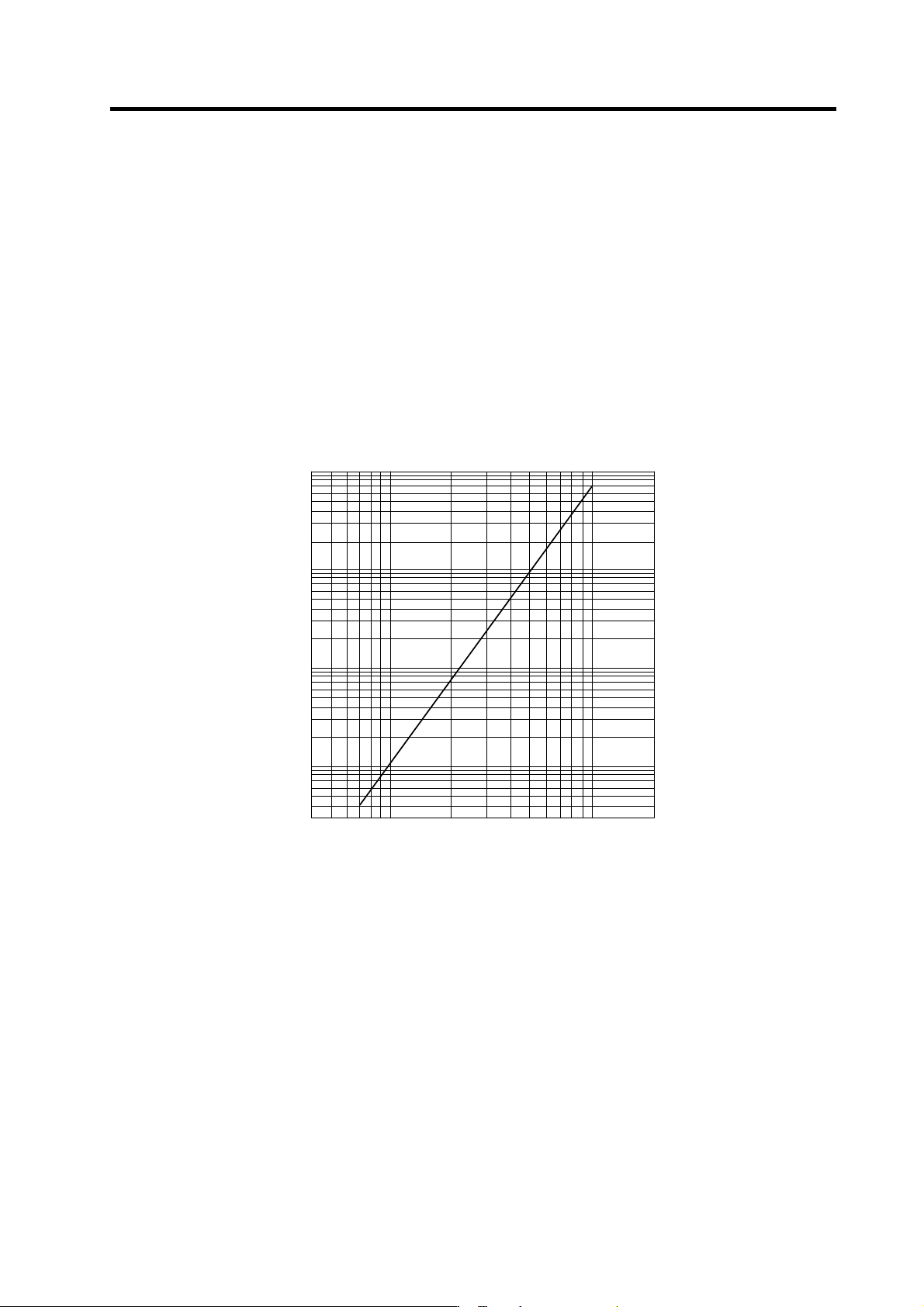
The bending life of the detector cable is as shown below. Regard this with a slight allowance. If the
servomotor/spindle motor is installed on a machine that moves, make the bending radius as large as
possible.
4 7 10 20 40 70 100 200
1×10
8
5×10
7
2×10
7
1×10
7
5×10
6
2×10
6
1×10
6
5×10
5
2×10
5
1×10
5
5×10
4
3×10
4
Detector cable bending life
(Material of Mits ubishi optional detector cable: A14B2343)
(Note)
The values in this graph are calculat ed values and are not guaranteed.
Bending radius (mm )
No. of bends (times)
4 7 10 20 40 70 100 200
3 x 10
4
5 x 10
4
1 x 10
5
2 x 10
5
5 x 10
5
1 x 10
6
2 x 10
6
5 x 10
6
1 x 10
7
2 x 10
7
5 x 10
7
1 x 10
8