Utah-94-721002-System-Manual.pdf - 第14页
mä~ëã~ä~Ä and fçåÑ~Ä lñÑçêÇ=fåëíêìãÉåíë=mä~ëã~=qÉÅÜåçäçÖó= Health and Safety NKN= fåíêçÇìÅíáçå= This section must be read and understood before the system is approached or operated and before any maintenance work is carr…
Health and Safety lñÑçêÇ=fåëíêìãÉåíë=mä~ëã~=qÉÅÜåçäçÖó= mä~ëã~ä~Ä and fçåÑ~Ä
NK= eÉ~äíÜ=~åÇ=p~ÑÉíó==
A l’attention des clients de langue française
Le document hygiène et securité est disponible en fraçais. Vous devez
vous assurer que cette version est présente dans ce manual. Si elle est
manquante contactez votre representant Oxford Instruments Plasma
Technology.
Für deutschsprachige Kunden
besteht dieses Kapitel “Health and Safety” unter dem Titel “Sicherheit
und Unfallverhütung” auch in deutscher Fassung, die in diesem
Handbuch enthalten sein sollte. Falls diese fehlt, fordern Sie bitte ein
Exemplar bei Oxford Instruments Plasma Technology an.
`çåíÉåíë=
=
1 Health and Safety.........................................................................................................................1-1
1.1 Introduction............................................................................................................................................1-2
1.1.1 Warnings and Cautions................................................................................................................1-2
1.2 Hazard Categories..................................................................................................................................1-3
1.3 Specific Hazards......................................................................................................................................1-4
1.3.1 Electrical........................................................................................................................................1-4
1.3.2 Electromagnetic Radiation..........................................................................................................1-5
1.3.3 Light..............................................................................................................................................1-6
1.3.4 High Temperature........................................................................................................................1-7
1.3.5 Low Temperature.........................................................................................................................1-7
1.3.6 Gases .............................................................................................................................................1-8
1.3.7 Materials.....................................................................................................................................1-10
1.3.8 Process Chemicals.......................................................................................................................1-12
1.3.9 Vacuum.......................................................................................................................................1-12
1.3.10 Compressed air...........................................................................................................................1-13
1.3.11 Mechanical..................................................................................................................................1-13
1.3.12 General........................................................................................................................................1-14
1.4 Warning and advisory labels ...............................................................................................................1-16
Health and Safety
Printed:29 May 2005, 06:31 Page 1-1 of 18 Issue 11: August 2004
mä~ëã~ä~Ä and fçåÑ~Ä lñÑçêÇ=fåëíêìãÉåíë=mä~ëã~=qÉÅÜåçäçÖó= Health and Safety
NKN= fåíêçÇìÅíáçå=
This section must be read and understood before the system is approached or operated and
before any maintenance work is carried out.
It is a requirement that procedures and practices taught in Oxford Instruments Plasma
Technology training courses are followed.
If the equipment is used in a manner not specified by Oxford Instruments Plasma Technology,
the protection provided by the equipment may be impaired.
Please read this section carefully, and note that certain aspects of the system can produce
more than one hazard (e.g. process gases can be a fire hazard and a toxic hazard).
Some safety features are fitted to guard against more than one hazard. In particular, note
that some view ports must guard against UV light emission (sub-section 1.3.3, page 1-6), RF
energy emission (sub-section 1.3.2, page 1-5) and must be fitted with implosion guards.
Note that this document is standardised and may contain warnings, which are not relevant to
your particular system.
NKNKN= t~êåáåÖë=~åÇ=`~ìíáçåë=
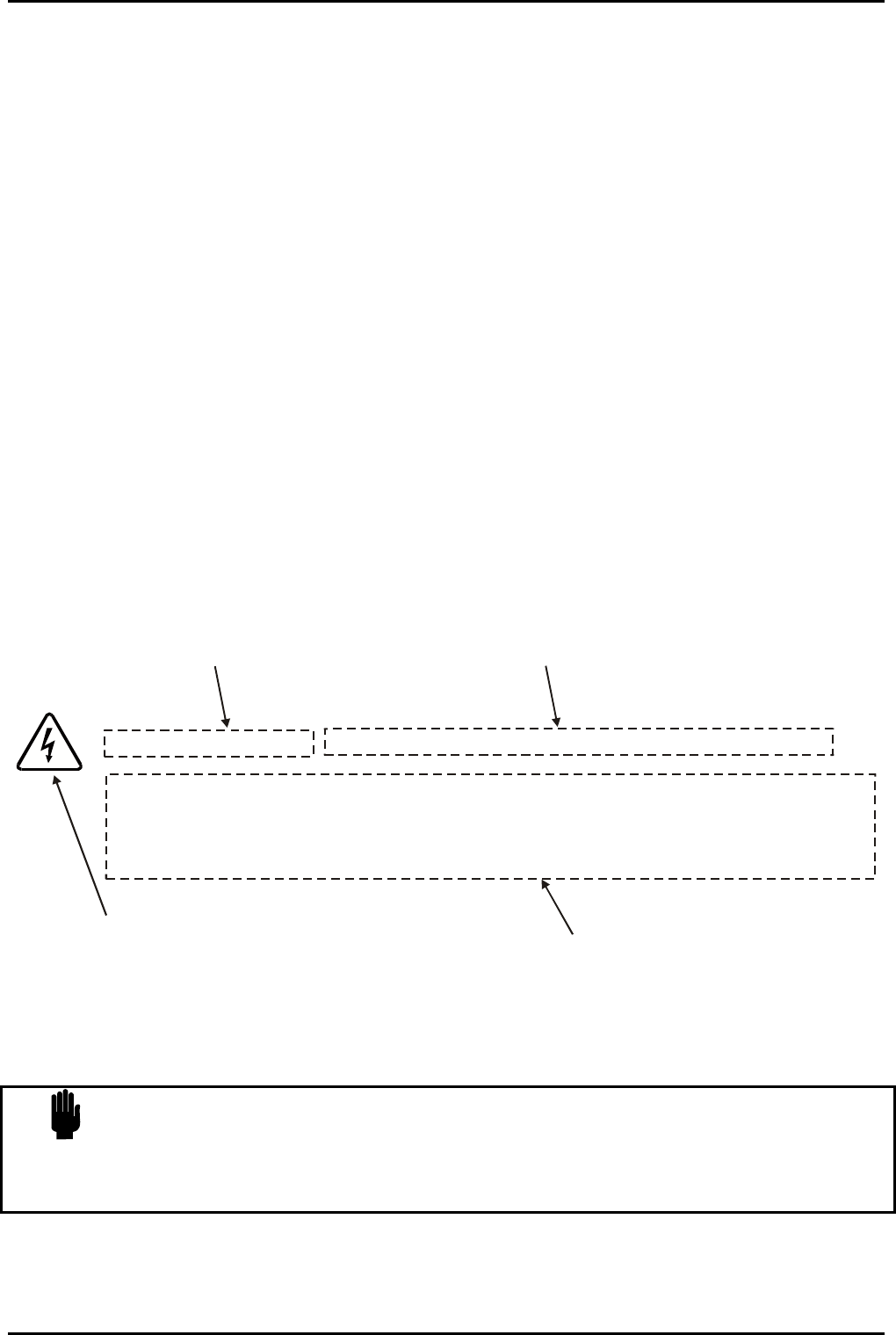
Throughout this manual WARNINGS are inserted in the text to draw the reader’s attention
to hazards. Failure to comply with a WARNING could result in death or serious injury. A
typical warning is shown below:
PICTORIAL SHOWING THE
HAZARD CATEGORY GRAPHICALLY
HAZARD IDENTIFICATION CONSEQUENCES OF IGNORING
THE HAZARD
HOW TO AVOID
THE HAZARD
WARNING
HAZARDOUS VOLTAGE - CONTACT CAN CAUSE DEATH, SEVERE INJURY OR BURNS
Any work requiring the removal of covers or panels must only be performed by authorised
personnel who are aware of the hazards involved.
Before removing any covers or panels, power down the system then carry out the lock out /
tag out procedure detailed in Section 6.
Throughout this manual CAUTIONS are inserted in the text to draw the reader’s attention to
situations and procedures, which could cause damage to the equipment. A typical CAUTION
is shown below:
CAUTION
Upper electrodes can become contaminated from finger marks etc.
When working on the upper electrodes, ensure that powder-free cleanroom
gloves are worn.
Health and Safety
Issue 11: August 2004 Page 1-2 of 18 Printed:29 May 2005, 06:31

Health and Safety lñÑçêÇ=fåëíêìãÉåíë=mä~ëã~=qÉÅÜåçäçÖó= mä~ëã~ä~Ä and fçåÑ~Ä
NKO= e~ò~êÇ=`~íÉÖçêáÉë=
Hazards and associated warnings relevant to Health and Safety which appear in the text of
this manual and in this section will fall into the following categories:
a) Electrical
(sub-section 1.3.1,
page 1-4)
The system carries voltages high enough to cause death or serious
injury. Even when the electrical power supply is isolated, electrical
energy at dangerous levels is stored by capacitors.
b) Electromagnetic
Radiation
(sub-section 1.3.2,
page 1-5)
Parts of the system produce electromagnetic radiation from audio
frequencies to 2.45 GHz. This radiation can have a field strength
strong enough to cause death or injury if not properly shielded.
c) Light
(sub-section 1.3.3,
page 1-6)
Ultra Violet (UV) or Laser light may be emitted in some systems.
These can cause permanent damage to the eyes or blindness if not
protected by the relevant shields or filters.
d) High Temperature
(sub-section1.3.4,
page 1-7)
Some components run at a temperature high enough to cause severe
burns.
e) Low Temperature
(sub-section 1.3.5,
page 1-7)
Components and gases at very low temperatures can cause severe
'burns' if allowed to contact the skin.
f) Gases
(sub-section 1.3.6,
page 1-8)
Some process gases and cleaning fluid vapour may be toxic, corrosive,
carcinogenic or flammable. They may also cause asphyxiation
through oxygen deprivation. Gases under pressure can, if applied to
the body, enter it and cause death or serious injury.
g) Materials
(sub-section 1.3.7,
page1-10)
Some materials used in the system can become toxic during use. If
this happens, then great care must be taken during maintenance to
prevent death or serious injury.
h) Process Chemicals
(sub-section 1.3.8,
page 1-12)
Some etching and deposition compounds are toxic during use, and
can leave toxic residues in the system.
i) Vacuum
(sub-section 1.3.9,
page 1-12)
Chambers or other components under partial vacuum represent
stored energy, which can cause injury if released carelessly.
j) Compressed Air
(sub-section 1.3.10,
page 1-13)
Compressed air can enter the body through the skin and cause
serious injury. Pneumatically operated system components can be
actuated suddenly, even when the system is not operating, causing
serious injury.
k) Mechanical
(sub-section 1.3.11,
page 1-13)
Injury can be caused by heavy components, sprung components,
deposition layers under stress, embrittled wire and machinery in
motion.
l) General
(sub-section 1.3.12,
page 1-14)
Various procedures must be studied and followed. These include
procedures specific to the system in question and also local and
national Health and Safety standards.
Health and Safety
Printed:29 May 2005, 06:31 Page 1-3 of 18 Issue 11: August 2004