Utah-94-721002-System-Manual.pdf - 第80页
mä~ëã~ä~Ä póëíÉãNMM lñÑçêÇ =fåëíêìã Éåíë= mä~ëã~ =qÉÅÜåçäçÖó == System Manual RKQKP= póëíÉã=~äÉêíë= System alerts are displayed when PC 2000 de tects an event that requires the attention of the user. Each alert is automa…
System Manual lñÑçêÇ=fåëíêìãÉåíë=mä~ëã~=qÉÅÜåçäçÖó== mä~ëã~ä~ÄpóëíÉãNMM
Similarly, existing Names, Passwords and Access Levels can be edited. In addition,
existing entries can be removed from the list by selecting a name and then selecting
the Delete button.
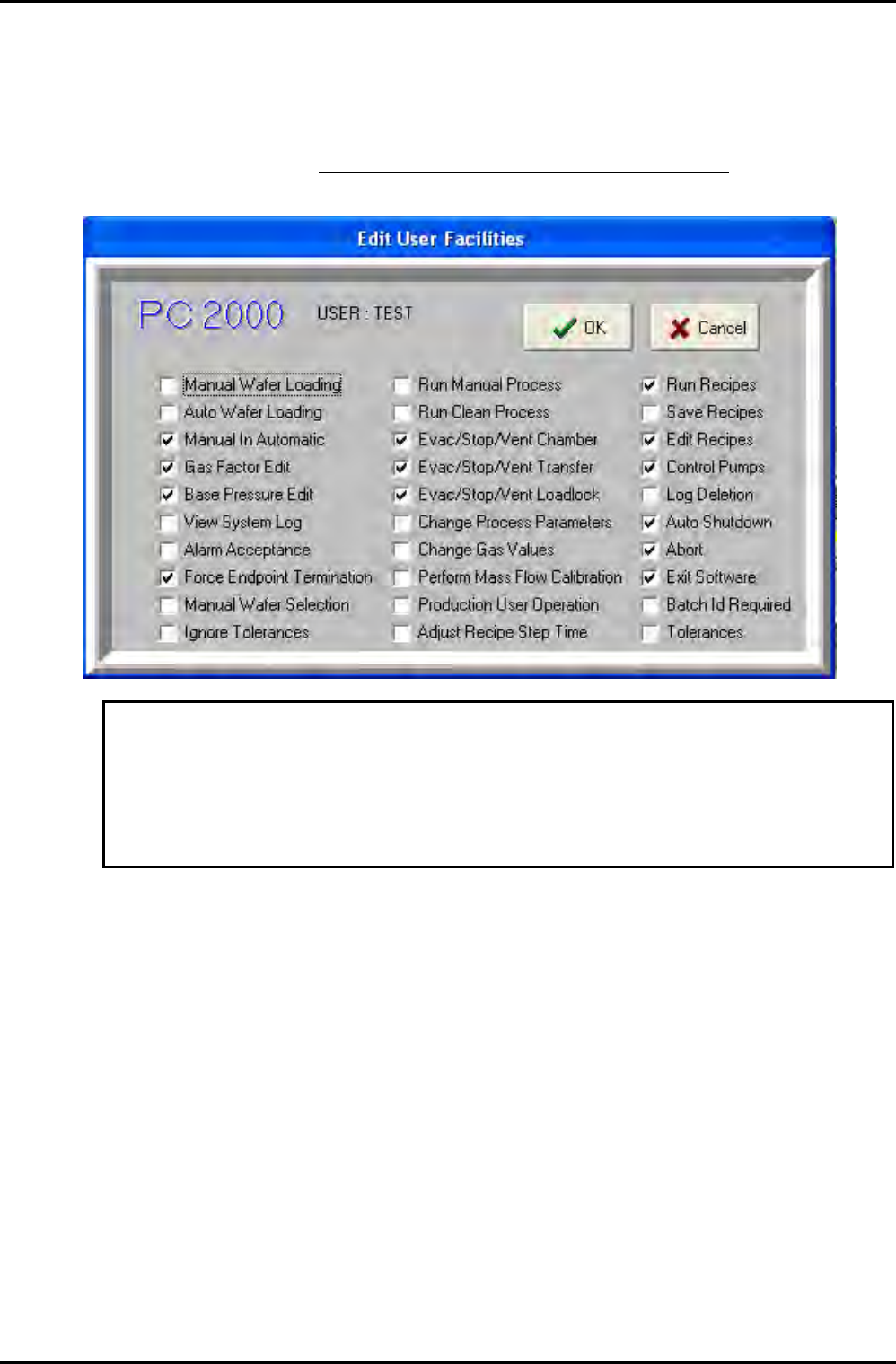
5) The Facilities enabled for ‘User’ (selected in Step 4) can be edited by selecting the
Facilities button while the cursor is in the name field for that user. This will display
the Edit User Facilities dialogue box.
WARNING
BEFORE ENABLING FACILITIES, CONSIDER CAREFULLY WHICH FACILITIES WILL BE
SELECTED FOR THE PERSON USING THE ‘LOG ON’ NAME. FOR EXAMPLE, ALLOWING
AN INEXPERIENCED USER ACCESS TO THE ‘TOLERANCES’ PAGE WOULD ALLOW THE
USER TO CHANGE TOLERANCES WHICH COULD POSSIBLY RESULT IN SYSTEM
MALFUNCTION AND EXPOSE THE OPERATOR TO HAZARDOUS SITUATIONS.
6) Click on the appropriate checkboxes to enable the facilities available to the selected
name (9 indicates enabled). Click on the OK button to accept the entered data and
exit.
Note that the enabled facilities are dependent on the name and not on the access
level, e.g. two people logged on as users can have different sets of facilities enabled.
Operating Instructions
Printed: 22-Mar-06, 10:42 Page 5-13 of 52 UC Davis 94-721001 Issue 1: March 06
mä~ëã~ä~ÄpóëíÉãNMM lñÑçêÇ=fåëíêìãÉåíë=mä~ëã~=qÉÅÜåçäçÖó== System Manual
RKQKP= póëíÉã=~äÉêíë=
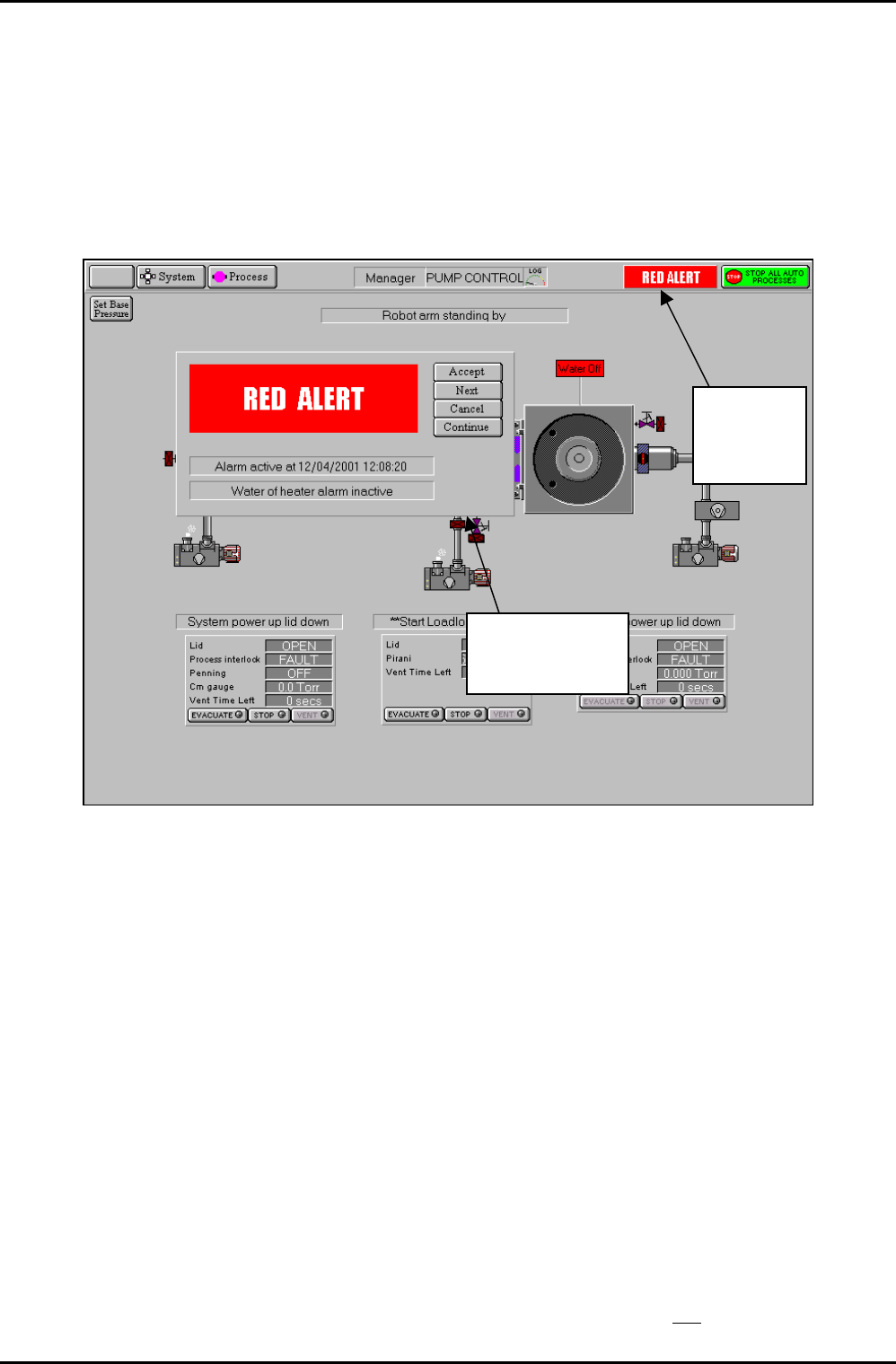
System alerts are displayed when PC 2000 detects an event that requires the attention of the
user. Each alert is automatically categorised depending on the nature of the event and the
response required by the user. The category of the event can range from a warning indicating
that a service parameter is out of tolerance to a process abort indicating that a process
setpoint has been out of tolerance for so long that the process cannot be completed. A
typical system alert is shown in Fig 5.2.
System
A
lert
b
anner
System Alert
dialogue
Fig 5.2: Typical system alert
The alert is displayed as a banner in the menu bar at the top of the screen with an associated
dialogue in the main screen area. Note that more than one alert can be active at the same
time, each requiring action by the user in turn.
There are three categories of alert indicated by the colour and text displayed in the banner
and dialogue:
Blue Warning e.g. water flow low.
Yellow Hazard – not currently used.
Red Process abort, e.g. high-reflected RF power.
A user logged on at any access level can close the alert dialogue, but only a user logged on as
a system manager can clear the alert banner from the menu bar. The dialogue options are:
Accept button: System Managers only. Clear the alert and log it.
Next button: View the next alert.
Cancel button: System Manager only. Clear the alert; do
not log it.
Operating Instructions
UC Davis 94-721001 Issue 1: March 06 Page 5-14 of 52 Printed: 22-Mar-06, 10:42

System Manual lñÑçêÇ=fåëíêìãÉåíë=mä~ëã~=qÉÅÜåçäçÖó== mä~ëã~ä~ÄpóëíÉãNMM
Continue button: Close the alert dialogue box – the alert banner remains displayed
on the menu bar.
Note that option buttons that are not available (i.e. Accept and Cancel due to user ‘logged
on’ status and Next when there is only one active alert) are greyed out.
The alert message usually contains an adequate description of the detected event. If it is a
service fault (water flow, purge gas etc.) then verify that the service is available to the
machine as soon as possible. Depending on the nature of the service, the system may allow
the machine to continue to operate, so that the current process can be completed.
Do not
start a new process before checking the service.
The red alerts are often due to a process setpoint being out of tolerance for too long. In these
cases, the process is halted by the system. If it is authorised to resume processing with a
parameter deviation then:
1) Check the most recent process log to find the process time remaining.
2) Construct a new process with a modified process time and check the ‘Ignore
tolerance’ option. Note that this removes
all tolerance checking. The machine should
be monitored by an operator for further deviations when operated in this condition.
RKQKQ= mìãéáåÖ=Ççïå=
1) On the Pump Control page, select the SET BASE PRESSURE button, then enter the
required process chamber base pressure if different from the default.
2) Ensure that the Automatic load lock/transfer chamber’s lid is closed. (Automatic load
lock/transfer chamber lid open/closed status is shown in the panel adjacent to the
mimic).
3) Click on each dry pump/rotary vane pump mimic to start the pump.
4) Select the Evacuate button for the process chamber. The relevant valves will
operate and the process chamber will be pumped down.
5) Select the Evacuate button for the Automatic load lock. You will be prompted to
enter a wafer identity - either enter the identity and click OK, or click Cancel (to
pump down without a wafer in the Automatic load lock). The relevant valves will
operate and the Automatic load lock will be pumped down.
NOTE: Turning off any rotary vane pump will cause all process and pumping
actions using that pump to stop.
6) To achieve a low base pressure in the system, pump for at least 12 hours. Where
chambers or process heaters are part of the system, raise the temperatures of these
near their maximum values for the first six hours of pumping to assist out-gassing,
then return the temperature to ambient.
WARNING
PARTS OF THE EQUIPMENT MAY BE TOO HOT TO TOUCH DURING CHAMBER
HEATING.
Operating Instructions
Printed: 22-Mar-06, 10:42 Page 5-15 of 52 UC Davis 94-721001 Issue 1: March 06