Utah-94-721002-System-Manual.pdf - 第19页
Health and Safety lñÑçêÇ=fåëíêìãÉåíë=mä~ëã~=qÉÅÜåçäçÖó= mä~ëã~ä~Ä and fçåÑ~Ä NKPKQ= eáÖÜ=qÉãéÉê~íìêÉ= WARNING HOT SURFACES - CLOSE CONTACT CAN CAUSE SERIOUS INJURY AND BURNS Allow sufficient time for heated components (e…
mä~ëã~ä~Ä and fçåÑ~Ä lñÑçêÇ=fåëíêìãÉåíë=mä~ëã~=qÉÅÜåçäçÖó= Health and Safety
NKPKP= iáÖÜí=
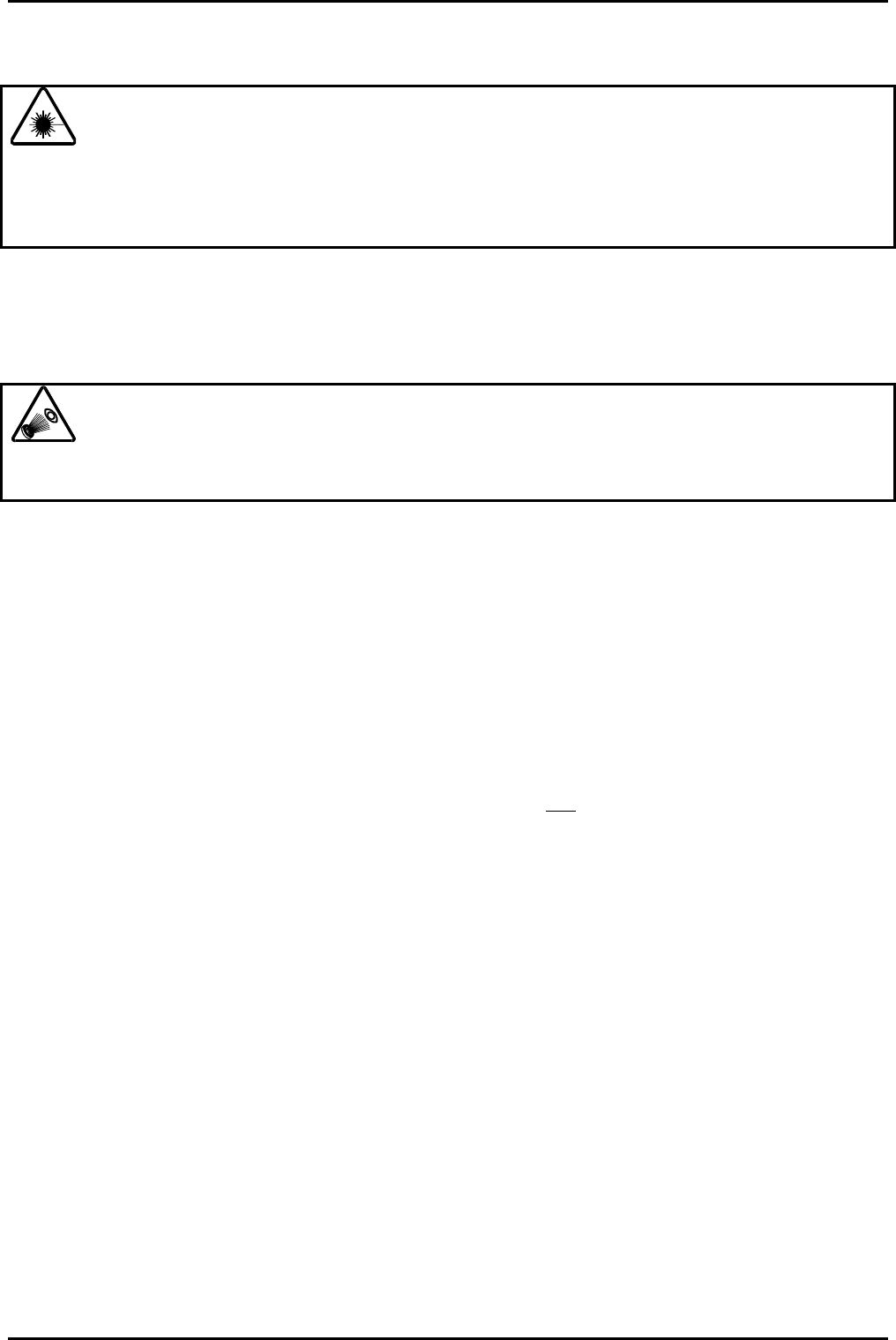
WARNING
LASER RADIATION - EXPOSURE CAN CAUSE SEVERE EYE DAMAGE OR BURNS
Before operating the system, ensure that all covers are fitted correctly.
Ensure that for laser equipment, the manufacturer’s instructions have been read
and fully understood.
1.3.3.1 Laser equipment when handled incorrectly or in a damaged condition can seriously
damage eyesight. Read and follow the manufacturer's instructions carefully. Ensure
that all covers supplied by Oxford Instruments Plasma Technology or by the
manufacturer are correctly fitted before the equipment is powered up.
WARNING
ULTRA VIOLET RADIATION - EXPOSURE CAN CAUSE SEVERE EYE DAMAGE OR BURNS
Ensure that all view ports are assembled correctly, and that any replacement filters
are of the correct specification.
1.3.3.2 View ports on Plasmalab systems are fitted with a clear plastic UV filter (Perspex -VE-
clear-003). Replace this item only with the correct part, and ensure that the ports are
correctly reassembled.
If a plastic filter is not fitted, or if there is any doubt about the type of filter that is
fitted, you must check with Oxford Instruments Plasma Technology before
proceeding.
1.3.3.3 The customer should be aware of the fact that view ports are available in glass or
quartz. Most view ports on Oxford Instruments Plasma Technology systems are glass,
but quartz is used in certain applications. Quartz view ports allow much more UV
light to pass through than glass does, and so present a greater hazard. They will
require very careful shielding or filtering in
ALL situations on Plasmalab and Ionfab
systems.
Be careful if the service history of the system is not fully known. It is possible that a
glass view port has been changed for a quartz one.
1.3.3.4 UV light can also escape from other parts of the system, e.g. from ICP plasma
sources, and downstream plasma discharge tubes. Discharge tubes of this type are
often made of quartz, and so very careful shielding or filtering is needed.
1.3.3.5 UV light can produce ozone from ambient air. Detectable quantities are produced
by ICP sources fitted with a quartz tube. Local extraction must be used in this case.
Health and Safety
Issue 11: August 2004 Page 1-6 of 18 Printed:29 May 2005, 06:31
Health and Safety lñÑçêÇ=fåëíêìãÉåíë=mä~ëã~=qÉÅÜåçäçÖó= mä~ëã~ä~Ä and fçåÑ~Ä
NKPKQ= eáÖÜ=qÉãéÉê~íìêÉ=
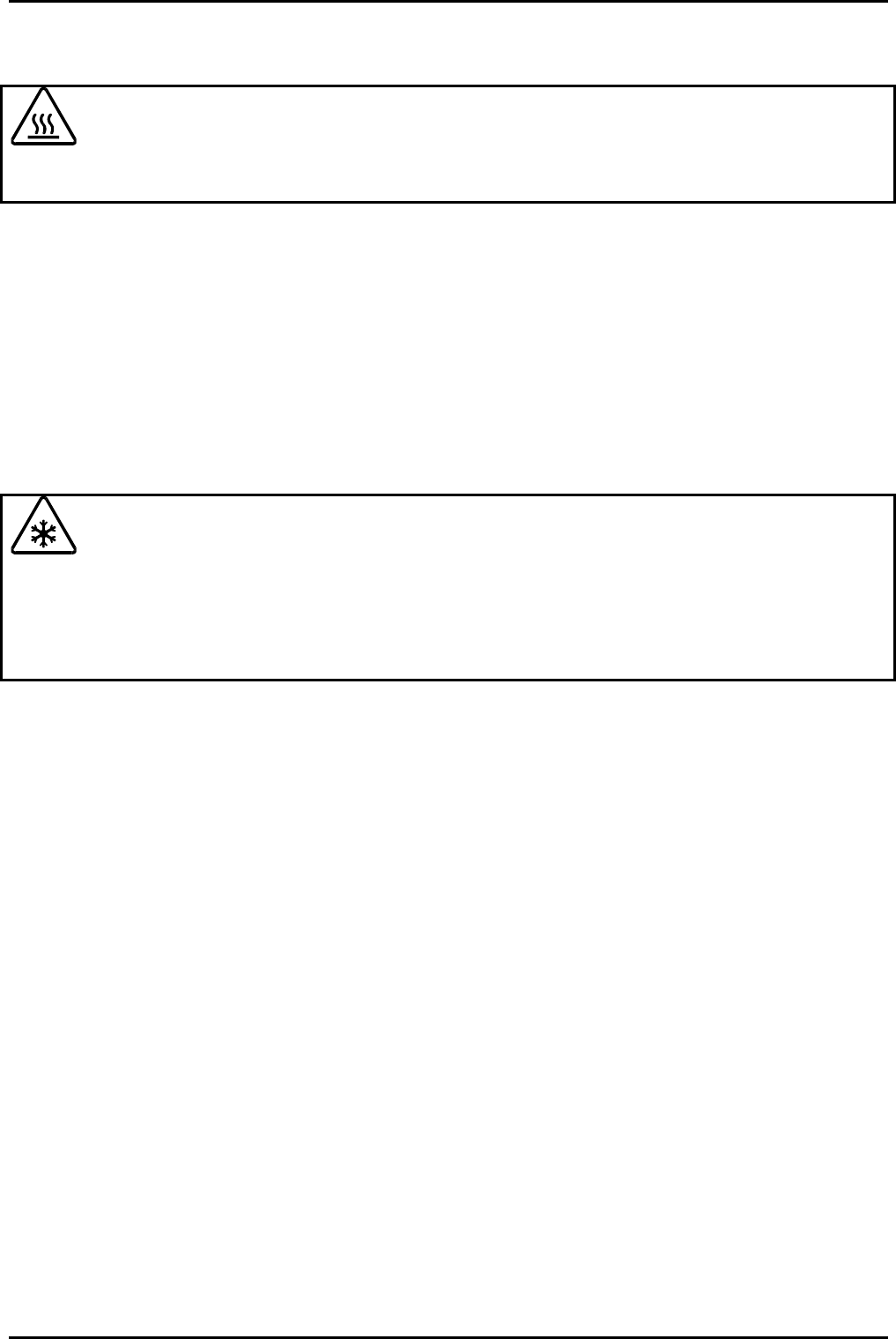
WARNING
HOT SURFACES - CLOSE CONTACT CAN CAUSE SERIOUS INJURY AND BURNS
Allow sufficient time for heated components (e.g. heated lower electrodes) to cool
to room temperature before carrying out maintenance.
1.3.4.1 During operation of the system some components can become dangerously hot.
Always allow time for these to cool to a safe temperature before handling them.
Components that become hot include electrically heated chambers, chamber
liners, lower electrodes, specimen holders and halogen lamps. Items illuminated by
halogen lamps can also reach very high temperatures.
Note that items such as neutralizers, ion sources, and ICP sources operate at high
temperatures.
NKPKR= =içï=qÉãéÉê~íìêÉ==
WARNING
COLD OBJECTS - CONTACT CAN CAUSE SERIOUS INJURY TO THE SKIN AND CAN CAUSE
THE SKIN TO ADHERE TO THE COLD OBJECT
Allow sufficient time for cold components (e.g. cryogenically cooled lower
electrodes) to return to room temperature before carrying out maintenance.
If cold objects must be handled, ensure that suitable protective clothing is worn.
1.3.5.1 Beware of the extreme cold produced in refrigerated or cryogenically cooled
systems. Contact with the skin by components at these temperatures can produce
'burns'. Allow the cooling system to reach a safe temperature before attempting
any maintenance tasks.
Components that become cold include cryogenically cooled lower electrodes,
cryogenic pumps and components that use liquid nitrogen.
Health and Safety
Printed:29 May 2005, 06:31 Page 1-7 of 18 Issue 11: August 2004
mä~ëã~ä~Ä and fçåÑ~Ä lñÑçêÇ=fåëíêìãÉåíë=mä~ëã~=qÉÅÜåçäçÖó= Health and Safety
NKPKS= d~ëÉë=
Gases are used in the system for venting and purging (N2), for aiding heat transfer (e.g.
helium) and for establishing the process environment (i.e. process gases).
Process gases used in the system are specified dependent on the process for which the system
is designed.
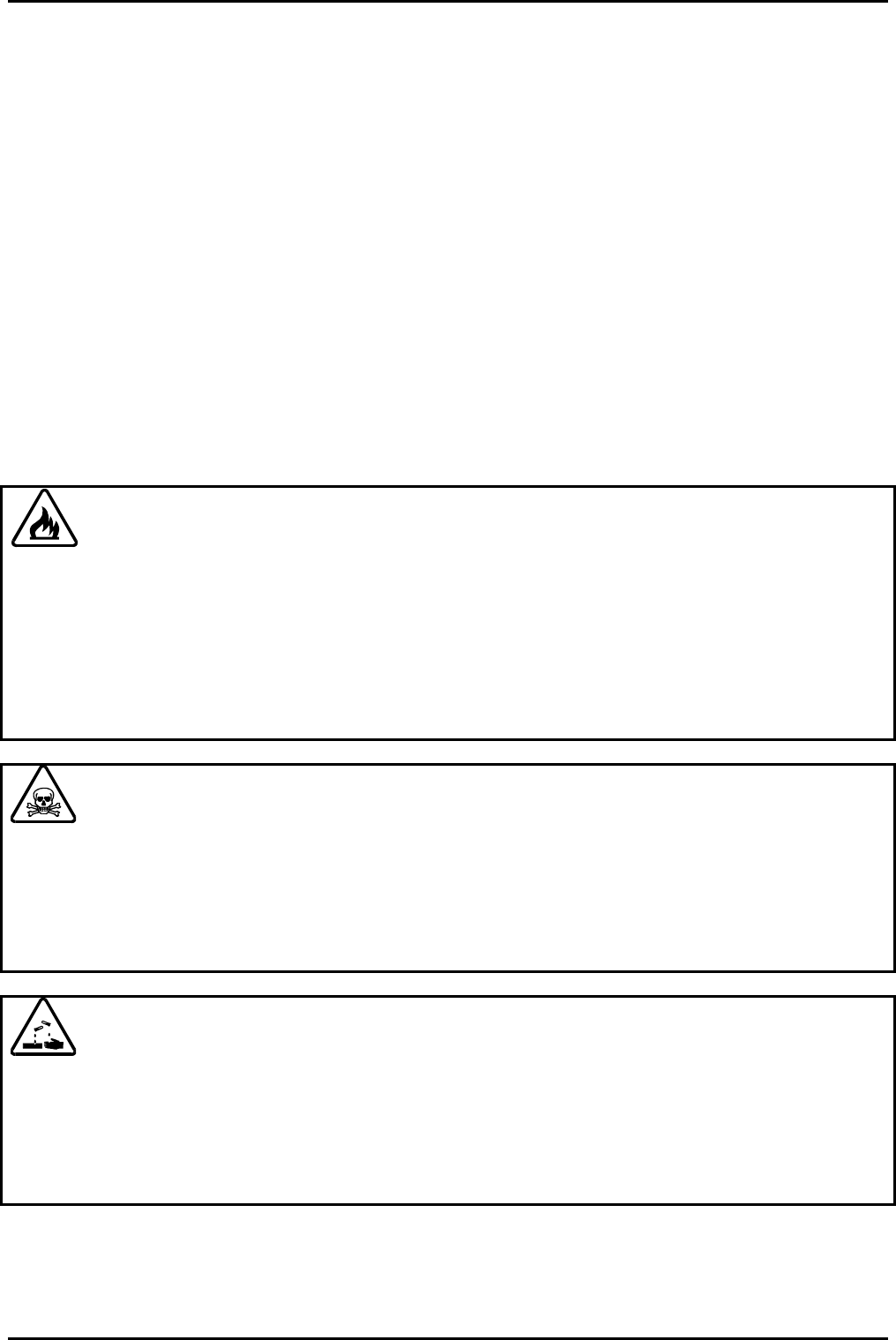
The hazards presented by gases fall into one or more of the following categories:
a) Asphyxiant - replaces Oxygen causing respiration difficulties and eventually death.
Examples of asphyxiants are: Nitrogen, Helium etc..
b) Flammable - can ignite in the presence of heat or arcing.
c) Toxic
d) Corrosive
The following WARNINGS may be applicable to the gases used in your system; it is your
responsibility to be aware of the hazards and take the necessary precautions. Contact your
gas supplier for full details.
WARNING
FLAMMABLE GASES - FLAMMABLE MATERIAL CAN IGNITE IN THE PRESENCE OF HEAT
OR ARCING, CAUSING SEVERE INJURY.
After a processing run, the process chamber must be subjected to at least one vent
cycle before any maintenance work is carried out.
Ensure that the gas lines have been purged before removing or loosening
components.
Wear personal protective equipment as necessary.
WARNING
TOXIC GASES - CONTACT CAN CAUSE DEATH OR SERIOUS INJURY
After a processing run, the process chamber must be subjected to at least two vent
cycles before any maintenance work is carried out.
Ensure that the gas lines have been purged before removing or loosening
components.
Wear personal protective equipment as necessary.
WARNING
CORROSIVE GASES - CONTACT CAN CAUSE SERIOUS INJURY
After a processing run, the process chamber must be subjected to at least two vent
cycles before any maintenance work is carried out.
Ensure that the gas lines have been purged before removing or loosening
components.
Wear personal protective equipment as necessary.
Health and Safety
Issue 11: August 2004 Page 1-8 of 18 Printed:29 May 2005, 06:31