Utah-94-721002-System-Manual.pdf - 第223页
System Manual lñÑçêÇ= fåëíêìãÉ åíë=m ä~ëã~ = qÉÅÜåçäçÖó== lfmq=póëíÉãë OKN= oÉÅáêÅìä~íáçå=ï~íÉê= WARNING CHILLERS HAVE COMPONENTS, WHICH BECO ME COLD ENOUGH TO CAUSE SERIOUS INJURY. READ THE MA NUFACTURER’S MANUA LS BEFO…

lfmq=póëíÉãë lñÑçêÇ=fåëíêìãÉåíë=mä~ëã~=qÉÅÜåçäçÖó== System Manual
OK= `ççäáåÖ=L=t~êãáåÖ=ï~íÉê=
There are two acceptable methods of applying cooling / warming water to an OIPT system:
Recirculation: Water is pumped through the system by a dedicated *heater / chiller or heat
exchanger. After passing through the system, the temperature of the water
is adjusted before recirculating through the system.
*Many customers have a water recirculation facility shared by several
systems. This shared facility seldom provides water of suitable quality, and
so cannot usually be used for cooling any part of the OIPT system without
the use of a heat exchanger dedicated to the OIPT system.
Total Loss
Cooling:
Municipal (drinking quality) water is applied to the system from a mains
supply, passed through the system to cool it, then fed to a drain for
disposal.
Water failing to meet the recirculation or total loss cooling specifications must not be put
into the system without close consultation with OIPT.
In some circumstances, it may be appropriate to use a combination of recirculation cooling
and total loss cooling in one system.
It is recommended that the customer uses a dedicated heater/chiller either for the whole
system, or at least for the critical components. Note that chillers, which cool only, can give
problems with condensation on chamber components in some environments. This is a
particularly important consideration for production systems of the batch-load type. In severe
cases, they can produce sufficient condensation to damage components such as RF power
supplies, ferrofluidic seals and automatch units. Any damage so caused cannot be covered by
the system warranty.
Note that if a heater-chiller is used to provide warm water (above 30
o
C) for heated parts of
the system, then items such as the turbo pump will need an independent water supply.
Items such as turbomolecular pumps can be cooled with total loss cooling if they are of
stainless steel construction and if the water is suitable. If the water is not suitable, then a heat
exchanger may be necessary.
Total loss cooling cannot be used on any components that have aluminium in direct
contact with the coolant. See sub-section 2.1.
Services Specifications
Issue 16: April 05 Page 4 of 22 Printed: 6-Jan-06, 8:44

System Manual lñÑçêÇ=fåëíêìãÉåíë=mä~ëã~=qÉÅÜåçäçÖó== lfmq=póëíÉãë
OKN= oÉÅáêÅìä~íáçå=ï~íÉê=
WARNING
CHILLERS HAVE COMPONENTS, WHICH BECOME COLD ENOUGH TO CAUSE SERIOUS
INJURY. READ THE MANUFACTURER’S MANUALS BEFORE INSTALLING, OPERATING
OR MAINTAINING CHILLERS, AND ENSURE THAT ADEQUATE PROTECTIVE CLOTHING
IS WORN.
Recirculation water is used in systems where the user does not wish to consume water at a
high rate, or where it is wished to supply water to the system at a constant temperature.
Some systems contain aluminium in direct contact with coolant. These are the fçåÑ~Ä=RMM=
mäìë, the fçåÑ~Ä=PMM=mäìë, and mä~ëã~ä~Ä systems fitted with tables or turbomolecular pumps
with plain aluminium cooling channels. Certain aluminium chambers are also included.
However, the fçåÑ~Ä=PMM=mäìë does not contain aluminium in contact with water, unless it is
in the turbomolecular pump.
In these aluminium-containing systems, it is MANDATORY that the approved coolant is used
at all times. If the approved coolant and installation are not used, the system warranty will
not cover any damage caused by the coolant either directly or indirectly to the system or to
anything else.
It is the customer's responsibility to comply with the above requirement. If the customer has
any doubt as to whether their system falls into this category, they must contact OIPT for
further advice.
In systems that do not contain aluminium components, severe corrosion can still sometimes
occur: water will collect corrosive chemicals, and will be lacking in the oxygen that protects
stainless steel. We strongly recommend that the approved coolant is used. If an alternative
product or water is used, then it is entirely the customer’s responsibility to check for any signs
of corrosion or contaminated water. If the customer’s coolant has not been approved in
writing by OIPT, then the system warranty will not cover any damaged caused by the coolant
either directly or indirectly to the system or to anything else
1
.
The approved installation and coolant are shown in sub-section 2.1.1 and in Fig 2.1. Note that
the total water flow meter and the isolation valves are recommended for cooling monitoring
and ease of maintenance.
1
Customers should note, for example, that certain types of inhibitor will damage the pumps of heater/chiller units, and that the use
of municipal (drinking water) or deionized water can introduce harmful chemicals into the system. If plain water is used, distilled
water is by far the safest option.
Services Specifications
Printed: 6-Jan-06, 8:44 Page 5 of 22 Issue 16: April 05
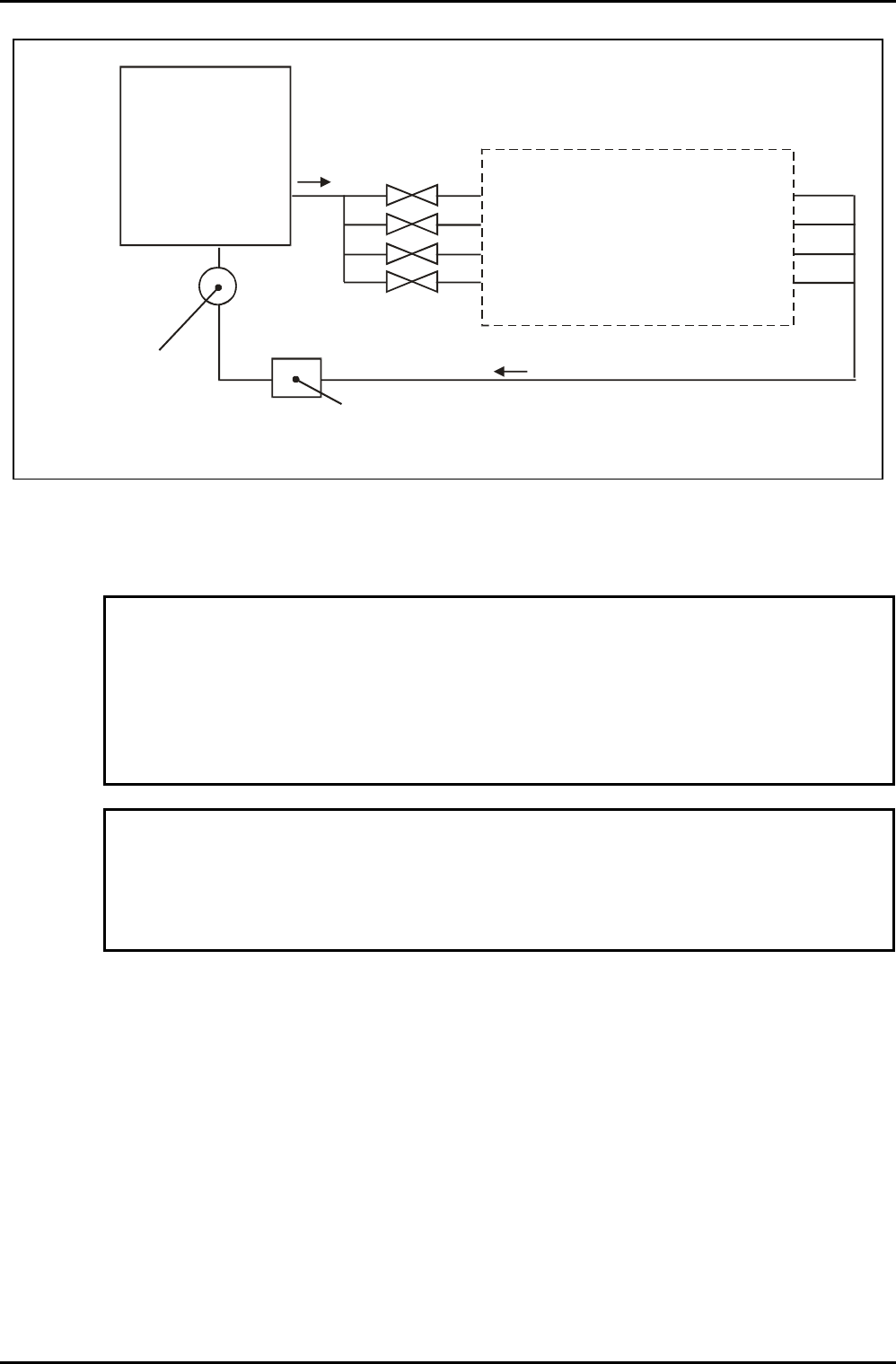
lfmq=póëíÉãë lñÑçêÇ=fåëíêìãÉåíë=mä~ëã~=qÉÅÜåçäçÖó== System Manual
DEDICATED
HEAT EXCHANGER
OR
CHILLER
PLASMALAB
OR
IONFAB
SYSTEM
ISOLATION
VALVES
10-MICRON METAL MESH FILTER
MAXIMUM PRESSURE DROP AT
RATED FLOW RATE 0.15 BAR (2.2 PSI)
TOTAL WATER FLOW
METER OF APPROPRIATE
RANGE
(FITTED WITH AN
EXTERNAL BYPASS
HAVING A CAPACITY OF
100% FLOW)
Fig 2.1: Recommended basic recirculation installation
OKNKN= j~åÇ~íçêó=péÉÅáÑáÅ~íáçåë=Ñçê=êÉÅáêÅìä~íÉÇ=ï~íÉê=ëóëíÉãë=
CAUTION
If clear (i.e. transparent) tubing is exposed to sunlight, algal growth can develop,
which can restrict coolant flow.
It is MANDATORY that clear tubing is not used in any part of the cooling system.
OIPT recommends the use of either black or dark green tubing.
CAUTION
It is the customer's responsibility not to exceed a pressure of 4.2 bar, or other
limit that has been set for the system. Exceeding this safe pressure may cause
irreparable damage to system components.
The water must be kept warm enough to prevent condensation on chamber surfaces and
outside system components. This applies to those parts of the system inside the clean room
and those parts in a service area. Condensation can damage components such as RF power
supplies, ferrofluidic seals and automatch units. Any damage so caused cannot be covered by
the system warranty.
Services Specifications
Issue 16: April 05 Page 6 of 22 Printed: 6-Jan-06, 8:44