CP643E.pdf - 第54页
FK-9F98-05 CP- 643E Training Text for Service Engineers Edition 5.0 Chapter 4. Station Adjustment [ 9 /18] Fuji Machine Mfg. Co., Ltd. Okazaki SMT Equipment Quality Assurance Dept. Technical Support Div. Section No.2 4- …
FK-9F98-05 CP-643E Training Text for Service Engineers
Edition 5.0 Chapter 4. Station Adjustment [8/18]
Fuji Machine Mfg. Co., Ltd. Okazaki
SMT Equipment Quality Assurance Dept.
Technical Support Div. Section No.2
4-
8
4.7 Station 12 Clutch Engagement Adjustment
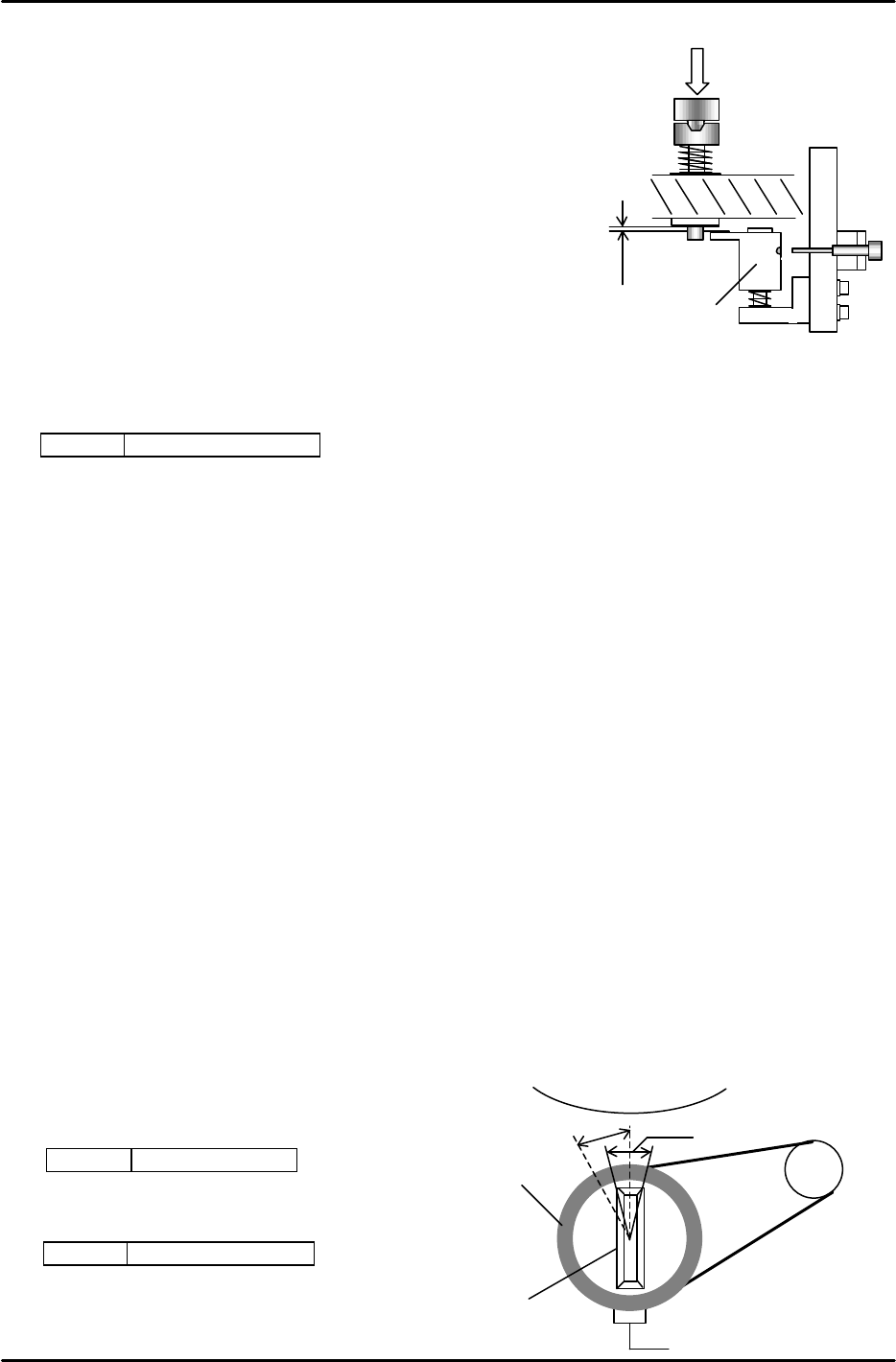
1. Use the nozzle shaft with the average deflection value.
Set the cam to 200 degrees. Lower the FRQ clutch and set the
clearance of A to 0.2mm.
2. Align the hole of the dog with the fiber sensor at this position.
(Check the hole position from the top of the dog.)
3. Move the fiber sensor to the end of the bracket, and fix.
4. Set the amplifier to turn OFF when the clutch engages,
and to turn ON when the clutch does not engage and the
dog is pressed down.
5. For sensor amp adjustment, refer to 4.6, [Setting the amplifier]
<I/O à Standard I/O à IN>
X053 NOZ CLUT ST12
4.8 Zero setting the FQ and FRQ axes
(A Zero-signal from the encoder comes ON every 4000 pulses. The encoder has 7200 pulses
per revolution.)
1. Measure the timing belt tension of the FQ and FRQ motors.(Appropriate value : 206 ± 5 Hz)
2. Zero set the FQ axis.
3. Loosen the set-screw of the zero setting dog at the rotor.
4. Set the clearance between the tip of the fiber sensor and the dog (silver area) to 5mm. Then fix
the sensor.
5. For the zero set sensor, normally silver means ON and black means OFF, “L-ON”. However, set
the amplifier to “ D-ON” temporarily. ( Silver = OFF, black = ON ) Turn ON the servo, and zero
set.
6. (Zero set several times. Find position, [1] where the rotor faces around the center of the nozzle
index.)
7. Set the amplifier back to “L-ON”, and fix the dog where the sensor comes ON, silver area. (Fix it
around the center since the ON range is about 300 pulses.)
8. Zero set to confirm that the rotor stops around the center of the nozzle index, [2].
9. Zero set FRQ in the same manner.
<I/O à ETC à Servobrd2 à IN>
SX00E FQ AXIS ZERO
<I/O à Servobrd1 à IN>
SX00A FRQ AXIS ZERO
* For the servo counter; FQ, FRQ proper data,
plus and minus values are acceptable.
A
Dog
“ON” position
Index
[2]
[1]
MotorDog
Rotor
Figure 17
Figure 18

FK-9F98-05 CP-643E Training Text for Service Engineers
Edition 5.0 Chapter 4. Station Adjustment [9/18]
Fuji Machine Mfg. Co., Ltd. Okazaki
SMT Equipment Quality Assurance Dept.
Technical Support Div. Section No.2
4-
9
4.9 FQ, FRQ Origin Calibration
1. Zero set FQ and FRQ.
2. Install the appropriate jig on shaft, A.
3. Set the cam angle to 200 degrees. Align the jig parallel to the X-axis using a dial indicator.
4. Turn the rotor to the position where it engages correctly with the aligned jig.
5. When the jig is aligned with the X-axis, the servo counter represents the origin position.
(Both FQ and FRQ should be within 300 pulses.)
6. FQ data, FRQ data (Calibrate 3 times, use the average value for final data.)
{FQ data} [ ] {FRQ data} [ ]
7. When completed, enter the final origin values for FQ & FRQ at the host computer.
Station 10
Jig
Jig No. 71615WPJ0660
Station 12
Jig
Jig No. 71615WPJ0670
FK-9F98-05 CP-643E Training Text for Service Engineers
Edition 5.0 Chapter 4. Station Adjustment [10/18]
Fuji Machine Mfg. Co., Ltd. Okazaki
SMT Equipment Quality Assurance Dept.
Technical Support Div. Section No.2
4-
10
4.10 [PQ] [PRQ] Origin Position Adjustment
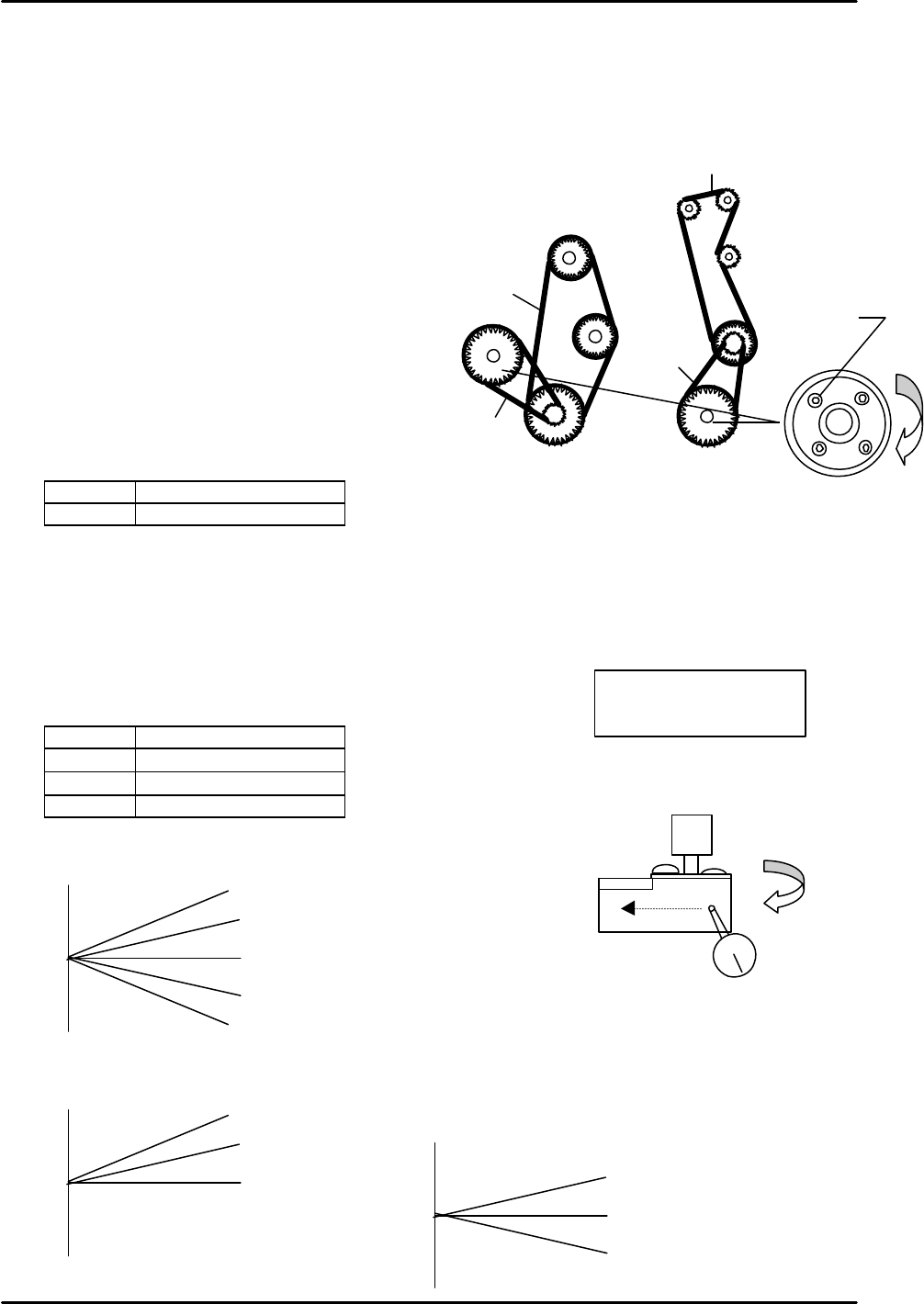
1. Set the cam angle to 0 degrees. Loosen the screw bolts of each timing pulley. Confirm that the
rotor faces the origin position. (Origin position means that the clutch rotor faces the center of the
index unit.)
2. Calibrate the timing belt tension of PQ and PRQ.
PQ1,2 (Appropriate value 188 ± 20Hz)
PRQ1 (Appropriate value 181 ± 20Hz)
PRQ2 (Appropriate value 376 ± 20Hz)
3. Calibrate at the positions shown in the right
illustration. Adjust from ? to ? for both
PQ and PRQ if necessary.
4. Set a jig to nozzle shaft A. Set the cam angle to 0
degrees. Turn ON the solenoid valve.
<I/O à Standard I/O à OUT>
Y022 PQ ROT SOL ON
Y02C PRQ ROT SOL ON
5. Set the cam angle around 250 degrees (after rotating to 90, 270 degrees). Align using a dial
indicator. Tighten a screw bolt temporarily.
6. Set the cam angle to 0 degree. Switch the solenoid valve. Confirm the scale when rotating to 90
and 270 degrees. Balance and secure the timing pulley.
<I/O à Standard I/O à OUT>
Y024 PQ ROT 90 DEG
Y025 PQ ROT 270 DEG
Y02E PRQ ROT 90 DEG
Y02F PRQ ROT 270 DEG
Balance is the key point. Adjust both 90 and
270 degree movement to balance equally.
(Factory target within +/- 0.1mm)
90
270
+ 0.1
- 0.1
(Max within 0.2mm)
(Max within – 0.2mm)
+ 0.190
270
NG
Not balanced
+ 0.15
Balanced perfectly
90
270
+ 0.1
– 0.1
Zero point.
Place dial gauge here
Always check after moving the
turret in the clockwise direction.
Station 3 & 13
jig no.:
71615WPJ0641
Figure 20
Figure 22
Figure 21
Figure 23
<<PQ>>
<<PRQ>>
1
1
2
2
Figure 19
5mm
Adjustment
Bolts