drt2_devicenet_q102-e1_20_22_csm2147.pdf - 第8页
F-8 F-9 Complies with the Highest Safety Standar ds in the W orld The CIP Safety on De viceNet System conforms to IEC 61508 SIL3 f or functional safety , and EN 954-1 Safety Category 4 for mac hine safety , complying wit…
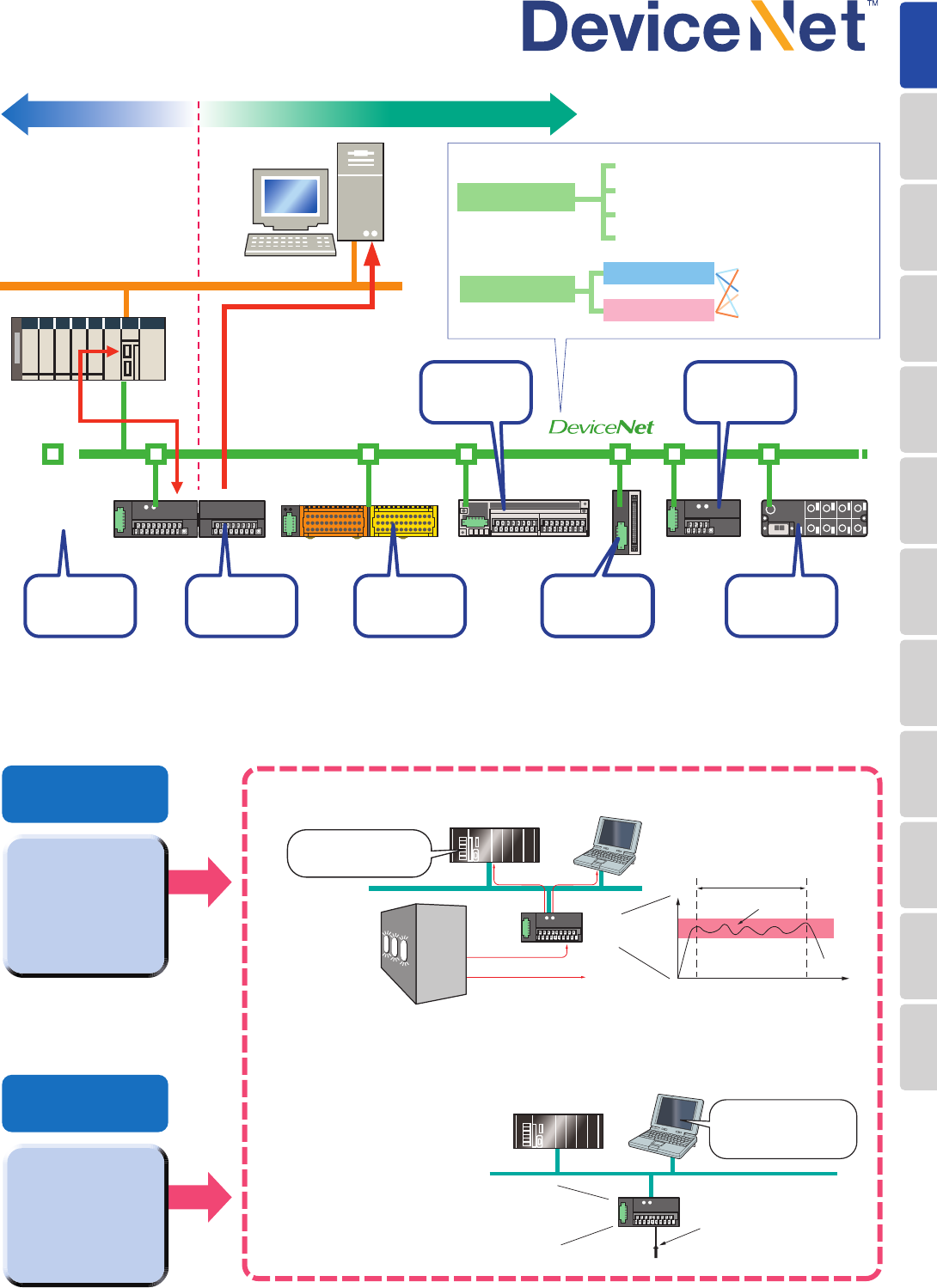
Maintenance System Control System
Maintenance System Control System
Slaves with Powerful Support
to Maintenance
DRT2-series
Smart Slave
DeviceNet
Configurator
Ethernet
Maintenance information
PLC
Control
information
Unit ON time
monitor
(See note.)
Operation time
monitor
External load
short-circuit detection
Contact operation
counter (See note.)
I/O power status
monitor
Communications error
history monitor
Network power
voltage monitor
Operation time monitor
Contact operation counter
Unit ON time monitor
Slave and connected component comments
I/O power status monitor
Reliable equipment
startup
Preventive maintenance
of equipment
Reduced startup time
Reduced downtime
The cylinder's
speed is
incorrect!
It might be time
for a switch
inspection!
Is the I/O
power supply
turned ON?
What was the
cause
of the error?
Communications error history
monitor
Network power voltage
monitor
The wiring to the
I/O device is
short-circuited
or broken!
If it takes too long to
modify the ladder
program on the
Master when a
Temperature Sensor
is replaced:
Short Startup
If prolonging the
time it takes to
reach a certain
temperature may
degrade
equipment:
Failure Prediction
and Maintenance
Using OMRON Temperature Input Terminals for Maintenance
Slaves internally convert
display values to
temperature input
values so the Controller
program no longer has
to be modified to
perform this task.
The operating time of a preset temperature range is counted in 1-s units.
The peaks or valleys of temperature inputs that change in a regular pattern
are counted to predict when devices operating with severe temperature
swings are due for maintenance.
Sensor replaced by one
with a different input range
Operating time
Indicator service
life control
Time
Input
Semiconductor
manufacturing equipment
Temperature
Scaling performed
inside the Slave
Slaves can notify the
Master when a setting is
exceeded.
Scaling points for 0% and
100% are set from the
Configurator
Note: The contact operation counter function and the unit ON time monitor function cannot be used simultaneously.
It's time for
motor
maintenance!
What is the
present
communications
voltage?
F-7
Overview
Introducing
DeviceNet Products
Network
Specifications
DRT2-series
Smart Slaves
SmartSlice
GRT1 Series
Intelligent
Slaves
Configurator
and Software
Peripheral
Devices
Ordering
Information
Master
Units
MULTIPLE I/O
TERMINAL Series
CIP Safety on
DeviceNet System
F-8
F-9
Complies with the Highest Safety Standards in the World
The CIP Safety on DeviceNet System conforms to IEC 61508 SIL3 for
functional safety, and EN 954-1 Safety Category 4 for machine safety,
complying with the world's highest level of safety standards.
IEC 61508 SIL 3
Safety circuits must be able to function
to provide safety at anytime. Conversely,
the degree of lack of safety is used as
the indicator. In IEC 61508, safety is
defined as the Probability of Failure per
Hour, or PFH. Based on this, the SIL
(Safety Level) is classified into four
levels. SIL 3 indicates a probability of
dangerous failure of once in 1,000
years, which is the highest level in
machine safety.
EN 954-1 Safety Category 4
EN standards evaluate the level of machine risk and require the
incorporation of risk minimization measures. In EN 954-1, five safety
categories have been established, with Safety Category 4 indicating
designs that require the highest safety design level. This category is
demanded for machines with the highest level of danger, wherein "serious
injury (severed limbs, death, etc.) will occur frequently, with little chance of
escaping danger." This category demands
that a single fault (failure) in any part of
the machine, or a series of faults,
will not lead to loss of the machine's
safety functions.
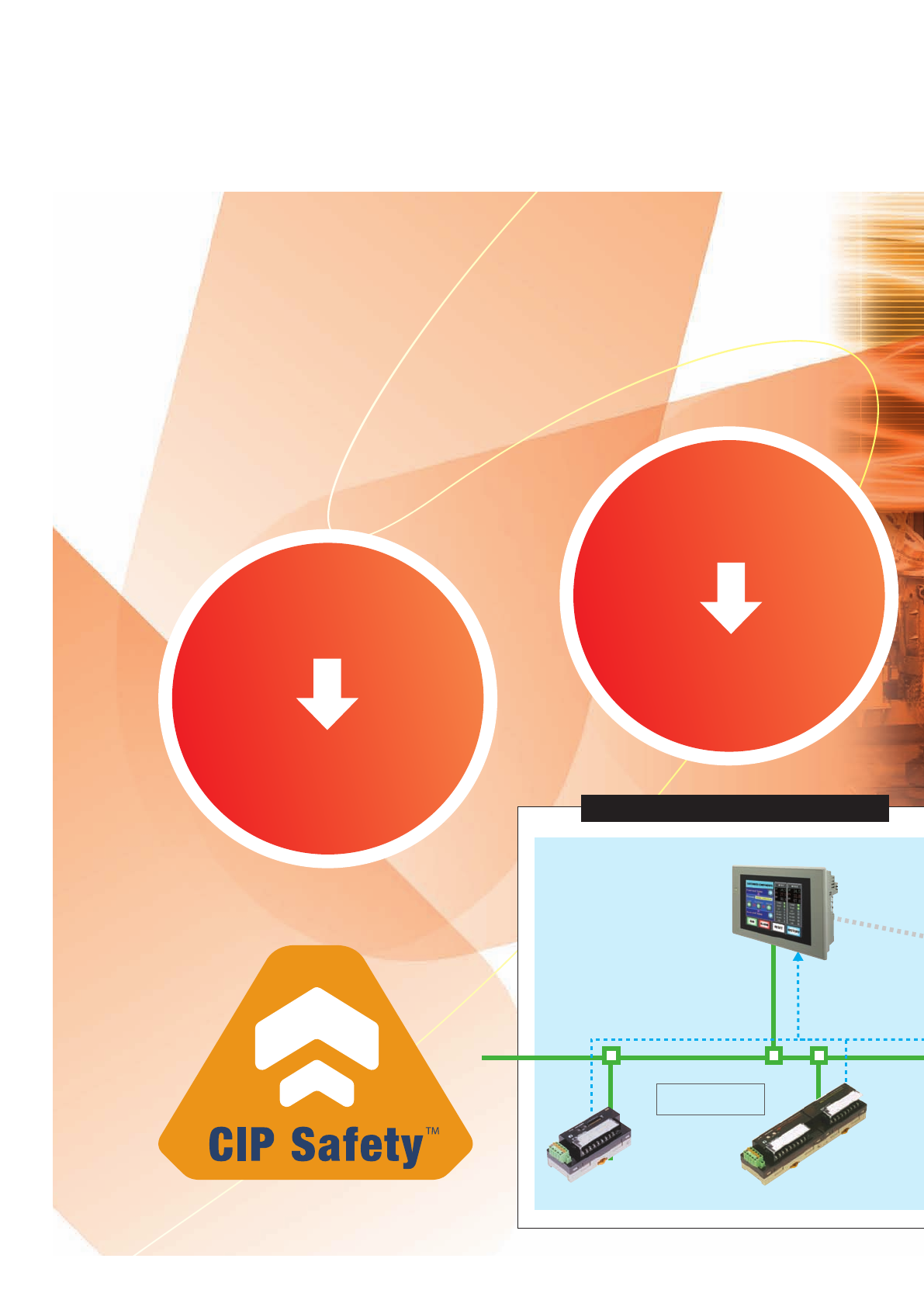
Compatible with
DeviceNet Open Network
Programmable
Safety Circuits
Distributed
safety controls.
Safety I/O Can Be
Expanded through
the Network
Coordination with
standard controls is
easy through
DeviceNet
More efficient
designing and
modification
USB
CIP Safety on
DeviceNet Slave
DeviceNet
Machine Control Safety Control
Programmable Terminal
NSJ Series
Safety Network Controller
DeviceNet
Slave
Analog I/O Terminal Remote I/O Terminal
Safety I/O Terminal
Safety I/O Terminal
CIP Safety on
DeviceNet Master
Network
Configurator
Incorporating DeviceNet Slave
functionality. Monitor safety I/O
and status information from the
DeviceNet Master directly without
requiring a geteway or other
interface.
Safety Network Controller
with CIP Safety on
DeviceNet Interface.
Network System Settings
and Safety Network
Controller programming.
Includes functions for
improving maintenance.
Overview
Introducing
DeviceNet Products
Network
Specifications
DRT2-series
Smart Slaves
SmartSlice
GRT1 Series
Intelligent
Slaves
Configurator
and Software
Peripheral
Devices
Ordering
Information
Master
Units
MULTIPLE I/O
TERMINAL Series
CIP Safety on
DeviceNet System
F-8
F-9
Complies with the Highest Safety Standards in the World
The CIP Safety on DeviceNet System conforms to IEC 61508 SIL3 for
functional safety, and EN 954-1 Safety Category 4 for machine safety,
complying with the world's highest level of safety standards.
IEC 61508 SIL 3
Safety circuits must be able to function
to provide safety at anytime. Conversely,
the degree of lack of safety is used as
the indicator. In IEC 61508, safety is
defined as the Probability of Failure per
Hour, or PFH. Based on this, the SIL
(Safety Level) is classified into four
levels. SIL 3 indicates a probability of
dangerous failure of once in 1,000
years, which is the highest level in
machine safety.
EN 954-1 Safety Category 4
EN standards evaluate the level of machine risk and require the
incorporation of risk minimization measures. In EN 954-1, five safety
categories have been established, with Safety Category 4 indicating
designs that require the highest safety design level. This category is
demanded for machines with the highest level of danger, wherein "serious
injury (severed limbs, death, etc.) will occur frequently, with little chance of
escaping danger." This category demands
that a single fault (failure) in any part of
the machine, or a series of faults,
will not lead to loss of the machine's
safety functions.
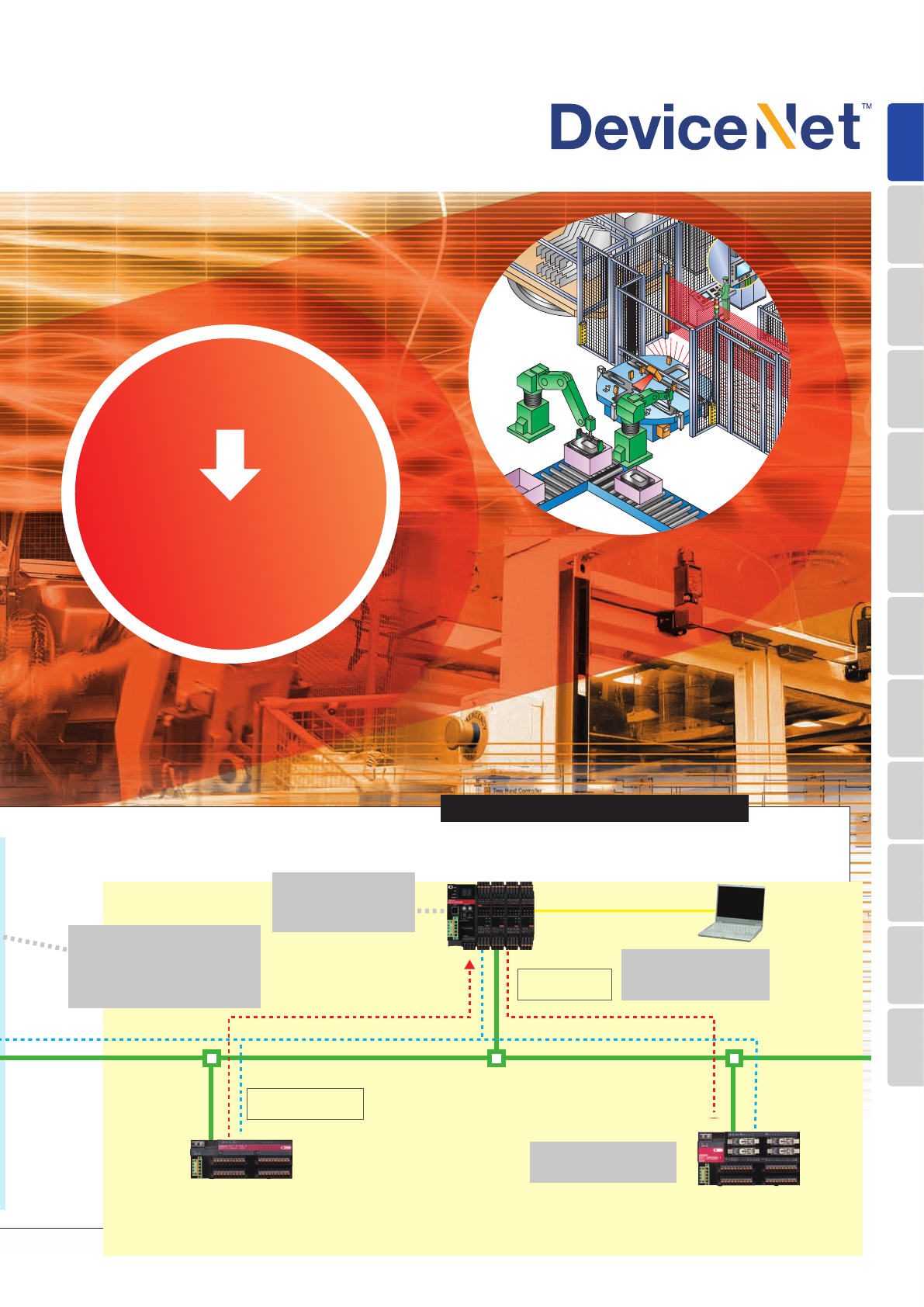
Compatible with
DeviceNet Open Network
Programmable
Safety Circuits
Distributed
safety controls.
Safety I/O Can Be
Expanded through
the Network
Coordination with
standard controls is
easy through
DeviceNet
More efficient
designing and
modification
USB
CIP Safety on
DeviceNet Slave
DeviceNet
Machine Control Safety Control
Programmable Terminal
NSJ Series
Safety Network Controller
DeviceNet
Slave
Analog I/O Terminal Remote I/O Terminal
Safety I/O Terminal
Safety I/O Terminal
CIP Safety on
DeviceNet Master
Network
Configurator
Incorporating DeviceNet Slave
functionality. Monitor safety I/O
and status information from the
DeviceNet Master directly without
requiring a geteway or other
interface.
Safety Network Controller
with CIP Safety on
DeviceNet Interface.
Network System Settings
and Safety Network
Controller programming.
Includes functions for
improving maintenance.
Overview
Introducing
DeviceNet Products
Network
Specifications
DRT2-series
Smart Slaves
SmartSlice
GRT1 Series
Intelligent
Slaves
Configurator
and Software
Peripheral
Devices
Ordering
Information
Master
Units
MULTIPLE I/O
TERMINAL Series
CIP Safety on
DeviceNet System