IPC-TM-650 EN 2022 试验方法--.pdf - 第11页
Material in this T est M ethods Manual was voluntarily establis hed by T echni cal Committees of IPC. Thi s mat erial is a dvisory only and its use or adaptation is entirely voluntary . IPC disclaims all lia bility of an…
Material in this Test Methods Manual was voluntarily established by Technical Committees of IPC. This material is advisory only
and its use or adaptation is entirely voluntary. IPC disclaims all liability of any kind as to the use, application, or adaptation of this
material. Users are also wholly responsible for protecting themselves against all claims or liabilities for patent infringement.
Equipment referenced is for the convenience of the user and does not imply endorsement by IPC.
Page 1 of 1
r
ASSOCIATION
CONNECTING
/
ELECTRONICS
INDUSTRIES
®
221
5
Sanders
Road
Northbrook,
IL
60062-6135
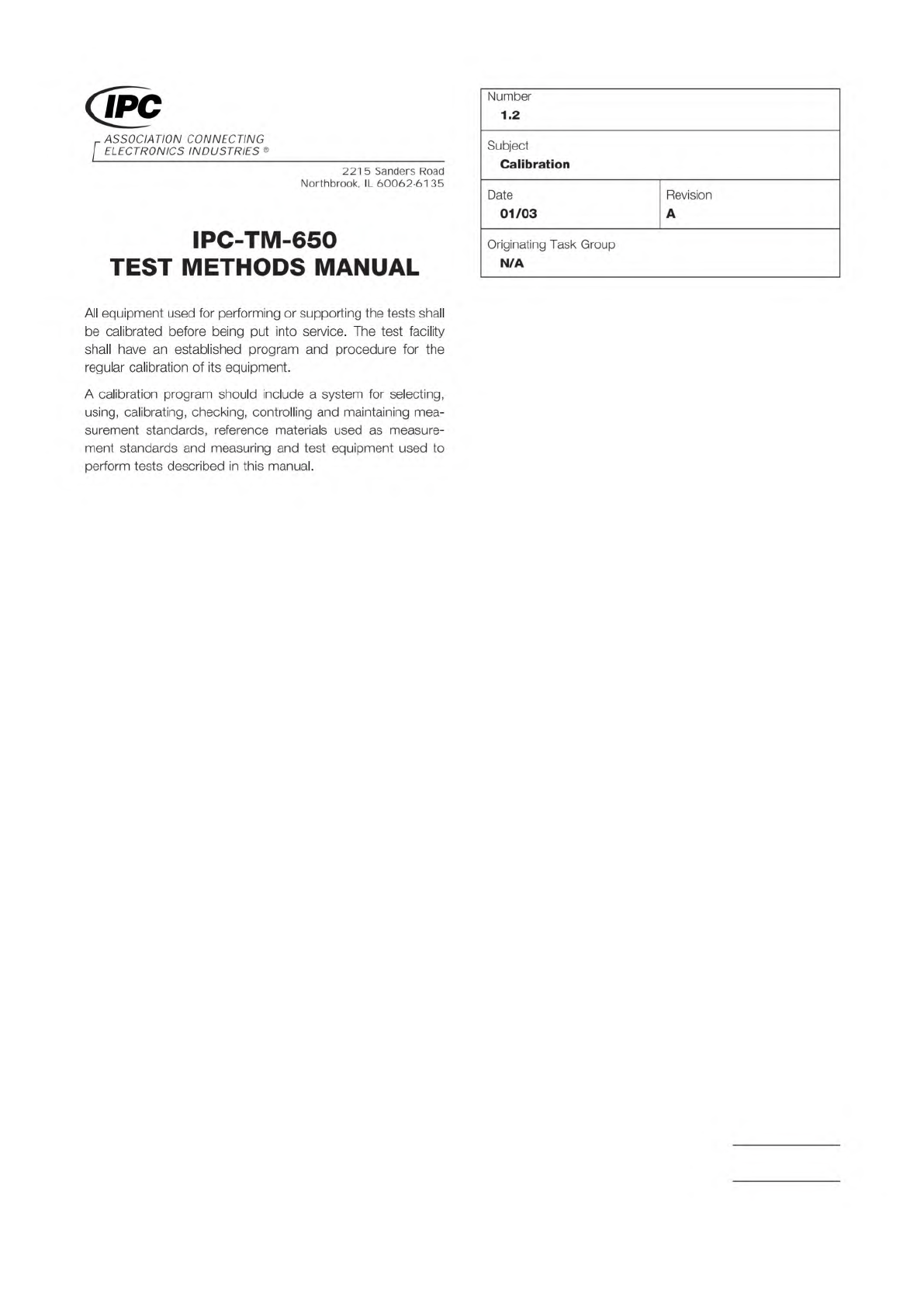
IPC-TM-650
TEST
METHODS
MANUAL
All
equipment
used
for
performing
or
supporting
the
tests
shall
be
calibrated
before
being
put
into
service.
The
test
facility
shall
have
an
established
program
and
procedure
for
the
regular
calibration
of
its
equipment.
A
calibration
program
should
include
a
system
for
selecting,
using,
calibrating,
checking,
controlling
and
maintaining
mea¬
surement
standards,
reference
materials
used
as
measure¬
ment
standards
and
measuring
and
test
equipment
used
to
perform
tests
described
in
this
manual.
Number
1.2
Subject
Calibration
Date
Revision
01/03
A
Originating
Task
Group
N/A
Material in this Test Methods Manual was voluntarily established by Technical Committees of IPC. This material is advisory only
and its use or adaptation is entirely voluntary. IPC disclaims all liability of any kind as to the use, application, or adaptation of this
material. Users are also wholly responsible for protecting themselves against all claims or liabilities for patent infringement.
Equipment referenced is for the convenience of the user and does not imply endorsement by IPC.
Page 1 of 2
r
ASSOCIATION
CONNECTING
/
ELECTRONICS
INDUSTRIES
®
221
5
Sanders
Road
Northbrook,
IL
60062-6135
IPC-TM-650
TEST
METHODS
MANUAL
Number
1.5
Subject
Reporting,
Format
Date
Revision
01/03
A
Originating
Task
Group
N/A
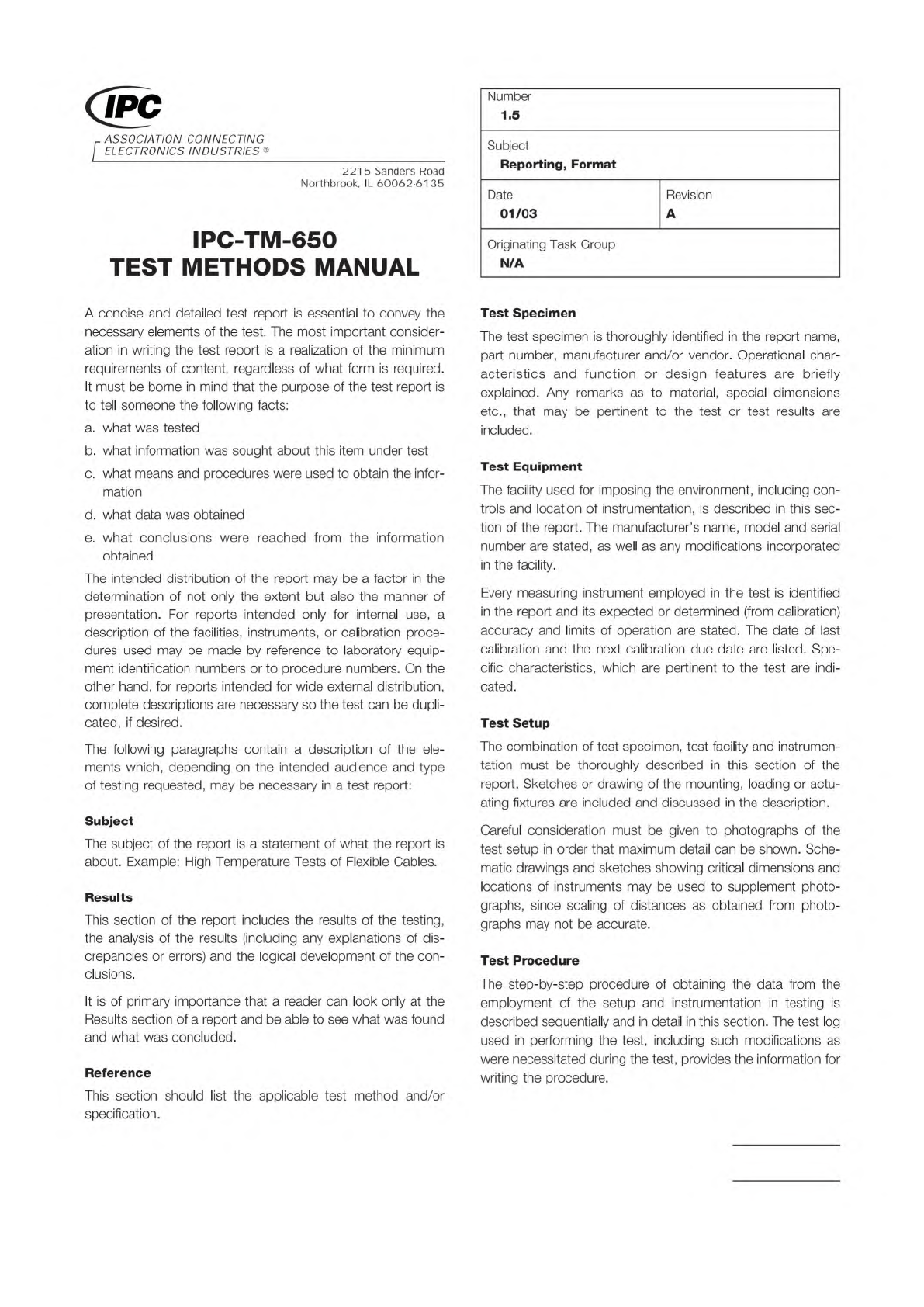
A
concise
and
detailed
test
report
is
essential
to
convey
the
necessary
elements
of
the
test.
The
most
important
consider¬
ation
in
writing
the
test
report
is
a
realization
of
the
minimum
requirements
of
content,
regardless
of
what
form
is
required.
It
must
be
borne
in
mind
that
the
purpose
of
the
test
report
is
to
tell
someone
the
following
facts:
a.
what
was
tested
b.
what
information
was
sought
about
this
item
under
test
c.
what
means
and
procedures
were
used
to
obtain
the
infor¬
mation
d.
what
data
was
obtained
e.
what
conclusions
were
reached
from
the
information
obtained
The
intended
distribution
of
the
report
may
be
a
factor
in
the
determination
of
not
only
the
extent
but
also
the
manner
of
presentation.
For
reports
intended
only
for
internal
use,
a
description
of
the
facilities,
instruments,
or
calibration
proce¬
dures
used
may
be
made
by
reference
to
laboratory
equip¬
ment
identification
numbers
or
to
procedure
numbers.
On
the
other
hand,
for
reports
intended
for
wide
external
distribution,
complete
descriptions
are
necessary
so
the
test
can
be
dupli¬
cated,
if
desired.
The
following
paragraphs
contain
a
description
of
the
ele¬
ments
which,
depending
on
the
intended
audience
and
type
of
testing
requested,
may
be
necessary
in
a
test
report:
Subject
The
subject
of
the
report
is
a
statement
of
what
the
report
is
about.
Example:
High
Temperature
Tests
of
Flexible
Cables.
Results
This
section
of
the
report
includes
the
results
of
the
testing,
the
analysis
of
the
results
(including
any
explanations
of
dis¬
crepancies
or
errors)
and
the
logical
development
of
the
con¬
clusions.
It
is
of
primary
importance
that
a
reader
can
look
only
at
the
Results
section
of
a
report
and
be
able
to
see
what
was
found
and
what
was
concluded.
Reference
This
section
should
list
the
applicable
test
method
and/or
specification.
Test
Specimen
The
test
specimen
is
thoroughly
identified
in
the
report
name,
part
number,
manufacturer
and/or
vendor.
Operational
char¬
acteristics
and
function
or
design
features
are
briefly
explained.
Any
remarks
as
to
material,
special
dimensions
etc.,
that
may
be
pertinent
to
the
test
or
test
results
are
included.
Test
Equipment
The
facility
used
for
imposing
the
environment,
including
con¬
trols
and
location
of
instrumentation,
is
described
in
this
sec¬
tion
of
the
report.
The
manufacturer's
name,
model
and
serial
number
are
stated,
as
well
as
any
modifications
incorporated
in
the
facility.
Every
measuring
instrument
employed
in
the
test
is
identified
in
the
report
and
its
expected
or
determined
(from
calibration)
accuracy
and
limits
of
operation
are
stated.
The
date
of
last
calibration
and
the
next
calibration
due
date
are
listed.
Spe¬
cific
characteristics,
which
are
pertinent
to
the
test
are
indi¬
cated.
Test
Setup
The
combination
of
test
specimen,
test
facility
and
instrumen¬
tation
must
be
thoroughly
described
in
this
section
of
the
report.
Sketches
or
drawing
of
the
mounting,
loading
or
actu¬
ating
fixtures
are
included
and
discussed
in
the
description.
Careful
consideration
must
be
given
to
photographs
of
the
test
setup
in
order
that
maximum
detail
can
be
shown.
Sche¬
matic
drawings
and
sketches
showing
critical
dimensions
and
locations
of
instruments
may
be
used
to
supplement
photo¬
graphs,
since
scaling
of
distances
as
obtained
from
photo¬
graphs
may
not
be
accurate.
Test
Procedure
The
step-by-step
procedure
of
obtaining
the
data
from
the
employment
of
the
setup
and
instrumentation
in
testing
is
described
sequentially
and
in
detail
in
this
section.
The
test
log
used
in
performing
the
test,
including
such
modifications
as
were
necessitated
during
the
test,
provides
the
information
for
writing
the
procedure.

IPC-TM-650
Page 2 of 2
Number
1.5
Subject
Reporting,
Format
Date
01/03
Revision
A
Recommendations
If
applicable
and
if
possible,
this
section
is
used
to
recom¬
mend
needed
corrections
or
to
indicate
discrepancies
in
the
design
of
the
specimen,
which
was
tested.
Care
should
be
taken
to
limit
the
recommendations
to
those
things
indicated
by
the
test,
and
not
go
into
design
problems,
which
are
the
responsibility
of
the
designer.