IPC-TM-650 EN 2022 试验方法--.pdf - 第313页
Figure 1 Specimen heigh t versus tempe rature IPC-TM-650 Number Subject Date Revision Page 3 of 3 2.4.41 Coefficient of Linear Thermal Expansion of Electrical Insulating Materials1 3/86 Temperature IPC-2441-1 11.1 The re…
Note 2—
Note 3—
Note 4—
Note 5—
Note 6—
Note 7—
IPC-TM-650
Number
Subject Date
Revision
Page 2 of 3
2.4.41
Coefficient
of
Linear
Thermal
Expansion
of
Electrical
Insulating
Materials1
3/86
Instruments
from
du
Pont
and
Perkin
Elmer
have
been
found
suitable.
6
.0
Test
Specimens
6.1
The
test
specimen
shall
be
between
.05
and
0.3
inches
thick.
This
thickness
may
be
as
received
or
may
be
laminated
by
the
user
from
pre-impregnated
"B”
stage
and
copper
free
“C”
stage
material.
It
laminated
by
the
user,
the
user
shall
be
responsible
to
contact
the
manufacturer
for
the
exact
layup
and
process
parameters
used
for
quality
acceptance
at
the
manufacturers
facility.
Repeatability
of
Test
Results
will
vary
with
layup,
bake
out,
laminating
pressure/ramp
speed,
press
time,
etc.
6.2
Specimens
should
be
between
0.3
and
0.4
inches
in
height
and
have
flat
and
parallel
upper
and
lower
surfaces.
The
surfaces
to
be
measured
shall
be
perpendicular
to
the
fiber
fillers
and
the
identity
of
the
direction
of
the
fiber
fillers
shall
be
maintained
throughout
the
test.
The
upper
and
lower
surfaces
shall
be
polished
with
600
grit
paper
to
remove
burrs
or
strands
of
fiber
filler.
The
specimens
shall
then
be
cleaned
using
isopropyl
alcohol,
and
dried
for
1
hour
at
10℃
above
the
maximum
specified
temperature
of
the
run.
The
1
hour
prebake
may
be
eliminated
if
Condition
(7.),
is
performed
immediately
after
final
polish.
6.3
There
shall
be
three
specimens
prepared
from
the
same
piece
of
material
for
each
direction
to
be
measured.
7
.0
Conditioning
7.1
Conditioning
of
test
specimen
shall
include
immersion
in
isopropyl
alcohol
with
agitation
for
20
seconds,
followed
by
Condition
E-1/1
10
and
C-|
40/23/50
in
accordance
with
D-618.
8
.0
Calibration
8.1
Calibrate
the
apparatus
in
accordance
with
the
instru¬
ment
manufacturer's
recommendations.
9
.0
Procedure
9.1
Measure
the
height
of
the
specimen.
9.2
Place
the
specimen
in
the
specimen
holder
under
the
probe.
The
thermocouple
or
other
means
for
sensing
speci¬
men
temperature
should
be
in
contact
with
the
specimen,
or
as
near
to
the
specimen
as
possible.
9.3
Assemble
the
furnace
to
the
specimen
holder.
If
mea¬
surements
at
subambient
temperatures
are
to
be
made,
cool
the
specimen
holder
and
furnace
to
at
least
20℃
below
the
lowest
temperature
of
interest,
using
procedures
as
given
by
the
instrument
manufacturer.
The
refrigerant
used
for
cooling
shall
not
come
into
direct
contact
with
the
specimen.
The
temperature
range
to
be
tested
shall
be
speci¬
fied
by
the
user,
so
that
the
manufacturer
and
user
will
test
over
the
same
temperature
range.
If
tested
over
different
tem¬
perature
ranges,
the
repeatability
may
be
unacceptable.
9.4
Place
weights
on
the
sensing
probe
to
ensure
that
the
probe
is
in
contact
with
the
specimen
with
a
1
to
3-g
load.
9.5
Increase
the
furnace
temperature
at
5
=
0.5℃/min.
over
the
desired
temperature
range.
9.6
Record
the
specimen
temperature
and
change
in
speci¬
men
height
using
appropriate
ranges
on
the
X-Y
recorder.
A
gas
purge
may
be
used
to
replace
the
air
around
the
specimen
for
measurement
of
expansion
in
different
atmo¬
spheres.
9.7
Test
at
least
three
specimens
of
the
same
material.
Retest
of
a
specimen
may
be
used
only
as
reference
and
shall
not
be
treated
as
an
independent
test
of
a
new
specimen.
10
.0
Calculation
10.1
Calculate
the
average
coefficient
of
thermal
expan¬
sions,
a,
over
the
temperature
intervals
of
interest
as
follows:
a
=
(
△
H/AT)/H
where:
H
二
original
height
of
specimen,
A
H
=
change
in
height
of
the
specimen
(in
the
same
units)
over
the
temperature
interval
AT,
and
AT
=
temperature
interval,
(see
Figure
1).
AH
and
AT
may
on
some
instruments
be
read
directly
from
the
recorder
chart.
On
other
instruments
con¬
stant
factors
may
need
to
be
applied
to
the
chart
readings
to
obtain
these
values.
11
.0
Report
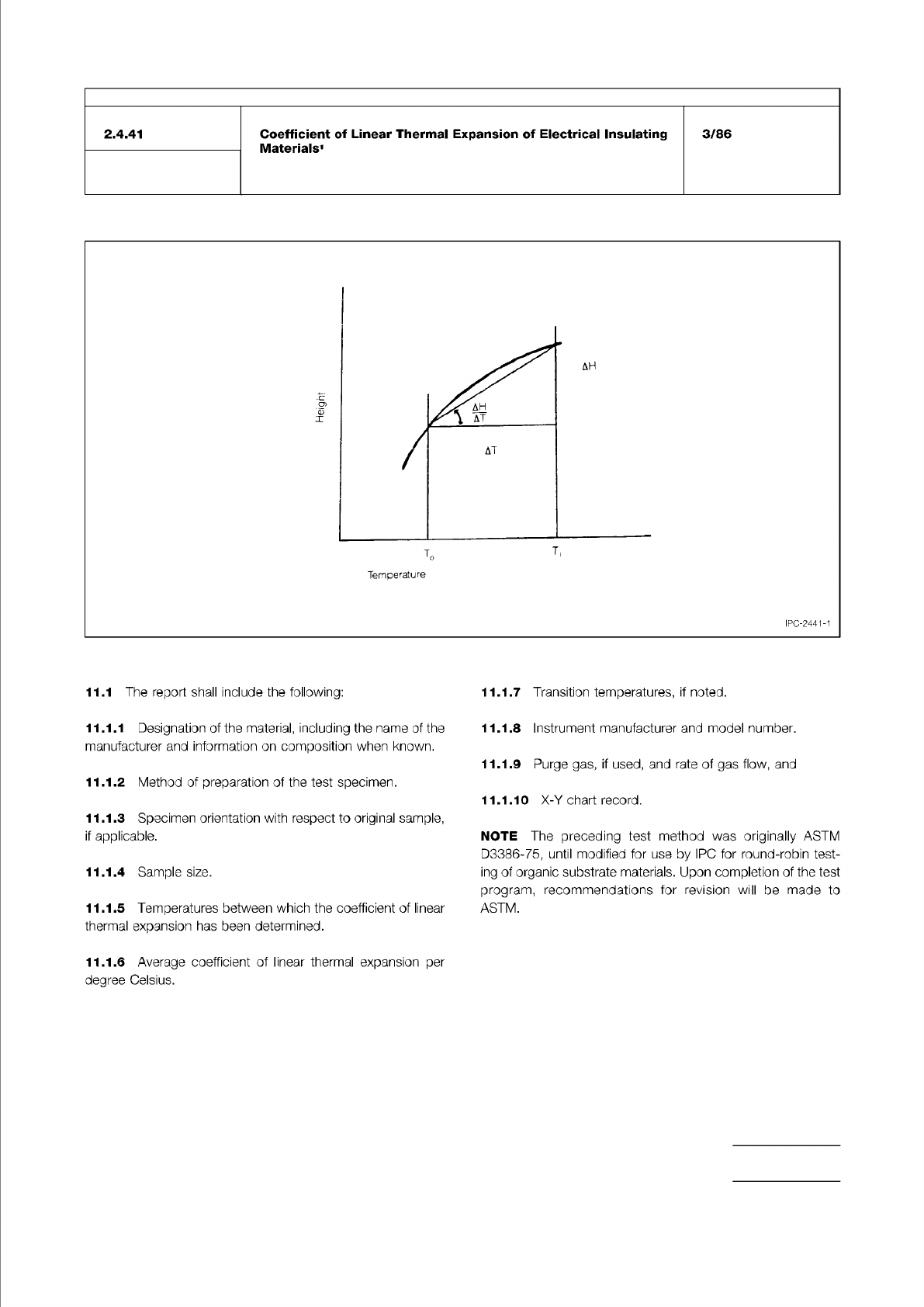
Figure 1 Specimen height versus temperature
IPC-TM-650
Number
Subject Date
Revision
Page 3 of 3
2.4.41
Coefficient
of
Linear
Thermal
Expansion
of
Electrical
Insulating
Materials1
3/86
Temperature
IPC-2441-1
11.1
The
report
shall
include
the
following:
11.1.7
Transition
temperatures,
if
noted.
11.1.1
Designation
of
the
material,
including
the
name
of
the
manufacturer
and
information
on
composition
when
known.
11.1.2
Method
of
preparation
of
the
test
specimen.
11.1.3
Specimen
orientation
with
respect
to
original
sample,
if
applicable.
11.1.4
Sample
size.
11.1.5
Temperatures
between
which
the
coefficient
of
linear
thermal
expansion
has
been
determined.
11.1.8
Instrument
manufacturer
and
model
number.
11.1.9
Purge
gas,
if
used,
and
rate
of
gas
flow,
and
11.1.10
X-Y
chart
record.
NOTE
The
preceding
test
method
was
originally
ASTM
D3386-75,
until
modified
for
use
by
IPG
for
round-robin
test¬
ing
of
organic
substrate
materials.
Upon
completion
of
the
test
program,
recommendations
for
revision
will
be
made
to
ASTM.
11.1.6
Average
coefficient
of
linear
thermal
expansion
per
degree
Celsius.
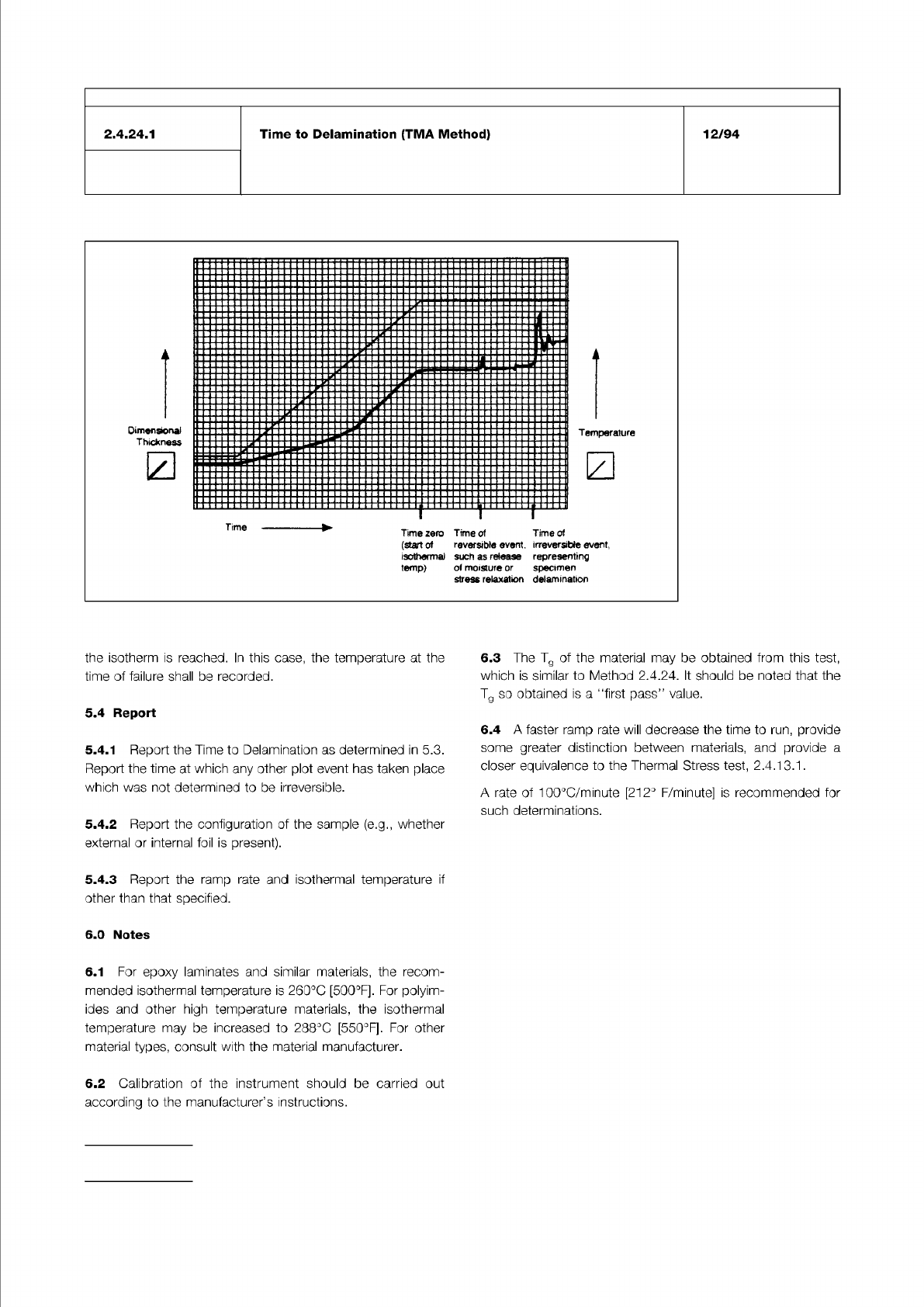
Figure 1
IPC-TM-650
Number
Subject Date
Revision
Page 2 of 2
2.4.24.1
Time
to
Delamination
(TMA
Method)
12/94
Ttme
—
A
Time
zero
Time
of
Time
of
(start
of
reversible
event,
irreversible
event,
isothermal
such
as
release
representing
temp)
of
moisture
or
specimen
stress
relaxation
delamination
the
isotherm
is
reached.
In
this
case,
the
temperature
at
the
time
of
failure
shall
be
recorded.
5.4
Report
5.4.1
Report
the
Time
to
Delamination
as
determined
in
5.3.
Report
the
time
at
which
any
other
plot
event
has
taken
place
which
was
not
determined
to
be
irreversible.
5.4.2
Report
the
configuration
of
the
sample
(e.g.,
whether
external
or
internal
foil
is
present).
5.4.3
Report
the
ramp
rate
and
isothermal
temperature
if
other
than
that
specified.
6.0
Notes
6.1
For
epoxy
laminates
and
similar
materials,
the
recom¬
mended
isothermal
temperature
is
260℃
[500°F].
For
polyim-
ides
and
other
high
temperature
materials,
the
isothermal
temperature
may
be
increased
to
288℃
[550°
F].
For
other
material
types,
consult
with
the
material
manufacturer.
6.3
The
Tg
of
the
material
may
be
obtained
from
this
test,
which
is
similar
to
Method
2.4.24.
It
should
be
noted
that
the
Tg
so
obtained
is
a
"first
pass"
value.
6.4
A
faster
ramp
rate
will
decrease
the
time
to
run,
provide
some
greater
distinction
between
materials,
and
provide
a
closer
equivalence
to
the
Thermal
Stress
test,
2.4.13.1
.
A
rate
of
100℃/minute
[212°
F/minute]
is
recommended
for
such
determinations.
6.2
Calibration
of
the
instrument
should
be
carried
out
according
to
the
manufacturer's
instructions.